
Buy a physical barrier, not a gadget. Netting can close a roost or a whole opening. Spikes, coiled wire or a sloped cover will stop pigeons landing on a ledge if they cover every perch and stay clear of nest material. Owl decoys, ultrasonic boxes and most sprays are easy to find and a poor bet.
As an Amazon Associate, Pigeonpedia earns from qualifying purchases. Amazon links on this page may earn us a small commission, at no extra cost to you.
Which pigeon deterrents last
A separate guide to keeping pigeons away walks through food, gaps and proofing in order. This page compares the fittings and devices sold as pigeon deterrents, and the evidence behind them.
Some links on this page go to Amazon. If you buy through them we may earn a small commission, at no extra cost to you. As an Amazon Associate I earn from qualifying purchases.
| Type | Best for | Main limit | Upkeep |
|---|---|---|---|
| Netting Check price on Amazon (opens in new tab) | A void, balcony opening or loading bay | Loose or gappy nets trap birds | Inspect often; keep it taut |
| Spikes Check price on Amazon (opens in new tab) | Sills, rails, signs and narrow ledges | Bare strips and the space behind the array | Clear twigs and debris |
| Sloped covers | Window sills and parapets | The angle depends on how rough the surface is | Little, if it is fixed well |
| Wires and coils | Ledges where spikes would look too heavy | May be weaker than a full spike array | Check the tension |
| Gel | A short run of sill | Short life; can mark porous stone | Replace it |
| Electric track | A ledge other systems have failed on | Pain-based systems did no better in tests | Usually a contractor job |
Bird netting
Netting is the deterrent that can take a whole roost or opening out of use. Historic England calls it very effective when it is installed with care, and barely visible if the mesh and fixings are chosen to match the building. The same advice is clear on the risk: birds must not be able to get behind the net and become trapped.
UK government wildlife-management advice gives a mesh guide of no more than 50 mm, measured on a square mesh, for pigeons. The edges have to sit tight to the building. In a 2008 University of Basel study, free-living feral pigeons could not pass a slot 4 cm wide, a gap 5 cm high, or a square opening of 6 × 6 cm, so a gap at the edge of a net is a way in.
The RSPB says the person who puts netting up is responsible for it. If the net is there to stop birds nesting, it should be checked at least once a day, and three times a day if that can be done, so that a trapped bird can be freed and a sag or tear can be repaired. The RSPB does not recommend flimsy netting, and points to geotextile mesh or solid metal mesh as safer choices than wide-mesh nylon. The RSPCA makes the same warning: poorly fixed netting can trap pigeons and kill them.

Best for an opening or void
Bird-X Standard Bird Netting, 3/4-inch mesh, 100 × 14 ft
- 3/4-inch (19 mm) mesh, tighter than the 50 mm UK guide for pigeons
- UV-stabilized black mesh in a 100 × 14 ft roll
- Listed for use on buildings and openings as well as gardens
Our take: A taut net can close a roost or opening, but only if the edges stay tight to the building. This is a large roll, so you cut it to the space. Check it often for sag or tears.
Check price on Amazon (opens in new tab)Spikes, wires and coils
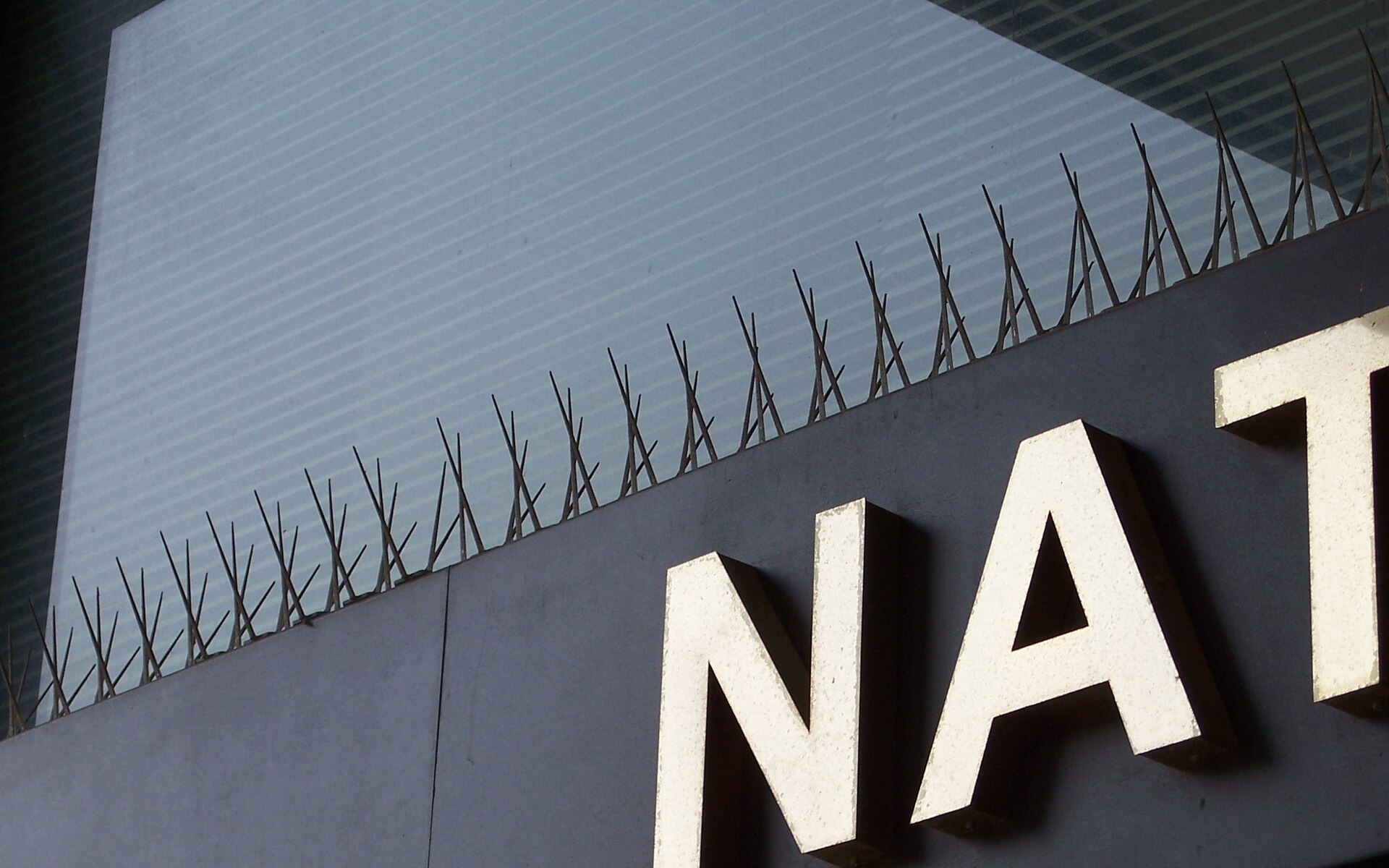
Plastic or stainless-steel spike arrays stop pigeons perching on a ledge by leaving them nowhere flat to stand. Historic England finds them effective, and also records the usual failures: they are easy to see, and they can create a new nest site in the space behind the array. The RSPCA treats blunt, well-fitted spikes as one of the more humane ways to keep pigeons off a perch, because they make landing uncomfortable and should not impale the bird.
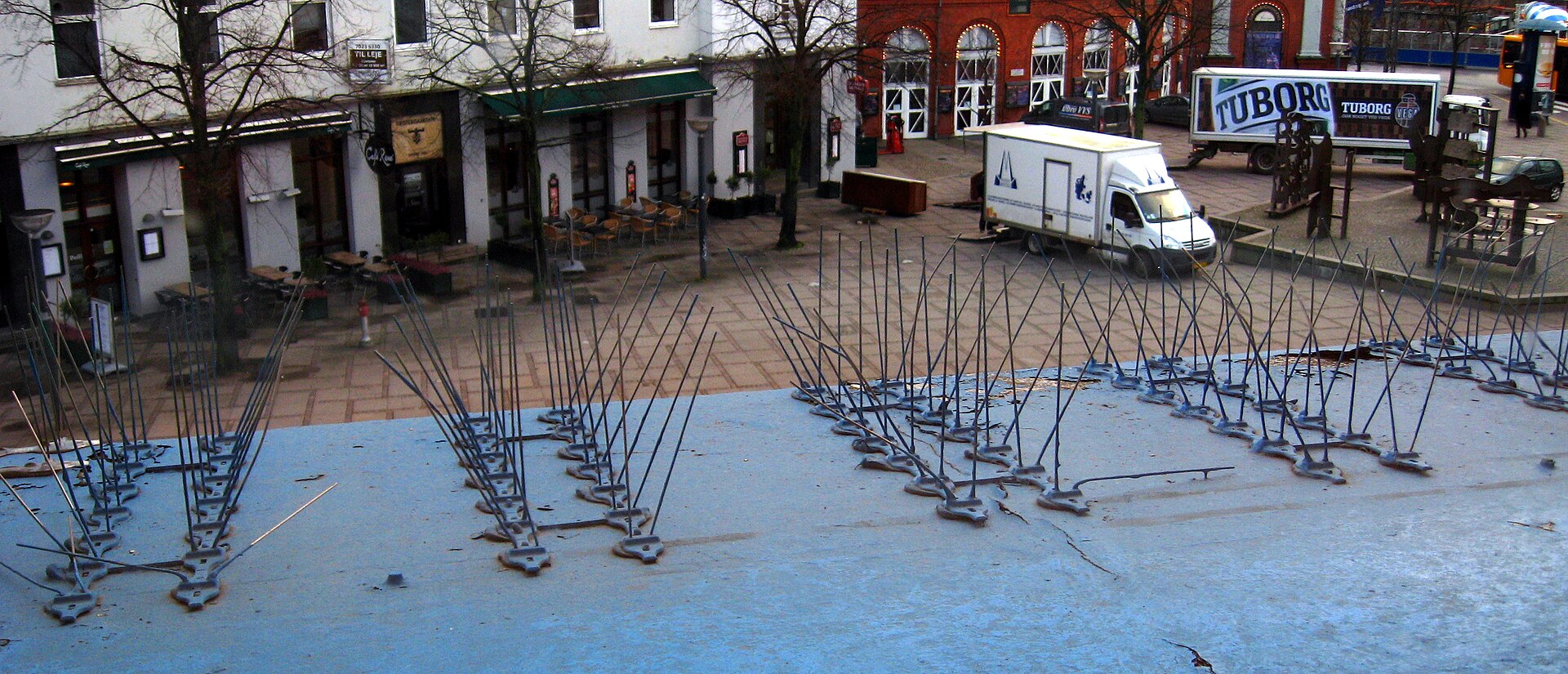
Coverage is the whole job. In the photograph below, the spikes sit in short clumps with bare roof between them. A pigeon can step into those gaps. The same thing happens on a window sill if the last few centimetres are left clear, or if twigs and nest material are allowed to build a platform over the pins. Daniel Haag-Wackernagel’s 2000 tests in Basel found that motivated feral pigeons could get past every deterrent system he tried, spikes included, once they wanted the site enough.
Best for a ledge or sill
Bird-X Stainless Steel Bird Spikes, 10 ft
- Stainless steel pins on a polycarbonate base
- 10 linear feet, in one-foot strips
- Can be fixed with adhesive, screws, nails or ties, including on a curved surface
Our take: Spikes work when they cover the whole perch and stay clear of nest material. Leave a bare strip and birds will use it. Wear gloves when you fit them: the pins are sharp.
Check price on Amazon (opens in new tab)Where spikes would be too obvious, Historic England describes spring-tensioned stainless-steel wires on posts about 1,500 mm apart, and wire coils that need fewer fixings. The wires are less obtrusive. They may also be less effective. Coils can still suit an exposed ledge or parapet. Fixings should go into mortar joints rather than into carved stone, and on a metal gutter a cable tie may be enough. On a listed building you may need permission before you drill.
Sloped covers and narrow ledges
Some “pigeon slides” are just a smooth sheet bent to an angle, or a narrow cap that leaves the bird no ledge. The useful numbers come from a 2008 experiment by Haag-Wackernagel and Ila Geigenfeind with free-living feral pigeons in a loft in Basel. A ledge 4 cm wide was too narrow for a pigeon to sit on. The angle that stopped perching depended on the surface:
If you buy or make a cover, match the angle to the material, and run it the full length of the sill. A short slope with a flat patch at one end is a perch.
Gel, electric tracks and scare devices
Tacky pigeon gels are sold for sills and parapets. Historic England says they have a short life and need regular replacement, and that the gel and any sealant under it can stain or damage porous masonry. For that reason it does not recommend gel on most historic buildings. The gels are sold as a way to put a bird off landing without injuring it; they are not a permanent proofing job.
Electric tracks, which work like a livestock fence, are also on the market. In the 2000 Basel tests, systems that were meant to hurt the birds gave no better protection than harmless ones. Haag-Wackernagel argued that painful systems should be dropped.
Owl decoys, scarecrows, hanging CDs and similar visual tricks wear off. A 2012 review by Giunchi and colleagues, drawing on Johnston and Janiga’s work on feral pigeons, reports that chemical or sound devices, and visual ones such as decoys, hold only for a short time, as the birds habituate within a few days. Historic England says a model bird of prey has to be moved often if it is to have any use. Ultrasonic boxes and scent devices had no deterring effect in the Basel tests, under the conditions used there.
Traps, shooting and poison
These are not everyday pigeon deterrents, and they are a poor first choice on a house or balcony. In England, all wild birds, including feral pigeons, are protected by the Wildlife and Countryside Act 1981. It is an offence, except under licence, to kill, injure or take a wild bird, to damage or destroy a nest that is in use or being built, or to take or destroy an egg. Poison is not a legal method.
For public health or public safety, an authorised person in England may rely on general licence GL41, which for 2026 covers feral pigeons for slips and falls, the spread of disease to people, and safety problems with nesting. The licence is issued for a year at a time and has conditions that must be followed. Scotland, Wales, Northern Ireland and other countries have their own rules. Our page on whether it is legal to shoot pigeons sets out the shooting side. Killing also has a weak record as population control. Giunchi and colleagues describe culling as one of the least reliable methods, because losses are often made up by birds moving in or by extra breeding.
Frequently asked questions
What is the most effective pigeon deterrent?
A physical barrier that the birds cannot sit on or walk through. Taut netting can close a whole roost or opening. Spikes, coils or a sloped cover can hold a ledge, if they cover every perch and stay clear of nest material. Scare devices and ultrasound are a weak choice beside those.
Do pigeon spikes work?
Yes, on a ledge they fully cover, if the pins stay too awkward to stand on. They fail when a strip is left bare, when birds nest behind the array, or when twigs are built up over the spikes. Motivated pigeons have got past spike systems in tests.
Do ultrasonic pigeon deterrents work?
Not in the test that has been published on this. Haag-Wackernagel (2000) tried an ultrasonic system on free-living feral pigeons and recorded no deterring effect, and a scent device failed in the same study.
Is pigeon gel safe for birds and buildings?
Historic England describes the gels as products designed not to harm birds, but they have a short life and can stain or damage porous masonry, so they are not recommended for most historic buildings. They need regular replacement and are not a substitute for netting or a full spike array.
Can I put up deterrents if pigeons are already nesting?
Not over an active nest, unless a licence applies. In England the Wildlife and Countryside Act 1981 makes it an offence to damage or destroy a nest in use or being built, except under licence. Check for eggs or young first, wait until they have fledged if you need to, then fit the deterrent so the site cannot be used again.
Sources
The claims on this page come from the sources below. Other pages on the site have more on separate guide to keeping pigeons away, on how to keep pigeons off a balcony, and on cleaning pigeon droppings.
- Haag-Wackernagel, D. (2000). Behavioural responses of the feral pigeon (Columbidae) to deterring systems. Folia Zoologica 49(2): 101–114. (opens in new tab)
- Haag-Wackernagel, D. and Geigenfeind, I. (2008). Protecting buildings against feral pigeons. European Journal of Wildlife Research 54: 715–721. (opens in new tab)
- Giunchi, D., Albores-Barajas, Y. V., Baldaccini, N. E., Battisti, C. and Soldatini, C. (2012). Feral pigeons: problems, dynamics and control methods. InTech. (opens in new tab)
- Historic England (2023). Bird deterrents. (opens in new tab)
- RSPCA. Pigeons nesting in gardens and balconies: what to do. (opens in new tab)
- RSPB. The use of netting to stop birds nesting. (opens in new tab)
- Defra / Natural England. Wildlife management advice note: legal measures to resolve conflict with wild birds (WML-GU01). (opens in new tab)
- Natural England (2026). GL41: general licence to kill or take certain species of wild birds to preserve public health or public safety (England, 1 January to 31 December 2026). (opens in new tab)
- GOV.UK. Wild birds: protection and licences. (opens in new tab)
Last updated 20 November 2026 · Problems