
“Types of pigeon” can mean two different things. There are the several hundred wild species in the pigeon and dove family, Columbidae. And there are the domestic breeds, all descended from the rock dove, Columba livia, which breeders have shaped into more than 175 breeds, according to the poultry extension service at extension.org, for racing, flying, showing and meat. This page sorts both into groups and links to our individual guides.

Wild pigeons in the UK
The RSPB lists five pigeons and doves you are likely to see in the UK:
- Woodpigeon: the largest, grey with a white neck patch and white wing bars.
- Feral pigeon (rock dove): the town and city pigeon, in every colour from blue-grey to white. Truly wild rock doves now survive mainly on sea cliffs in Scotland and Ireland.
- Stock dove: smaller than a woodpigeon, grey with a green neck sheen and no white patch.
- Collared dove: pale grey-brown with a thin black half collar.
- Turtle dove: small, with orange and black chequered wings. Now rare in the UK.
See types of pigeon in the UK, feral pigeons and Eurasian collared dove.

Wild pigeons around the world
Pigeons live on every continent except Antarctica. Some well-known groups:
- Fruit pigeons and green pigeons of Asia and the Pacific, such as the pink-necked green pigeon and Philippine green pigeon.
- Imperial pigeons, large fruit eaters such as the pied imperial pigeon.
- Crowned pigeons of New Guinea, the largest living pigeons (see Victoria crowned pigeon).
- The Nicobar pigeon, a close living relative of the extinct dodo.
- Australian pigeons and doves, such as the crested pigeon, spinifex pigeon and wonga pigeon. See Australian pigeons and doves.
- North American doves, including the mourning dove and band-tailed pigeon.
- Extinct species such as the passenger pigeon.
Pigeon or dove?
There is no scientific difference. Both words describe members of the same family, and English usage tends to call smaller species doves. See difference between dove and pigeon.
Domestic pigeon breeds
The 4-H Pigeon and Dove Project from Oregon State University groups domestic pigeons into three classes: utility, fancy and flying. The US National Pigeon Association’s standard uses more detailed groups. Here is a simple version.
Racing and homing pigeons
Bred for speed, stamina and the ability to find home. The racing homer is the main breed. See how to train a carrier pigeon and how fast do pigeons fly.
Flying and performing breeds
Bred for how they fly: rollers and tumblers that somersault in the air, and high flyers bred for endurance. See Birmingham roller, Oriental roller, tippler pigeons and why do tumbler pigeons tumble.
Utility breeds
Large breeds kept for squab (young pigeon meat), such as the king pigeon, Carneau, French Mondain and giant runt.
Fancy and show breeds
Bred for looks. Groups include:
- Frills and owls: Chinese owl, Old German owl, African owl, Italian owl
- Feather-ornamented breeds: Jacobin, fantail, frillback, helmet, nun
- Croppers and pouters, which inflate their crops: Dutch cropper
- Wattled breeds with large ceres: barb, dragoon, Scandaroon
- Colour breeds: archangel, ice pigeon, Lahore, Modena
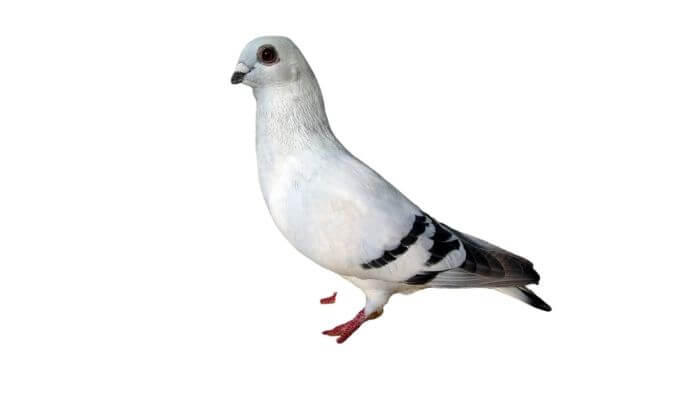
Welfare and breed choice
The pet pigeon guide pigeon.guide points out that some breeds with extreme features, such as very short beaks, heavy feathering on the feet or eyes, or unusual skeletons, can have health problems. If you are choosing a breed, ask breeders and rescues about the breed’s welfare as well as its looks.
How to identify a pigeon you’ve seen
- Look at size, neck markings, eye colour and wing bars.
- Note where you are. A wild species in the UK is likely one of the five above.
- A ring on the leg means a kept bird (see what to do if you find a racing pigeon).
- For photos, see pictures of pigeons and doves.
FAQ
What is the most common type of pigeon?
Worldwide, the feral pigeon. In the UK countryside, the woodpigeon.
What is the rarest pigeon?
Several are critically endangered, including the tooth-billed pigeon of Samoa. See are pigeons endangered.
Sources
- RSPB: How to identify different types of pigeons and doves
- RSPB: Rock dove and feral pigeon
- Extension.org: Raising pigeons in small and backyard flocks
- Oregon State University Extension: 4-H Pigeon and Dove Project
- National Pigeon Association: Breeds from the NPA Standard
- The Pet Pigeon Guide: Choosing a pigeon
Last updated 21 October 2026 · Types