
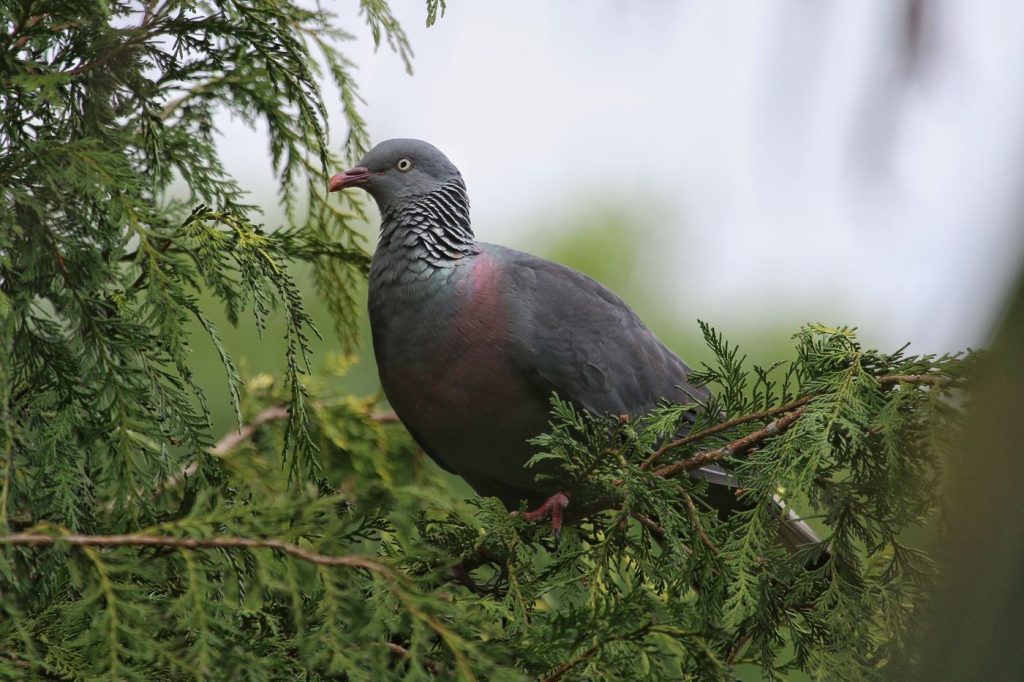
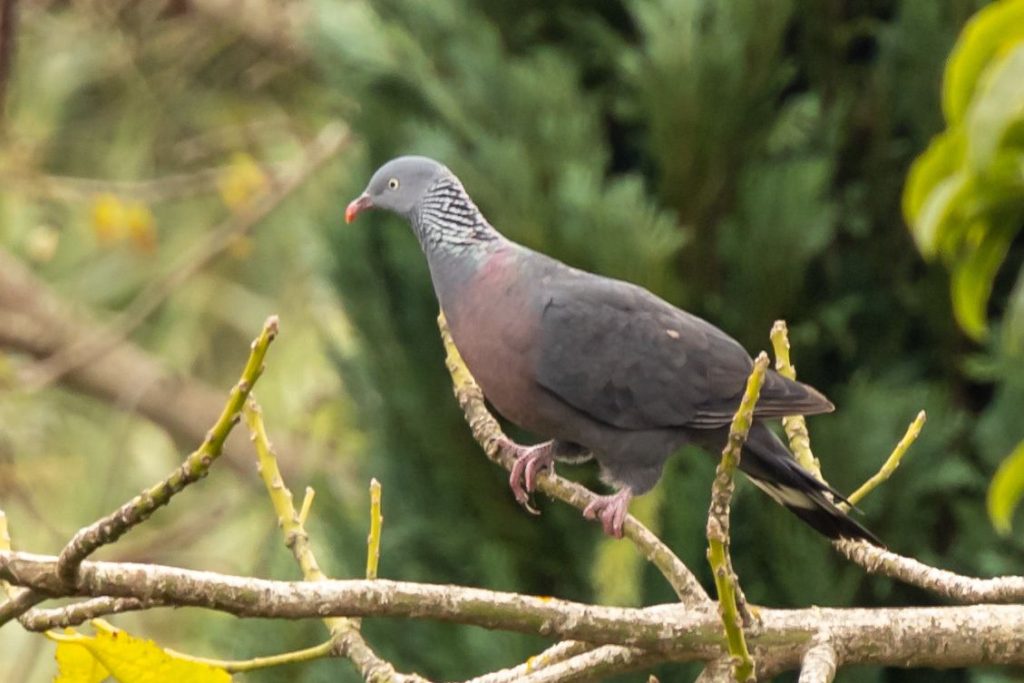
The trocaz pigeon (Columba trocaz), also called the Madeira laurel pigeon or long-toed pigeon, is a large, dark grey pigeon that lives only on the island of Madeira, Portugal. A striped silvery patch on each side of the neck, a pinkish breast, a red bill and wings with no white markings separate it from the common wood pigeon, the species it descends from.
It lives mainly in Madeira’s laurel forest. The species once also lived on neighbouring Porto Santo, where it has died out. After falling to about 2,700 birds in 1986, the population recovered, and the IUCN Red List now classes it as Least Concern.
Trocaz pigeon at a glance
| Feature | Trocaz pigeon |
|---|---|
| Scientific name | Columba trocaz Heineken, 1829 |
| Other names | Madeira laurel pigeon, long-toed pigeon; pombo-trocaz in Portuguese |
| Range | Madeira only; formerly also Porto Santo |
| Habitat | Laurel forest, mostly below 850 m |
| Length | 38–40 cm (IFCN); 44.6–49 cm in measurements by Zino and Zino (1986) |
| Wingspan | 72–76 cm (IFCN); 70.8–76.5 cm (Zino and Zino, 1986) |
| Weight | 390–520 g (Zino and Zino, 1986) |
| Eggs | Usually one |
| Incubation | 19–20 days |
| Population | 10,000–14,000 mature birds (BirdLife, 2012 estimate) |
| IUCN Red List | Least Concern (last assessed 2017) |
The IOC World Bird List (opens in new tab) (version 15.2) lists the species with no subspecies. The two length figures come from different sources and probably reflect different measuring methods, so both are given.
How to identify a trocaz pigeon
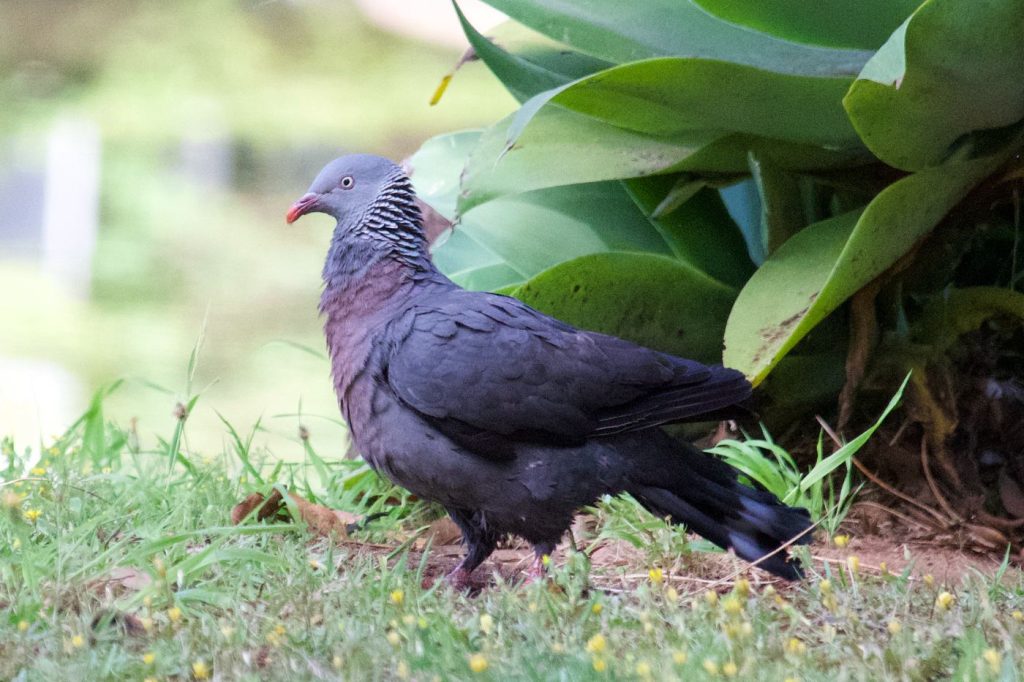
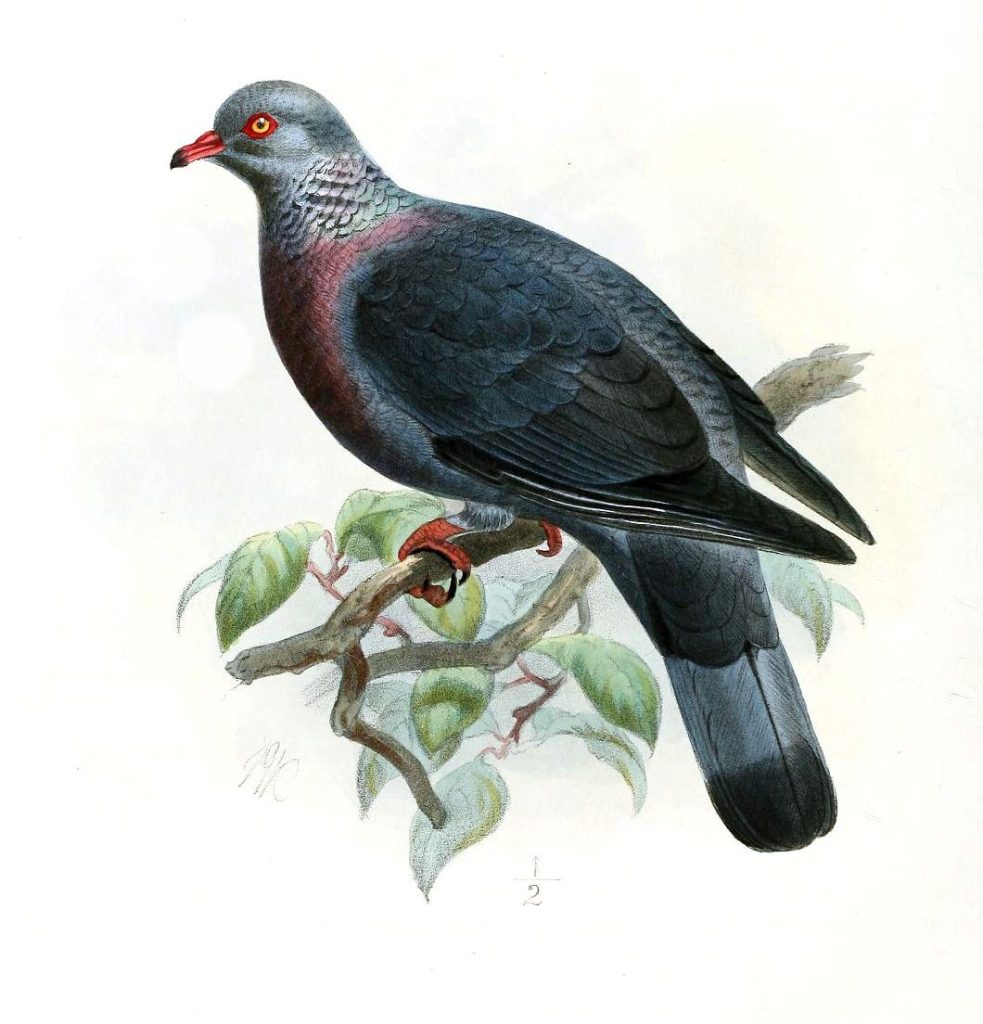
Madeira’s regional nature agency, the Instituto das Florestas e Conservação da Natureza (IFCN) (opens in new tab), describes the bird as much darker than a wood pigeon, with a dark blue-grey back and wings. It has lost the white wing bars of its ancestor, but the white neck mark has grown into a larger silvery patch. The glossy neck feathers have brownish and greenish tones and are duller than a wood pigeon’s.
Look for these features:
- Dark slate-grey body and wings, with no white patch on the wing
- A striped, silvery patch on each side of the neck
- A pinkish breast
- A red bill, red feet and a pale yellow eye with a red ring around it
- A pale band across the dark tail, easiest to see in flight
Males are slightly bulkier than females, but the difference shows mainly in wing and leg measurements, so the sexes look alike in the field. Young birds are duller and browner than adults and lack the glossy neck feathers.
Trocaz pigeon or wood pigeon?
No wood pigeons live on Madeira today. The island had its own form, Columba palumbus maderensis, but IFCN notes that it died out after people arrived. The only other pigeon a visitor is likely to see on Madeira is the feral pigeon, which is smaller and paler.
Elsewhere in the Atlantic islands, the Azores have their own wood pigeon subspecies, Columba palumbus azorica. Bolle’s pigeon (Columba bollii) lives in the Canary Islands, so it never meets the trocaz pigeon in the wild.
Name and history
Karl Heineken described the species in 1829. Its scientific name matches the bird’s local name on Madeira, pombo trocaz. The Portuguese name is close to pombo-torcaz, which means the common wood pigeon, so the two are easy to mix up when reading Portuguese sources.
When Portuguese sailors reached Madeira in 1419 or 1420, most of the island was covered in laurel forest. Much of it was cleared for timber and farmland over the following centuries, and the pigeon lost most of its habitat. Hunting added to the losses, both for sport and because the birds fed on crops.
Where trocaz pigeons live
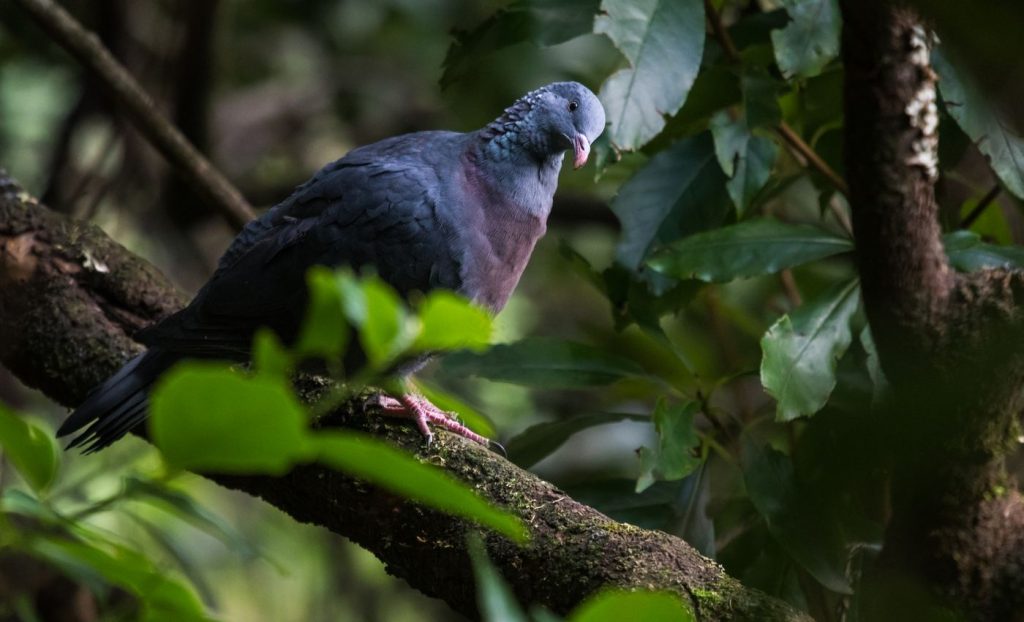
BirdLife International (opens in new tab) gives the species’ range as about 820 km², mostly on the mountainous northern slopes, with a few birds in isolated pockets of laurel forest in the south. Laurel forest covers about 15,000 hectares, roughly a fifth of the island. It is protected as a nature reserve and is a UNESCO World Heritage Site.
The pigeons prefer forest where til (Ocotea foetens) is common, and they use it all year. They occur at all heights within the laurel forest but are found mostly below 850 m. Birds move between valleys at different times of year. IFCN reports that in recent years the species has spread to exotic woodland and farmland outside the laurel forest and can now be found over much of the island.
What trocaz pigeons eat
The trocaz pigeon eats only plants. A study of 224 droppings from laurel forest in north-west Madeira, collected in 1996 and 1997, found that fruit made up 57% of the material, leaves 38% and flowers less than 1%. The researchers identified more than 33 plant species. The fruits found most often were til, Azores laurel (Laurus azorica), Madeira mahogany (Persea indica) and Canary holly (Ilex canariensis), whose leaves were also eaten.
Most seeds passed through the birds whole, apart from laurel seeds, which were usually damaged. IFCN adds that viable seeds of every laurel forest tree have been found in the droppings, which suggests the pigeon can spread the seeds of the forest’s trees.
Fruit in autumn and winter, leaves in spring and summer
Share of the main food type in trocaz pigeon droppings, by season. Each bar shows the food that was the main component in that season.
The diet changes with the seasons. Fruit is the main food in autumn and winter, when most trees are fruiting. In spring and summer, when fruit is scarce, the birds switch to leaves and flowers. For comparison with town and farm pigeons, see what pigeons eat.
Feeding on farmland
Some trocaz pigeons leave the forest to feed on crops. A 1997 study compared 94 droppings from farmland with 63 from forest. Cabbage made up more than 54% of the farmland samples, while no crop plants turned up in the forest samples. The birds visited farms most in winter, when forest fruit was plentiful, so the researchers concluded that a shortage of wild food was not the reason. IFCN says cabbage suffers the most damage, probably because it is the most widely grown crop, and that watercress, young bean plants and peas are also eaten.
Breeding
Little is known about the breeding cycle. IFCN thinks the species probably nests all year. The nest is a loose platform of dry twigs, built in a forest tree, a shrub or a sheltered spot among rocks, and occasionally on the forest floor.
The female usually lays a single egg. Clutches of two are occasionally found, but no nest with two chicks has been recorded. Compare this with the two-egg clutch of most pigeons in how many eggs a pigeon lays. Captive breeding has also been achieved.
From nest to first flight
Introduced black rats take eggs and chicks, and BirdLife lists nest predation by rats as a likely limit on breeding.
Population and conservation
The population has grown from about 2,700 birds to more than 10,000 in about 40 years. The first full census, in 1986, put the population at about 2,700. The same year, the species was added to Annex I of the EU Birds Directive, and hunting was banned by the end of the 1980s. Before that, in 1985, a special shooting season on five Sundays in January and February killed more than 300 birds, and another 150 to 200 may have been poisoned.
Trocaz pigeon population estimates since 1986
Published estimates, labelled by source. Counting methods and survey areas differ, so this is not a single trend line. Lighter bar sections show the upper end of a range.
The IUCN Red List classed the species as Threatened in 1988, as Lower Risk/Conservation Dependent from 1994 to 2000 and as Near Threatened in 2004 and 2008. It has been Least Concern since 2011. BirdLife describes the population as stable. IFCN’s censuses in 2023, 2024 and 2025 put the population at 10,000 to 12,000 birds, but the 2025 count covered only four routes because more tourists now use the forest paths. For other members of the pigeon family that remain at risk, see are pigeons endangered.
The species is protected under Annex III of the Bern Convention as well as the Birds Directive. IFCN says 80 to 100% of its main range lies inside Natura 2000 sites and the Madeira Natural Park.
Conflict with farmers
Crop damage keeps the bird unpopular in rural Madeira. Since 2010, IFCN has given farmers free gas bird scarers, nylon exclusion nets and reflective holographic tape. Where those measures fail, the government authorises shooting as a “special correction measure”. Shooting was also permitted in 1985, 1997, 1998 and 2004. In 2023, the Portuguese bird society SPEA, on behalf of eight conservation groups, complained to the European Commission about the culls. Its complaint says 4,253 pigeons were shot between 2012 and 2020, an average of 472 a year.
Seeing a trocaz pigeon
The laurel forest on Madeira’s north side is the most reliable place to look. IFCN’s census routes run along forest trails and levadas (irrigation channels), such as the paths to Caldeirão Verde and along the Levada do Norte. The bird is shy, a habit linked to years of shooting, so early morning and quiet watching from the path work best. The pigeon in the main photo was in a garden in Funchal. Stay on marked trails, do not feed the birds and keep away from nests.
For the wild pigeons and doves covered on this site, see the types of pigeon guide.
Frequently asked questions
Is the trocaz pigeon endangered?
No. It has been listed as Least Concern on the IUCN Red List since 2011, after the population recovered from about 2,700 birds in 1986. It was classed as Threatened in 1988 and Near Threatened as recently as 2008.
Where can you see a trocaz pigeon?
Only on Madeira, mainly in the laurel forest on the island’s northern slopes. It no longer lives on Porto Santo.
Is the trocaz pigeon a type of wood pigeon?
It is a separate species that evolved from the common wood pigeon. It is darker, has a silvery neck patch instead of a white one and has no white on the wing.
How many eggs does a trocaz pigeon lay?
Usually one. Two are occasionally laid, but no nest with two chicks has been recorded. Incubation takes 19 to 20 days.
Why do some farmers in Madeira dislike the trocaz pigeon?
The birds eat crops, especially cabbage, near the forest edge. Madeira’s government gives farmers scaring devices and also authorises some shooting, which conservation groups have challenged.
What is the difference between pombo-trocaz and pombo-torcaz?
Pombo-trocaz is the Portuguese name of the trocaz pigeon of Madeira. Pombo-torcaz is the Portuguese name of the common wood pigeon. The names differ by two swapped letters.