
The chestnut-quilled rock pigeon is a native pigeon of Australia.
It is distinguishable from other Australian pigeons by its coloring and markings.
Origins Of The Chestnut-Quilled Rock Pigeon
Australia has around 25 native pigeon species and, as with much of the continent’s wildlife, not a great deal is known about their origins.
Because Australia has long been isolated from other continents, much of its wildlife is found nowhere else in the world.
Despite its name, the chestnut-quilled rock pigeon is not descended from the rock pigeon (the ancestor of feral pigeons). It belongs to the Australian genus Petrophassa and evolved in the wild, without human intervention.
The German naturalist Ludwig Leichhardt is often credited with the first recorded sighting, near the head of the South Alligator River in the Northern Territory on 11 November 1845.
Closest Relatives Of The Chestnut-Quilled Rock Pigeon
The chestnut-quilled rock pigeon is very similar to its closest relative, the white-quilled rock pigeon.
In birdwatching terms, they share the same jizz (sometimes written GISS), the overall impression a bird gives through its shape, posture, style of flight, size, coloring, calls and habitat.
The two quilled rock pigeons have similar coloring with different wing patches, and both live in rocky sandstone country in neighbouring parts of northern Australia.
Distribution And Habitat Of The Chestnut-Quilled Rock Pigeon
The chestnut-quilled rock pigeon has a small range extending from about Pine Creek and Katherine to the East Alligator River and into Kakadu National Park and Western Arnhem Land in the Northern Territory.
The preferred habitat is areas of sandstone gorges and escarpments, with grass and shrubs in between scattered rocks and/or outcrops.
This species likes to roost on high rocky cliffs or on top of sandstone towers, and they have a routine of coming down to the surrounding sandy ground in the early mornings and evenings.
The chestnut-quilled rock pigeon prefers to walk rather than fly and has evolved to be capable of walking on very hot rock surfaces under the Australian sun.
Status Of The Chestnut-Quilled Rock Pigeon
As of 2022, the chestnut-quilled rock pigeon is categorized as being of ‘Least Concern’ on the IUCN Red List (opens in new tab).
However, its Northern Territory Conservation Status (opens in new tab) is Near Threatened.
Appearance Of The Chestnut-Quilled Rock Pigeon
| Wingspan | Length | Weight | Coloring | |
|---|---|---|---|---|
| Chestnut-quilled Rock Pigeon | Unknown | 28 – 32 cm | 130 – 180 g | Brown with chestnut wing patch |
| Average Feral Pigeon | 64 – 72 cm | 32 – 37 cm | 300 – 500 g | Bluish grey with some black |
A medium-sized short-legged bird, the chestnut-quilled rock pigeon is dark sooty brown in color, and it has a very distinctive bright chestnut patch on its wing that is visible when in flight and gives it its quirky name. This patch is often hidden when the bird’s wing is folded.
There is a faint blue-grey iridescence in the feathers and there are black lores (opens in new tab) and pale spots all across its neck, head and chin with a small off-white chin patch.
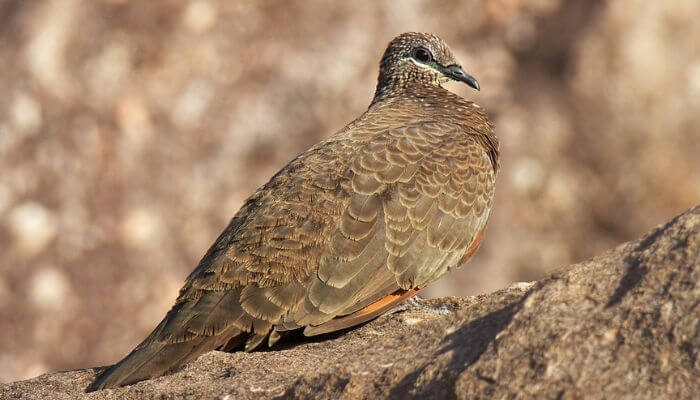
The chestnut-quilled rock pigeon has distinctive facial markings.
Pale grey lines run across the face, from the base of the upper mandible curving above and behind the eye, and from the lower mandible below the eye, curving across the sides of the head.
Character Of The Chestnut-Quilled Rock Pigeon
This species has a distinctive stance and they’ll be observed on a rock or ledge with their body held horizontally, tail held clear of the ground and the wings dropping below the tail.
Chestnut-quilled rock pigeons are most often seen when they have been flushed in small groups or pairs.
One of the signature moves that you might witness a chestnut-quilled rock pigeon executing is flying with loud clapping wing beats, often up a totally straight line from a gorge where they have been resting or hiding.
Quite sociable birds, they live in groups of 6 to 20 and communicate with a quiet double coo.
Diet Of The Chestnut-Quilled Rock Pigeon
Like many ground-feeding pigeons, the chestnut-quilled rock pigeon eats mainly seeds, along with some fruit and other plant material.
Seeds of spinifex grasses are among its most common foods.
The birds will venture a few metres out into open woodland in order to find food, especially in the dry season when speargrass seeds are abundant. They will, however, quickly fly back to the safety of their sandstone at the first sign of any disturbance.
Chestnut-Quilled Rock Pigeon Mating And Breeding
Chestnut-quilled rock pigeons have been recorded breeding from about March to November, usually laying two creamy white eggs.
Both the male and female incubate the eggs, which are reported to hatch after about 17 days. The young leave the nest at roughly three weeks old.
Chestnut-quilled rock pigeon nests are well hidden on shady ledges and built as a flatbed of roots and sticks.
Pairs may reuse the same nest site in later years if it is left undisturbed.
Taking Care Of The Chestnut-Quilled Rock Pigeon
Being a wild species, there are no care instructions for the chestnut-quilled rock pigeon, but you can help by protecting the small, specific areas of sandstone habitat where it lives.
Last updated 30 October 2026 · Types