
A pigeon’s colour is decided by a handful of genes. A gene is one instruction in the bird’s DNA. Each pigeon gets one copy of most genes from its father and one from its mother. If a version of a gene is dominant, one copy is enough for it to show. If it is recessive, the bird needs two copies, and a bird with only one copy looks normal but can pass it on. Breeders call that bird “split” for the colour.
The colour you see is built up in layers.
- Base colour: Every pigeon is blue (the grey and black of a town pigeon), ash-red (red markings on a pale grey body) or brown (chocolate). This gene sits on a sex chromosome, so it is inherited differently in cocks and hens. With the right pairing you can tell young cocks from hens by colour alone.
- Wing pattern: A separate gene decides the markings on the wing: no bars, two bars, a chequered wing, or a nearly solid dark wing.
- Modifiers: Other genes then adjust the result. Some lighten it, which is how blue becomes silver and ash-red becomes yellow. Others spread one colour over the whole bird or add white flecks and mottling, so a blue can end up solid black or grizzled.
So a “silver checker” is a blue pigeon with the checker pattern and the lightening gene. The rest of this guide explains each layer in more detail, with photos of the main colours.
How pigeon pigmentation works
Every colour seen in a domestic pigeon is built from two classes of melanin laid down in the growing feather. Eumelanin gives black and brown. Phaeomelanin gives the red and yellow range. The ratio between them, and the way the pigment granules are packed, is set first by one gene on the Z sex chromosome. That gene has three common alleles, and they produce the three base colours every fancier works from: ash-red, blue/black and brown. Everything else, from a silver show Modena to an almond tumbler, is one of those three base colours changed by a pattern gene and one or more modifiers.
That gene is the classical B locus. In 2014 the Shapiro lab at the University of Utah identified it as TYRP1 (tyrosinase-related protein 1), an enzyme in the eumelanin pathway (Domyan et al., Current Biology). Ash-red traces to a single amino acid change (A23P) that appears to have arisen once and spread through the fancy by breeding. Brown is caused by several different loss-of-function mutations in the same gene.
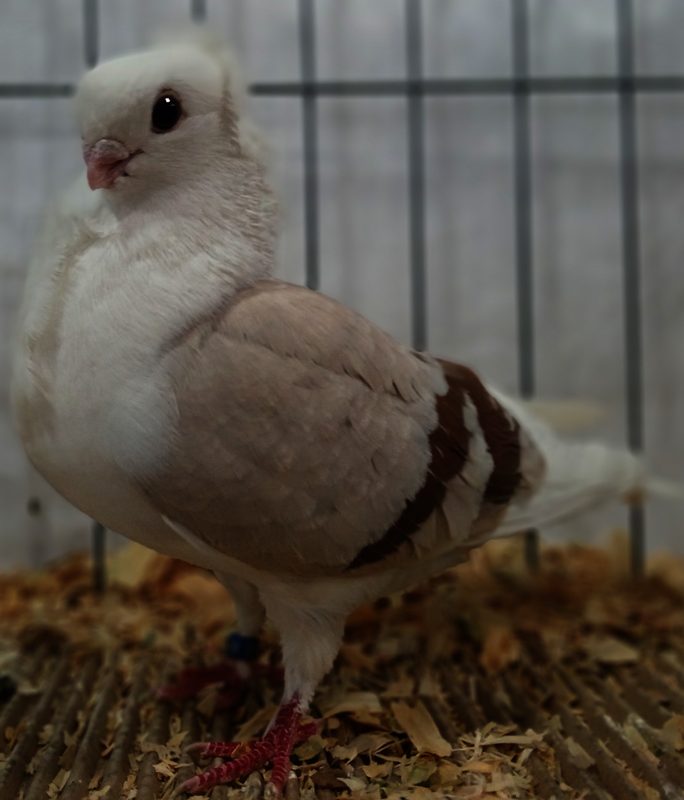
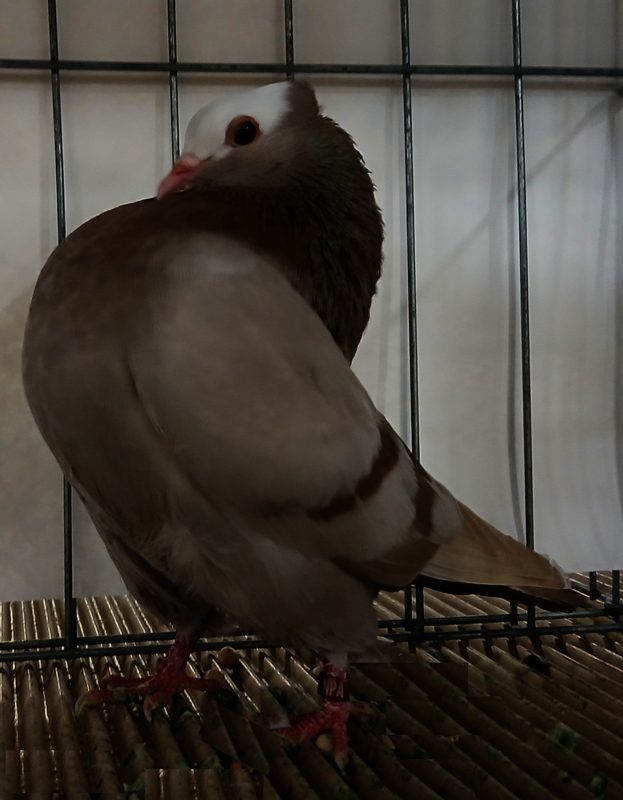
The base pigments
Eumelanin and phaeomelanin
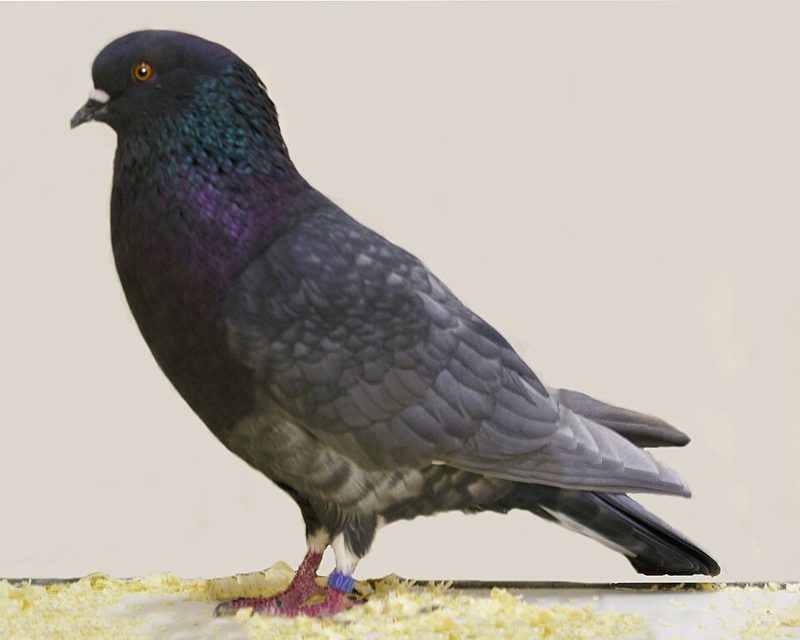
A blue bar pigeon is a black-pigmented bird. Its “blue” ground colour is black eumelanin packed into fewer, clumped granules, which reads as slate grey. In the bars, tail band and flights the granules are dense and the feather looks black. Brown birds make eumelanin as well, but a defective TYRP1 enzyme turns it into a brown form, so the bird looks chocolate rather than black. In ash-red birds the balance tips the other way: they make far more phaeomelanin and much less eumelanin. The pattern areas come out red and the ground colour is a pale, ashy grey.
The green and violet sheen on the neck is a separate matter. It comes from the structure of the feather barbules, not from a pigment. The article on iridescent feathers covers how that works.
Z-linked inheritance
Birds reverse the mammalian system. Cocks are ZZ and hens are ZW. The W chromosome carries no B locus, so a hen has one copy of the gene and shows whichever allele she has. A cock has two copies and can carry an allele he does not show.
The dominance order at B is:
| Allele | Symbol | Colour | Dominance |
|---|---|---|---|
| Ash-red | B^A | Red pattern on ash ground | Dominant to blue and brown |
| Blue/black | B+ | Wild type, black pattern on slate ground | Dominant to brown |
| Brown | b | Chocolate pattern on khaki ground | Recessive to both |
This gives three working rules. A hen can never be split (carrying an allele she does not show) for a base colour. A brown hen must have received brown from her sire, because a hen’s only Z always comes from her father. A brown cock must have received brown from both parents.
Ash-red is not completely dominant in practice. Cocks heterozygous for ash-red and blue (B^A/B+) often show black flecks or smudges, because some cells in the feather follicle express the blue allele. Hens cannot show this, since they have only one allele. Flecking on an ash-red bird therefore usually marks a cock.
The pattern series: a separate autosomal locus
Bar, checker and the other wing patterns are not modifiers of colour. They come from an independent autosomal gene, the C locus, which controls how much of the wing shield is filled with dark pigment. Every pigeon has both a base colour and a pattern. A “blue checker” and an “ash-red bar” are two-part genotypes.
In order of decreasing pigment, the series is:
- T-check (C^T): wing shield almost solid, with a faint chequered texture
- Checker (C): a regular chequer of dark and light on the shield
- Bar (+): the wild type, two dark bars across a plain shield
- Barless (c): no bars and the least pigment, recessive to the others

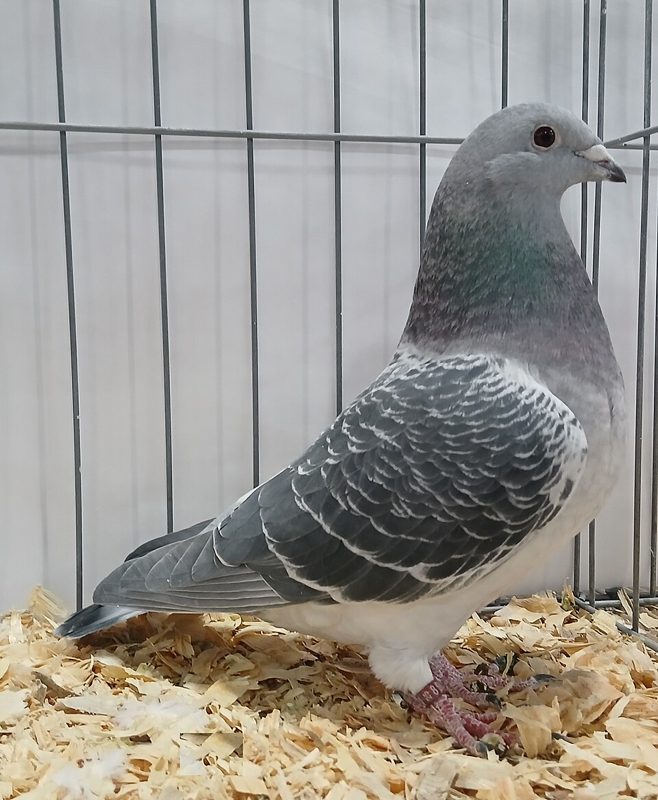
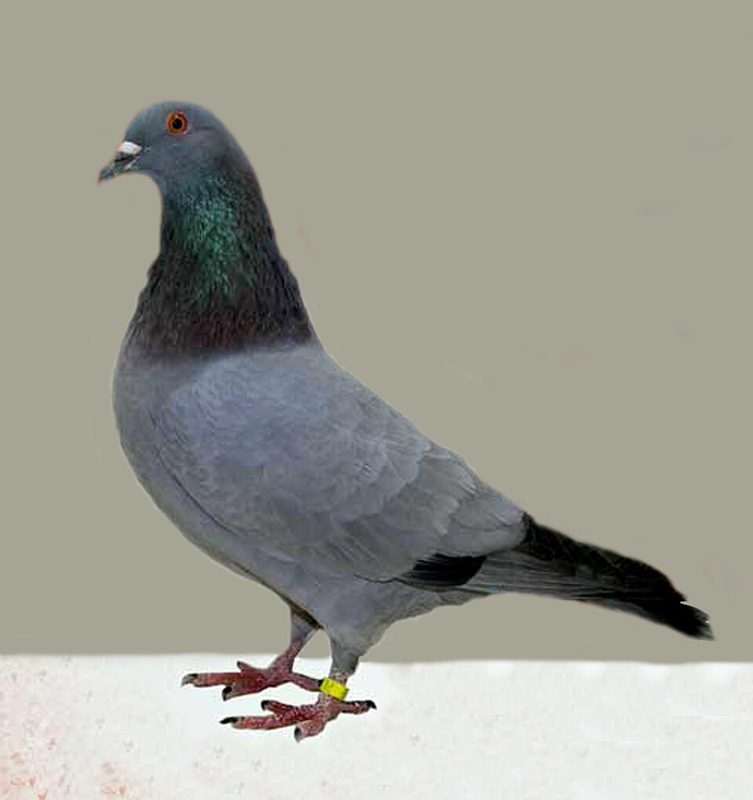
In 2018 the Shapiro lab (Vickrey et al., eLife) linked the series to the gene NDP. The checker and T-check alleles appear to have entered the rock pigeon by introgression from the speckled pigeon, Columba guinea. Barless birds carry a start-codon mutation in NDP and have a higher rate of vision defects.
The same pattern gene acts on every base colour. On a blue bird a checker shows as black on slate. On ash-red it shows as red on pale grey. On brown it shows as chocolate on khaki. Dark checker birds such as the Strasser and the Dragoon display these combinations clearly.
Modifiers
A modifier changes the intensity or distribution of pigment that the base colour and pattern have already set. Some are sex-linked and so follow the same rules as B. Most are autosomal.
Dilute (sex-linked recessive)
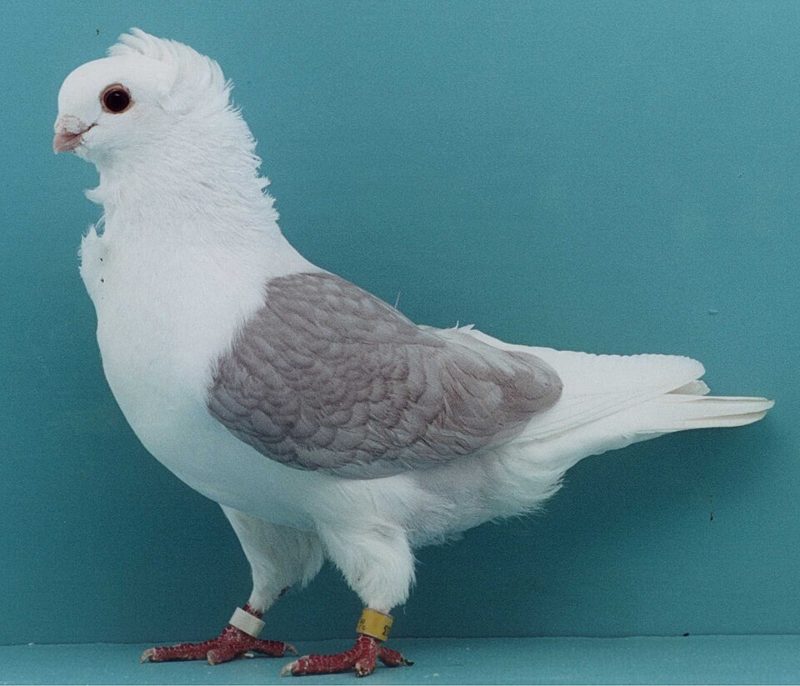
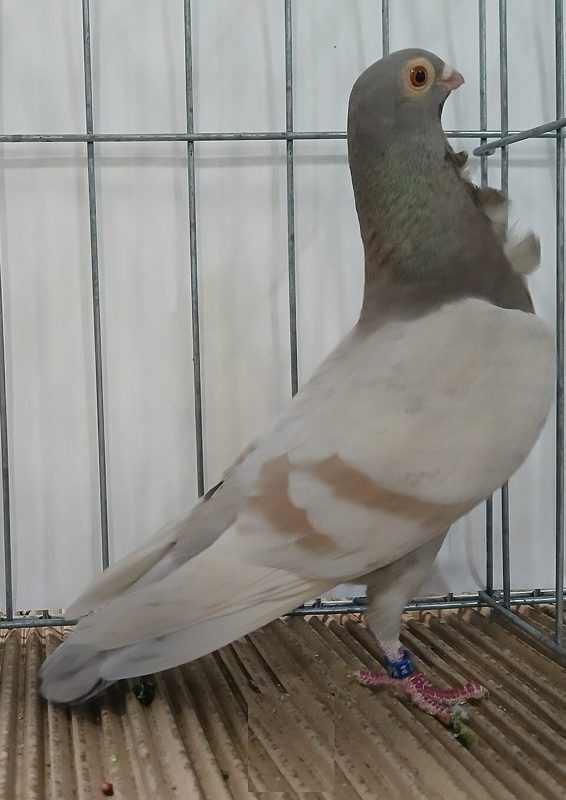
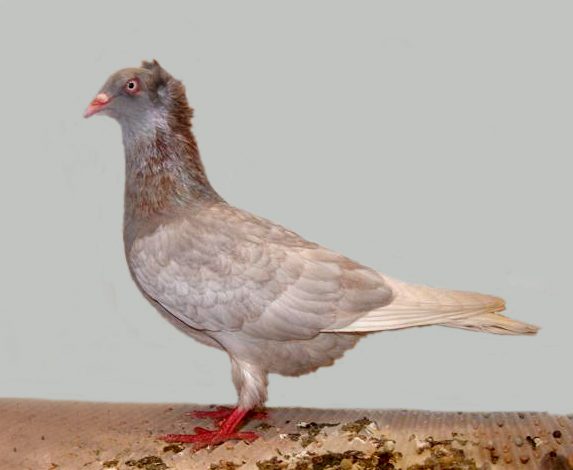
Dilute (d) packs less pigment into each feather. Blue becomes silver (a dun-grey bird with dark grey bars), black becomes dun, ash-red becomes yellow and brown becomes khaki. It sits on the Z chromosome and is recessive, so a hen with one copy is dilute and a cock needs two. The 2014 Utah study associated dilute with a missense mutation (H341R) in SLC45A2.
Pale (sex-linked, same locus as dilute)
Pale (d^P) is an allele at the dilute locus. Sell treats it as intermediate in effect between full colour and dilute. A pale bird is a lighter, washed version of its base colour and less extreme than a dilute. Because pale and dilute are alleles of one gene, a cock can carry one of each, but no single Z can carry both.
Recessive red (autosomal recessive, epistatic)
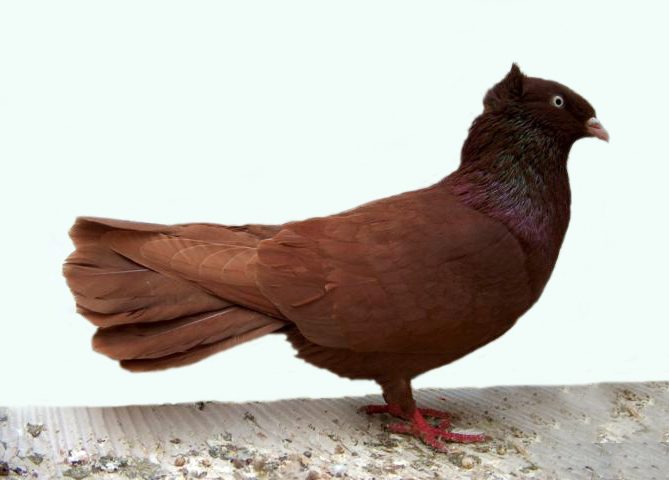
Recessive red (e) switches pigment production heavily towards phaeomelanin, whatever the bird’s base colour. A homozygous e/e bird is red, and it hides its base colour and most of its pattern. Combined with dilute it gives recessive yellow. The Utah group traced it to deletions in an enhancer of SOX10, which cut expression of TYRP1 and other pigment genes downstream. Because it masks the base colour, a recessive red can carry blue, brown or ash-red without any outward sign.
Spread (autosomal dominant)
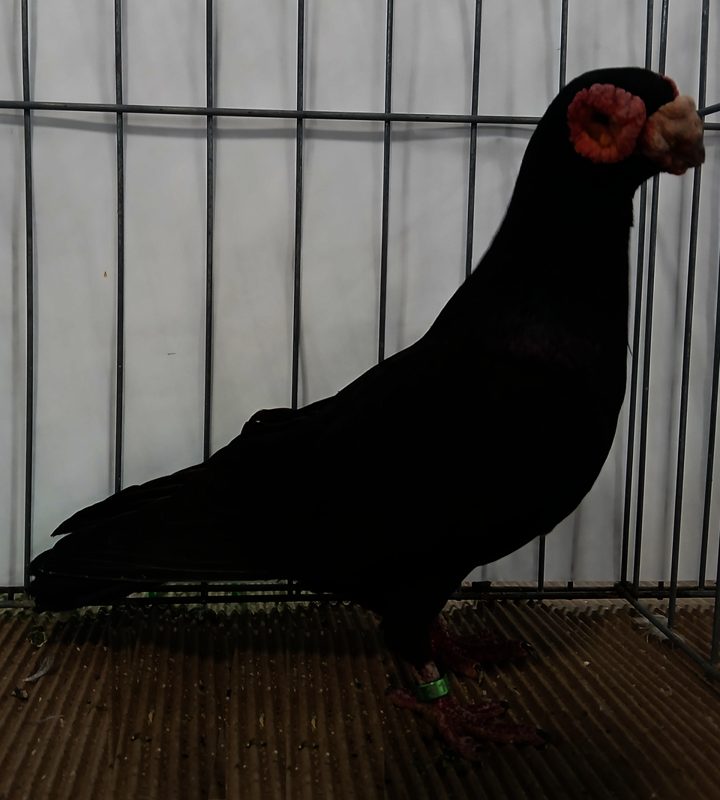
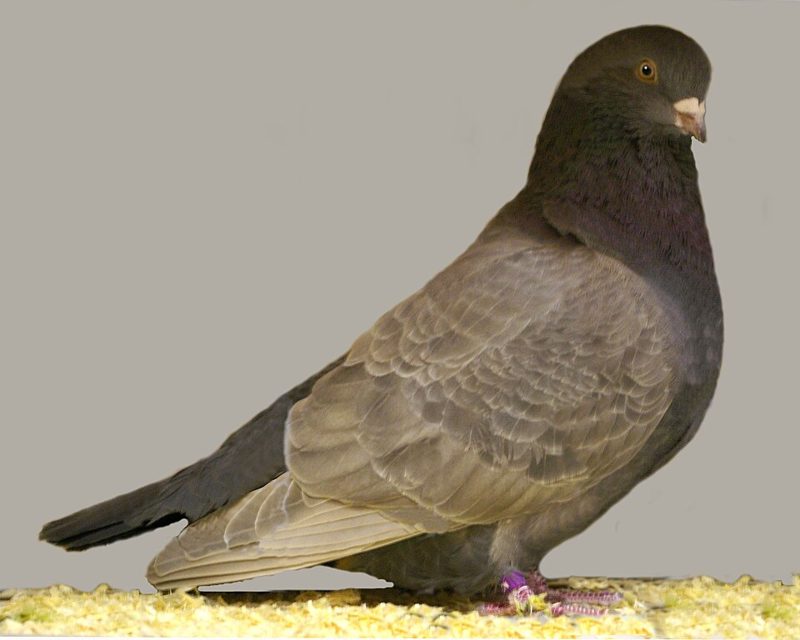
Spread (S) takes the darkest pigment of the pattern and spreads it evenly over the whole bird. A blue spread bird is self black. A brown spread is self chocolate. On ash-red, spread gives a pale, lilac-grey bird usually called spread ash or lavender, because ash-red’s pattern pigment is spread over its pale ground. Spread hides the pattern gene completely.
Indigo (autosomal, incompletely dominant)
Indigo (In) shifts black towards a bronzed, rusty tone and lightens the bars on blue birds. One copy gives indigo bar or indigo checker. Two copies give a lighter, more washed-out bird. Indigo combined with spread in a single dose gives the Andalusian colour, a slate-blue bird with darker lacing.
Grizzle (autosomal, incompletely dominant)
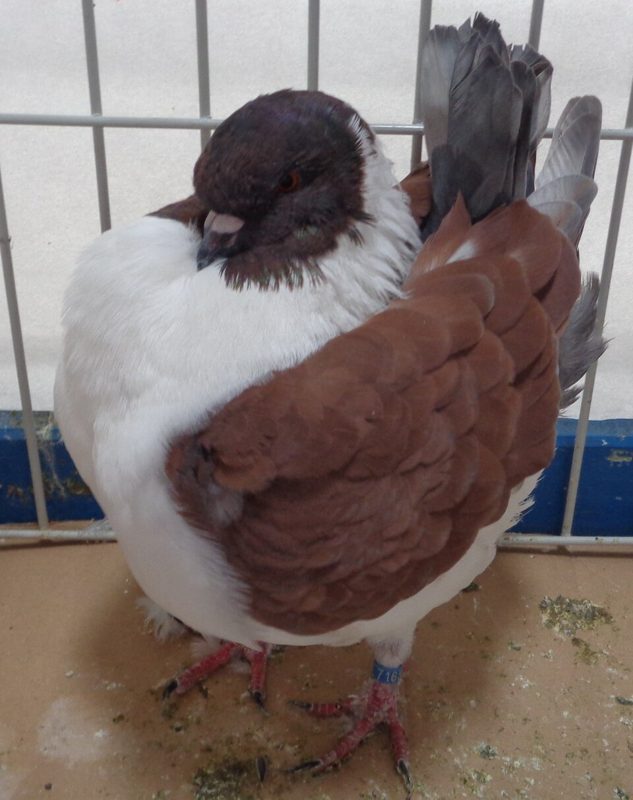
Grizzle (G) acts on any base colour and mixes white into pigmented feathers, either as a fine stippling across the feather or as white at the base. Heterozygous birds are usually stippled or pepper-and-salt. Homozygous grizzles are often close to white, with a few dark flecks.
Dominant opal (autosomal dominant)
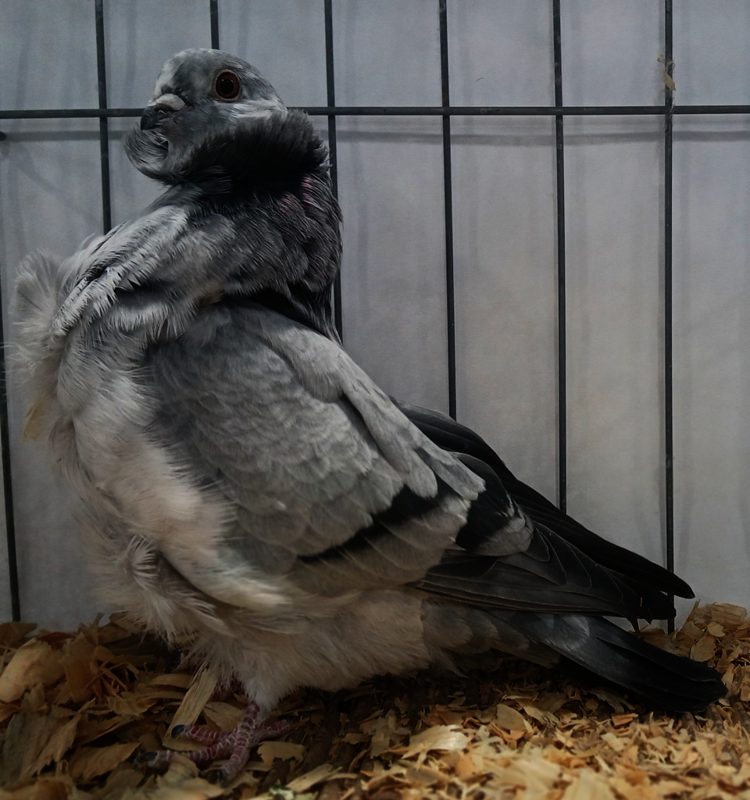
Dominant opal (Od) bleaches the bars and the outer part of the flights towards a pale whitish tone, while the rest of the bird stays close to normal. A blue bar dominant opal has white or near-white bars edged with dark. Sell describes the homozygote as having reduced viability, and breeders normally pair dominant opal to non-opal birds.
Recessive opal (autosomal recessive)
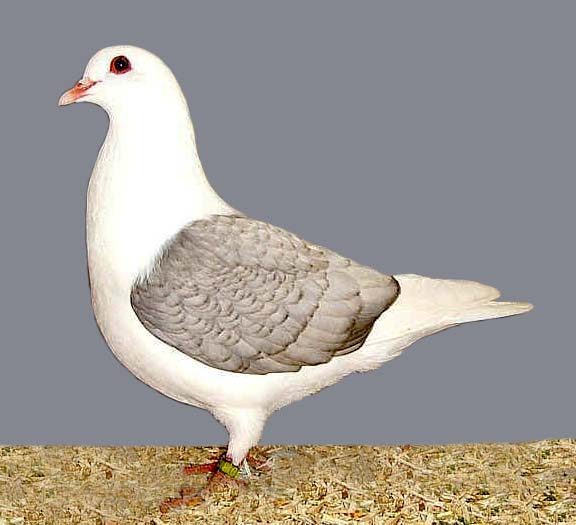
Recessive opal (o) is a separate gene and needs two copies. It lightens the bird as a whole, giving a soft, faded blue with paler, often brownish bars.
Almond (sex-linked, semi-dominant)
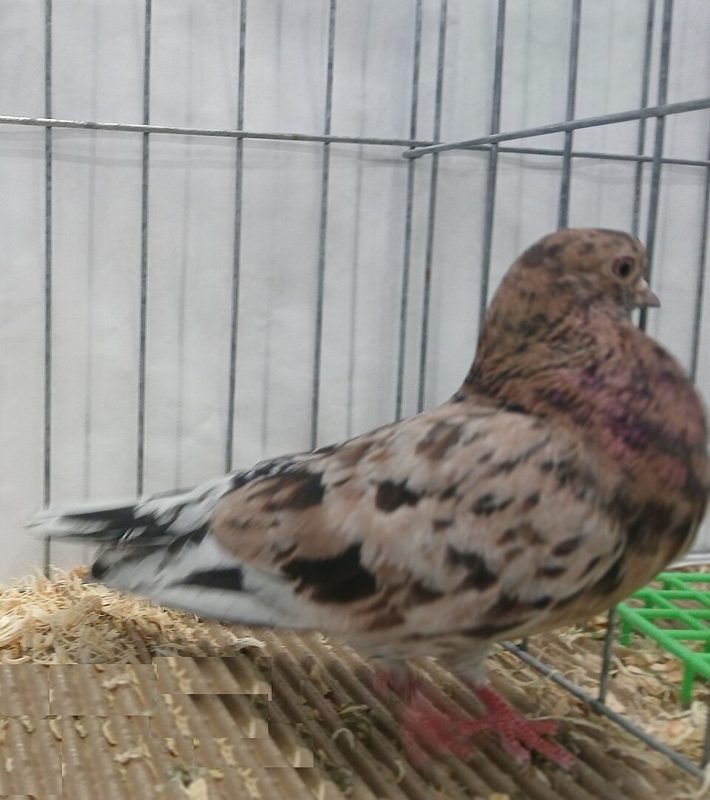
Almond is the classical Stipper (St) locus on the Z chromosome. It produces the variegated, flecked patchwork of the almond tumbler and of many Oriental rollers. Hens with one copy and heterozygous cocks show the pattern. Homozygous cocks (St/St) are usually very light and prone to severe eye defects. Bruders et al. (PLOS Genetics, 2020) linked almond to a copy number variant on the Z chromosome that includes the melanosome gene MLANA. Almond-to-almond pairings are avoided for that reason. The standard pairing is an almond cock to a non-almond hen, or an almond hen to a non-almond cock.
How the layers stack
A bird’s final appearance is read in layers. Start with the base colour. Add the pattern, unless spread or recessive red hides it. Then apply any modifiers. A silver checker is blue base, checker pattern and dilute. A yellow bar is ash-red base, bar pattern and dilute. A dun is blue base, spread and dilute. The same reasoning works for breeds with wide colour standards, such as the Modena, the Frillback and the Old German Owl.
Practical breeding
How breeders track traits
Colour breeders keep a loft book, tied to ring numbers (pigeon banding), that records each bird’s phenotype alongside its known or suspected genotype. A cock bred from a brown hen, for example, is recorded as “split for brown” even if he looks blue. The sex-linked genes are the easiest to track, since a hen always shows her single Z allele and always passes it to her sons, never to her daughters. The autosomal recessives such as recessive red, barless and recessive opal are harder. They can hide for several generations and are usually confirmed by test-mating to a bird known to be homozygous.
Sex-linked crosses at the B locus
A hen passes her Z to her sons and her W to her daughters. Daughters therefore take their base colour entirely from their sire.
Homozygous ash-red cock × blue hen
– Cocks: all ash-red (B^A/B+), carrying blue
– Hens: all ash-red (B^A/W)
– No colour sexing is possible from this pair.
Blue cock × ash-red hen
– Cocks: all ash-red (B^A/B+), carrying blue
– Hens: all blue (B+/W)
– Every red squab is a cock and every blue squab is a hen, so the young can be sexed in the nest once the feathers break through.
Heterozygous ash-red cock (B^A/B+) × blue hen
– Cocks: 1/2 ash-red (B^A/B+), 1/2 blue (B+/B+)
– Hens: 1/2 ash-red (B^A/W), 1/2 blue (B+/W)
– Overall: 1:1 ash-red to blue, with no sex link visible in the colour.
Blue cock split for brown (B+/b) × blue hen
– Cocks: all blue, 1/2 of them carrying brown
– Hens: 1/2 blue, 1/2 brown
– A brown squab from two blue parents is always a hen.
Dilute crosses
Dilute follows the same Z-linked rules.
Dilute cock (d/d) × normal-intensity hen (+/W)
– Cocks: all full colour, carrying dilute (+/d)
– Hens: all dilute (d/W)
– Sexable. A silver squab from a silver cock and a blue hen is a hen.
Normal cock (+/+) × dilute hen (d/W)
– Cocks: all full colour, carrying dilute
– Hens: all full colour
– No dilute young in the first generation.
Normal cock carrying dilute (+/d) × normal hen
– Cocks: all full colour, 1/2 carrying dilute
– Hens: 1/2 full colour, 1/2 dilute
Autosomal ratios
Pattern, spread, recessive red and the opals follow ordinary Mendelian ratios, with no link to sex. Two checkers that each carry bar (C/+) give 3 checker to 1 bar on average. A checker split for bar paired to a bar gives a 1:1 ratio. These are odds for each squab, so judge them over a season.
Combining sex-linked and autosomal genes
For two-gene problems, work out each gene separately and then multiply. A blue checker cock (B+/B+, C/+) paired to an ash-red bar hen (B^A/W, +/+) gives ash-red cocks and blue hens. Within each sex, about half will be checker and half bar. So roughly a quarter of the young will be ash-red checker cocks, a quarter ash-red bar cocks, a quarter blue checker hens and a quarter blue bar hens.
Sources
- Domyan ET et al. (2014). Epistatic and combinatorial effects of pigmentary gene mutations in the domestic pigeon (opens in new tab). Current Biology 24: 459–464. Free full text on PubMed Central (opens in new tab).
- Vickrey AI et al. (2018). Introgression of regulatory alleles and a missense coding mutation drive plumage pattern diversity in the rock pigeon (opens in new tab). eLife 7: e34803. Free full text on PubMed Central (opens in new tab).
- Bruders R et al. (2020). A copy number variant is associated with a spectrum of pigmentation patterns in the rock pigeon (opens in new tab). PLOS Genetics 16: e1008274. Free full text on PubMed Central (opens in new tab).
- Sell A. (2012). Pigeon Genetics: Applied Genetics in the Domestic Pigeon (opens in new tab). Sell Publishing, Achim. ISBN 978-3-9812920-3-9.
- Hollander WF. (1983). Origins and Excursions in Pigeon Genetics (opens in new tab). The Ink Spot, Burrton, Kansas (published uncopyrighted; PDF).
- University of Utah, Genetic Science Learning Center. Pigeon genetics (opens in new tab), a plain-English introduction based on the Shapiro lab’s work.
Last updated 23 October 2026 · Types