
The African collared dove (Streptopelia roseogrisea) is a small, pale dove with a black half-collar on the back of its neck. It lives in the dry belt south of the Sahara, from Mauritania and Senegal to Sudan and Ethiopia, and in the Horn of Africa and south-west Arabia.
It is the wild ancestor of the Barbary dove, also kept as the ringneck dove, a tame cage bird. The wild ring-necked dove (Streptopelia capicola) is a different species, found in eastern and southern Africa.
The bird most often confused with it is the Eurasian collared dove, a larger relative that has spread from Asia across Europe.
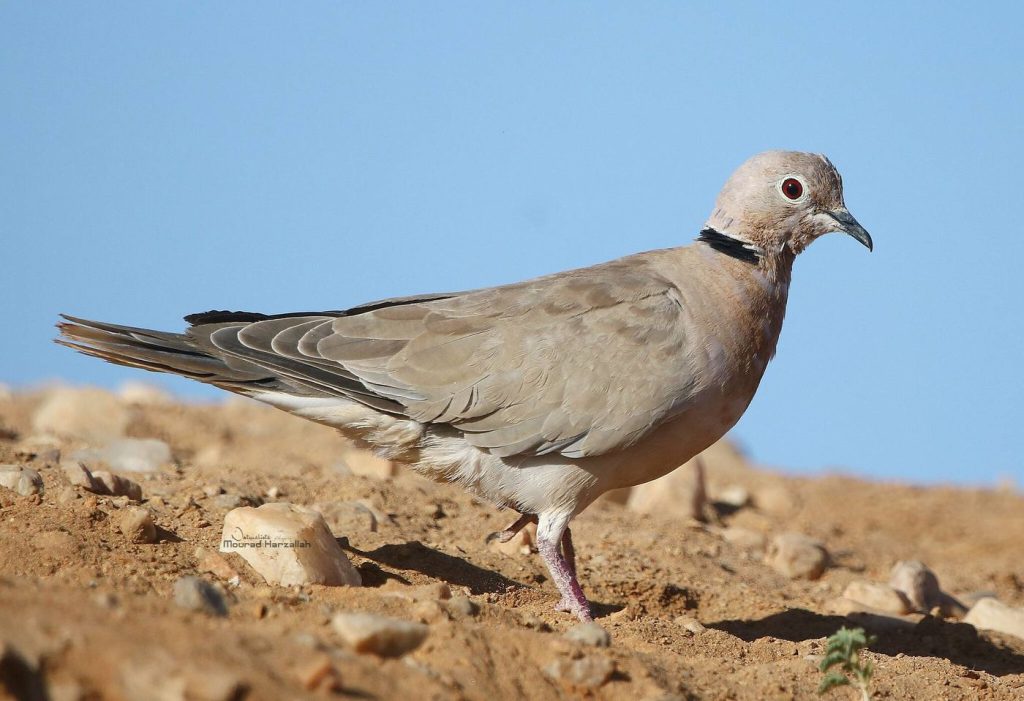
African collared dove at a glance
| Feature | Details |
|---|---|
| Scientific name | Streptopelia roseogrisea (Sundevall, 1857) in the IOC World Bird List. Some authors use Streptopelia risoria |
| Other names | The domestic form is the Barbary dove or ringneck dove |
| Length | About 28 cm (feral birds, New Zealand Birds Online) |
| Weight | About 140 g (same source) |
| Native range | Sahel from south-west Mauritania, Senegal and Gambia to Sudan and north-west Ethiopia; north-east Sudan to northern Somalia; south-west Arabia |
| Habitat | Dry savanna and dry grassland; also dry shrubland, hot desert and farmland |
| Eggs | Two, white |
| Incubation | About 14 to 16 days |
| Conservation status | Least Concern (IUCN Red List, assessed 2018), population thought to be stable |
| Introduced populations | Listed by BirdLife for the USA, Puerto Rico, the Bahamas and New Zealand |
How to identify it
The upperparts are a pale fallow brown and the underparts a creamy buff to peach pink. A narrow black crescent runs across the back of the neck. In adult males it has a white fringe; in females the white edge is weaker. Otherwise males and females look alike.
The flight feathers are grey-brown, and the undertail coverts are white. The outer tail feathers are darker than the central ones and have broad white tips. Adults have a red iris and deep pink legs. Young birds are paler, with pale brown edges to the wing feathers, a pale yellow-brown iris and grey-brown legs, and their collar is missing or faint. The bill is dark grey at every age.
This description is from New Zealand Birds Online, which describes feral birds there. Wild African collared doves look the same, although birds from the eastern population (subspecies arabica) are usually darker, with pale grey underwing coverts rather than off-white ones. A 2023 study found that these differences turn up across the whole range and suggested the species may have no real subspecies.
African collared dove vs Eurasian collared dove
Both species have a sandy body and a black half-collar, so the collar alone will not separate them. Size, the tail and the call are more useful.
| Feature | African collared dove | Eurasian collared dove |
|---|---|---|
| Average weight | About 140 g | 204.8 g (BTO average) |
| Outer edge of the outermost tail feather | Usually white | Coloured |
| Call | Two notes, “coo crrooo”, plus a rapid “heh-heh-heh” | Different call; see our Eurasian collared dove guide |
| Native range | Sahel, Horn of Africa, south-west Arabia | Asia; has spread across Europe |
| In captivity | Wild-caught birds settle quickly, according to Hein van Grouw; the ringneck is its domestic form | Does not become tame, even after several generations (same source) |
Average weight compared
Grams. The two figures come from different sources and populations.
The tail feature comes from museum skins examined for the 2023 genome study. In Eurasian collared doves the outer web of the outermost tail feather is coloured. In African collared doves it is usually white. First-generation hybrids also have a coloured outer web, and the authors found one pure African collared dove whose tail looked like a hybrid’s, so this feature is a guide rather than proof.
Hybrids make identification harder. Ringneck doves and Eurasian collared doves breed together readily and their young are fertile. In places where both live, such as the Canary Islands, hybrid features turn up in both. Our page on whether doves and pigeons can mate covers hybrids between other species.
Range and habitat
BirdLife International gives an extent of occurrence of about 11 million km² for the resident and breeding range. Its native range takes in countries from Mauritania, Senegal and Gambia across Mali, Niger, Nigeria, Cameroon and Chad to Sudan, Egypt, Eritrea, Ethiopia, Djibouti and Somalia, and to Saudi Arabia and Yemen.
BirdLife lists dry savanna and dry tropical grassland as its main habitats, with dry shrubland, hot desert and farmland also used. The photograph at the top was taken at Bordj Badji Mokhtar, in the far south of Algeria.
Escaped or released ringneck doves have founded small feral populations outside Africa. BirdLife lists introduced populations in the USA, Puerto Rico, the Bahamas and New Zealand. In New Zealand, a first release at Nelson in 1867 failed, and the birds now found in Northland, around Auckland, in Waikato and in Hawke’s Bay are thought to come from local aviaries.
Food and breeding
New Zealand Birds Online describes feral birds feeding on the ground, mostly on the seeds of grasses, cereal crops and herbs. They sometimes stretch up to take seeds from low seed heads.
The nest is a loose platform of sticks in a tree, a hedge or on a ledge in a building. Both birds build it. The female almost always lays two white eggs, one or two days apart. Both parents sit on the eggs, the male mostly in the middle of the day and the female overnight.
From egg to fledgling
Like other pigeons and doves, the parents feed newly hatched chicks on crop milk, a secretion from the lining of the crop. Once the chicks’ feathers start to grow, at about five days old, they get regurgitated seeds instead.
Voice: the “laughing” dove
The advertising call is a soft, repeated two-note “coo crrooo”, with a short pause between the notes. Birds landing beside other doves often give a fast “heh-heh-heh-heh” that people compare to laughing.
That call gave the bird its old scientific name. When Linnaeus described the tame form in 1758 he called it Columba risoria, from the Latin for “laugher”, probably because of the giggling call. The German name Lachtaube and the French tourterelle rieuse both mean “laughing dove”.
The coo itself has been studied in detail. In 2004 researchers in the Netherlands and the USA reported in Nature that the ring dove controls the trill in its coo with superfast muscles in its syrinx, the bird’s voice box. These muscles go from 10% to 90% of their twitch force in about 4 milliseconds, which puts them in the same “superfast” class as the muscles that shake a rattlesnake’s rattle. A follow-up study measured the trill at an average of 24.2 sound elements a second.
The domestic form, and a similar wild species
The tame ringneck dove, also called the Barbary dove, is the domesticated African collared dove. A genome study published in 2023 confirmed that the African collared dove is its main ancestor.
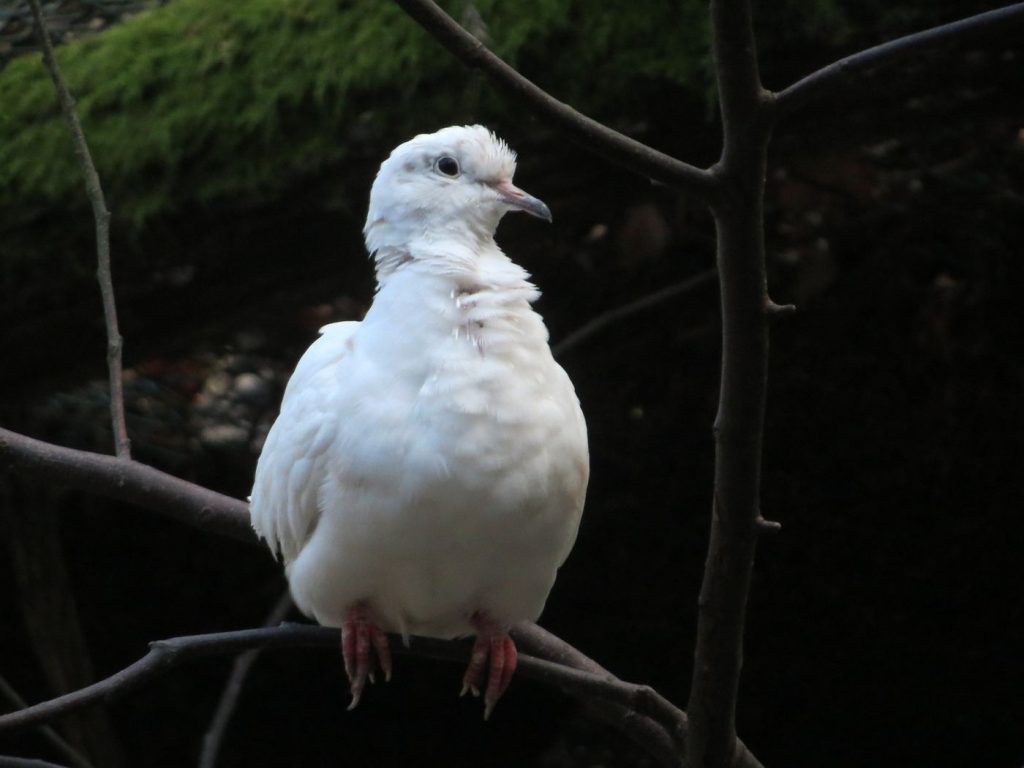
The wild ring-necked dove (Streptopelia capicola) is a different species. The IOC World Bird List treats it as separate from the African collared dove and gives its range as eastern and southern Africa, and the Comoros.
Status and conservation
BirdLife International assessed the African collared dove as Least Concern for the IUCN Red List in 2018. Nobody has counted the world population, but the species is described as common to locally abundant, its range is very large, and BirdLife suspects the population is stable because there is no evidence of declines or major threats.
BirdLife also lists it as traded internationally as a pet and display bird, which fits its long history in captivity.
Frequently asked questions
Is a ringneck dove the same as an African collared dove?
The pet ringneck dove, or Barbary dove, is the domesticated form of the African collared dove. The wild ring-necked dove (Streptopelia capicola) is a different species, found in eastern and southern Africa.
What is the difference between an African collared dove and a Eurasian collared dove?
The African collared dove is smaller, at about 140 g against an average of about 205 g for the Eurasian collared dove. It usually has white on the outer edge of its outermost tail feather, and it gives a two-note coo and a laughing call. The Eurasian collared dove does not become tame in captivity.
Where do African collared doves live?
In the wild they live across the Sahel, from Mauritania and Senegal to Sudan and Ethiopia, and in Eritrea, northern Somalia and south-west Arabia. Feral ringneck doves live in a few other places, including parts of the USA and New Zealand.
Why is it called the laughing dove?
Because of its call. Birds meeting others give a rapid “heh-heh-heh” that sounds like laughing, and the Latin name risoria, given by Linnaeus in 1758, means “laugher”. The name laughing dove is also used for a different species, Spilopelia senegalensis.
Is the African collared dove endangered?
No. It is listed as Least Concern on the IUCN Red List. Its population has not been counted, but it is common over a very large range and is thought to be stable.
Sources
IOC World Bird List, version 15.2 (opens in new tab).
BirdLife International: African Collared-dove species factsheet (opens in new tab).
BTO BirdFacts: Collared Dove (opens in new tab); RSPB: Collared Dove (opens in new tab).
Elemans, C. P. H. and others (2004). Superfast muscles control dove’s trill. Nature 431: 146 (opens in new tab); Elemans and others (2006). Syringeal muscles fit the trill in ring doves. Journal of Experimental Biology 209: 965–977 (opens in new tab).