
Yes, some can, but it is rare and happens almost only in captivity. A domestic pigeon and a ringneck dove can produce hybrid chicks, but the hybrids are sterile or nearly so: females lay no eggs and males are almost always infertile. In the wild, pigeons and doves of different species very seldom pair.
Updated 3 November 2026. Based on published breeding studies and genetics papers listed under Sources.
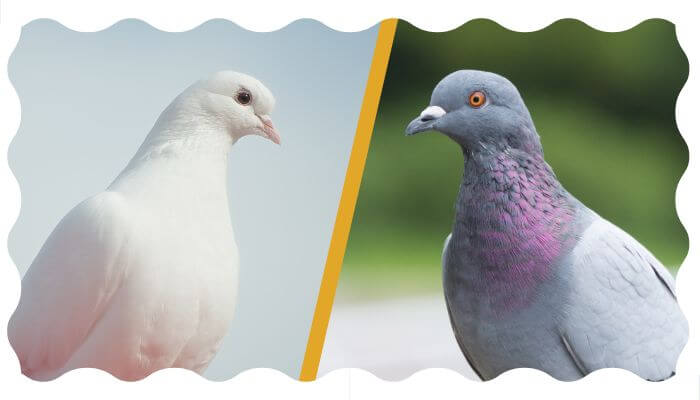
Which pigeons and doves can breed together?
“Pigeon” and “dove” are everyday names, not scientific groups, so the answer depends on which two species you mean. The closer the relationship, the more likely the chicks are to be fertile.
| Pair | How related | Chicks? | Fertile? |
|---|---|---|---|
| Feral pigeon × racing or fancy pigeon | Same species (Columba livia) | Yes | Yes |
| Ringneck (Barbary) dove × Eurasian collared dove | Same genus (Streptopelia) | Yes | Yes, the hybrids can breed |
| Domestic pigeon × ringneck dove | Same family, different genera | Yes, mostly in captivity | Sterile or nearly so |
| Pigeon × seagull | Different orders | No | No |
Why pigeons and doves are different species
All pigeons and doves belong to one family, the pigeon family (Columbidae), which has about 300 living species. Within it, the feral pigeon is the rock pigeon Columba livia, while the ringneck or Barbary dove is Streptopelia risoria, a domestic form of the African collared dove. The two genera last shared a common ancestor about 23 to 35 million years ago, according to a 2015 genetics study by Vickrey and colleagues.
That gap is large. Members of the same species, such as a feral pigeon and a racing homer, breed freely. Two species in the same genus can sometimes produce fertile young. Two genera this far apart can still produce chicks, but the chicks are rarely able to breed themselves. Our guide to the difference between doves and pigeons explains how the names are used.
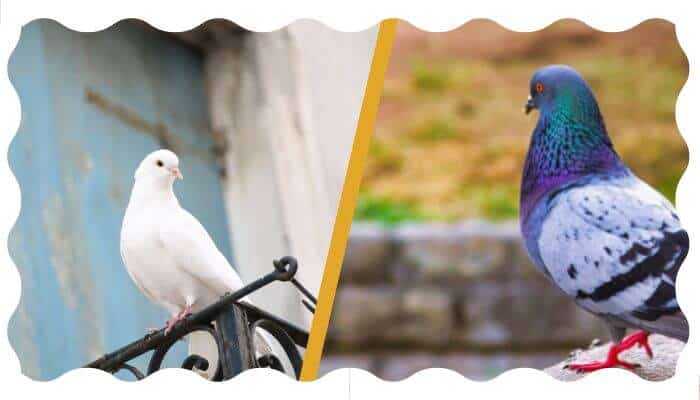
What happened when pigeons were crossed with ringneck doves
The most detailed record comes from L. J. Cole and W. F. Hollander at the University of Wisconsin, who crossed domestic pigeons with domestic ringneck doves for about 25 years and published the results in The American Naturalist in 1950.
Natural matings were possible, especially between a male pigeon and a female dove, and small pigeons gave the best results. A male dove rarely mated with a female pigeon, and artificial insemination was used for some crosses. Fertility varied widely: eight pairings of male pigeons with female doves produced 104 eggs that were all infertile, while seven other pairings of the same kind produced 147 eggs, 94% of them fertile.
Hybrids from a pigeon father were almost all male. Female hybrids came more readily from a dove father, but none of them ever laid an egg. Male hybrids produced plenty of sperm, much of it abnormal. Backcrossed to pigeons they were practically infertile; backcrossed to doves, just over 2% of eggs were fertile and nine hatched. Every one of those backcross chicks was male and sterile.
Chromosomes and fertility
Pigeons and doves also differ in their chromosomes. A 2020 study in Genes lists the rock pigeon with 80 chromosomes and the Eurasian collared dove, a close relative of the ringneck dove, with 76. Collared doves have chromosomes that have fused together, which the rock pigeon lacks.
When a hybrid tries to make eggs or sperm, chromosomes that do not match well cannot pair up neatly, which is a common reason why hybrids between distant species are sterile. Cole and Hollander also suggested that some of their backcross birds may have had an extra set of chromosomes.
Not every gene behaves strangely in a hybrid. Cole and Hollander found that about 20 pigeon colour genes worked in the hybrids much as they do in pure pigeons, crested pigeons crossed with crested ringneck doves give crested chicks. A 2015 study traced the crest in both species to the same gene, EphB2. For how pigeon colours are inherited, see pigeon colour genetics.
Do pigeons and doves mate in the wild?
Very rarely, when the two species are not closely related. Wild birds pick mates of their own species by size, voice and courtship display, so a feral pigeon has no reason to pair with a collared dove when other pigeons are all around. The two often feed side by side in parks and gardens without pairing.
Crosses are more likely between close relatives. Escaped ringneck doves breed with wild Eurasian collared doves, and their young are fertile, which is why the ringneck dove’s status as a separate species is sometimes questioned. Read more about the Eurasian collared dove.
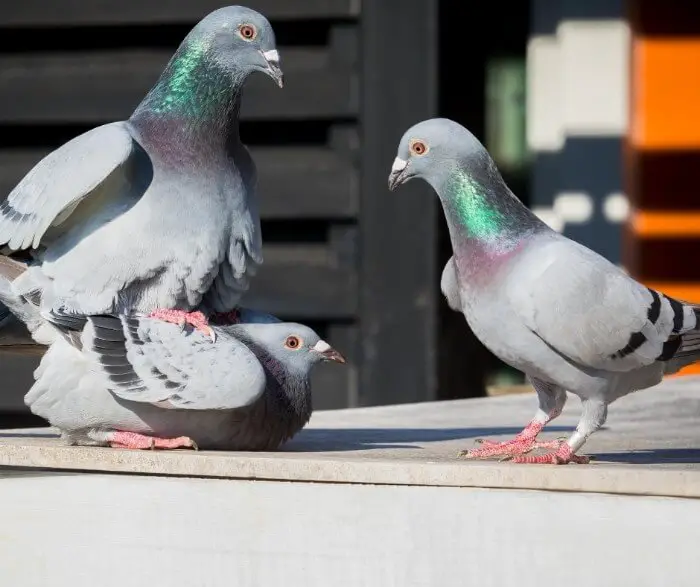
Is a pigeon a male dove?
No. “Pigeon” and “dove” are not the male and female of one bird. Both names cover many species, and every species has males and females. In practice, larger species tend to be called pigeons and smaller ones doves, but the names overlap: the rock pigeon is also called the rock dove. To see how a pair of the same species courts and mates, read how pigeons mate.
Breeds are not hybrids
The hundreds of fancy and utility pigeon breeds, from show birds to the meat-type king pigeon, all belong to one species, the rock pigeon. Crossing two breeds is not hybridisation, and the young are fully fertile. True hybrids between pigeons and doves are mostly made for genetic research or out of curiosity, and because they cannot breed, each one comes from a new cross. See our guide to pigeon breeds for more breeds.
Frequently asked questions
Can doves and pigeons mate?
Some can. A domestic pigeon and a ringneck dove can mate and produce chicks, mostly in captivity. In the wild, pigeons and doves of different genera very rarely pair.
Can a pigeon and a dove have a baby?
Yes. A pigeon and a ringneck dove can produce hybrid chicks, but they are sterile or nearly so. Hybrid females lay no eggs, and hybrid males are almost always infertile.
Are pigeon and dove hybrids fertile?
Almost never. In 25 years of crosses, Cole and Hollander found no egg-laying female hybrids, and backcrosses gave only a few sterile males.
Can a mourning dove mate with a pigeon?
It is very unlikely. The mourning dove and the feral pigeon belong to different genera, differ in size, voice and courtship, and normally choose mates of their own species.
Can seagulls and pigeons mate?
No. Gulls and pigeons belong to different orders of birds and cannot produce young together. See seagull pigeon hybrids and pigeons vs seagulls.
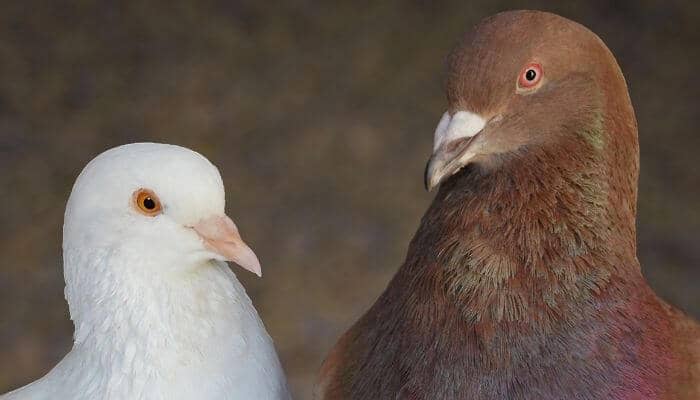
Is a white dove a pigeon?
Often, yes. Many “doves” released at weddings are white homing pigeons; others are white ringneck doves. See white doves and release pigeons.
Sources
We checked each source on 3 November 2026.
- Cole, L. J. and Hollander, W. F. (1950). Hybrids of pigeon by ring dove. The American Naturalist 84: 275–307 (opens in new tab)
- Full text of Cole and Hollander (1950), Pigeon Research archive (PDF) (opens in new tab)
- Vickrey, A. I. et al. (2015). Convergent evolution of head crests in two domesticated columbids. Molecular Biology and Evolution (opens in new tab)
- Kretschmer, R. et al. (2020). A comprehensive cytogenetic analysis of several members of the family Columbidae. Genes 11: 632 (opens in new tab)
- Barbary dove: species account (domestication and hybridisation with collared doves) (opens in new tab)
- Washington Department of Fish and Wildlife: Domestic pigeons (rock doves) fact sheet (PDF) (opens in new tab)
Changelog, 3 November 2026: rewritten with a direct answer, a table of which pairs can breed, a summary of the Cole and Hollander breeding study with an original infographic, a chromosome section with cited counts, and an FAQ. Corrected the chromosome comparison (the 76 figure is from Streptopelia doves generally, measured in the Eurasian collared dove). Removed an off-topic list of mammal hybrids, a bear photo and the closing paragraph about “Mother Nature”.
Last updated 3 November 2026 · Health