
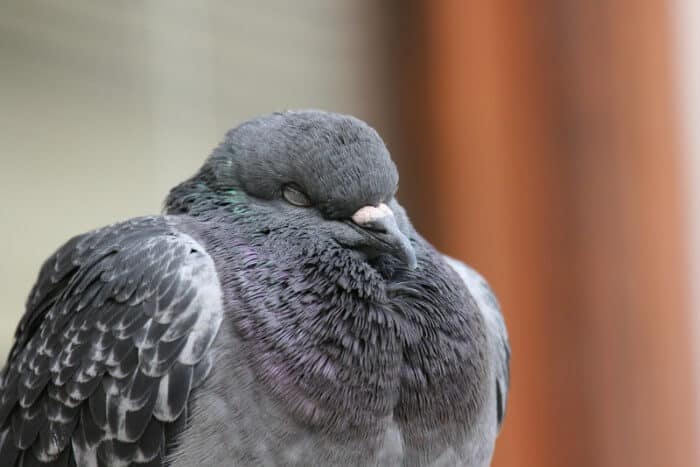
Pigeons sleep mainly at night, on a high and sheltered perch such as a ledge, beam or branch. They draw the head down into the shoulders instead of tucking it under a wing, usually stand on one leg, and take short naps later in the day. A pigeon can also sleep with one eye open, with one half of its brain sleeping more deeply than the other.
Updated 30 October 2026. Every claim below is checked against the studies and guides listed under Sources.
Pigeon sleep at a glance
| Question | Short answer | Based on |
|---|---|---|
| When do pigeons sleep? | Mostly at night. They also nap, especially in the last hours of the day. | Martinez-Gonzalez et al. 2008 |
| Where? | On raised, sheltered perches. Wild rock doves use cliff ledges and caves; city pigeons use buildings and bridges. | Goodwin; Tisdale et al. 2018 |
| In what position? | Head drawn close into the body, never turned under the wing. Usually on one leg, swapping legs now and then. | Goodwin, Pigeons and Doves of the World |
| Can they sleep with one eye open? | Yes. The hemisphere linked to the closed eye sleeps more deeply. | Rattenborg et al. 2001 |
| Do they have REM sleep? | Yes, in many very short bouts mixed with slow-wave sleep. | Ungurean et al. 2020; Tisdale et al. 2018 |
| What happens if they miss sleep? | They sleep more deeply afterwards rather than for longer. | Martinez-Gonzalez et al. 2008 |
Where do pigeons sleep at night?
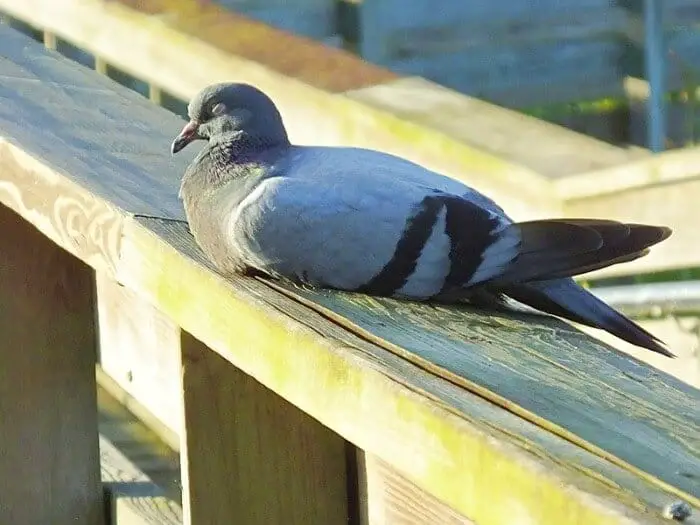
Pigeons pick a roost that is high and out of the weather. Wild rock doves, the ancestor of the town pigeon, roost and nest in caves and on cliff ledges. Feral pigeons use the man-made versions: window ledges, roof spaces, the girders under railway bridges and the beams of old buildings. Woodpigeons, a separate species, roost in trees.
Height matters to them. In a 2018 study at the Max Planck Institute for Ornithology, captive pigeons preferred high perches at night, probably to keep away from mammals that hunt on the ground at night. When the high perches were taken away, the birds slept for the same total time, but their sleep was lighter and they had less REM sleep. You can read more about the animals that hunt them in our guide to the natural predators of pigeons.
Do pigeons sleep in their nests?
Only when they have eggs or young chicks. A pair takes turns: the hen usually sits from late afternoon until mid-morning, and the cock covers the rest of the day. So at night it is normally the female on the nest, with the male roosting close by.
Outside the breeding cycle, pigeons sleep on a roosting perch rather than in a nest. A pair that nests again often looks for a new site near the old one, though they will reuse the old nest if they cannot find one. Our guide on where pigeons build their nests covers the sites they prefer.
How does a pigeon sleep?
A roosting pigeon fluffs its feathers slightly, pulls its head down until the neck almost disappears, and closes its eyes. Many songbirds turn the head round and tuck the bill into the back feathers, but pigeons do not. The ornithologist Derek Goodwin, who studied the species for decades, wrote that a pigeon’s head is “never turned and tucked under the wing”.
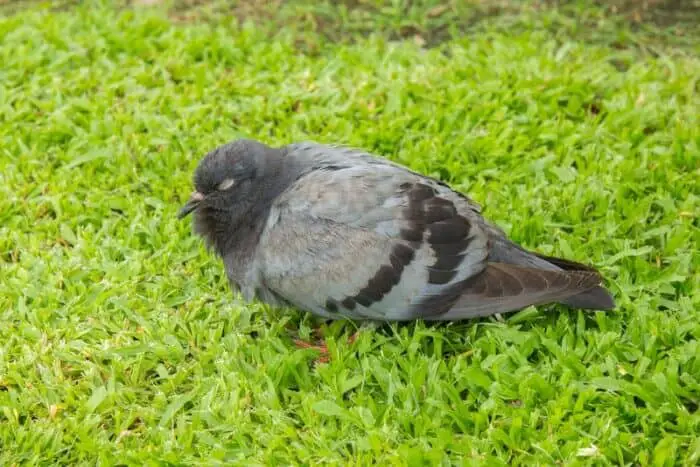
A healthy adult usually rests on one leg at a time, with the other drawn up into the belly feathers, and swaps legs every so often. During the day it may also squat, or lie down on one wing. A bird’s feet hold its perch firmly while it sleeps, so roosting birds rarely fall off.
Sleeping with one eye open
Pigeons can rest one side of the brain at a time. In 2001 Niels Rattenborg and colleagues recorded the brain activity of sleeping pigeons and found that when one eye was closed, the opposite hemisphere showed more of the slow waves typical of deep sleep. The birds used the open eye to watch their surroundings.
Each pigeon tended to favour one eye, left or right, and the choice seemed to depend on what was around it. This half-awake state lets a roosting bird react to danger without losing all its rest.
Slow-wave sleep, REM sleep and what the brain is doing
Like mammals, pigeons have two kinds of sleep: slow-wave sleep and REM (rapid eye movement) sleep. Bird REM sleep comes in many very short bouts. During REM a pigeon’s head may droop or nod as its neck muscles relax.
Pigeons have helped scientists show how different bird sleep can be. A 2021 study found that their pupils behave in the opposite way to ours: they stay dilated in non-REM sleep, while REM sleep brings rapid bursts of constriction and dilation. A 2023 brain-scanning study found that REM sleep activates the parts of a pigeon’s brain that process vision, including the motion seen in flight. Whether pigeons dream in the way we do cannot be measured.
Naps, and catching up on lost sleep
Pigeons nap during the day, and especially in the last hours before dusk. In a 2008 experiment researchers kept pigeons from napping during the last eight hours of the day. The birds did not sleep any longer that night, but their sleep was more intense for the first three hours, as shown by stronger slow waves in their brain activity. They also spent more time in REM sleep.
In short, a pigeon that has been disturbed catches up by sleeping more deeply rather than for longer. Pigeons are active by day and have poor vision in the dark, which is why they settle on a roost before night falls (see can pigeons see in the dark?).
Asleep or unwell? How to tell
Pigeons often rest on the ground or on a wall in the daytime, so a still, fluffed-up bird is not always in trouble. These signs help you tell the difference:
| Probably resting | May need help |
|---|---|
| Stands on one leg, or swaps legs | Stands on both legs all the time, or sits and cannot stand |
| Opens its eyes and moves or flies off as you get close | Lets you walk right up to it without moving |
| Fluffed up for a short time, especially on a cold day | Stays fluffed up for hours, looks sleepy and does not eat |
| Head tucked in, feathers clean and smooth | Head drooping, eyes half closed, dirty vent feathers, or visible injury |
If a pigeon shows signs from the right-hand column, our guides to a pigeon sitting still and not moving and what to do if you find an injured pigeon explain what to do. The RSPCA advises taking a sick or injured pigeon to a vet in a ventilated box, wearing gloves. Fluffing up is also how pigeons keep warm, so check the weather too: see how cold is too cold for pigeons and why pigeons puff up.
Frequently asked questions
Where do pigeons go at night?
They fly to a roost: a high, sheltered spot such as a ledge, roof space, bridge girder or, for woodpigeons, a tree.
Do pigeons sleep in their nests?
Only while they have eggs or small chicks. The hen usually covers the nest overnight while the cock roosts nearby. At other times pigeons sleep on a perch.
Do pigeons sleep standing up?
Yes. A healthy pigeon usually sleeps standing on one leg and swaps legs from time to time. A bird that stays on both legs or sits down all the time may be ill.
Can pigeons sleep with one eye open?
Yes. Research on pigeons shows that one half of the brain can sleep more deeply than the other while the eye on the more awake side stays open and watches for danger.
Do pigeons fly at night?
Rarely. They are active by day, see poorly in the dark and settle on a roost before dusk.
Do pigeons dream?
They have REM sleep, and brain scans show the visual areas of the brain become active during it. Whether this means they dream as we do cannot be tested.
Is a pigeon with its head tucked in asleep or sick?
Usually just resting. Worry if it stays fluffed up for hours, will not move when approached, stands on both legs or sits all the time, or has dirty vent feathers.
Sources
We read each source on 30 October 2026. Where a study was done on captive pigeons, we say so.
- D. Goodwin, Pigeons and Doves of the World and R. Johnston and M. Janiga, Feral Pigeons: ethogram excerpts (Great Lakes Pigeon Rescue) (opens in new tab)
- Rattenborg, Amlaner and Lima (2001). Unilateral eye closure and interhemispheric EEG asymmetry during sleep in the pigeon. Brain, Behavior and Evolution 58:323–332 (opens in new tab)
- Martinez-Gonzalez, Lesku and Rattenborg (2008). Increased EEG spectral power density during sleep following short-term sleep deprivation in pigeons. Journal of Sleep Research 17:140–153 (opens in new tab)
- Max Planck Society (2008): “Power napping” in pigeons (opens in new tab)
- Tisdale et al. (2018). Pigeons shift to lighter forms of sleep when sleeping near the ground. Journal of Experimental Biology 221 (opens in new tab)
- Ungurean, van der Meij, Rattenborg and Lesku (2020). Evolution and plasticity of sleep. Current Opinion in Physiology 15 (opens in new tab)
- Ungurean et al. (2021). Pupillary behaviour during wakefulness, non-REM sleep and REM sleep in birds is opposite that of mammals. Current Biology 31 (opens in new tab)
- Ungurean et al. (2023). Wide-spread brain activation and reduced CSF flow during avian REM sleep. Nature Communications 14 (opens in new tab)
- Cornell Lab of Ornithology K-12: Do birds sleep? (opens in new tab)
- RSPCA: Injured pigeon, what to do and how to help (opens in new tab)
Changelog, 30 October 2026: rewritten around the sleep research. Corrected the sleeping posture (pigeons draw the head in and never tuck it under the wing), the account of nests at night and the description of one-eye-open sleep. Added the summary table, infographic, REM sleep and napping sections, the “asleep or unwell” checklist, FAQ and sources.
Last updated 30 October 2026 · Facts