
The King is a large American pigeon breed developed in the 1890s to produce heavy squabs (young pigeons raised for meat). It now exists in two forms: the Utility King, still kept for squab production and as a foster parent, and the heavier Show King, bred for exhibition. The American King Club standard asks for show birds of 30 to 37 oz (about 850 to 1,050 g), more than twice the weight of a wild rock pigeon.

King pigeon at a glance
| Feature | Details |
|---|---|
| Species | Domestic rock pigeon, Columba livia |
| Origin | United States, 1890s |
| Breed group | Utility pigeon |
| Show weight | 30–37 oz (850–1,050 g), all ages (American King Club, 2025) |
| Utility White King weight | 750–850 g adults (NSW Department of Primary Industries) |
| Height (show standard) | 11¾ in (about 30 cm) |
| Kept for | Squab production, exhibition, foster parents, pets |
| Flying | Poor flyers; Show Kings spend most of their time on the ground |
| Breed clubs | American King Club (USA); British King Club (UK, listed by the National Pigeon Association) |
How big is a King pigeon?
Kings are judged partly on weight. The American King Club standard, updated in 2025, gives 30 to 37 oz for birds of all ages, a height of 11¾ in (30 cm), a chest width of 5½ in (14 cm) and a body depth of 4½ in (11.4 cm). The older 1993 National Pigeon Association standard allowed young birds to be lighter, at 28 to 34 oz.
Utility Kings bred for squab are lighter. The New South Wales Department of Primary Industries gives adult White Kings as 750 to 850 g. For scale, the University of Michigan Animal Diversity Web puts the average rock pigeon at 358.7 g. The chart compares the main utility breeds using the figures in their own standards.
Show King measurements
Figures from the NPA standard, in inches with centimetres in brackets.
The wing tips should sit about 1 in (2.5 cm) apart.
Where the King came from
Like every domestic pigeon, the King descends from the rock pigeon. The breed was developed in the United States during the 1890s, when commercial pigeon farming was expanding. According to the Australian national book of standards, as cited by Wikipedia, four older breeds went into it: the Duchess, the Homer, the Maltese and the Runt. Wendell Levi, the American authority on pigeons, lists the King (as cited by Wikipedia) as a dual-purpose breed of US origin in his Encyclopedia of Pigeon Breeds.
Levi also co-founded the Palmetto Pigeon Plant in Sumter, South Carolina, in 1923. The South Carolina Encyclopedia describes it as growing into America’s largest squab producer, Show Kings followed as fanciers selected for type; Wikipedia notes that the American Pigeon Journal ran special Show King issues in 1938, 1959, 1964 and 1970.
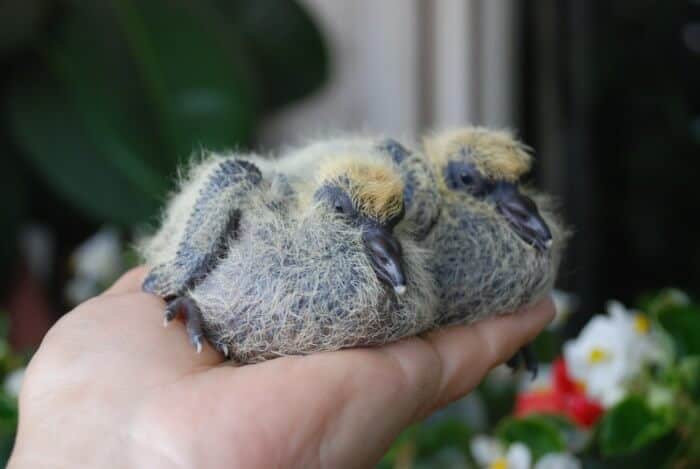
Utility King or Show King?
The two forms look alike but are bred for different jobs, and that changes how they behave in the loft.
| Utility King | Show King | |
|---|---|---|
| Bred for | Squab production; rearing other breeds’ young | Exhibition, judged to the King standard |
| Weight | About 750–850 g (White King, NSW DPI) | 30–37 oz, about 850–1,050 g (AKC) |
| Parenting | Prolific; the American King Club recommends Utility Kings (also called Hubbles) as foster parents | White show lines have lost much of their parenting ability; many breeders use foster pairs |
| Behaviour | Calm, used to handling | Mostly ground birds that walk more than they fly; can be aggressive to other pigeons but gentle with people (AKC) |
The University of Kentucky extension article on raising pigeons makes the general point: show types are usually larger, blockier and heavier than the utility breed they came from, and selection for show points has cost some of the original traits, such as careful feeding of young and fast breeding. A 2020 study in the journal Animals that compared Kings with carrier pigeons after three breeding seasons found the Kings had heavier, larger carcasses, and that their meat was harder and chewier.
Utility King and Show King weights
Ideal weights in the two NPA standards, in ounces with grams in brackets.
The Utility King standard treats weighing less than these figures as a serious fault. A reasonable amount over is accepted.
What the breed standard asks for
Judges score Kings out of 100 points. The table shows how the American King Club splits those points. A further 10 floating points can be cut for an unkempt bird or poor show manners, and another 10 for faulty colour.
| Feature | Points | What the standard wants |
|---|---|---|
| Weight | 8 | 30–37 oz, all ages |
| Legs | 10 | Straight and stout, 2⅝ in (6.7 cm) clearance under the keel; lower shanks beet red |
| Plumage | 10 | Close and smooth, with a little give in the hand |
| Head | 9 | Moderately large, broad, well-rounded skull |
| Breast | 8 | Prominent, broad, showing well beyond the wing butts |
| Body | 8 | Short, broad, firm and well-rounded |
| Keel | 8 | Straight, rocker-shaped, ending close to the vent |
| Wings | 7 | Held snugly, tips about 1 in apart |
| Beak | 5 | Short, stout, held horizontally |
| Neck | 5 | Stout, carried upright; cocks heavier than hens |
| Back | 5 | Short and broad |
| Tail | 5 | Short, carried at least 35° above horizontal |
| Eye cere | 4 | Perfectly round and fine |
| Eyes | 3 | Prominent, round and bright |
| Toes | 3 | Straight, clean, beet red |
| Wattle | 2 | Small, smooth, powdered |
The overall picture is a short, broad, upright bird. Cocks should look masculine and hens feminine, but as with most breeds you cannot reliably sex a pigeon by looks alone.
Where the points go: Show King and Utility King
Points out of 100 in each standard. Some features are grouped so the two scales line up.
- Show King
- Utility King
The Show King scale has no colour points. Coloured Show Kings can instead lose 1 to 10 points for faulty colour.
King pigeon colours
White is the classic King and still the largest class at shows. The standard describes it with a pinkish-white beak, dark “bull” eyes, a beet-red eye cere and pure white feathers. The American King Club recognises many other colour classes; each has its own description for beak, eye and plumage.

| Colour class | What it looks like (AKC description, shortened) |
|---|---|
| White | Pure white; pinkish-white beak; bull (dark) eyes |
| Red (recessive) | Rich horse-chestnut all over; orange eyes |
| Yellow | Dilute of recessive red: dark yellow all over |
| Black | Jet black with a green sheen on the neck |
| Dun | Dilute of black: gun-metal colour |
| Brown | Rich chocolate or cocoa; pearl eyes |
| Silver (brown bar) | Clear silvery blue with dark chocolate wing bars; pearl eyes |
| Blue | Sky blue with two black wing bars and a black tail bar |
| True silver bar | Dilute of blue: silvery grey with dark dun bars |
| Ash red bar | Ash grey with chestnut-red bars; no tail bar |
| Ash yellow bar | Dilute of ash red: light grey with yellow bars |
| Andalusian | Steel grey laced with black |
| Indigo bar and check | Steel grey with rust bars or rust checkering |
| Check class | Open checks, T-pattern checks and velvets |
| Grizzle, tortoiseshell, mottled | Peppered or spotted mixtures of white and colour |
| A.O.C. and rare colours | Any other colour, including almond, reduced, opal and milky |
Two names cause confusion. A “Silver King” in the AKC standard is genetically a brown bar bird, while the “true silver bar” is a dilute blue. AKC member Gary Smith explains that Kings have three base colours (ash red, blue/black and brown) and that white is not a colour at all but its absence, so a white bird still carries a hidden colour and pattern. Our pigeon colour genetics guide explains how these combine.

Breeding and lifespan
Kings breed like other domestic pigeons. The National Pigeon Association’s basic care notes give the timeline below; for squab production the University of Kentucky article adds that squabs are taken at 26 to 30 days, at about 500 g, and that 10 pairs can produce around eight squabs a month. Providing each pair with a second nest lets the hen lay again while the cock feeds the first pair of young.
Two problems come up again and again in Show Kings. The American King Club says white show lines have lost much of their parenting ability, so many breeders move King eggs under foster pairs (Utility Kings, Indian Mondains or Homers). The club also notes that fertility can be poor, especially in heavily inbred white lines, and recommends avoiding very close matings. Our guides on how long pigeon eggs take to hatch and the pigeon life cycle cover the general process.
There is no King-specific lifespan study. The US rescue Palomacy, which rehomes many Kings, tells adopters that pigeons and doves live 10 to 25 years, so a King is a long commitment. See how many years pigeons live for what affects lifespan.
Housing and care
Kings are heavy and do most of their living on the floor, so floor space matters more than height or perches. The American King Club suggests pens of 10 to 15 sq ft (0.9 to 1.4 m²) for each breeding pair, with 3 × 3 ft (0.9 × 0.9 m) as a minimum, or at least 12 sq ft (1.1 m²) per pair in a shared pen. Crowding makes them fight, get stressed and fall ill more often. Kings are poor nest builders, and a low nest site with suitable nesting material helps.
The general rules for any loft apply: keep it dry and well ventilated, protect the birds from cats, rats and hawks, and feed a mix of grains with pigeon grit. The University of Kentucky article recommends about 27 cubic feet (0.76 m³) of loft space per pair as a starting point.
Kings as pets, and why they must never be released
Kings are calm and used to people, and many end up as pets. Palomacy describes them as tame, gentle and well suited to living indoors or in an aviary. It also explains why they should never be “set free”: Kings are bred too heavy to fly well, have no survival skills, and their white plumage makes them easy prey for hawks, gulls and cats. Released Kings are usually killed by hawks, dogs, cats or cars, often within hours.
If you find a white, heavy pigeon walking about that will not fly off, it is probably a lost or dumped domestic bird. Contain it and contact a local pigeon rescue or vet rather than leaving it outside. The white “doves” released at weddings are usually homing pigeons trained to fly home, not Kings; see white dove releases.
King vs Carneau, Mondain and Runt
The four big utility breeds are often confused when birds are sold as “giant” or “meat” pigeons. The table uses figures from each breed’s standard.
| Breed | Weight | Origin | Main use today | Notes |
|---|---|---|---|---|
| King | Show 850–1,050 g; utility White King 750–850 g | USA, 1890s | Squab, exhibition, foster parents | Short, broad, upright; white is the most common colour |
| Carneau | Show 30–37 oz (850–1,050 g); utility 650–740 g | Northern France; shown as a breed at Lille in 1889 | Squab, exhibition | Taller standard (13¼ in); NSW DPI says it breeds less prolifically than the White King |
| French Mondain | Cocks 34–40 oz (960–1,130 g); hens 30–36 oz (850–1,020 g) | France | Squab, exhibition | Heaviest of the three squab breeds by standard |
| Giant Runt | No standard weight; can reach about 3.5 lb (1.6 kg) | Europe; standardised in the USA as the Giant Runt | Exhibition | The largest domestic pigeon; has been used for squab (NSW DPI) |
Compare the breeds, or check whether a King suits you
Pick two breeds to compare them side by side, or answer six quick questions to see whether a King fits the way you want to keep pigeons. The figures are the same sourced figures used on this page.
Frequently asked questions
How big is a King pigeon?
Show Kings should weigh 30 to 37 oz (about 850 to 1,050 g) and stand about 11¾ in (30 cm) tall under the American King Club standard. Utility White Kings are lighter, at about 750 to 850 g. Both are more than twice the weight of a wild rock pigeon.
Can King pigeons fly?
They can fly short distances, but they are too heavy to fly well or escape predators. Show Kings in particular are mostly ground birds. Kings should be kept in a loft, aviary or indoors and never released.
How long do King pigeons live?
There is no lifespan study for Kings specifically. Palomacy, a US rescue that rehomes many Kings, says pigeons and doves live 10 to 25 years in good care.
What is the difference between a Utility King and a Show King?
Utility Kings are bred to produce squab and are good parents. Show Kings are heavier, bred to the exhibition standard, and white show lines often need foster parents to rear their young.
What is a Silver King pigeon?
In the American King Club standard, a Silver King is a brown bar bird: clear silvery blue with dark chocolate wing bars and pearl eyes. The “true silver bar” King is a different colour, a dilute blue.
Are King pigeons good pets?
They are calm, tame and used to people, and rescues describe them as good indoor or aviary pets. They need floor space, daily care and a long-term home.
How many squabs does a pair of Kings produce?
The University of Kentucky extension article says 10 pairs of meat pigeons can produce about eight squabs a month, more if each pair has a second nest.
Where can I find King pigeon breeders?
Through the breed clubs: the American King Club in the US and the British King Club, listed by the National Pigeon Association in the UK. Rescues also rehome Kings that need pet homes.
Sources and how we checked
We read each source on 28 October 2026. Weights and measurements come from the breed standards themselves, not from sales listings. Where a figure exists only on Wikipedia it is marked as such. If you spot an error, please contact us.
- American King Club: King standard and articles (updated 2025) (opens in new tab)
- National Pigeon Association: Book of Standards (2025 PDF) (opens in new tab)
- Pigeoncote: King, NPA standard 1993 (opens in new tab)
- National Pigeon Association: Basic pigeon care information (Frank Mosca) (opens in new tab)
- Jacquie Jacob, University of Kentucky: Raising pigeons in small and backyard flocks (poultry.extension.org) (opens in new tab)
- NSW Department of Primary Industries: Squab raising, Primefact 601 (G. Bolla, 2007, PDF) (opens in new tab)
- Kokoszyński D. et al. (2020). Carcass characteristics… of carrier and King pigeons. Animals 10(8):1315 (opens in new tab)
- Palomacy: Gentle Kings need help to escape cruel fate (opens in new tab)
- Palomacy: Adoption contract (lifespan 10–25 years) (opens in new tab)
- National Pigeon Association (UK): Breed club list, including the British King Club (opens in new tab)
- South Carolina Encyclopedia: Palmetto Pigeon Plant (opens in new tab)
- Animal Diversity Web: Columba livia (opens in new tab)
- Avifede: Carneau history (French) (opens in new tab)
- Wikipedia: King pigeon (for the Australian standard and Levi citations) (opens in new tab)
About the author
Dan, founder of Pigeonpedia. Dan started Pigeonpedia in January 2020. More about Pigeonpedia.
Last updated 15 November 2026 · Types