
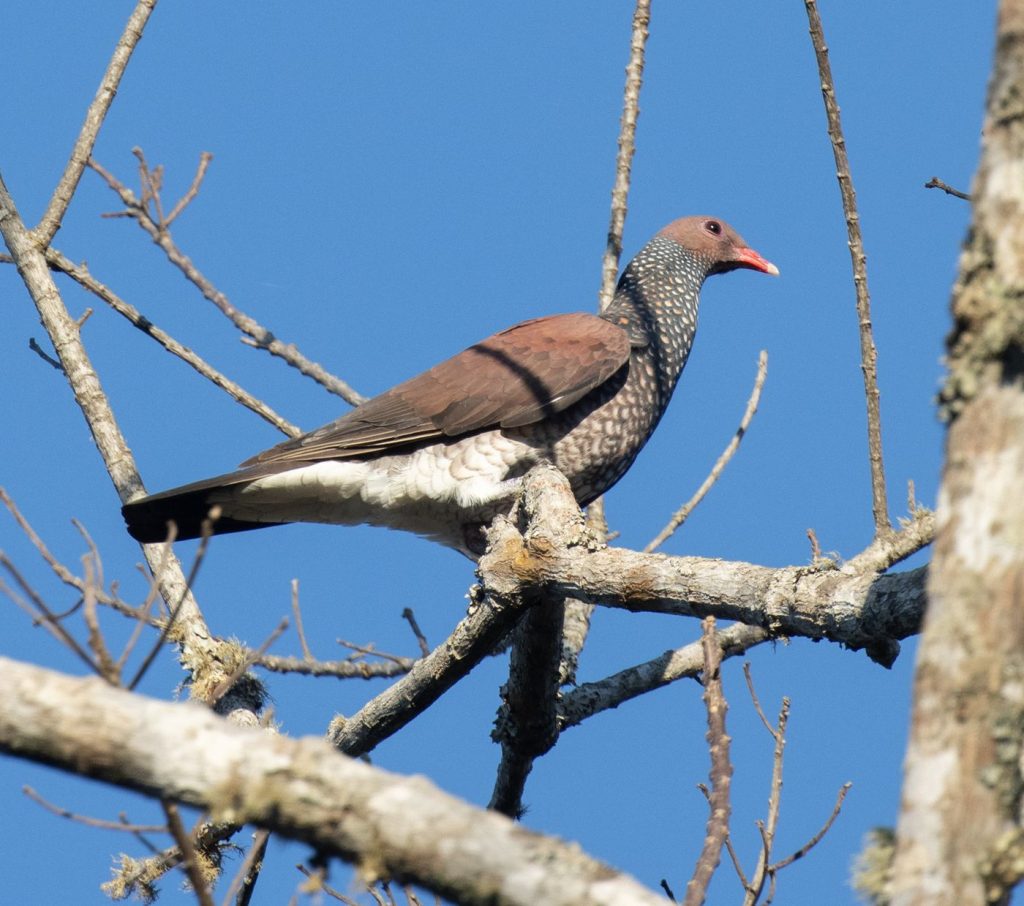
The scaled pigeon (Patagioenas speciosa) is a large forest pigeon of tropical America. Its name comes from the neck and breast, where each dark feather carries a pale spot, so the bird looks covered in small scales. A red bill with a pale tip and a red ring of skin around the eye complete the picture.
It lives from southern Mexico through Central America and much of South America to Paraguay, north-east Argentina and southern Brazil, and on the island of Trinidad. The IUCN Red List classes it as Least Concern.
Scaled pigeon at a glance
| Feature | Scaled pigeon |
|---|---|
| Scientific name | Patagioenas speciosa (Gmelin, 1789) |
| Other names | Paloma escamosa or paloma trocal in Spanish; pomba-trocal in Portuguese; pigeon ramiret in French |
| Range | Southern Mexico to Paraguay, north-east Argentina and southern Brazil; Trinidad |
| Habitat | Lowland moist forest, forest edges, clearings and second growth |
| Altitude | Sea level to 1,400 m, sometimes up to about 1,500 m |
| Length | 28–34 cm |
| Eggs | Usually 1, sometimes 2 |
| Chick leaves the nest | About 14–17 days after hatching |
| Population | 500,000–5,000,000 mature birds (estimate) |
| IUCN Red List | Least Concern (last assessed 2020) |
The IOC World Bird List (opens in new tab) (version 15.2) recognises no subspecies. The altitude and population figures come from BirdLife International (opens in new tab). We could not find a weight from a reliable source, so none is given here.
How to identify a scaled pigeon
The scaled pigeon is about the size of a town pigeon but longer in the tail. The Online Guide to the Animals of Trinidad and Tobago gives its length as 28 to 34 cm, and the Smithsonian Tropical Research Institute’s Bocas del Toro species database gives 30 to 33 cm. Look for these features:
- Dark feathers with white or buff spots on the neck, upper back, throat and breast, which make the scaled pattern
- A purplish or reddish-brown head
- Reddish-brown back and wings, and a dark brown tail
- A bright red bill with a pale, cream or yellowish tip
- A red ring of bare skin around the eye, and red legs
- A whitish belly, with the feathers edged in purple
The eBird species account (opens in new tab) describes the male as ruddy brown overall and the female as grey-brown, with less colour. In flight, the whitish belly stands out against the blackish underside of the tail. Young birds are duller than adult males and have plain brown backs and wings.
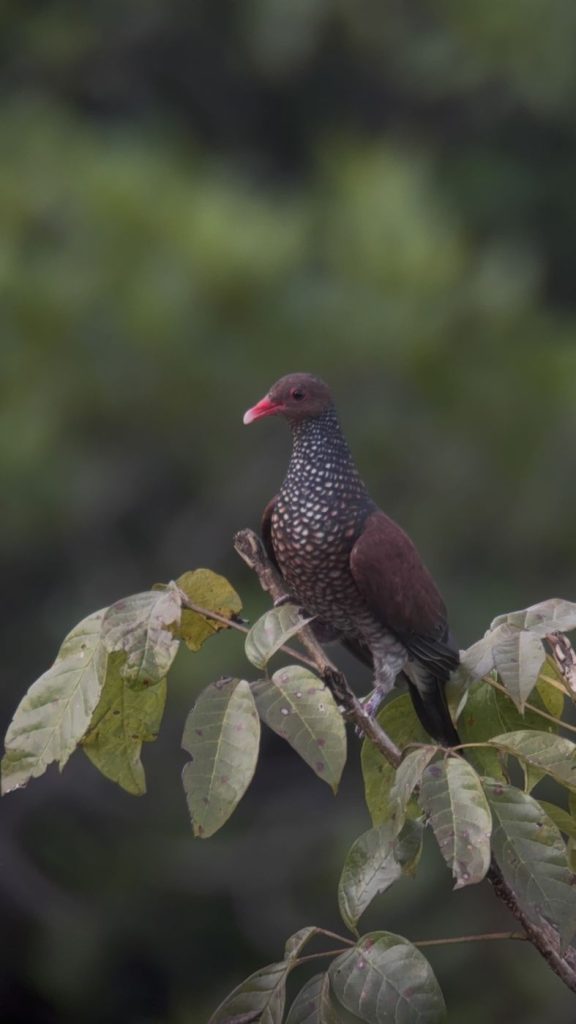
Most sightings are of birds flying high over the forest or perched in the canopy. Birds of the World notes that scaled pigeons often sit on bare, exposed branches, which makes them easier to find than many forest pigeons.
Scaled pigeon or a similar bird?
Several American pigeons share its range or its name. These are the ones most likely to cause confusion:
- The pale-vented pigeon (Patagioenas cayennensis) lives in the same lowlands from Mexico to Argentina. It has a grey head, a pale grey vent and a black bill, and no scaled pattern on the neck.
- The picazuro pigeon (Patagioenas picazuro) of central and southern South America has shiny black scaled feathers on the neck as well, but it has a pinkish head, a bluish-grey body and white bands on the wings.
- The scaly-naped pigeon (Patagioenas squamosa) is a Caribbean island species. Only the nape is scaled, and the rest of the bird is dark slate grey with a purple-red head and neck.
- The scaled dove (Columbina squammata) is a small ground dove of dry savanna and scrub. Its scaled look comes from dark edges to grey-brown feathers, and it feeds on the ground, where a scaled pigeon rarely goes.
Where scaled pigeons live
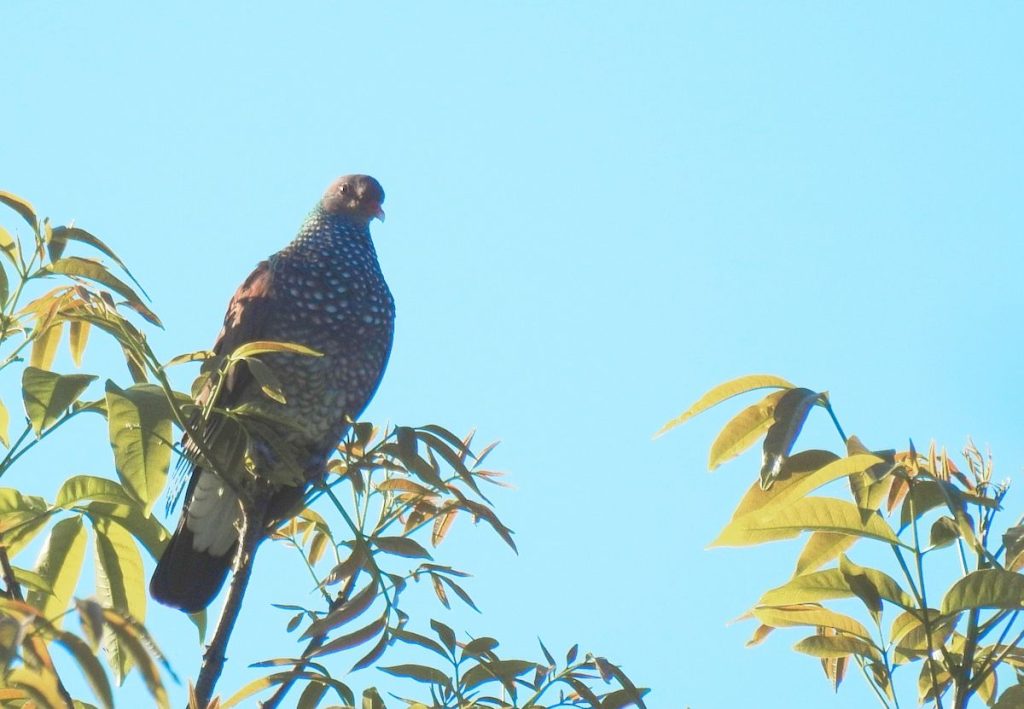
The IOC list gives the range as southern Mexico to southern Brazil. BirdLife International lists the scaled pigeon as a native resident in 19 countries and territories, from Mexico, Guatemala and Belize through Central America to Colombia, Venezuela, the Guianas, Ecuador, Peru, Bolivia, Brazil, Paraguay and Argentina, and Trinidad and Tobago. It is not a migrant. On Trinidad it is found mostly over the Northern Range, and it does not occur on Tobago.
In Brazil, the scaled pigeon lives in forests over most of the country but is rare or absent in the far south and in most of the dry north-east. A 2023 paper in the Bulletin of the British Ornithologists’ Club, citing the Brazilian ornithologist Helmut Sick, notes that the Atlantic Forest population is separated from the birds of the Cerrado and the Amazon.
BirdLife rates tropical moist lowland forest as its main habitat, with moist montane forest and dry savanna as suitable habitats. In practice it uses forest edges, clearings with tall trees, second-growth woodland and savanna with scattered trees, as well as closed forest. Most birds live below 1,400 m, though there are records up to about 1,500 m.
What scaled pigeons eat
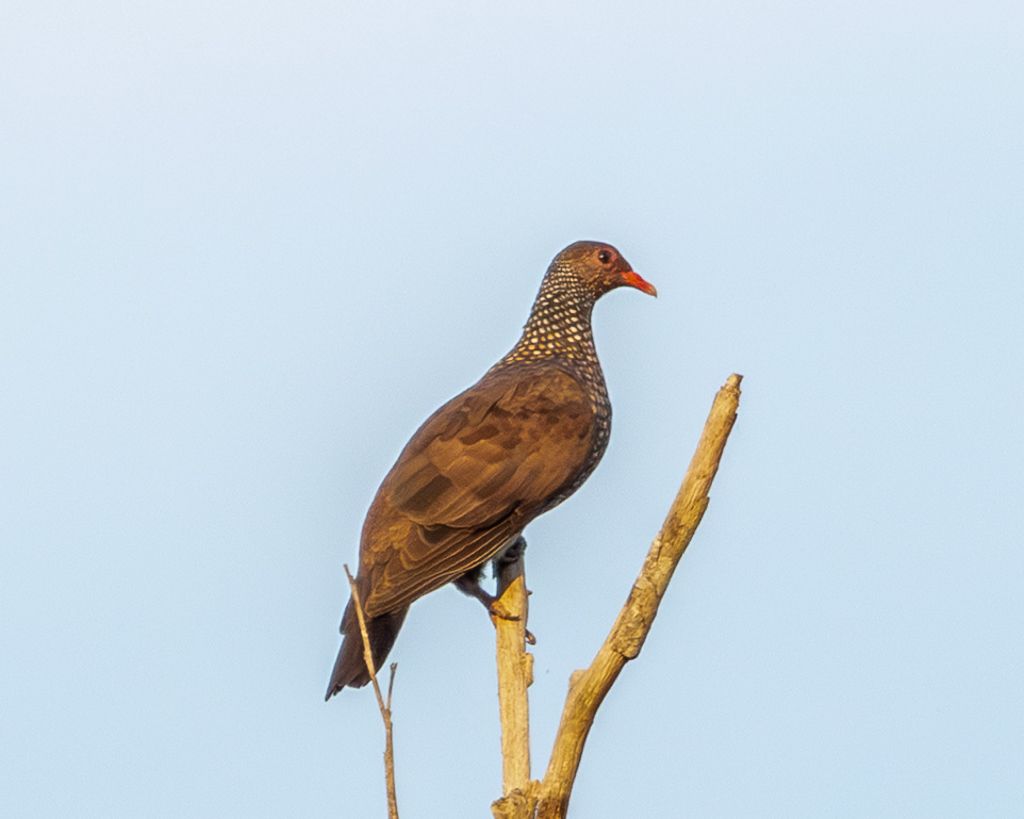
The scaled pigeon is a fruit eater of the treetops. The Trinidad and Tobago guide says it feeds on fruit and berries in the canopy and only rarely comes down to the ground for food it has dropped. Fresh green leaves and sometimes crops have also been recorded. The Smithsonian’s Bocas del Toro database describes the diet as forest fruits and seeds.
Nobody has published a detailed list of the plants it eats across its whole range. For what town and farm pigeons eat, see what pigeons eat.
Breeding
Published nesting records for the scaled pigeon are scattered and few. A 2023 study by Anita Studer and Marco Aurélio Crozariol described two nests in Alagoas, north-east Brazil, and gathered the earlier records from across the range. Their summary shows no single breeding season: the dates differ from one region to the next.
Months with published nesting records
Filled cells mark months in which nests or nest building have been reported. The dates come from a review of earlier records, plus two nests found in Alagoas in April.
The July mark for Central America is a single record of nest building. The chart shows the months as published; it is not a full calendar of the breeding season.
Both members of the pair bring sticks to build the nest, a loose platform resting on a tangle of vines or branches. The two nests in Alagoas measured 28 and 30 cm across. Some nests are so flimsy that they barely hold the eggs, and eggs have been seen to fall out.
Although the birds feed high in the canopy, many nests are built lower down, and nest height varies a lot from place to place:
How high published nests were found
Height above the ground, in metres, from records gathered by Studer and Crozariol (2023). Longer bars show a range of heights from one region.
In Venezuela, nests have even been found on the ground, and in Costa Rica and Venezuela some were built in bracken in recently cleared areas.
Eggs and chicks
A single white egg is the usual clutch. In Ecuador, Trinidad and central Brazil, nests with two eggs seem to be common (see how many eggs a pigeon lays). The two eggs measured in Alagoas were 37.7 × 25.6 mm and 35.8 × 24.9 mm. The incubation period has not been worked out.
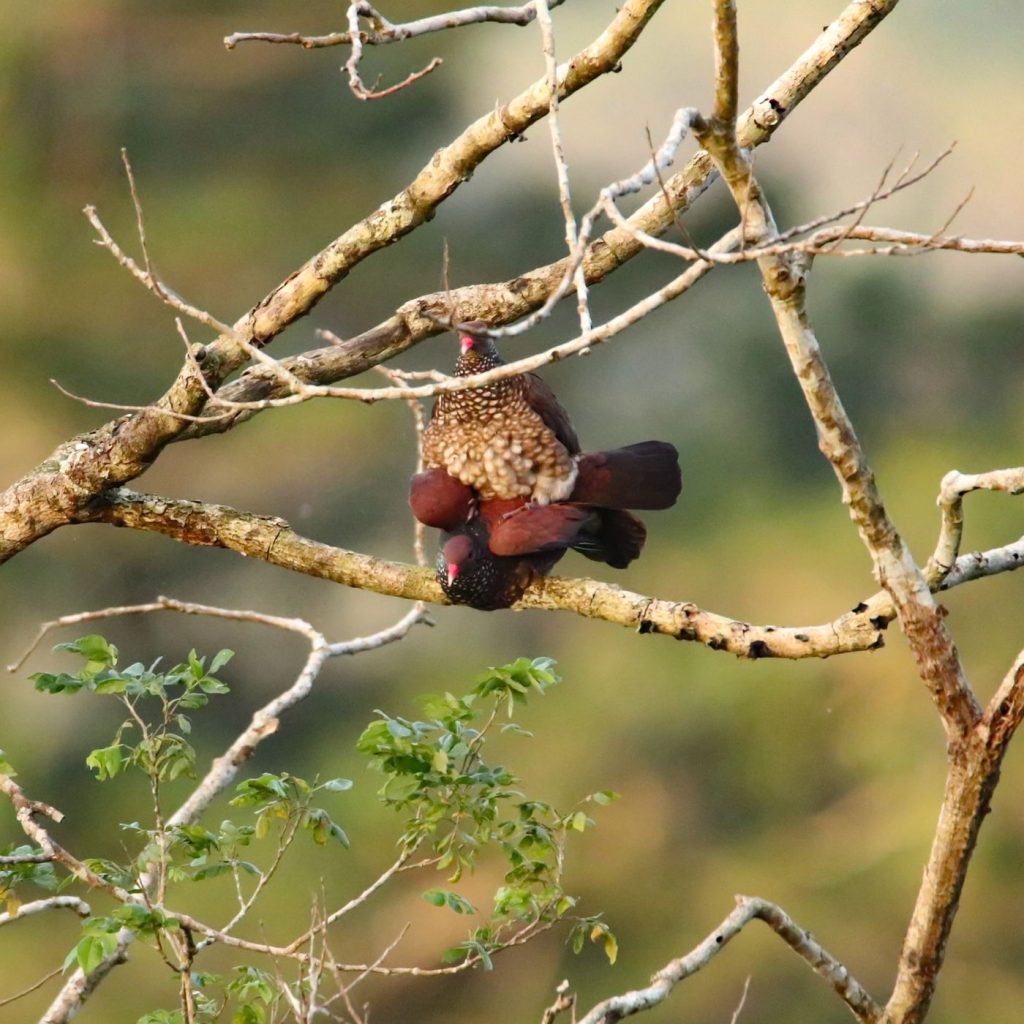
The chick hatched with dense, pale grey down, a black bill and black legs. Both parents fed it, and it left the nest after 14 days, the same period recorded in Costa Rica. Other sources give 15 days in Venezuela and 16 to 17 days. At one nest, the researchers watched the pair greet each other at the nest by opening their wings and preening each other’s neck before the male took over brooding.
Behaviour
Scaled pigeons are usually seen alone or in pairs. Birds flying long distances may travel in groups of three or four. Flocks of up to 100 have been reported, though the Trinidad and Tobago guide, citing a field guide to northern South America, says such flocks are very rare.
The species is wary, which the same guide links to hunting: people hunt it for food in parts of its range.
Population and conservation
BirdLife International assessed the scaled pigeon as Least Concern on the IUCN Red List in 2020, and every assessment since 1988 has placed it in the lowest risk category.
IUCN Red List assessments of the scaled pigeon
Every assessment since 1988 has put the species in the lowest risk category.
Partners in Flight estimate the population at 500,000 to 5,000,000 mature birds, but BirdLife rates the quality of that estimate as poor.
The population is thought to be falling slowly. Between 2000 and 2012, about 5% of the forest inside its range was lost, and BirdLife puts the likely decline at under 10% over three generations (11.7 years), too slow for a threatened category. BirdLife also records scaled pigeons being kept as pets and taken for local use.
In Mexico, at the northern edge of its range, the species is listed in the official NOM-059 list as sujeta a protección especial (under special protection). For pigeons and doves that are at risk worldwide, see are pigeons endangered.
Seeing a scaled pigeon
Look along forest edges and in clearings with tall trees, and check bare branches at the top of the canopy. Many sightings are of birds flying high over the trees, so the pale belly and dark tail are often the first things you see. In Trinidad, the forested Northern Range is the place to look.
Scaled pigeon nests are fragile, and many are built low enough to disturb by accident. Watch from a distance and don’t approach a nest.
For other wild pigeons of the Americas, see the types of pigeon guide and the guides to the band-tailed pigeon, the bare-eyed pigeon and the eared dove.
Name and history
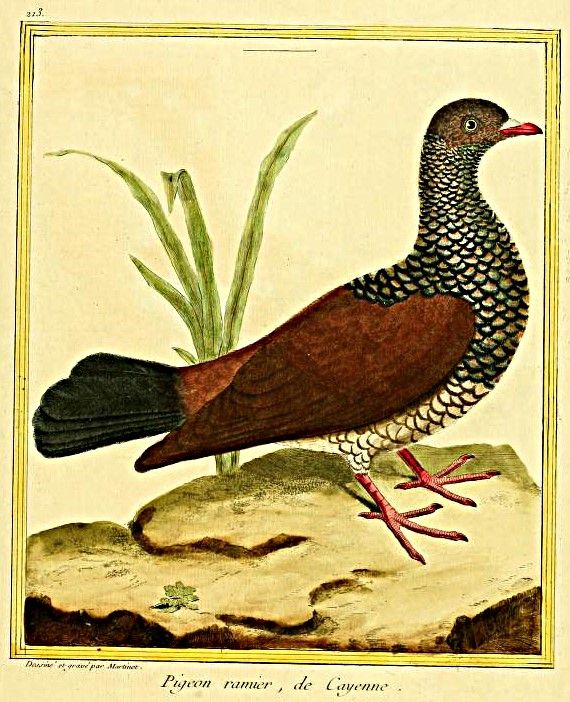
The German naturalist Johann Friedrich Gmelin named the species Columba speciosa in 1789, in his edition of Linnaeus’s Systema Naturae. He based it on the bird that Buffon called “le ramiret” and on the hand-coloured plate of the “pigeon ramier de Cayenne” in the Planches enluminées, so the type locality is Cayenne in French Guiana. Speciosa is Latin for “beautiful”.
The species was later moved from Columba to Patagioenas, the genus for most American pigeons, after a 2001 DNA study showed that the American pigeons form a separate group.
Frequently asked questions
Where does the scaled pigeon live?
In tropical forests from southern Mexico through Central America to Paraguay, north-east Argentina and southern Brazil, and on Trinidad. Most birds live below 1,400 m.
Why is it called the scaled pigeon?
The dark feathers of its neck and breast have pale spots, which give the bird a scaly look. The species name speciosa means “beautiful”.
Is the scaled pigeon the same as the scaled dove?
No. The scaled dove (Columbina squammata) is a small ground dove of dry country in South America. The scaled pigeon is a large forest pigeon that spends most of its time in the treetops.
How can you tell a male from a female?
Males are ruddy or purplish brown, while females are greyer or duller brown and their scaled pattern is less bold. Both have a red bill with a pale tip.
How many eggs does a scaled pigeon lay?
Usually one white egg. Nests with two eggs seem to be common in Ecuador, Trinidad and central Brazil.
Is the scaled pigeon endangered?
No. It is listed as Least Concern, with an estimated 500,000 to 5,000,000 mature birds. Forest loss is causing a slow decline, and Mexico lists it as a species under special protection.