
The Donek (Turkish dönek) is a flying pigeon from Turkey, kept for the way it comes down from the sky. When the owner signals from the ground, a Donek folds its wings, dives and spins around its own body on the way down, like a falling propeller.
On the ground it looks like a plain, medium-sized pigeon with a long body. Most Turkish birds have no crest and no feathers on the feet, and many have a white head, white flight feathers and a white tail. The breed is flown mainly in western Turkey, and related lines are kept in the Balkans.
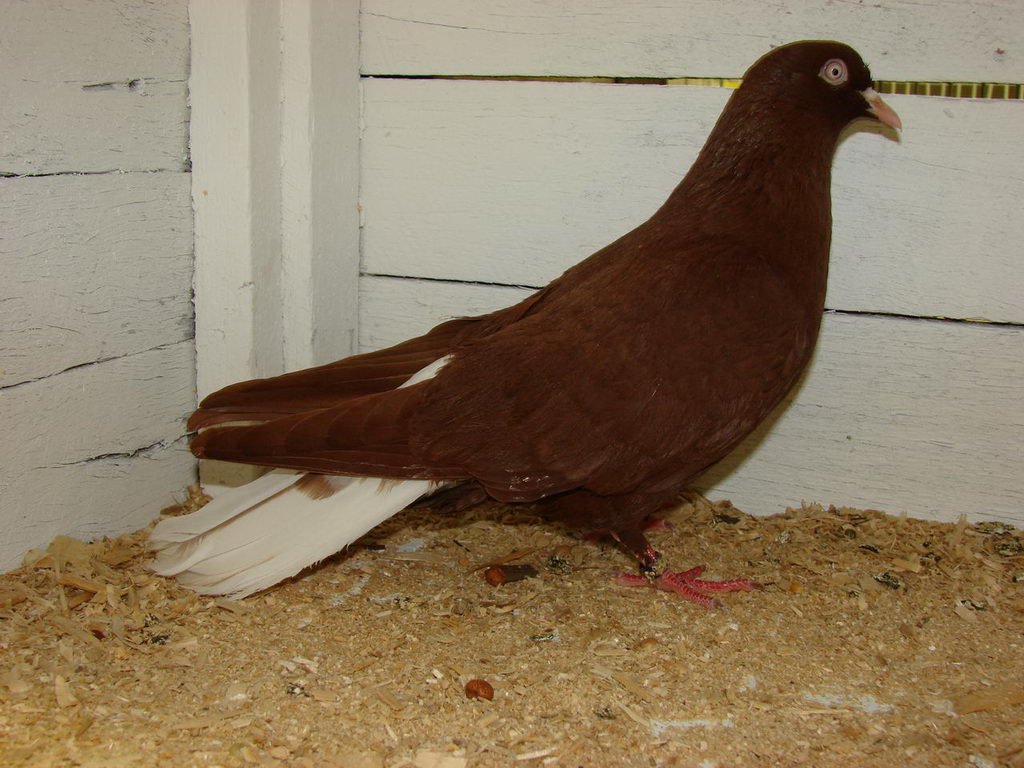
Donek pigeon at a glance
| Feature | Donek |
|---|---|
| Other names | Dönek; Dunek; Selanik and Muradiye (local names in Turkey); Macedonian Dunek (European list) |
| Origin | Turkey; related lines in North Macedonia, Kosovo and Greece |
| Kind | Flying breed: a diver that spins as it drops |
| Main areas in Turkey | Balıkesir, Bursa, Denizli, İzmir and Edirne |
| Head and feet | Round head, no crest, no foot feathers (Turkish birds) |
| Tail | Usually 14 feathers |
| Weight | About 320 g on average (Muradiye study) |
| Wingspan | About 68 cm on average (Muradiye study) |
| European list | Macedonian Dunek, no. 1029, tumblers and highfliers group, 7 mm ring |
The weight and wingspan come from a 2021 study of 100 Muradiye Döneks by Özbaşer and colleagues, described below. They describe one local population, not a show standard.
Where the Donek comes from
The name comes from the Turkish verb dönmek, “to turn”. A 2012 review of Turkish pigeon breeds (opens in new tab) by Orhan Yılmaz and M. Akif Boz lists the Dönek as a diving and spinning breed. It gives Selanik and Muradiye as local names and says the breed is kept mainly around Balıkesir, Bursa, Denizli, İzmir and Edirne. Selanik is the Turkish name for Thessaloniki in Greece, and Muradiye is a district of Balıkesir.
Turkish fanciers sort Döneks by region, build and spinning style, and the 2021 study names the Dolapçı and the Selanik Dönek as varieties. Some breeders treat the Dolapçı as a breed of its own.
The breed also spread through the Balkans. The European breed list (EE list, 2018 revision) has no Turkish entry for the Dönek, but it includes the Macedonian Dunek as no. 1029 in its tumblers and highfliers group, with a 7 mm ring. In Kosovo, breeders in Prishtina developed their own line, the Prishtina Roller or Dunek. According to the Yugoslav book Golubovi novije rase (Modern Breeds of Pigeons), it was bred from the Oriental Roller and received a standard from the Yugoslav federal commission in 1981.

How a Donek flies
Döneks climb quickly once let out. The dive starts when the owner shows a signal from the ground, the pırıltı (“shine”). Yılmaz and Boz describe it as a white pigeon held up in the owner’s hand. The 2021 study adds that anything that catches the bird’s eye, such as a female pigeon or a shiny spinning object, can set off the dive.
The Donek’s dive, step by step
The bird then closes its wings and drops. On the way down it beats the wings once or more around the axis of the tail, so the whole bird rotates like a propeller. Wing position varies from bird to bird. Some hold the wings tight to the body, many keep them about a quarter open, and a few spread them wide.
Turkish breeders judge a Donek by how long and how fast it spins. They also look for a clean dive at about 45 degrees to the ground and say that a steeper or flatter line spoils the spin. Seen from the side, each turn is separate and easy to count. This is the main difference from a Birmingham Roller, whose rolls run together, and from a tumbler, which turns somersaults.
Donek, Dolapçı, rollers and tumblers
Several Turkish and European flying breeds turn in the air, and their names are easy to mix up.
| Breed | Where it is kept | What it does in the air |
|---|---|---|
| Donek | Western Turkey; Balkans | Dives at about 45 degrees and spins around its own body |
| Dolapçı | Turkey | Dives in tight, fast spirals with the wings fully open, without the Donek’s long propeller spin |
| Prishtina Roller (Dunek) | Kosovo | Rolls in a closed circle with half-spread wings at about 45 degrees |
| Birmingham Roller | Britain, then worldwide | Drops in a fast series of backward rolls and rejoins the flock |
| Oriental Roller | Middle East, then Britain and the US | A roller with its own flying and show standards |
| Turkish Takla | Turkey | A tumbler: turns somersaults and claps its wings in low flight |
For more breeds that turn somersaults or rolls in flight, see the tumbler pigeons guide and why tumbler pigeons tumble.
What a Donek looks like
A Donek is a medium-sized pigeon with a long body, a fairly long beak and short legs, so it stands almost level with the ground. The wings rest on top of the tail. Birds raised in Turkey have no crest and no muffs. Breeders say that Döneks with feathered feet, which have become more common in recent years, are crosses with Macedonian birds.
Colours and marks in 100 Muradiye Döneks
Share of birds in a 2021 study of 100 Döneks from Muradiye, Balıkesir. All had a white head, white flight feathers and a white tail; the colour named is the rest of the body.
The best measured data come from the Muradiye Dönek. Fatma Tülin Özbaşer and three colleagues examined 100 birds (50 males and 50 females) from seven lofts in the Muradiye district of Balıkesir between February 2018 and March 2019 and published the results in the Ankara University veterinary faculty journal (opens in new tab) in 2021. All the birds had a round head with no crest and no foot feathers. Three quarters had 14 tail feathers and the rest had 13. The beak and nails were usually light yellow.
Colours and local names
Every bird in the Muradiye study had a white head, white flight feathers and a white tail, with the rest of the body black, red or blue. Local breeders call this pied pattern galaça. Around İzmir, a bird with a white head and white flights but a coloured tail is called a baska. Breeders also have names for small marks:
- Zikir: black spots on a yellow beak or on the nails
- Bıyık (“moustache”): black feathers among the white ones on the head
- Kemer (“belt”): black feathers in the white tail
- Tekir (“tabby”): grey feathers mixed into black body plumage
The study recorded eye colour as black in 60% of birds, blue in 25% and white in 15%. The wing patterns were T-check, checker and barless. None of the birds had bars.
Size
The Muradiye birds weighed 319.7 g on average. Males averaged 333.1 g and females 306.3 g. The average wingspan was 67.6 cm (68.7 cm in males and 66.5 cm in females), and the average body length was 35.1 cm. The authors class the Muradiye Dönek as a medium-sized breed. They also compared their figures with earlier studies of other Turkish breeds:
Average wingspan of Turkish breeds
Figures as reported in the Muradiye Dönek study, which compared its own measurements with earlier studies of other breeds. The Edremit Kelebek figure is for males.
The authors think breeders have selected these birds for their performance in the dive. They suggest the Muradiye Dönek could be recognised as a separate breed, but they say DNA studies are needed to confirm it.
Keeping Döneks
The Donek is a performance breed, and the spin is the reason people keep it. Birds need a loft they can be let out from every day, open sky above, and enough training to climb and to answer the signal. A Donek kept in an aviary will never show what it was bred for.
Spinning belongs in the air. A pigeon that spins on the ground, twists its neck or cannot fly straight is ill, not performing. These are typical signs of pigeon paramyxovirus, so isolate the bird and contact an avian vet.
Frequently asked questions
What does dönek mean?
Dönek comes from the Turkish verb dönmek, “to turn”. It describes the way the bird spins as it dives.
Is the Donek a tumbler or a roller?
Neither, strictly. Turkish writers class it as a diver that spins. A tumbler turns somersaults, and a roller turns a fast series of backward rolls. A Donek dives at an angle and rotates around its own body, and each turn can be seen separately.
How big is a Donek pigeon?
In the 2021 study of 100 Muradiye Döneks, the average bird weighed about 320 g and had a wingspan of about 68 cm. Males were heavier than females.
Where are Döneks kept?
Mainly in western Turkey, especially around Balıkesir, Bursa, Denizli, İzmir and Edirne. Related lines are kept in North Macedonia, Kosovo and Greece.
Is the Macedonian Dunek the same as the Turkish Dönek?
They are close relatives. The European list recognises the Macedonian Dunek, and Turkish breeders say that Döneks with feathered feet are crosses with Macedonian birds, while Turkish lines have clean feet.