
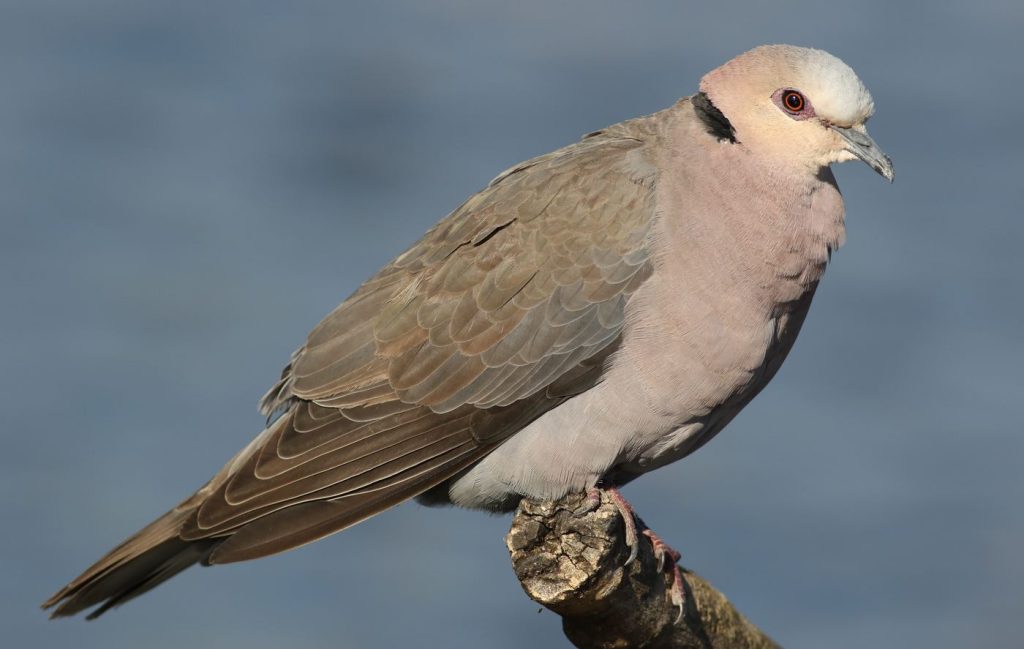
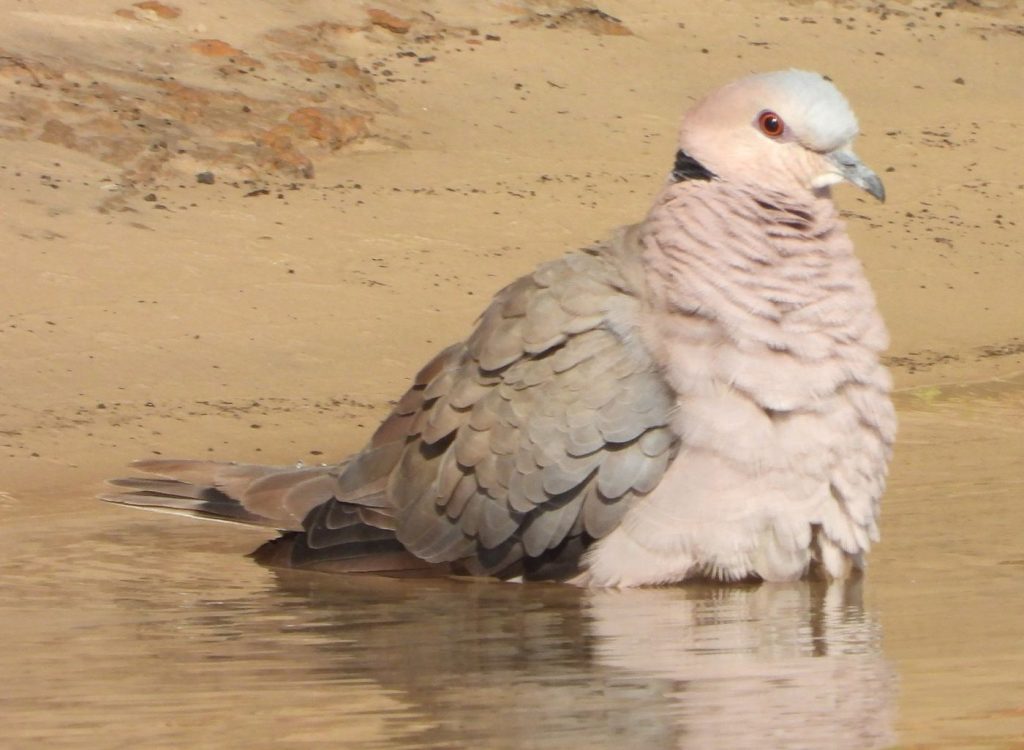
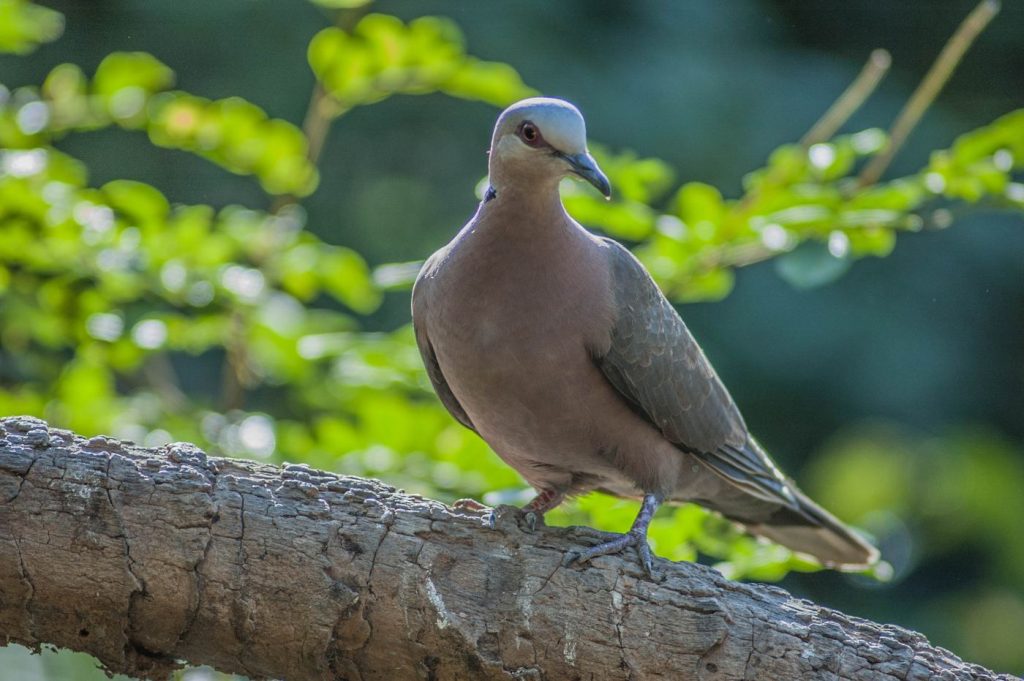
The red-eyed dove (Streptopelia semitorquata) is the largest of Africa’s “ringneck” doves, the group of brownish doves with a black half-collar on the back of the neck. A dark red eye set in a ring of bare red skin, a pale grey forehead and a deep pinkish head and breast set it apart from its smaller relatives.
It lives across most of Africa south of the Sahara and in south-west Arabia, and it is common in gardens, parks and farmland as well as woodland near water. The IUCN Red List classes it as Least Concern.
Red-eyed dove at a glance
| Feature | Red-eyed dove |
|---|---|
| Scientific name | Streptopelia semitorquata (Rüppell, 1837) |
| Other names | Half-collared dove; grootringduif in Afrikaans; hua fifi in Swahili |
| Range | Africa south of the Sahara; Saudi Arabia and Yemen |
| Habitat | Woodland and tall trees near water, plantations, parks and gardens; absent from deserts |
| Altitude | Sea level to 2,530 m |
| Length | About 30 cm |
| Weight | 162–310 g |
| Eggs | 1 or 2 |
| Incubation | 14–17 days, by both parents |
| IUCN Red List | Least Concern (last assessed 2024) |
The IOC World Bird List (opens in new tab) (version 15.2) recognises no subspecies. The weight range is from the Mpala Research Centre field guide in Kenya, and the altitude range is from BirdLife International.
How to identify a red-eyed dove
The red-eyed dove is a stocky, medium-sized dove. The eBird species account (opens in new tab) calls it the largest and stockiest of the ringneck doves. Look for these features:
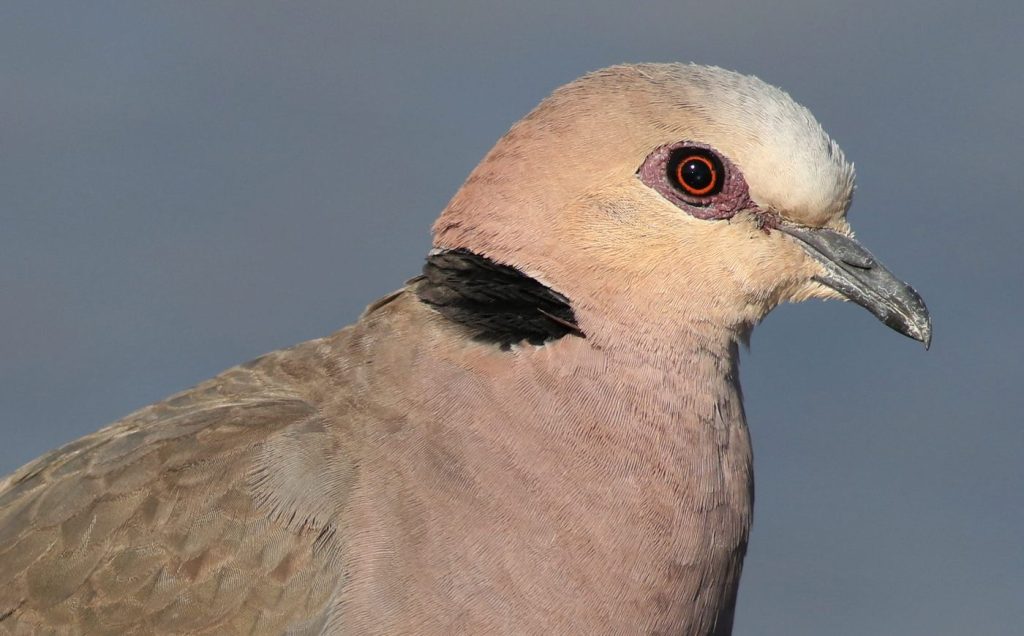
- A dark red eye surrounded by red or purplish-red bare skin
- A pale grey forehead and crown, fading into a pinkish face
- A deep pinkish-mauve neck and breast
- A black half-collar on the back of the neck
- Grey-brown back, wings and tail
- Red legs and a black bill
Males and females look alike. Young birds are duller and browner, with pale scalloped edges to the body feathers and only a faint collar.
The song
The call is the easiest way to find one. It is a loud six-note coo, usually written as “I AM the red-eyed dove”, with the stress on “AM”. The Mpala Research Centre notes that the birds call in the morning and at sunset, and sometimes on moonlit nights. For the sounds other pigeons and doves make, see what sound a pigeon makes.
Red-eyed dove or a similar dove?
Several ringneck doves share the black half-collar, so check the eye, the size and the tail.
- The ring-necked dove or Cape turtle dove (Streptopelia capicola) is smaller and greyer, with a dark eye and no obvious bare skin around it. In flight it shows broad white tips and sides to the tail. Its song is a three-note “work HAR-der”.
- The mourning collared dove or African mourning dove (Streptopelia decipiens) has a grey head and a yellow eye inside red skin, with white in the outer tail. Its song is often written “look AT me”.
- The African collared dove (Streptopelia roseogrisea) is much paler and is a bird of dry scrub along the southern edge of the Sahara and in Arabia.
- The laughing dove (Spilopelia senegalensis) is much smaller, with a speckled patch on the front of the neck rather than a black half-collar.
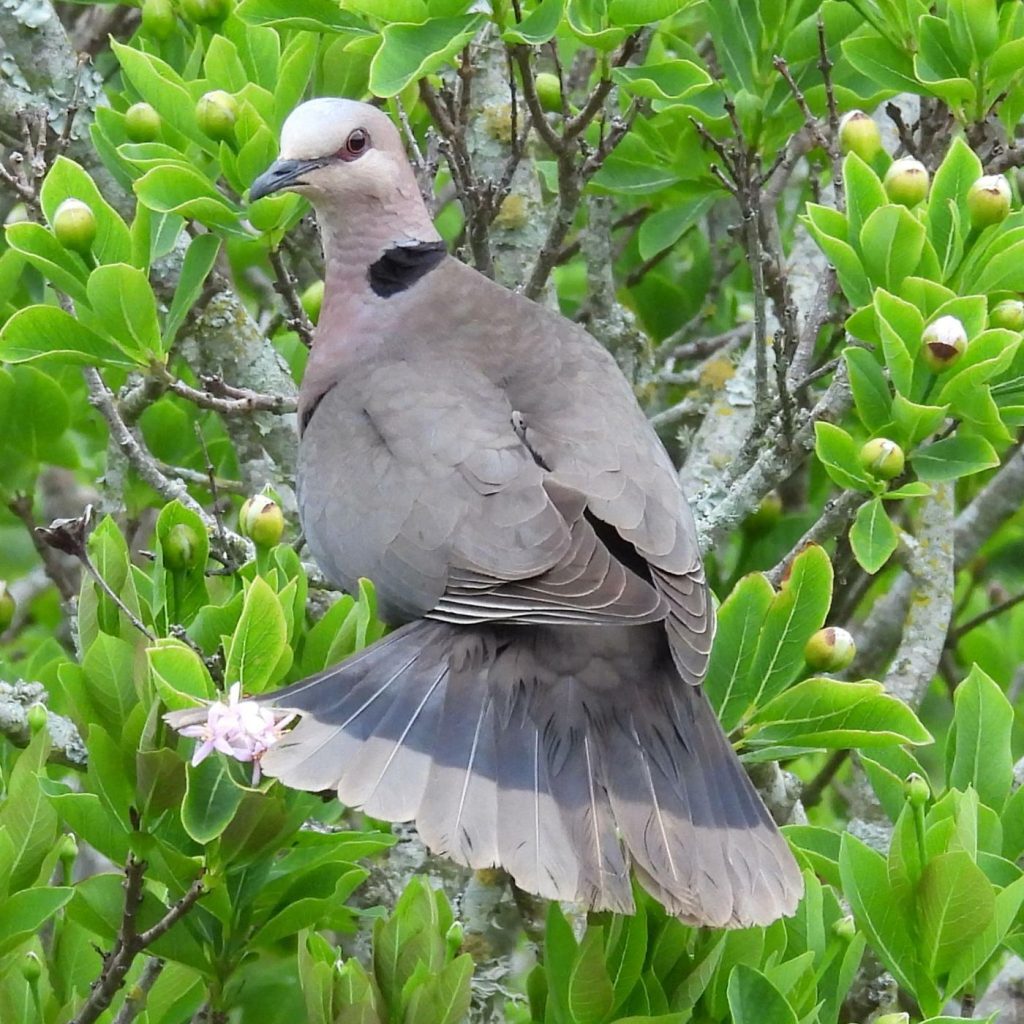
In flight, the red-eyed dove’s tail has no white. The base of the tail is dark grey and the outer half is a paler brownish grey, so the tail looks banded when it is spread. This pattern is a good way to tell it from a ring-necked dove at a distance.
The pet ringneck dove or Barbary dove is a domesticated form of the African collared dove, not of either wild species above.
Name and history
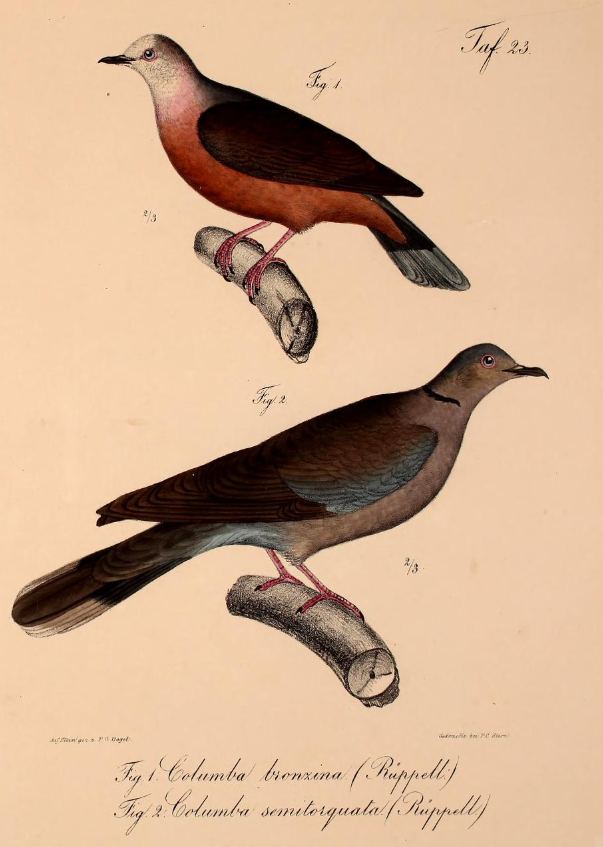
The German naturalist Eduard Rüppell described the species as Columba semitorquata in his book on the animals of Abyssinia, Neue Wirbelthiere zu der Fauna von Abyssinien gehörig. Birds of the World gives the type locality as the Taranta Mountains. The species name means “half-collared”, after the black band that only goes part of the way round the neck. In Afrikaans the bird is called grootringduif, “big ring dove”.
Where red-eyed doves live
The IOC list gives the range as widespread south of the Sahara, plus Saudi Arabia and Yemen. BirdLife International (opens in new tab) lists it as native in 44 countries, from Senegal and Mauritania in the west to Ethiopia and Somalia in the east and south to South Africa and Lesotho, and estimates the area of its range at about 26 million km². It does not occur in Madagascar.
Tall trees near water are the main thing the species needs. The account by B. D. Colahan in the first Southern African Bird Atlas Project (SABAP1, 1997) says it favours riverside woodland, forest edges and other well-wooded country, and that it occurs widely in suburban parks and gardens. In the dry Karoo it keeps to rivers, especially the Orange River. Around the Okavango Delta and in Zimbabwe it often nests over water, in swamp plants or reeds.
The same account says the species has spread considerably in southern Africa since about 1920, mainly because people planted trees and built artificial watering points. In South Africa it now uses plantations of pine, eucalyptus and Australian acacias such as rooikrans and Port Jackson willow. It is still largely absent from the arid Northern Cape.
Which habitats suit it best
The SABAP1 atlas recorded red-eyed doves in 2,178 of its grid cells across southern Africa, with 60,890 records. How often observers reported the species in each type of vegetation shows its liking for wetter, well-wooded country:
How often red-eyed doves were reported, by vegetation type
Reporting rate in the first Southern African Bird Atlas Project: the percentage of atlas checklists from each vegetation type that recorded the species. 12 of the 19 types in the atlas are shown.
Most red-eyed doves stay in one area. Of 50 ringed birds later found again in southern Africa, 49 were less than 80 km from where they had been ringed. Seasonal movements have been reported further north in Africa.
What red-eyed doves eat
Red-eyed doves feed mainly on the ground, often under trees, and usually in the early morning and late afternoon. The Biodiversity Explorer site of Iziko Museums of South Africa, drawing on Roberts Birds of Southern Africa, lists the food recorded in their diet:
- Seeds of crops, including sorghum, maize, millet, cowpeas and sunflowers
- Seeds of grasses, castor oil plant and acacias
- Fruits such as mulberry and pigeonwood (Trema orientalis)
- Flowers of trees such as the broad-leaved coral tree
- Bulbs of nut grass, groundnuts, and discarded apple pulp at juice factories
- Now and then insects and other small animals, such as termites and millipedes
Feeding on sunflower and other grain crops means farmers sometimes treat it as a pest. For the diet of town and farm pigeons, see what pigeons eat.
Breeding
In southern Africa, red-eyed doves lay eggs in every month of the year, with a peak from September to January. The SABAP1 account notes that the season is less distinct further north.
The male collects twigs and grass and the female builds the nest, a shallow bowl of twigs lined with grass, usually in a tree. Sometimes the pair takes over an old nest built by a crow, a thrush or an egret.
From nest to first flight
The female lays one or two eggs, as most pigeons and doves do (see how many eggs a pigeon lays). Both parents incubate. The chicks leave the nest 15 to 20 days after hatching.
Predators
Recorded predators include the African python, several sparrowhawks and goshawks, and the peregrine and lanner falcons.
Population and conservation
BirdLife International assessed the red-eyed dove as Least Concern on the IUCN Red List in 2024, and every assessment since 1988 has placed it in the lowest risk category. Nobody has counted the world population, but it is described as common to abundant across much of its range. A 1994 estimate put the number in Eswatini alone at about 20,000 birds.
BirdLife does suspect a slow decline. Tree cover inside the species’ mapped range fell by about 10.1% over three generations (about 13 years, at a generation length of 4.4 years), so it suspects that the population has fallen by between 1% and 19% over the same period. The species also turns up in the wild bird trade, in three of seven trade datasets that BirdLife reviewed.
Iziko’s Biodiversity Explorer says the species has benefited greatly from human changes to the land. Its numbers in the south-western Cape fell from the mid-1600s to about 1900 and then recovered, and the planting of trees in towns and on farms opened up new habitat. For pigeons and doves that are at risk, see are pigeons endangered.
Seeing a red-eyed dove
In much of its range the easiest place to find one is a leafy garden or park with tall trees and water nearby. Listen first, because the six-note song carries a long way. Red-eyed doves readily visit gardens, and the Biodiversity and Development Institute includes the species in its guide to birds seen at garden feeders in Cape Town. Watch from a distance and don’t disturb nests.
For other wild pigeons and doves, see the types of pigeon guide, which includes the spotted dove and the Eurasian collared dove.
Frequently asked questions
Why is it called the red-eyed dove?
Its eye is dark red and sits in a ring of red or purplish-red bare skin, which shows well against the pale grey forehead. Several pigeons have orange or red eyes (see why pigeons have red eyes), but among Africa’s ringneck doves this one stands out for it.
Where does the red-eyed dove live?
Across most of Africa south of the Sahara, from Senegal to Ethiopia and south to South Africa, and in south-west Arabia (Saudi Arabia and Yemen). It avoids deserts and needs tall trees and water nearby.
How big is a red-eyed dove?
About 30 cm long, with a weight range of 162 to 310 g. It is the largest of the African ringneck doves.
What does a red-eyed dove sound like?
A loud six-note coo that birdwatchers in southern Africa write as “I AM the red-eyed dove”. The ring-necked dove’s song has three notes, “work HAR-der”.
Is the red-eyed dove the same as the ring-necked dove?
No. The ring-necked dove (Streptopelia capicola) is a smaller, greyer species with a dark eye and white in the tail. The pet ringneck dove is different again: it is a domesticated form of the African collared dove.
Is the red-eyed dove endangered?
No. It is listed as Least Concern. BirdLife suspects a small decline linked to the loss of tree cover, but the species is still common in most of its range.