
The ringneck dove, also called the Barbary dove or ring dove (Streptopelia risoria), is the domesticated form of the African collared dove. It is a slim, tame dove about 28 cm long and 140 g in weight. The classic colour is pale fawn with a narrow black half-collar across the back of the neck, and breeders now keep it in white, pied and many other colours.
Ringnecks are quiet, live well in pairs and have been kept in cages and aviaries for centuries. The longest recorded lifespan in captivity is 12 years.
The name causes confusion. The wild ring-necked dove of eastern and southern Africa (Streptopelia capicola) is a different species, and so is the larger Eurasian collared dove.
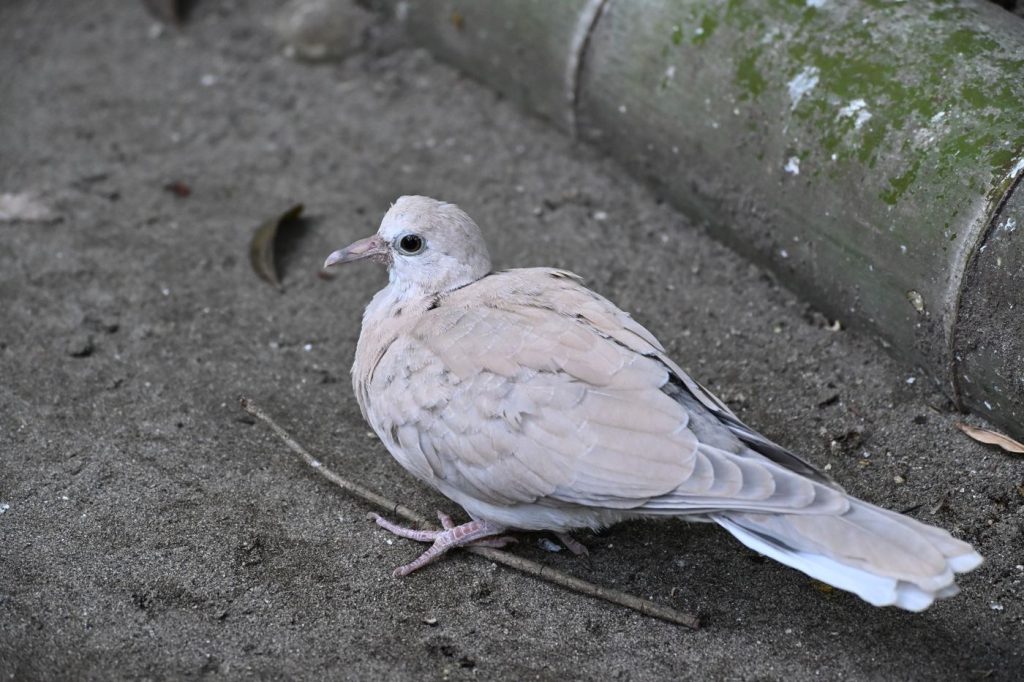
Ringneck dove at a glance
| Feature | Details |
|---|---|
| Scientific name | Streptopelia risoria for the domestic form. The IOC World Bird List calls the wild ancestor Streptopelia roseogrisea |
| Other names | Barbary dove, ring dove, ringed turtle dove |
| Length | About 28 cm (New Zealand Birds Online). The American show standard asks for 10 to 11 inches (about 25 to 28 cm) from beak tip to tail |
| Weight | About 140 g |
| Classic colour | Pale fawn with a black half-collar |
| Eggs | Two, white |
| Incubation | About 14 to 16 days |
| Lifespan | Up to 12 years recorded in captivity |
| Kept as | Pet, aviary and show bird |
Where the ringneck dove comes from
Ringneck doves were already known in the 16th century, in two colours: a pale fawn and a near-white. The naturalist Ulisse Aldrovandi wrote in 1600 that his live birds, a fawn male and a white female, came from Egypt.
For a long time some writers thought the ringneck came from the Eurasian collared dove. In 2023 Hein van Grouw and colleagues sequenced the genomes of 26 Streptopelia samples dated between 1871 and 2019. They found that the African collared dove is the main ancestor and that the domestic bird probably comes from its Arabian population. Recent ringnecks from western Europe carry more Eurasian collared dove DNA, because the two species interbreed and their young are fertile. Our African collared dove guide covers the wild bird, its range and its status.
Linnaeus named the tame bird Columba risoria in 1758, from the Latin for “laugher”, probably because of its giggling call. In 2008 the International Commission on Zoological Nomenclature ruled that the name risoria has priority, while the IOC list keeps roseogrisea for the wild species and calls the question unsettled.
Ringneck dove or ring-necked dove?
“Ringneck dove” in pet shops and aviaries means the domestic Barbary dove. The IOC World Bird List uses the English name Ring-necked Dove for a separate wild species, Streptopelia capicola, also called the Cape turtle dove. It lives in eastern and southern Africa and the Comoros.
The Eurasian collared dove is the other common mix-up. It is a heavier wild bird, with an average weight of 204.8 g according to the BTO, against about 140 g for a ringneck.
Weight: ringneck dove and Eurasian collared dove
Appearance
New Zealand Birds Online describes the Barbary dove like this:
- pale fallow brown upperparts and creamy buff to peach-pink underparts
- a narrow black half-collar, edged with white in adult males and less so in females
- red eyes in adults
- deep pink legs and a dark grey bill
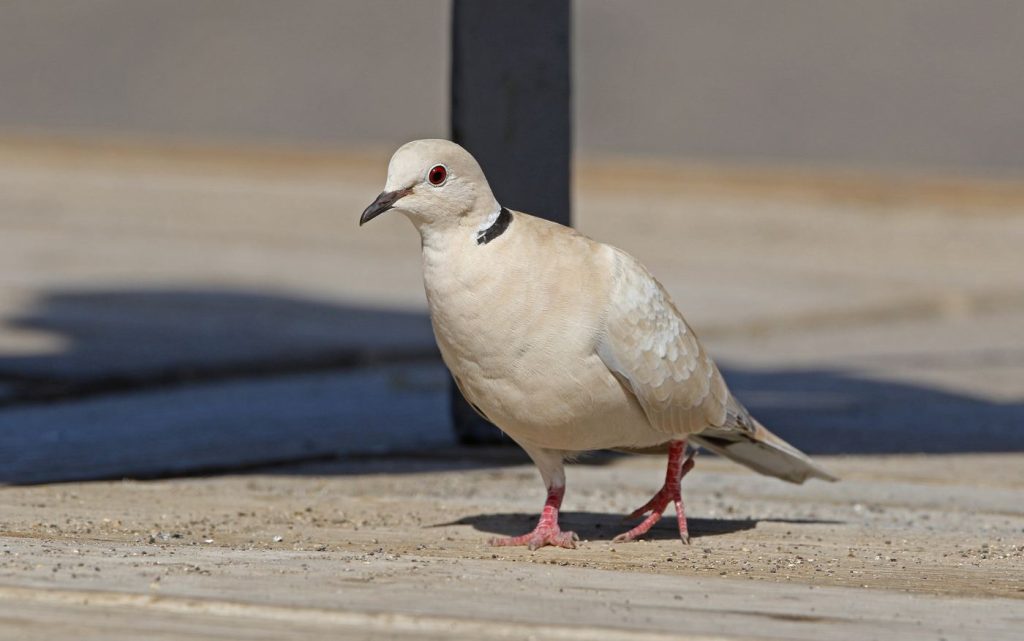
Males and females otherwise look alike.
The National Pigeon Association’s ringneck standard, revised by the American Dove Association in 2004, describes a slim, streamlined bird standing at about 45 degrees and about 6 inches (15 cm) tall. The ring should run from just below one eye, round the back of the neck, to just below the other, with a fine white border on coloured birds. Eye colour depends on the variety: orange in fawns, orange with a reddish tint in whites, black in pieds and pink in true albinos. Fawns have a very dark beak and whites a flesh-coloured one.
The standard also warns that a dove can drop a handful of feathers at once when it struggles. Handle ringnecks as little as you can and move slowly when catching them.
Colours and feather types
A 1978 study in the Proceedings of the Iowa Academy of Science listed six colour mutations in the ringneck dove: blond, white, rosy, ivory, pied and albino. Combinations of these give many of the other colour names that breeders use.
| Colour | What it does |
|---|---|
| Dark (wild type) | The original colour, darker than the familiar fawn |
| Blond (fawn) | A diluted form of the dark colour. This is the classic pet ringneck |
| White | A stronger dilution, so the bird looks almost white |
| Rosy | Gives a reddish tone |
| Ivory | Reduces the colour |
| Pied | Patches of white among coloured feathers |
| Albino | No dark pigment at all; it hides any other colour the bird carries |
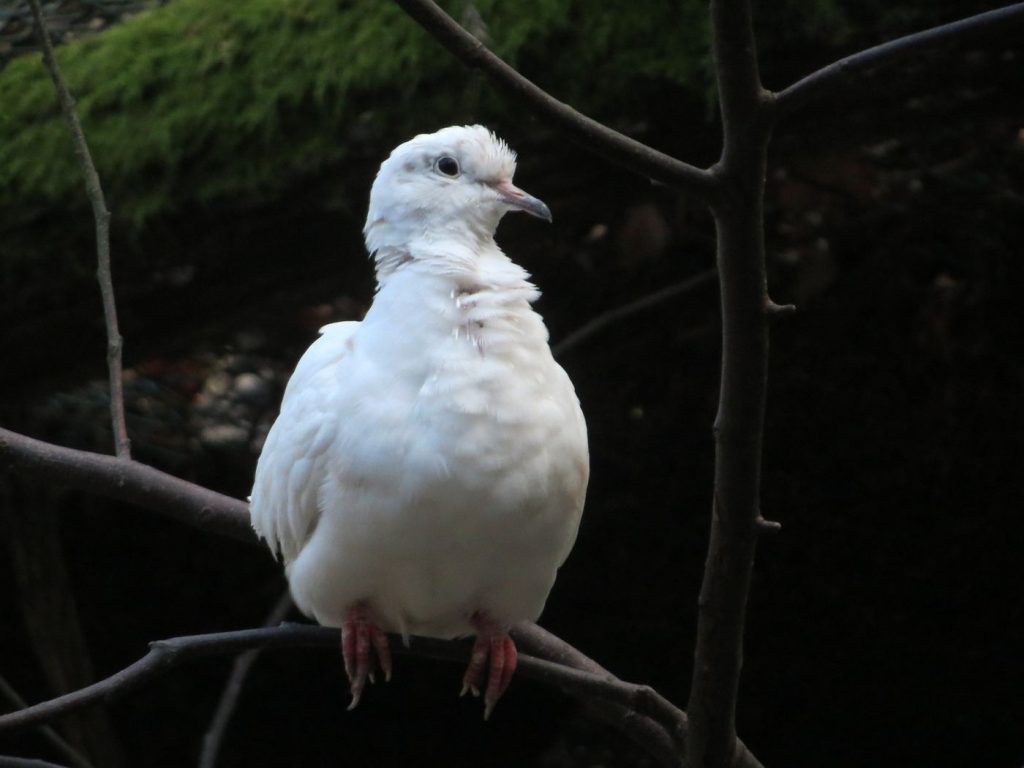
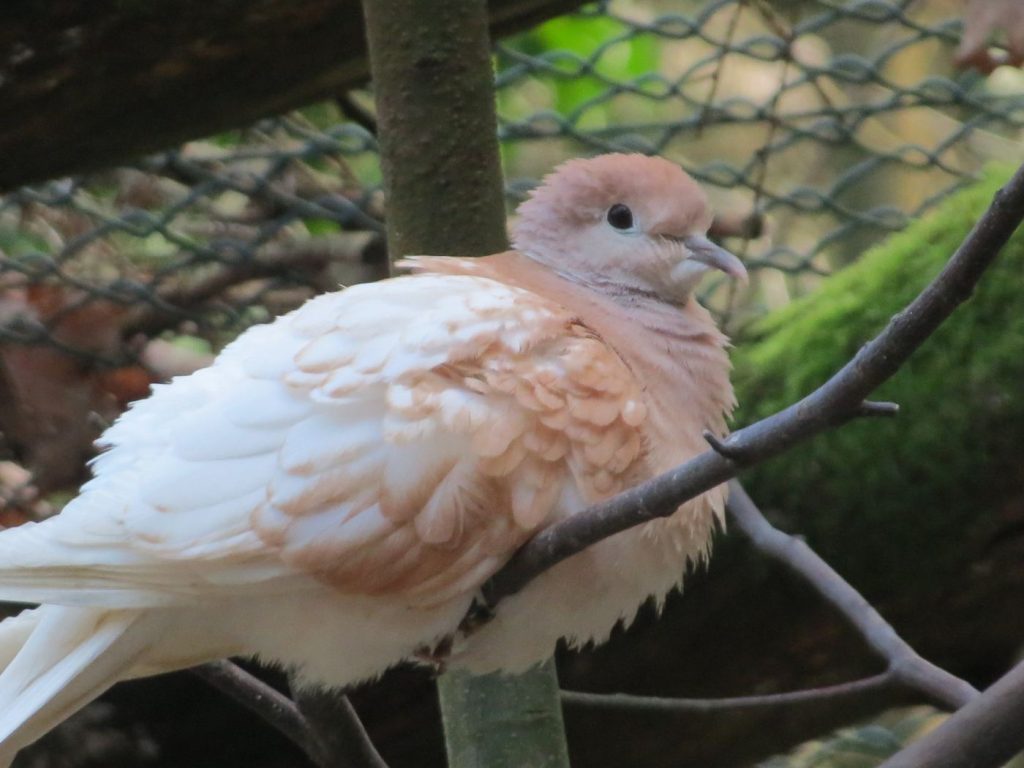
Blond and white are sex-linked. The genes sit on the Z chromosome, which males carry two of and females one. A female shows whichever of these colours she inherits from her father, while a male can carry blond or white hidden behind a darker colour. Blond is recessive to the dark wild type, and white is recessive to both. The other colour mutations are not sex-linked.
The show standard also recognises three feather types. Silky birds have loose feathering because the outer web of each feather is not joined to the shaft. Tufted birds have a small tuft above the beak, and crested birds have a peak of feathers at the back of the head.
Housing
Doves cannot climb cage bars the way parrots do. They move by flying from perch to perch, so the width of a cage matters more than its height. PetMD’s dove care sheet recommends a cage at least 36 inches (about 90 cm) wide for a pair, with bars no more than 3/8 inch (about 1 cm) apart so the birds cannot get their heads stuck.
Indoors, PetMD advises normal room temperatures of about 18 to 27 °C (65 to 80 °F), a draught-free spot off the floor, and no access for cats or dogs. In fair weather ringnecks can live in an enclosed outdoor aviary, provided it keeps out hawks, snakes and other predators.
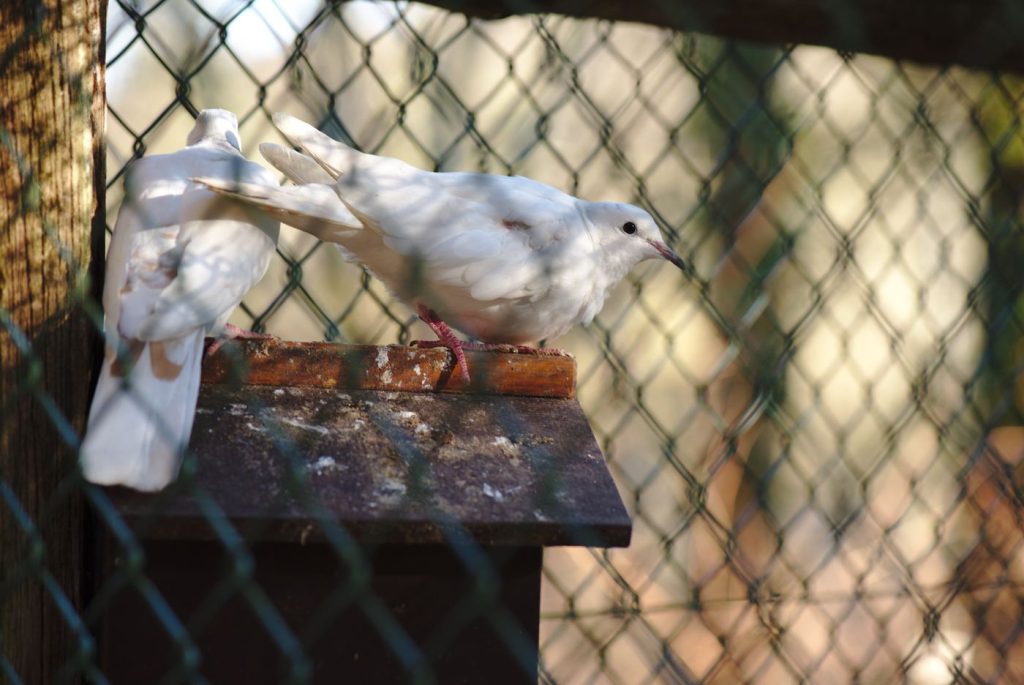
Give them perches of several widths, which helps keep their feet healthy, and a water dish large enough to bathe in. Our guide on bathing pigeons applies to doves too. Wash food and water dishes every day and change the cage floor covering at least once a week.
Ringnecks can be kept singly or in pairs. A male and a female kept together will nest and lay eggs, so plan for that before you buy a pair. Introduce new birds slowly and separate any that fight.
Diet
Wild African collared doves eat seeds from the ground. Pet ringnecks need more than a seed mix, which is short of some nutrients. PetMD recommends this balance:
- a pelleted food made for doves as 60 to 70% of the diet
- small seeds such as millet, canary seed, hemp, milo and wheat as occasional extras
- chopped greens and shredded orange or yellow vegetables, kept to about 10% of the diet
- crushed oyster shell every day as a source of calcium
- a small amount of insoluble grit, because doves swallow seeds whole
Diet proportions from PetMD
PetMD also recommends small seeds as occasional extras, crushed oyster shell every day, and a little insoluble grit.
Our page on whether pigeons need grit explains the two kinds. Change the water every day and remove uneaten fresh food after about 10 hours. Never give avocado, fruit pips, chocolate, caffeine, alcohol, or salty and fatty food.
Breeding
Ringnecks breed readily, often from about 12 months old, and pairs are not fussy about nest sites. Lafeber, a bird food company, notes that some will even nest in the food bowl. The female lays two white eggs, one or two days apart, and both parents incubate them.
From egg to fledgling
Breeding takes a lot from the hen. Lafeber recommends extra calcium during breeding and a rest of a few months after every two or three clutches.
A ringneck and a domestic pigeon can produce hybrid chicks, but they are sterile or nearly so. Our page on whether doves and pigeons can mate covers this in more detail.
Health and handling
Please note: this section is general information and is not a substitute for advice from an avian vet. If your dove seems unwell, contact a vet who treats birds. If you have found a sick or injured bird outdoors, contact a vet or your local rescue.
PetMD advises a check-up with a vet who treats birds at least once a year. Signs that need a vet visit include cloudy or runny eyes, discharge from the mouth, changes in droppings, loss of appetite, lethargy and new lumps or swellings.
Red mites are a common pest. They hide in the cage by day and feed on the birds’ blood at night. Doves kept outdoors can also pick up roundworms and tapeworms. Canker, an infection that causes cheesy growths in the mouth and throat, can kill a dove if it is not treated.
Doves can pass Chlamydia and Salmonella to people, so wash your hands after handling birds or cleaning their cage.
Why ringnecks should not be released
Ringnecks are sometimes used in release ceremonies, but they are not homing pigeons. New Zealand Birds Online notes that the Barbary dove seems less able than other doves to survive for long in the wild. Our page on white release doves explains the welfare problems, and our guide to keeping pigeons as pets and to the smaller diamond dove cover other birds kept at home.
Ringnecks in research
Scientists have studied the ringneck’s courtship and parenting in laboratories since at least the 1950s. Daniel Lehrman’s 1964 Scientific American article, “The Reproductive Behavior of Ring Doves”, is one well-known account. Its coo has been studied too. In 2004 researchers reported in Nature that the ring dove controls the trill in its coo with “superfast” muscles in its syrinx, the bird’s voice box, and a follow-up study measured the trill at an average of 24.2 sound elements a second.
Frequently asked questions
Is a ringneck dove the same as a ring-necked dove?
Not always. The pet ringneck dove is the domestic Barbary dove, descended from the African collared dove. The IOC World Bird List uses Ring-necked Dove for a separate wild species, Streptopelia capicola, from eastern and southern Africa.
How long do ringneck doves live?
New Zealand Birds Online gives a maximum recorded lifespan of 12 years in captivity. Lafeber says well-kept ringnecks can live for more than 10 years.
Can a ringneck dove live alone?
Yes. PetMD says doves can be kept alone or in pairs. A male and a female kept together will breed.
What do ringneck doves eat?
A pelleted dove food should make up most of the diet, with small seeds as extras, chopped greens and vegetables, crushed oyster shell for calcium, a little grit and fresh water every day.
Can you release ringneck doves?
No. Ringnecks are domestic birds with no homing ability, and the Barbary dove seems less able than other doves to survive for long in the wild.
Sources
IOC World Bird List, version 15.2 (opens in new tab).
National Pigeon Association (2022). Book of Standards: Ringneck Dove (revised by the American Dove Association, July 2004).
PetMD: Dove Care Sheet (opens in new tab).
Lafeber Co.: Ring-Necked Dove (opens in new tab).
BTO BirdFacts: Collared Dove (opens in new tab).
Elemans, C. P. H. and others (2004). Superfast muscles control dove’s trill. Nature 431: 146 (opens in new tab); Elemans and others (2006). Syringeal muscles fit the trill in ring doves. Journal of Experimental Biology 209: 965–977 (opens in new tab).