
The diamond dove (Geopelia cuneata) is a small, quiet Australian dove and a popular aviary and pet bird. At 19 to 24 cm long and around 33 g, it is the smallest dove in Australia. Pet birds are captive-bred. Diamond doves need a wide cage or aviary with floor space, a seed-based diet with some fresh food, a dust bath, and a companion of their own kind. With good care they are reported to live for around 10 years.
This guide covers housing, diet, company, breeding and health, with figures taken from BirdLife Australia, the published research on the species and veterinary care sheets for pet doves.
Diamond dove care at a glance
| Need | What to provide |
|---|---|
| Cage size (pair) | At least 91 × 61 × 76 cm (36 × 24 × 30 in), longest side horizontal. Bigger is better, and an aviary is best. |
| Bar spacing | No more than about 1 cm (⅜ in) |
| Cage material | Stainless steel or another bird-safe finish. Avoid galvanised wire, wood and lead or zinc parts. |
| Temperature indoors | About 18 to 27 °C (65 to 80 °F), away from draughts and air-conditioning |
| Diet | Dove pellets and/or a small-seed mix, small amounts of greens and soft vegetables, clean water every day |
| Supplements | Crushed oyster shell for calcium, especially for laying hens |
| Bathing | A shallow tray of dry sand for dust bathing, and a shallow water dish |
| Company | Usually kept in pairs or small groups |
| Never feed | Avocado, chocolate, caffeine, alcohol, fruit stones and pips, salty or fatty food |
| Vet check | Once a year with an avian vet, and sooner if the bird seems unwell |
| Lifespan | Around 10 years with good care |
About the diamond dove
In the wild the diamond dove lives across inland Australia, in arid and semi-arid grassland and open woodland with a reliable source of water. It is nomadic, moving with rain and food, and sometimes turns up in large numbers far outside its usual range. It feeds on the ground on the small seeds of grasses and herbs, needs to drink every day, and gathers at water in flocks of up to 30. BirdLife International lists it as Least Concern with a stable population. It is native only to Australia, though an introduced population is recorded in Puerto Rico.
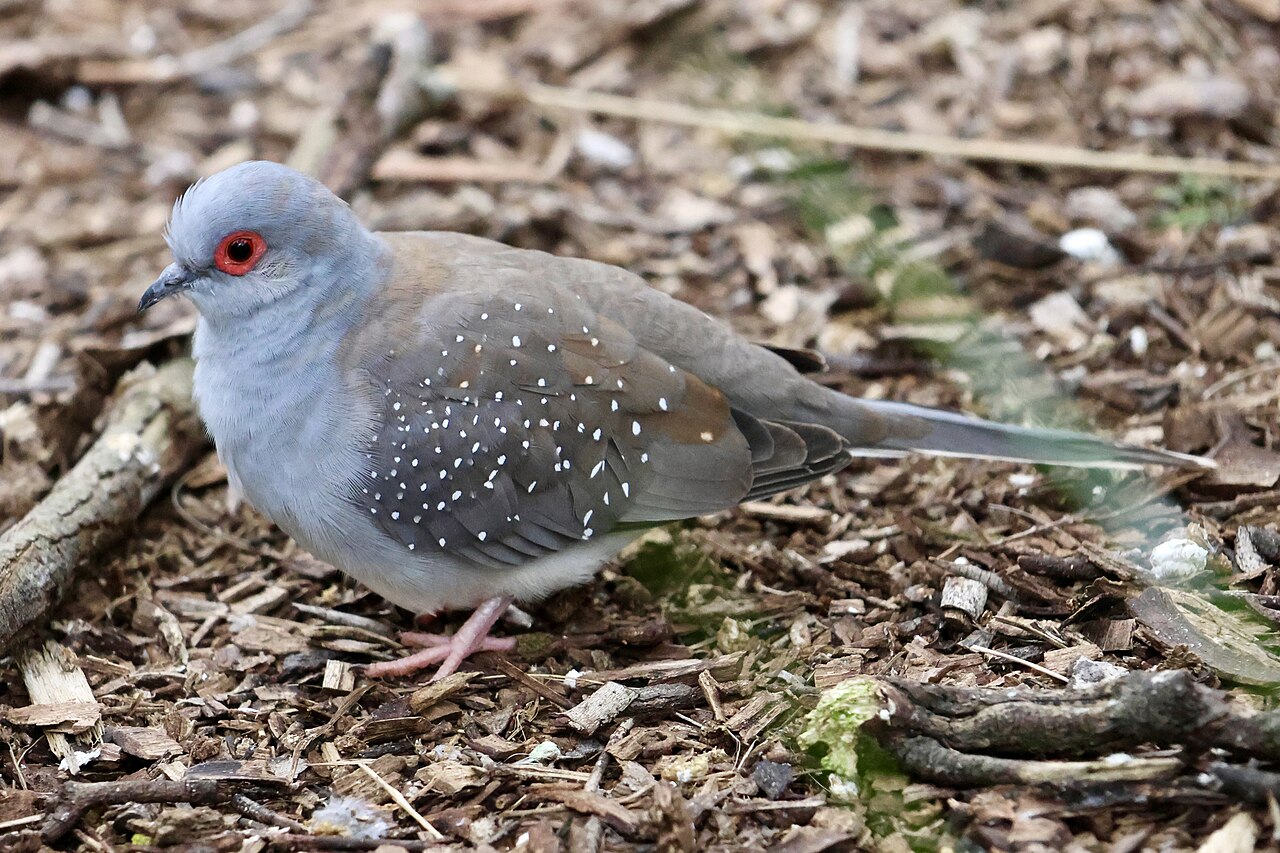
Both sexes are blue-grey with fine white spots on the wings, a red ring of bare skin around the eye, pink legs, and a long, wedge-shaped tail. In flight a chestnut panel shows in the wing. The species is described in our guide to Australian pigeons and doves, alongside the similar bar-shouldered dove and peaceful dove. Diamond doves are smaller and slimmer than peaceful doves, with a proportionally longer tail.
Telling males, females and young apart
| Adult male | Adult female | Juvenile | |
|---|---|---|---|
| Plumage | Pale blue-grey head, neck and breast | Like the male but browner | Duller and browner, with fine barring on the neck, breast and back |
| White wing spots | Many | Many | Few |
| Eye-ring | Dark pink to bright red | Dark pink to bright red | Light grey to brown or pale orange |
Plumage is only a guide, and the difference between the sexes is small. Behaviour helps, as cocks bow and coo when courting. If you need to be sure, an avian vet can arrange a DNA sexing test.
Housing: cage or aviary
Doves do not climb like parrots. They walk on the floor and fly from end to end, so width and floor area matter more than height. The PetMD dove care sheet, written by a vet, gives 91 × 61 × 76 cm (36 × 24 × 30 in) as the smallest cage for a pair and recommends the largest you can fit. Lafeber, the bird-food company, makes the same point: a bird that cannot exercise is at risk, and a hen that gets no exercise may become egg-bound.
- Floor. Diamond doves spend much of the day on the ground, so give them a solid floor area to walk on, lined with paper or a paper-based litter that is easy to change.
- Perches. Use perches of different thickness and material, around 1.3 cm (½ in) across for a bird this size. Natural branches work well. Avoid sandpaper perch covers.
- Position. Keep the cage off the floor, in a bright room away from draughts, kitchens and other pets.
- Light. Window glass filters out UV light. Time in a secure outdoor cage in good weather, or a UV lamp made for birds, helps the bird make vitamin D.
- Outdoor aviaries. BirdLife Australia calls the diamond dove a popular aviary species. In a UK aviary they need a dry, draught-free shelter that they can use in cold, wet weather, and protection from predators.
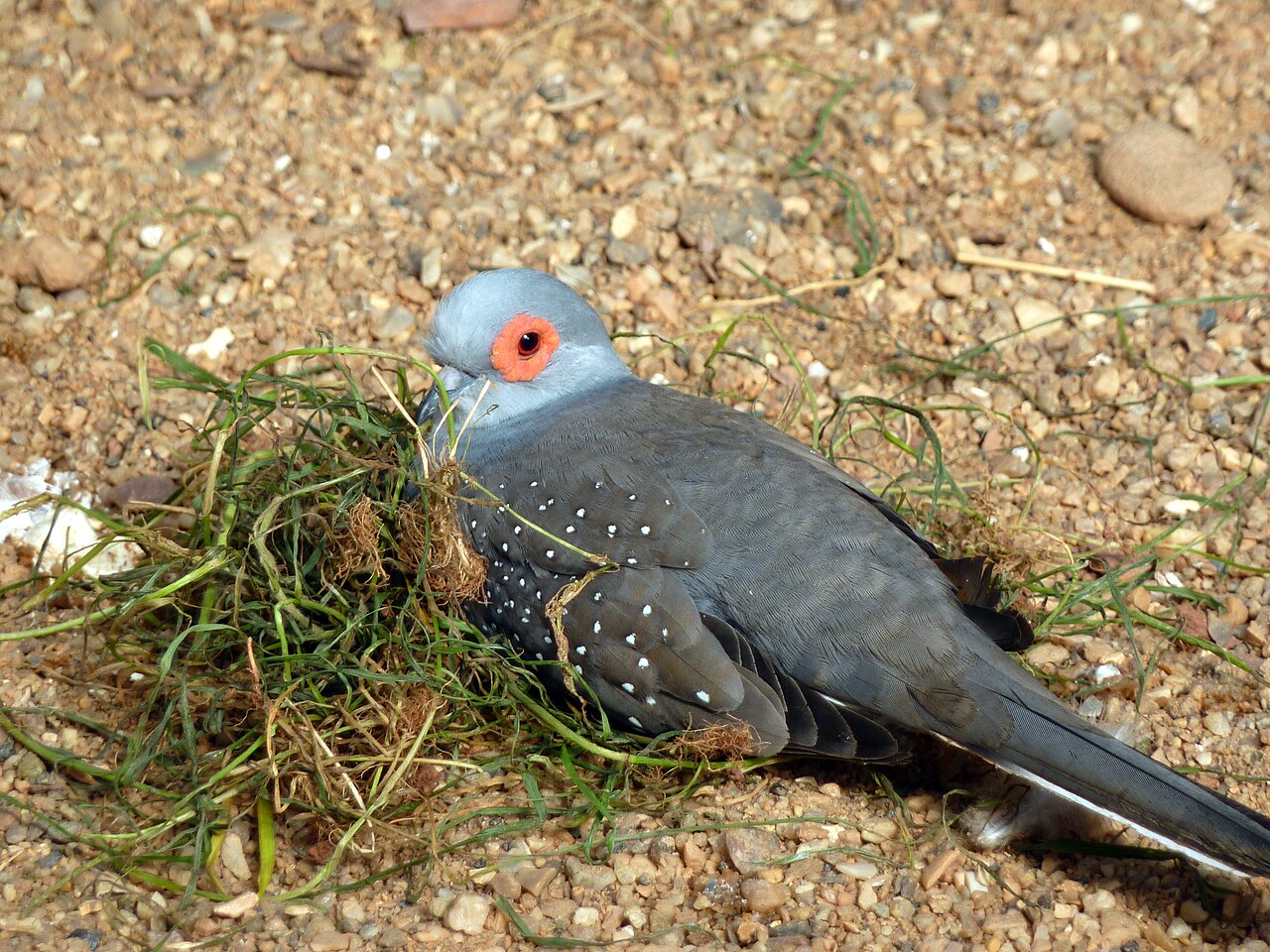
- Nest site. Pairs will try to nest whether you want them to or not. An open nest pan or small basket, a little bigger than a canary nest, with some nesting material, is what they use.
What to feed a diamond dove
Wild diamond doves eat very small seeds. Seed alone is not a complete diet, though. Vets at VCA Animal Hospitals point out that commercial seed mixes are short of calcium, vitamin A and other nutrients, and that all-seed diets can lead to ill health.
| Food | How much | Notes |
|---|---|---|
| Dove pellets | About half to two-thirds of the diet | VCA suggests about 50%; PetMD 60 to 70%. Use small pellets made for doves. |
| Small seeds (millet, canary seed and similar) | The rest of the dry food | Finch or dove mixes suit the size of the beak |
| Greens and vegetables | Small amounts daily | Shred or chop finely. Iceberg lettuce and celery are mostly water. |
| Soft fruit | Occasional | Remove stones and pips |
| Hard-boiled egg | Small amounts, mainly when breeding | Extra protein for parents feeding young |
| Crushed oyster shell | Separate dish | Calcium, important for laying hens |
| Water | Always | Change and clean the dish daily |
Offer food on the floor or in low, wide dishes, as diamond doves feed on the ground. Take away uneaten fresh food the same day.
Do diamond doves need grit?
Vets disagree. Doves swallow seeds whole, unlike parrots, which hull them. The PetMD care sheet recommends a very small amount of insoluble grit to help grind seed in the gizzard, and warns that too much can cause blockages. VCA’s vets say that pigeons and doves seem to do fine without grit. Crushed oyster shell is different: it dissolves and is a calcium source, and both sources support offering calcium. If you do give insoluble grit, give a pinch, not a full dish, and ask your vet. Our article on whether pigeons need grit goes into the debate in more detail.
Foods to avoid
Avocado is toxic to birds. PetMD also lists chocolate, caffeine, alcohol and fruit seeds as toxic, and advises against salty or fatty food. Never share food from your mouth or plate, as human mouths carry germs that can make birds ill.
Company, behaviour and handling
Diamond doves live in pairs and small flocks in the wild, and most keepers house them in pairs or small groups. A male and a female will breed. Two males in a small cage may fight. Introduce new birds slowly, on neutral ground, and separate them if they fight.
They are gentle, quiet birds. The call is a soft, slow, repeated coo, and BirdLife Australia notes that they sometimes call at night, especially in the breeding season. When alarmed they take off with a whistling sound from the wings, which works as a warning to the flock. They are not cuddly birds and many never like being handled, so expect to watch rather than hold them. A calm routine and food offered by hand can make them steadier.
Dust bathing is normal. Wild diamond doves dust-bathe in fine sand to keep their feathers clean, so give your birds a shallow tray of clean, dry sand. They will also use a shallow water dish, and some birds like a light misting with warm water. See how to bathe a pigeon for the general method.
Breeding diamond doves
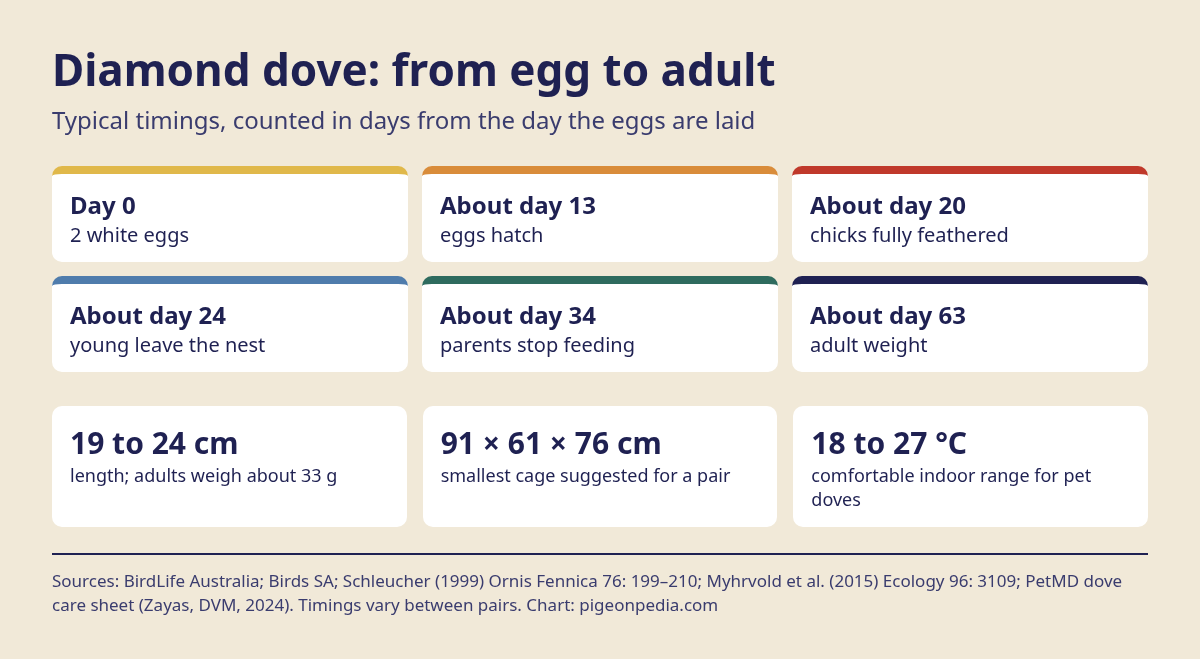
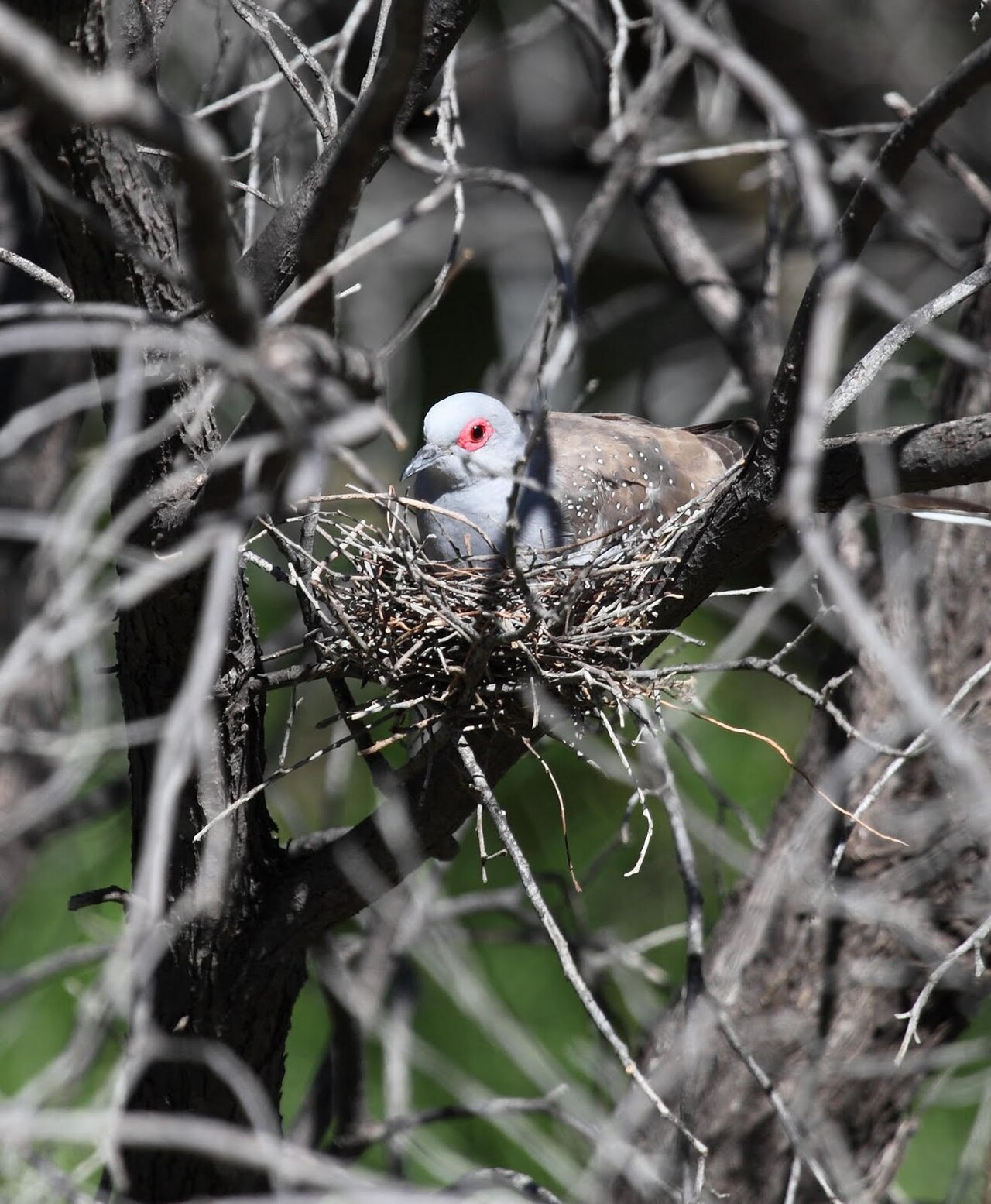
In the wild, breeding follows rain and food and can happen in any month. Both parents build a flimsy platform nest of twigs or grass, share incubation of the two white eggs, and feed the young on crop milk. In captivity a pair can raise brood after brood, which wears the hen out. Lafeber advises resting the birds for a few months after every two clutches.
| Stage | Typical timing | Source |
|---|---|---|
| Clutch | 2 white eggs | Birds SA |
| Incubation | About 13 days | Myhrvold et al. 2015 |
| Fully feathered | About 7 days after hatching | Schleucher 1999 |
| Leaves the nest | About 11 days after hatching (10.8 days on average in 36 nestlings) | Schleucher 1999 |
| Fed by parents after leaving | About 10 more days | Schleucher 1999 |
| Adult weight | About 50 days after hatching | Schleucher 1999 |
Young that have left the nest still depend on their parents for about ten days, so leave them with the pair until they feed themselves. If you do not want chicks, talk to an avian vet about the options, as simply removing eggs can make some hens lay again. For more on pigeon and dove eggs, see how long pigeon eggs take to hatch and crop milk.
Health and cleaning
Find an avian vet before you need one, and book a check-up once a year. Take the bird in a small travel cage, with its partner if it is one of a bonded pair.
| Healthy dove | See a vet if you notice |
|---|---|
| Clean, clear eyes | Cloudy eyes or discharge |
| Clean beak and nostrils | Discharge from the nostrils or mouth, or drooling |
| Smooth, clean feathers | Fluffed-up feathers, plucked or broken feathers |
| Clean vent | Staining around the vent, or a change in droppings |
| Smooth skin on the feet | Growths, cracks or sores on the feet |
| Good appetite and normal calls | Not eating, lethargy, a change in voice, lumps or swellings |
PetMD lists bacterial and respiratory infections, circovirus, pox, Newcastle disease, herpesvirus, adenovirus and yeast infections among the illnesses seen in pet doves. Like other doves, diamond doves can also get canker (trichomonosis), mites and lice. See our guides to canker and pigeon lice. Doves hide illness, so a bird that sits fluffed up on the floor needs a vet the same day.
Cleaning routine, based on the PetMD care sheet:
- Every day: spot-clean droppings and spilled food, and wash the food and water dishes.
- Every week: replace the floor lining, or more often if several birds share the cage.
- Use cleaners made for bird cages and move the birds to another room first. Birds’ lungs are sensitive to sprays and fumes.
Before you buy
- Buy captive-bred birds from a breeder or a bird club, and plan for at least two.
- Have the cage or aviary set up before the birds arrive.
- Check that an avian vet near you sees doves.
- In the UK, owners have a legal duty under the Animal Welfare Act 2006 (opens in new tab) to meet their animal’s needs for a suitable environment, diet, normal behaviour, company and protection from pain and disease. Similar laws apply in Scotland and Northern Ireland.
- If you are deciding between a dove and a pigeon, read the difference between doves and pigeons and pigeons as pets.
Frequently asked questions
Are diamond doves good pets?
PetMD rates doves as suitable for beginners, and diamond doves are small, quiet and simple to feed. They suit people who want to watch birds rather than handle them, and they do best in pairs with plenty of floor space.
How long do diamond doves live?
Lafeber reports a lifespan of up to 10 years with good care, and PetMD gives 10 years or more for pet doves in general.
Can a diamond dove live alone?
A single dove can be kept, but diamond doves are social and live in pairs and flocks in the wild. Most keepers house at least two. Two hens can live together, though they may still lay infertile eggs.
Are diamond doves noisy?
No. Their coo is soft and slow. Cocks coo more, and calling increases in the breeding season and can happen at night.
Can diamond doves live outside in the UK?
They can live in an outdoor aviary if it has a dry, draught-free shelter and protection from predators. Watch them closely in cold, wet weather and bring them into a frost-free shelter if they struggle.
Can diamond doves live with budgies or finches?
Some keepers house them in large mixed aviaries with small, peaceful birds. PetMD’s general advice for pet birds is not to house different species together in the same cage, so only consider a mixed group in a large aviary and watch for bullying.
Are diamond doves the same as zebra doves or ringneck doves?
No. The zebra dove (Geopelia striata) is a close relative in the same genus, with barred rather than spotted plumage. The ringneck or Barbary dove is a larger domestic dove, about 30 cm long. Diamond doves are smaller than both.
Sources
- BirdLife Australia. September bird of the month: Diamond Dove (opens in new tab).
- BirdLife International. Diamond Dove Geopelia cuneata species factsheet (opens in new tab). IUCN Red List assessment 2024.
- Baptista LF, Trail PW, Horblit HM, Boesman PFD (2020). Diamond Dove (Geopelia cuneata) (opens in new tab), version 1.0. In Birds of the World. Cornell Lab of Ornithology (subscription).
- Birds SA. Diamond Dove (opens in new tab), bird directory.
- Schleucher E. (1999). Energetics and body temperature regulation in two convergent dove species from extreme habitats (opens in new tab). Ornis Fennica 76: 199–210.
- Myhrvold NP et al. (2015). An amniote life-history database to perform comparative analyses with birds, mammals, and reptiles (opens in new tab). Ecology 96: 3109.
- Zayas M, DVM; reviewed by Jones L, VMD (2024). Dove care sheet (opens in new tab). PetMD.
- Rich G, Hess L, Axelson R, DVM. Feeding pigeons and doves (opens in new tab). VCA Animal Hospitals.
- Lafeber Company. Diamond dove (opens in new tab), species profile.
Last updated 27 October 2026 · Keeping