
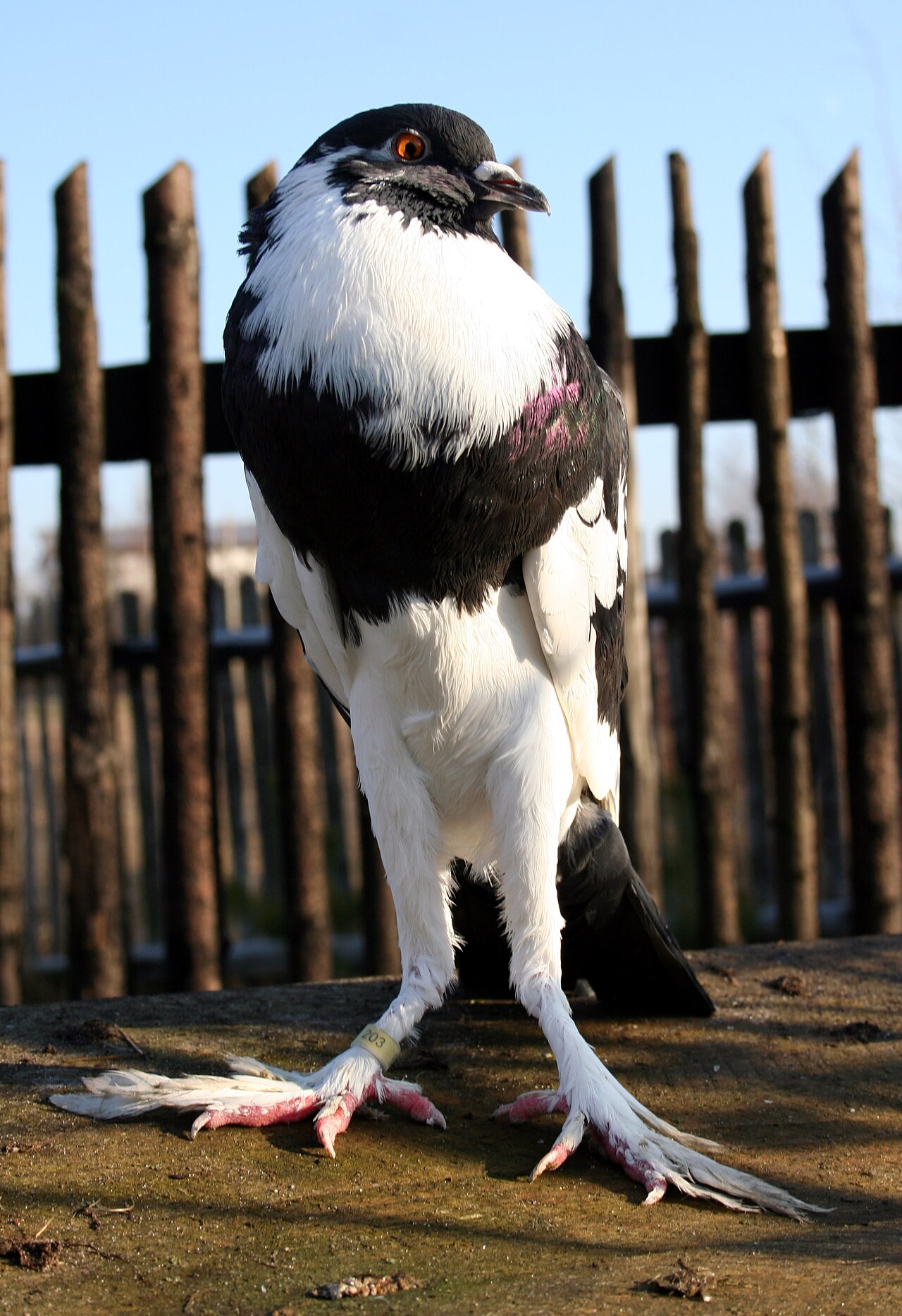
The English Pouter is a tall, slim fancy pigeon bred to stand almost upright on long, feathered legs while it inflates its crop into a round “globe” under the head. It was developed in Britain from older European pouter and cropper breeds, has been described by fanciers since at least 1735, and today is kept for exhibition. Charles Darwin, who kept and measured pouters, called the improved English Pouter “perhaps the most distinct of all domesticated pigeons”.
This guide covers what the breed standard asks for, where the breed came from, what Darwin found when he measured and dissected pouters, what genome studies say about pouter breeds, and the practical points of keeping them.
English Pouter at a glance
| Feature | Details |
|---|---|
| Species | Domestic rock pigeon, Columba livia |
| Breed group | Croppers and pouters (National Pigeon Association, USA) |
| Developed in | England, from Dutch and other continental pouters |
| First written description | John Moore, 1735 |
| Main show points, in order | Size, length of leg, the globe, slimness of waist, colour and marking |
| Body length | 18 in (46 cm) was the minimum standard in 1858; Darwin measured one bird at 19 in (48 cm), beak to tail |
| Leg | As long as possible, closely feathered like a stocking, with feathered feet |
| Kept for | Exhibition |
| Miniature version | Pigmy Pouter, judged to the same proportions |
What is a pouter pigeon?
A pouter is any pigeon breed selected for the habit of filling its crop with air. All domestic pigeons can puff the crop slightly, especially cocks when they display. In pouters the habit is carried to an extreme. Darwin described the group as having an “oesophagus of great size, barely separated from the crop, often inflated”, with the body and legs elongated.
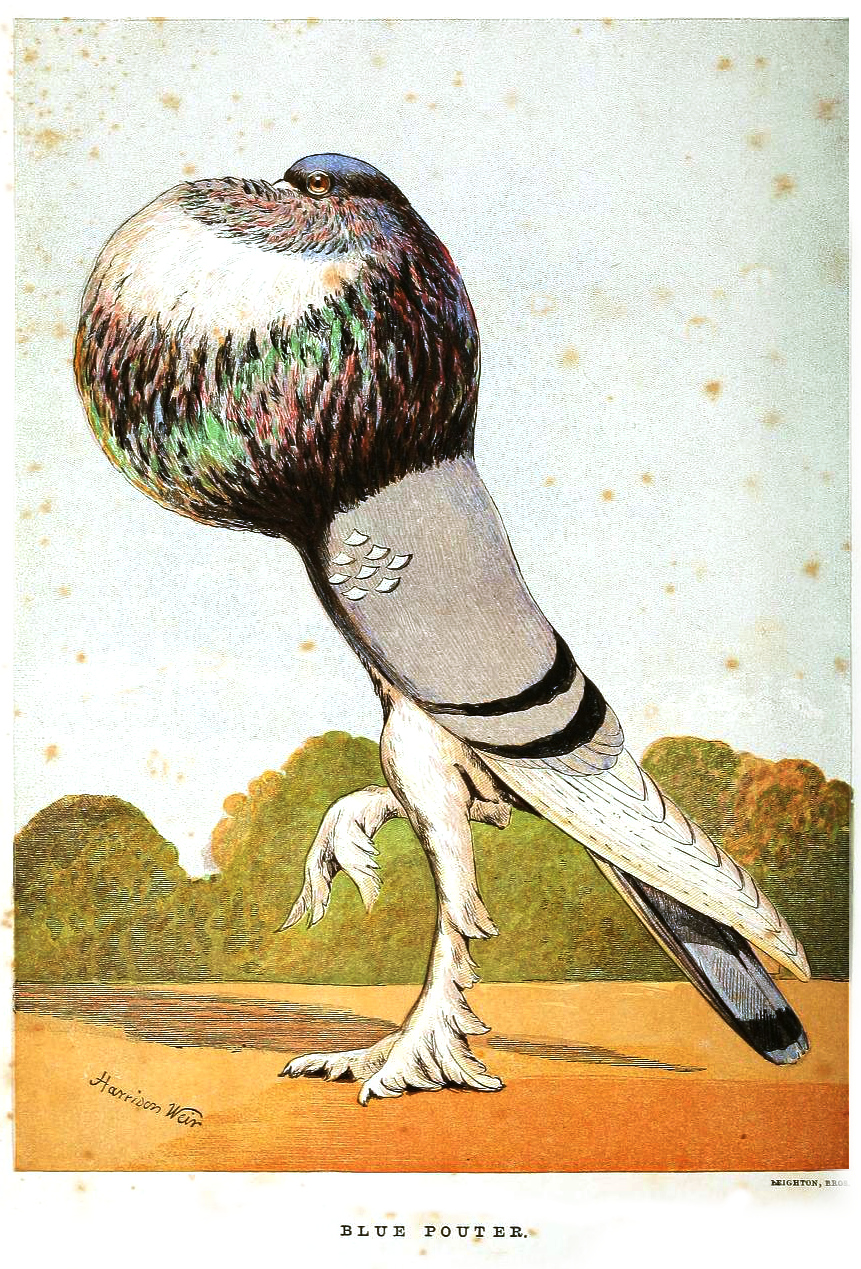
There are dozens of pouter and cropper breeds. The National Pigeon Association’s list of the group in the USA runs to more than 30, from the Brunner Pouter to the Voorburg Shield Cropper. Some of these breeds are called croppers and others pouters, and the two names overlap. The Dutch Cropper is one of these and is one of the breeds behind the English Pouter. For where pouters sit among other fancy breeds, see our overview of types of pigeon.
Breed standard: what judges look for
The standard below is summarised from the English Pouter Standard of Perfection used by the National English Pouter Association in the USA (as transcribed by Jeff Clemens) and the concise standard for the English and Pigmy Pouter published in Aviculture Europe. If you plan to show, get the current standard from your national club, because wording and point values differ between countries.
Fanciers have traditionally ranked five points in this order:
- Size
- Length of leg
- The globe (the inflated crop)
- Slimness of the waist
- Colour and marking
| Feature | Standard asks for | Common faults |
|---|---|---|
| Station and carriage | So upright that the eyes almost line up over the balls of the feet. Walks with high steps, feet going forward, often compared to a prancing horse. | Waddling, a horizontal stance, feet thrown out sideways (straddling) |
| Globe and neck | Long neck and a large, round globe that springs sharply from the waist, with fullness at the back of the neck as well | Sausage-shaped globe, over-blowing so the bird rears back, a globe that is not inflated |
| Head | Small, dove-shaped, smooth on top | Coarse head |
| Body and waist | Slim and narrow. The waist is long and V-shaped, close to a third of the bird’s length. | Thick girth, short waist |
| Wings | Narrow, carried high and tight, resting on the tail. Tips touch but do not cross. | Crossed or dropped wings |
| Tail | Short, narrow and in line with the back, clearing the ground when the bird poses | Split tail, wry tail (carried to one side) |
| Legs and feet | As long as possible, especially from foot to hock, fine in bone, set close together, clad evenly in feathers like a stocking, with feathered “slippers” on the feet | Rough or sparse leg feathering, a ruff of long feathers, knock knees, cow hocks, buckled or stiff legs |
The American standard notes that a split-tailed bird often has no oil gland, and that split and wry tails are both inherited, so breeders usually avoid pairing such birds unless they are outstanding in every other point.
Colour and marking come last of the five points. The breed is shown in pied varieties, such as black pied and silver pied, as well as other colours. The pigeon colours and genetics guide explains how blue, ash-red and brown base colours and their dilutes are inherited.
History of the English Pouter
Pouters were well established in Europe by 1600: Darwin pointed out that the Italian naturalist Ulisse Aldrovandi described them before that date. The English bird was shaped from these older breeds. Darwin thought the Dutch Pouter “seems to be the parent-form of our improved English Pouters”, and later breed histories add that the English Pouter came from crossing a pouter of the Horseman type with the Dutch Cropper. The breed was described as early as 1735 by John Moore, whose Columbarium is one of the first English books on fancy pigeons.
Darwin compared Moore’s figures with those given to him in 1858 by Mr Bult, whom Darwin called the most successful pouter breeder in the world. The comparison shows what breeders had changed in 123 years:
| Moore, 1735 | Bult, 1858 | |
|---|---|---|
| Body length | 17 to 18 in (43 to 46 cm) “reckoned a very good length”; one bird of 20 in seen | 18 in (46 cm) the minimum standard; best measured bird 19 in (48 cm) |
| Leg length | 6½ to 6¾ in (16.5 to 17 cm) “a very good one”; never quite 7 in seen | 7 in (18 cm) the standard; two of Bult’s birds 7½ in (19 cm) |
Body length had barely moved, while leg length had increased. Darwin also recorded a change of fashion around 1765, when “stouter and more feathered legs” came to be preferred to thin and nearly bare ones. The fully stockinged leg of the modern standard follows from that.
The Pigmy Pouter is a smaller version judged to the same proportions. The pigeon show calendar in Britain includes pouter events such as the HOT Pouter Show Society show.
What Darwin found inside the pouter
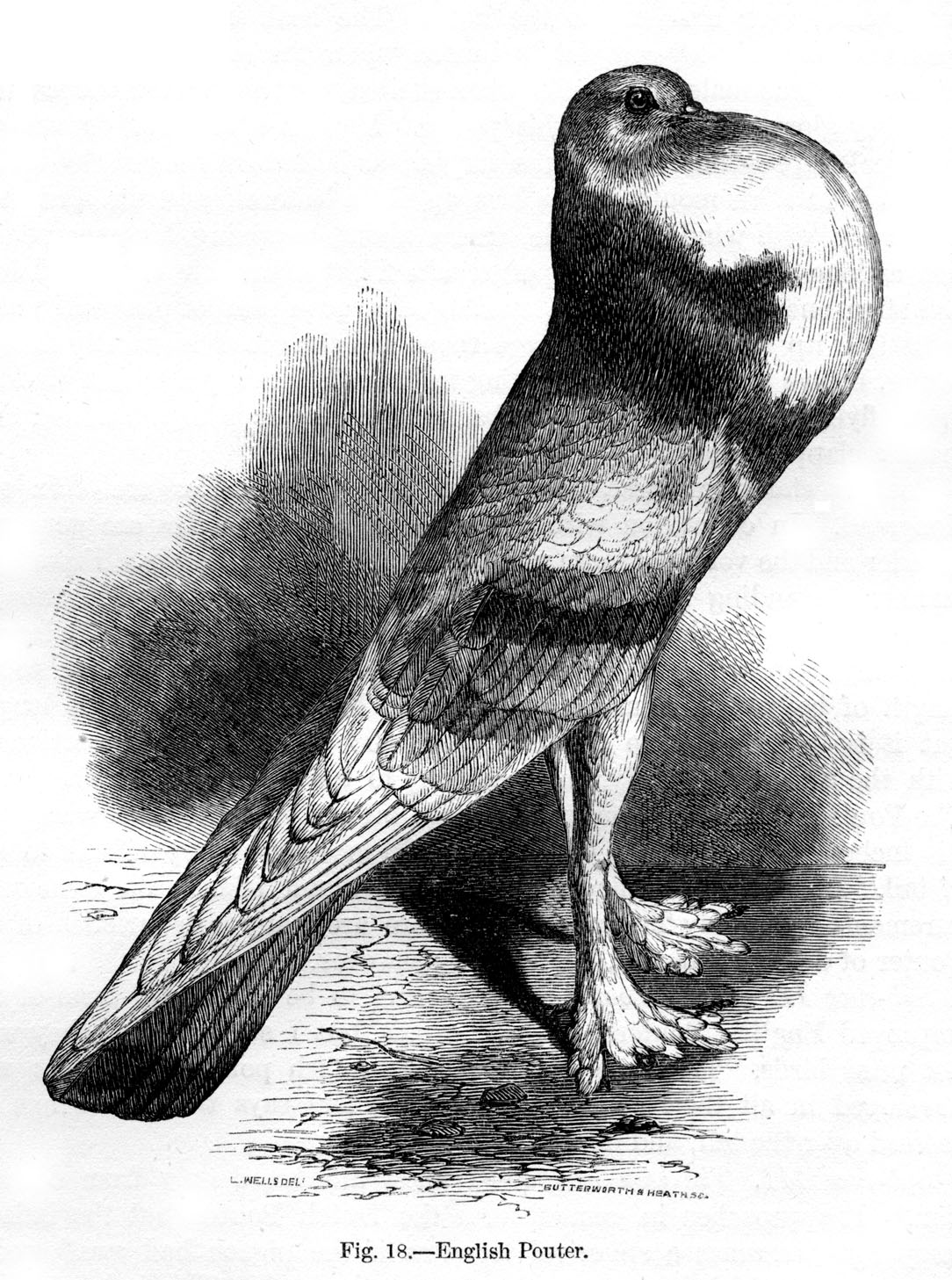
Darwin bred pigeons at Down House and used them as his main example of how far selection can change a species. His notes on the pouter in The Variation of Animals and Plants under Domestication (1868) are still the most detailed early account of the breed.
- The crop itself is normal apart from its size. What differs is the upper oesophagus, which is “immense, even close up to the head”, and less clearly separated from the crop than in other pigeons. In one of his birds the beak was almost buried when the oesophagus was fully blown up.
- Cocks pout more than hens. Darwin saw only one hen, owned by a Mr Evans, that “pouted excellently” and called it unusual.
- A bird that will not “play” can be blown up by the fancier, who takes its beak in his mouth. Darwin watched this done.
- Pouters fly with the crop inflated. He heard peas rattling inside the inflated crop of one of his cocks as it flew up to feed its young, and noted that pouters often clap their wings together in flight.
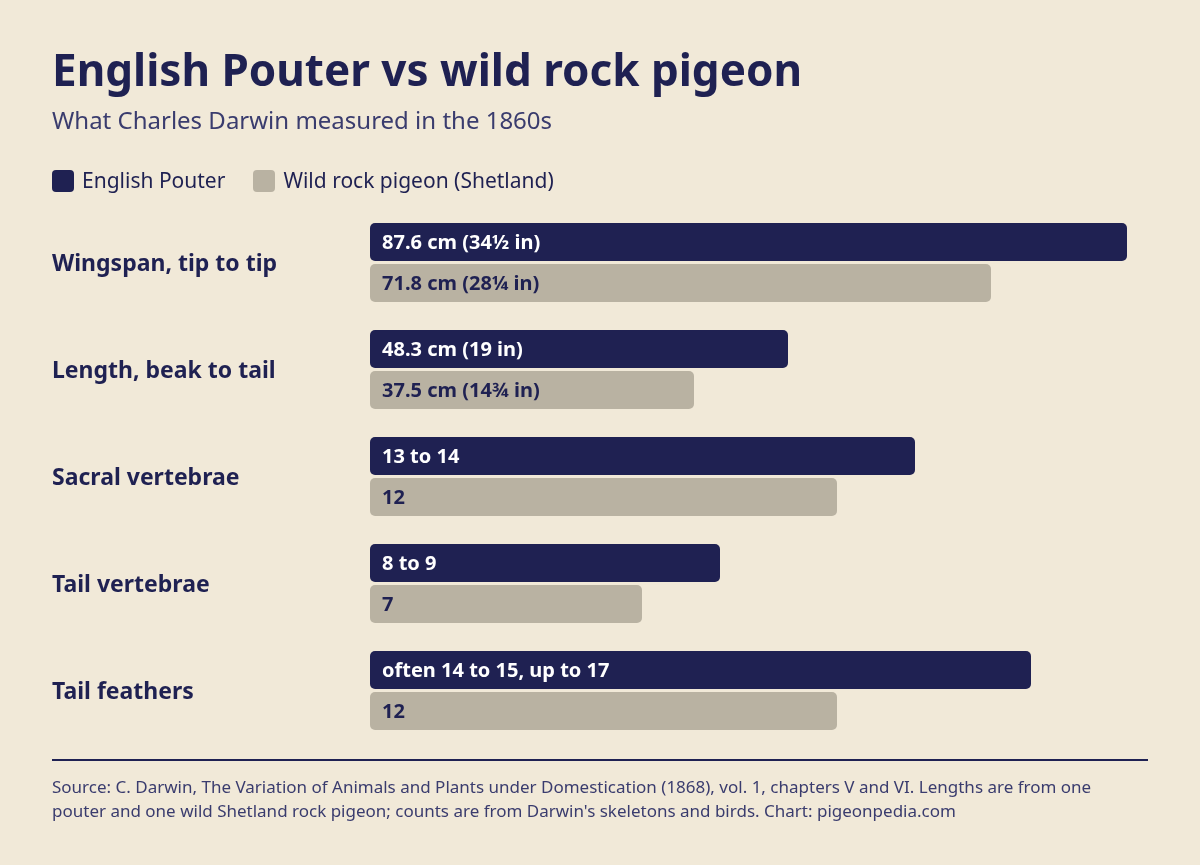
- The long body is real, not an illusion. Pouters had broader ribs, 13 or 14 sacral vertebrae instead of the rock pigeon’s 12, 8 or 9 tail vertebrae instead of 7, and a breastbone longer than their size alone would explain.
- The legs look longer than they are because of the upright stance, but measured against body size they are still longer than a wild rock pigeon’s. The beak, which looks long, is in fact slightly shorter in proportion.
- Extra tail feathers were common: 14 or 15 in his own birds and 17 in one of Bult’s, against 12 in the rock pigeon. He also found 11 primaries in one wing of two pouters, where the rock pigeon has 10.
Darwin went as far as to say that if the improved English Pouter had been found in the wild, ornithologists would have placed it in a new genus. He used it, with the carrier, fantail and short-faced tumbler, to argue that all these breeds came from the one wild rock pigeon. Our page on the anatomy of the pigeon shows where the crop and oesophagus sit in an ordinary bird.
What genome studies say about pouters
Darwin’s view that every domestic breed descends from the rock pigeon has been tested with DNA. In 2013 Michael Shapiro’s group at the University of Utah and colleagues published the first rock pigeon reference genome in Science, sequenced from a male Danish Tumbler, and re-sequenced 40 more genomes from 36 domestic breeds and two feral pigeons (Shapiro et al. 2013).
Three findings matter for pouter keepers:
- The breeds form groups that largely match the traditional ones fanciers use. In the paper’s family tree, pouters fall in a group with utility breeds.
- The data point to the Middle East as the origin of major breed groups, with breeds later carried along trade routes.
- The study found that the head crest seen in many breeds is linked to one gene, EphB2, and arose once before spreading between breeds. It is a reminder that a single striking trait can be shared by breeds that look nothing alike, through crossing.
The genes behind the pouter’s inflated crop and long legs had not been identified in that study. Later work from the same lab has mapped other traits, such as colour, which is covered in our colour genetics guide.
Keeping English Pouters
The English Pouter is a show breed, and its long legs and large crop make it more demanding than a homer or a utility pigeon. Breeders’ clubs are the best source of practical advice. In the UK that is the English and Pigmy Pouter Club, and in the USA the National English Pouter Association. A few points follow directly from the breed’s build:
- Space and perches. A tall, upright bird needs headroom and perches it can stand on without crouching.
- Clean, dry floors. Stockinged legs and slippered feet soil easily. A dry loft and regular cleaning keep feathering in show condition.
- Training for the show pen. The standard describes a well-trained show bird as one that keeps strutting with its globe well inflated, so birds need to get used to the show pen and to being handled.
- Watch the crop. A crop that stays full, sour-smelling or swollen long after feeding is not normal pouting. Our guide to sour crop in pigeons covers the signs, and an avian vet should see the bird.
- Feeding. Feed as for other fancy pigeons: a good seed mix, grit and clean water. See what pigeons can eat and do pigeons need grit.
If you are new to pigeons in general, start with pigeons as pets before choosing a demanding exhibition breed.
English Pouter compared with related breeds
| Breed | Main difference from the English Pouter |
|---|---|
| Pigmy Pouter | A miniature of the English Pouter, judged to the same proportions |
| Dutch Pouter / Dutch Cropper | Described by Darwin as smaller and less developed in every point; one of the English Pouter’s ancestors |
| Lille Pouter | A spherical globe “as if the pigeon had swallowed a large orange”, rising to the crown of the head; only the middle toe feathered (Darwin, from French sources) |
| Common German Pouter (as Darwin described it) | Less upright, oesophagus less distended, bare feet, shorter legs and beak, long tail |
Frequently asked questions
Why do pouter pigeons puff up?
All pigeons can inflate the crop a little, and cocks do it when courting. Pouters have been selected for centuries to do this to an extreme, and they have an unusually wide upper oesophagus that holds the air. Cocks pout more than hens, especially when excited.
Does pouting hurt the bird?
Pouting is normal display behaviour for the breed. A crop that stays swollen with food or fluid, smells sour, or comes with vomiting is a health problem, not pouting, and needs a vet.
Can English Pouters fly?
Yes. Darwin noted that pouters often take off with the crop inflated and clap their wings in flight. They are not kept for flying performance, though, and show birds usually live in pens and lofts.
How big is an English Pouter?
It is a large but slim pigeon. The 1858 standard Darwin quoted asked for a body of at least 18 in (46 cm) and a leg of 7 in (18 cm). Darwin measured one bird at 19 in (48 cm) from beak to tail, with a wingspan of 34½ in (88 cm).
What is the difference between a pouter and a cropper?
Both names describe breeds that inflate the crop, and they overlap. The NPA puts croppers and pouters in one group. Darwin treated them all as one race, the pouters, and the Dutch Cropper was formerly called the Old Holland Pouter. In the English Pouter the upright, long-legged stance counts as much as the globe.
Are English Pouters good for beginners?
They are usually kept by experienced exhibitors. Their size, legs and show training take more work than a hardier breed, so most new keepers start with an easier breed and get advice from a pouter club before buying.
Sources
- Darwin C. (1868). The Variation of Animals and Plants under Domestication (opens in new tab), vol. 1, chapters V and VI. London: John Murray. Full text at Darwin Online.
- Shapiro MD et al. (2013). Genomic diversity and evolution of the head crest in the rock pigeon (opens in new tab). Science 339: 1063–1067. Free full text on PubMed Central (opens in new tab).
- National English Pouter Association. English Pouter Standard of Perfection (opens in new tab), transcribed by J. Clemens.
- Aviculture Europe. The English Pouter and Pigmy Pouter (opens in new tab) (PDF), with concise standard and faults.
- National Pigeon Association (USA). Breeds by group (opens in new tab) and Book of Standards.
Last updated 27 October 2026 · Types