
Interactive pigeon anatomy
Pigeon anatomy centres on a seed-eater’s gut and a strong flyer’s frame. Birds have no teeth: seed is stored in a bilobed crop, then ground in a muscular gizzard with grit. Ear openings sit behind each eye under soft feathers. A transparent third eyelid sweeps the cornea. Large keel muscles power flight, and take-off often claps the wings.
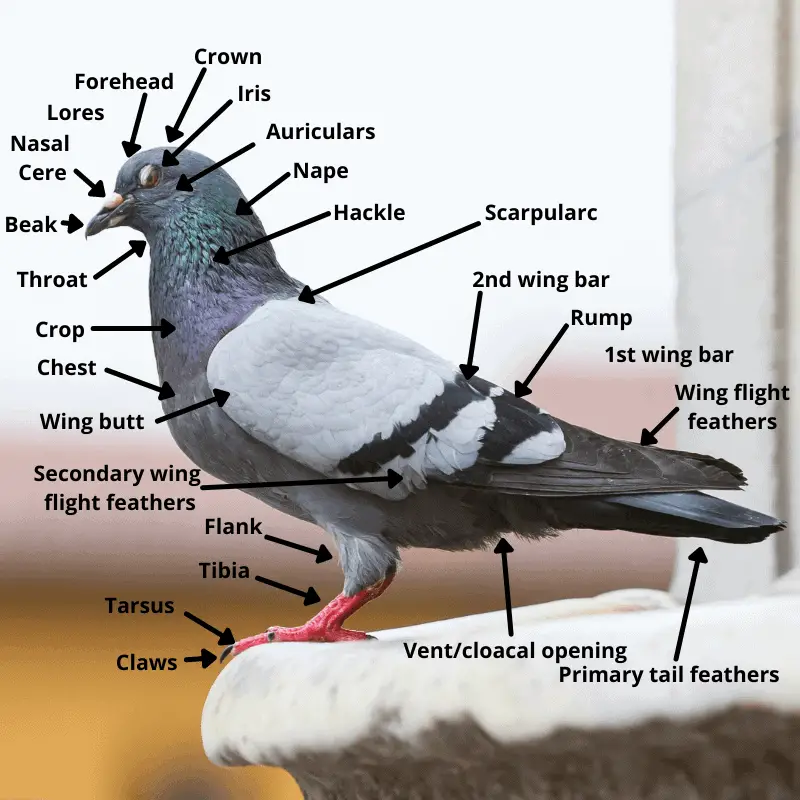
Pigeon body map
Use this map as a quick orientation. External parts such as the pigeon beak, pigeon cere and eye are covered in more detail on their own pages. The digestive path below is what most keepers mean when they ask how a pigeon’s body works.
Pigeon anatomy quick facts
| Feature | In pigeons |
|---|---|
| Teeth | None. Seed is swallowed whole and ground in the gizzard |
| Crop | Large, bilobed; food store and crop-milk organ |
| Stomach | Proventriculus (glandular) then muscular gizzard |
| Ears | Feather-covered openings; no pinna; balance organs in the inner ear |
| Eyelids | Upper, lower, and a transparent nictitating membrane |
| Tongue | Small, pointed; helps move food; pigeons drink by continuous suction |
| Flight frame | Long keel; large pectoral muscles |
| Typical size | Rock dove about 32-37 cm; adults often about 300-400 g (BTO) |
Crop, proventriculus and gizzard
Food travels beak → oesophagus → crop → proventriculus → gizzard → intestine → cloaca. The crop (ingluvies) is a thin-walled, bilobed out-pocket of the oesophagus just before the chest. It stores a meal so the bird can feed quickly and digest later, and it softens dry seed with moisture and gland secretions.
From the crop, food enters the proventriculus, the glandular stomach that adds acid and digestive enzymes, then the gizzard (ventriculus), a thick muscular mill. Seed-eaters such as pigeons swallow small stones or commercial grit that stay in the gizzard and help crush grain. Keepers often offer grit even though birds can manage without it in some conditions; see do pigeons need grit.
Both sexes of pigeons and doves also use the crop to feed chicks. Under prolactin, lining cells thicken and slough off as crop milk: a protein- and fat-rich, carbohydrate-poor paste that is the exclusive food for the first days of life. Details and welfare notes are on do pigeons produce milk. Pouter breeds such as the English Pouter have been selected so the crop and upper oesophagus inflate into a display globe.
Do pigeons have teeth?
No. Living birds have no teeth. A pigeon swallows seeds whole; grinding happens in the gizzard, not in the beak. The tooth-billed pigeon of Samoa is named for tooth-like notches on the lower bill – those notches are part of the beak keratin, not true teeth.
Do pigeons have ears?
Yes. There is no outer ear flap (pinna). Each side of the head has an ear opening a little behind and below the eye, covered by soft feathers. Middle and inner ear structures handle hearing and balance.
Pigeons hear very low-frequency sound (infrasound) that humans cannot. Some research has linked that ability to navigation, though the idea is still debated; see how do pigeons navigate.
Do pigeons blink? Eyes and the third eyelid
Yes. Pigeons have upper and lower eyelids. They also have a third eyelid, the nictitating membrane: a thin, nearly clear sheet that sweeps from the inner corner across the cornea to clean and moisten it, often during head movement. The sweep is fast, so casual watchers rarely notice it. Pigeons are among the birds that also use the upper lid in some blinks.
Eye colour (orange, red, pearl or dark) varies with breed and age; see why do pigeons have red eyes. For field of view and colour vision, see pigeon eyesight.
Do pigeons have tongues?
Yes. The tongue is small, narrow and pointed on the floor of the lower beak. It helps shift seed toward the throat. Taste buds are far fewer than in humans, but pigeons can still discriminate some tastes.
Drinking is unusual among birds: many species scoop water and tip the head back, but pigeons (and some close relatives) keep the beak in the water and draw it up in a continuous suction.
Why do pigeons’ wings make a noise when they fly?
The clap or whir you hear at take-off comes from the wings striking the air (and sometimes each other) at high wingbeat rates. In ordinary city pigeons it is mostly mechanical noise from hard flapping.
In the Australian crested pigeon, a 2017 Australian National University study published in Current Biology showed that a specially narrowed eighth primary feather produces a high note on each downstroke. Faster escape wingbeats raise the tempo, and playback trials showed that other crested pigeons treat that sound as an alarm. Ordinary rock-dove take-off clatter is related physics without that specialised alarm feather.
Keel, flight muscles and powder down
Like other strong fliers, pigeons have a deep keeled sternum (carina) for the large pectoral muscles that power the downstroke. Wings fold at wrist and elbow; flight feathers attach to the hand and forearm bones.
Many pigeons produce a lot of feather powder (powder down). Most pigeons and doves lack a well-developed uropygial (preen) gland; powder and preening keep plumage in order instead. Neck feathers often show structural iridescence rather than pigment alone; see iridescent feathers. Feet and toes are covered on why do pigeons have bad feet; overall size on how big is a pigeon.
Other quick anatomy notes
- Heart: four-chambered, as in other birds and mammals.
- Air sacs linked to the lungs support a one-way airflow during flight.
- No teeth and a short gut mean food moves quickly; that is one reason gas-producing “farts” are rarely if ever documented in pigeons.
- Feral pigeons often lose toes to string and hair entanglement rather than to anatomy defects; see why do pigeons have bad feet.
Pigeon anatomy FAQs
Do pigeons have teeth?
No. They swallow seed whole and grind it in the gizzard with grit.
Do pigeons have ears?
Yes: a feather-covered opening behind and below each eye, plus middle and inner ear structures for hearing and balance.
Do pigeons blink?
Yes. They use upper and lower lids and a transparent third eyelid (nictitating membrane) that sweeps across the eye.
What is a pigeon’s crop for?
It stores and softens food, and in breeding birds both sexes produce crop milk for chicks.
Why do pigeon wings clap on take-off?
Hard, fast wingbeats slap the air. In crested pigeons a modified primary feather also creates an alarm whistle.
Do pigeons fart?
There is no good published evidence. Birds have short guts and rapid transit, so mammalian-style gas is uncommon and has not been clearly recorded in pigeons.
Sources
Primary references used for this page:
- LafeberVet – Pigeon anatomy and physiology: 15 facts (Pollock, reviewed Rupiper) (opens in new tab)
- University of Wisconsin-Milwaukee – Birds training notes (digestive system, crop milk) (opens in new tab)
- Stanford Birds – Bird milk (crop milk essay) (opens in new tab)
- Australian National University – Crested pigeons use mystery feather to signal danger (opens in new tab)
- Murray et al. 2017, Current Biology – Sounds of modified flight feathers (DOI) (opens in new tab)
- PMC – The various ways in which birds blink (nictitating membrane) (opens in new tab)
- BTO BirdFacts – Rock Dove size and mass (opens in new tab)
Last updated 6 November 2026 · Facts