
Famous pigeon fanciers include Queen Elizabeth II, whose racing loft at Sandringham dated back to 1886, and Charles Darwin, who bred fancy pigeons while he worked on On the Origin of Species. Mike Tyson has kept pigeons since he was a boy in Brooklyn. These are seven fanciers whose interest is well recorded, with the source for each.
| Fancier | What they kept or did | Era |
|---|---|---|
| Queen Elizabeth II | Royal racing loft at Sandringham | 1952–2022 |
| Charles Darwin | Bred every fancy breed he could get | From 1855 |
| Nikola Tesla | Fed and nursed city pigeons in New York | 1920s–1943 |
| Pablo Picasso | Grew up with his father’s pigeons; drew the Dove of Peace | 1881–1973 |
| Mike Tyson | Kept pigeons from childhood; raced homers on TV | From childhood |
| Duncan Ferguson | Has kept pigeons since he was 12 | Footballer |
| Gerry Francis | Pigeon keeper and football manager | Footballer |
Queen Elizabeth II
The royal loft began in 1886, when King Leopold II of the Belgians gave racing pigeons to the British royal family. The Royal Pigeon Racing Association says Elizabeth II kept up her interest in the lofts and visited them regularly when she was at Sandringham. She was patron of the RPRA and the National Flying Club.
In 2015 the loft was renovated for about £40,000 for her 200 pigeons, according to The Guardian. In 2024 King Charles III declined to take on those two patronages, though the loft itself was still running. Royal birds also served in both world wars, as our page on famous pigeons explains.
Charles Darwin
Darwin began breeding pigeons in the 1850s to study variation. In the first chapter of On the Origin of Species (1859) he wrote that he had kept every breed he could buy or obtain, and had been allowed to join two of the London pigeon clubs.
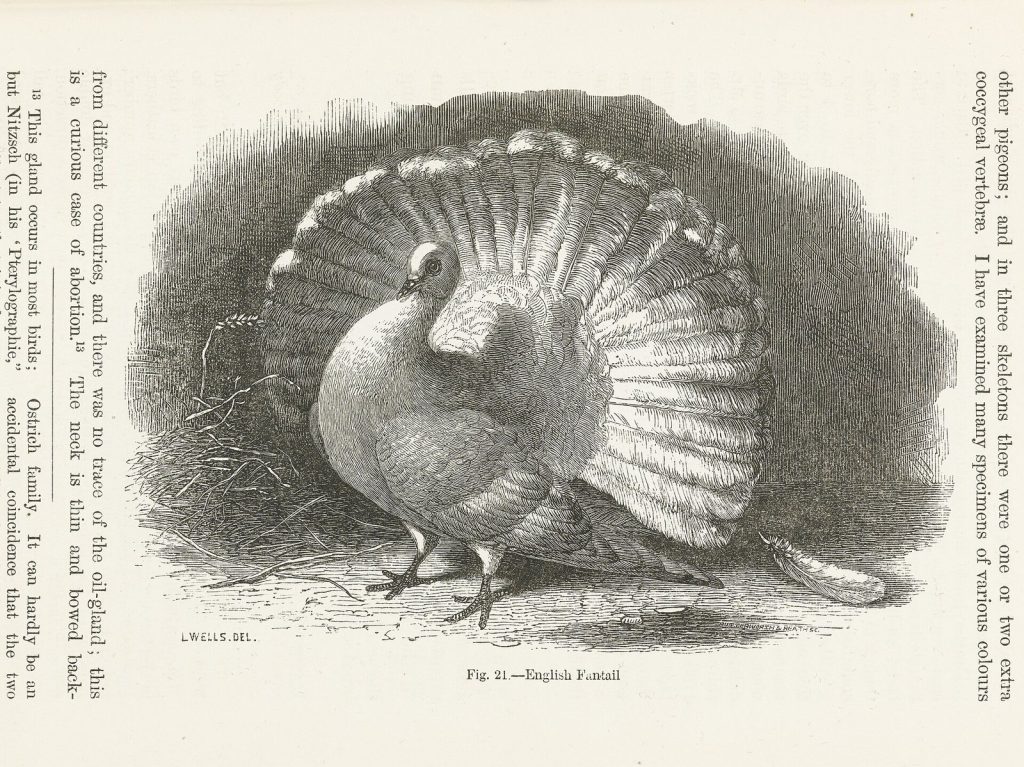
His itinerary records a Columbarian Society meeting on 29 November 1855 and a Philoperisteron Society meeting on 8 January 1856. Breeds such as the English Fantail appear as engravings in his 1868 book on domestic variation.
Nikola Tesla
The inventor fed pigeons in New York for many years, many of them at his hotel window. One hotel asked him to leave, partly because of the birds, and the pigeons followed him to the Pennsylvania Hotel. He spent his last decade at the Hotel New Yorker.
His friends John O’Neill and the science journalist William L. Lawrence recorded Tesla describing a white female pigeon with light grey marks on her wings. “I loved that pigeon as a man loves a woman, and she loved me,” he said, and he told them that when she died he knew his life’s work was finished.
Pablo Picasso
Picasso’s father, José Ruiz Blasco, was an art teacher who painted pigeons and raised them with passion, according to the Museu Picasso in Barcelona. A family story says young Pablo finished his father’s pigeon paintings by adding the feet.
In 1949 the poet Louis Aragon chose Picasso’s lithograph of a fan-tailed pigeon for the poster of the first World Peace Congress in Paris. Tate notes that doves were often kept in Picasso’s homes and studios, and that he named his daughter, born on the eve of the congress, Paloma: Spanish for dove. More on what the bird stands for in our page on pigeon symbolism.
Mike Tyson
Tyson’s interest goes back to his childhood in Brooklyn. CBS News reported that he threw his first punch when a neighbourhood bully killed one of his pigeons. “The first thing I ever loved in my life was a pigeon,” he told CBS News in 2011.
That year he made Taking on Tyson, a six-part Animal Planet series in which he learned to race homing pigeons against experienced New York fanciers. Pigeon racing has its critics, and we look at both sides in our article on whether pigeon racing is cruel.
Footballers who keep pigeons
The Evening Standard reported that the former Everton striker Duncan Ferguson has kept pigeons since he was 12. The same article named the former Tottenham and QPR manager Gerry Francis as another keen pigeon keeper. Racing pigeons are trained to home over long distances, as described in our guide to training a carrier pigeon.
Names we left out
Lists of pigeon fanciers often include Walt Disney, George Foreman and Samuel Pepys. We could not find reliable records that any of them kept pigeons, so they are not on this list. Pepys did write about pigeons during the Great Fire of London in 1666, hovering by their houses until their wings burned, but that does not make him a fancier. If you are shopping for a fancier, see our gift ideas for pigeon lovers.
Questions about famous pigeon fanciers
Did Queen Elizabeth II keep pigeons?
Yes. The royal racing loft at Sandringham dates from 1886, and the RPRA says she kept up her interest and visited the lofts regularly. She was patron of the RPRA and the National Flying Club.
Does King Charles keep racing pigeons?
The Sandringham loft was still running in 2024, but King Charles declined to take on his mother’s patronage of the RPRA and the National Flying Club.
Why did Darwin keep pigeons?
To study variation under domestication. He kept every breed he could obtain and joined two London pigeon clubs, and he used pigeons as a key example in On the Origin of Species.
Does Mike Tyson still keep pigeons?
He has kept pigeons since childhood and said in 2011, “If I’m lucky enough to die an old man, I’m going to have birds.”
Was Tesla in love with a pigeon?
He told friends he loved a white female pigeon “as a man loves a woman”, according to an account recorded by John O’Neill and William L. Lawrence.
Sources
This list is based on:
- Royal Pigeon Racing Association: The Royal Connection (opens in new tab)
- The Guardian (6 July 2024): King Charles ruffles feathers as he drops royal patronage for pigeon racing (opens in new tab)
- Charles Darwin, On the Origin of Species (1859), chapter 1, Project Gutenberg (opens in new tab)
- John van Wyhe, Itinerary of Charles Darwin, Darwin Online (opens in new tab)
- Tesla Universe: In the Footsteps of Genius (Galaxy, 1984), page 18 (opens in new tab)
- Museu Picasso Barcelona: José Ruiz Blasco, the father of a genius (opens in new tab)
- Tate: Picasso, Peace and Freedom, Room 3: The Dove of Peace (archived) (opens in new tab)
- CBS News (3 March 2011): Mike Tyson races homing pigeons on new show (opens in new tab)
- Evening Standard: Tough guys who don’t ruffle feathers (opens in new tab)
Last updated 17 November 2026 · Facts