
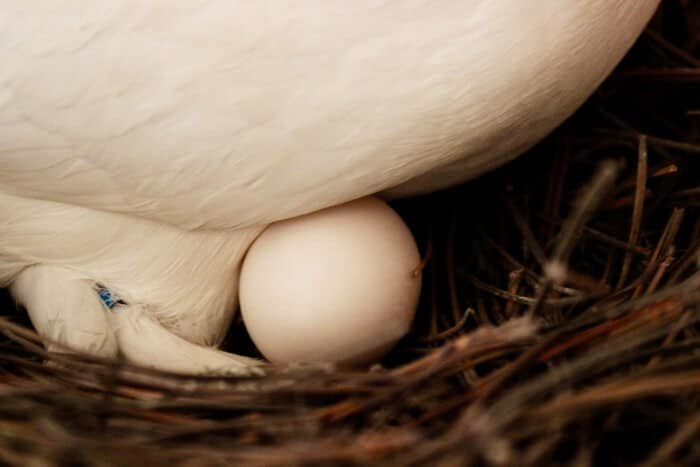
Pigeon eggs usually hatch 17 to 19 days after steady incubation begins, most often around day 18. Both parents sit: the hen typically covers late afternoon through mid-morning, and the cock takes the middle of the day. A clutch is almost always two white eggs, laid about two days apart, so the chicks often hatch within a day of each other.

New to pigeon keeping?
A Beginner’s Guide to Pigeon Keeping. Practical care for pets, lofts and first-year keepers.
Price: $2.95.

How long do pigeon eggs take to hatch?
Across rock pigeon (Columba livia) accounts used by wildlife agencies, incubation is given as 17 to 19 days, with 18 days the figure most often quoted. The Canadian Council on Animal Care (CCAC) laboratory guide states 18 days counted from the first egg. Serious sitting often starts once the second egg is laid, which is why both squabs tend to emerge close together.
Hatching itself is slow: the CCAC notes about 24 hours from the first crack (pip) to a free chick. If you keep pigeons, pair behaviour before laying is covered in how pigeons mate.
Who sits, and when
Both sexes incubate. Agency and laboratory summaries agree the hen usually sits from late afternoon overnight to mid-morning, while the cock covers roughly mid-morning to late afternoon so she can feed. Either bird will sit if eggs are left uncovered.
The nest is a loose platform of twigs and debris on a ledge, building or nest bowl, often reused. Keepers usually offer two bowls so a pair can start the next clutch while older squabs are still present; the CCAC recommends two nests for that reason.
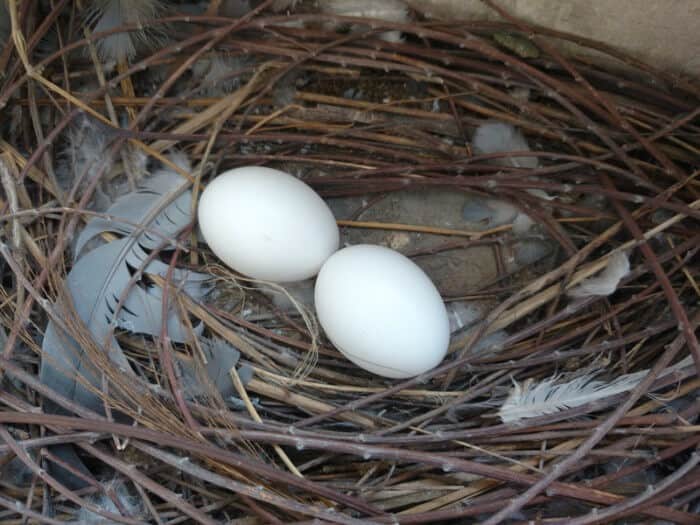
Candling and fertile eggs
From about day five of steady sitting, a bright torch in a dark room can show a fertile egg: a dark embryo spot and a web of red veins. An infertile egg stays clear and yellowish. Work quickly, keep the egg warm, and return it under a parent. Wash your hands before and after.
Wild nests in the UK are protected: it is an offence to take eggs or damage an active nest. If you are not a keeper, leave nests alone. For parents that will not sit, see why a pigeon may not sit on eggs.

If eggs have not hatched by day 21
Many clear or early-dead eggs never hatch. Parents often give up after about 18 to 20 days of sitting, though a live chick can still emerge a little later. After day 26, hatching is extremely unlikely. Candle again and listen for peeping before you discard an egg.
An unincubated egg may stay viable for roughly a week in mild weather. Once development has started, chilling for long periods can kill the embryo. Keep found eggs warm only if you are prepared to incubate and hand-rear; parent-reared squabs do far better than incubator chicks because of crop milk.
After hatching
New squabs are helpless, with sparse yellow or white down. Both parents feed crop milk at first, then seed; see crop milk and what a baby pigeon looks like. Nestling periods in summer are often about 25 to 32 days; cold weather can stretch that. Fledglings may stay near the parents for another week or two.
Pairs can raise several broods a year when food and climate allow. Town pigeons with steady food may nest in any month (RSPCA).
Pigeons and doves: hatching time
Rock pigeon eggs take longer than many smaller doves. The CCAC guide gives about 18 days for pigeons and 15 days for the doves it covers. Exact timing still depends on species and how steadily the eggs are warmed. Cross-species mating is a separate question; see whether doves and pigeons can mate.
Pigeon egg hatching FAQs
How many days do pigeon eggs take to hatch?
Usually 17 to 19 days of incubation, most often around day 18.
Do both pigeon parents sit on the eggs?
Yes. The hen typically sits overnight into mid-morning; the cock covers the middle of the day.
How far apart are the two eggs?
About 40 to 48 hours. The CCAC guide cites roughly 45 hours between eggs.
When should I candle a pigeon egg?
Around day five of steady sitting. Fertile eggs show veins and a dark spot; infertile eggs stay clear.
Can a pigeon egg hatch after 21 days?
Occasionally, yes. After about day 26 it is very unlikely. Candle and listen before discarding.
How long do baby pigeons stay in the nest?
Often about 25 to 32 days in warm weather, longer in cold; then a short time near the parents.
Sources
Primary references used for this page:
- Texas A&M , Texas Breeding Bird Atlas: Rock Pigeon (17-19 day incubation) (opens in new tab)
- Tennessee Wildlife Resources Agency , Rock Pigeon (16-19 days; fledging notes) (opens in new tab)
- California DFG , Rock Pigeon life history (Harrison 1978 via account; 17-19 days) (opens in new tab)
- CCAC Guide vol. 2 , Pigeons and doves (incubation, sitting shifts, candling context) (opens in new tab)
- Washington Department of Fish and Wildlife , Living with wildlife: domestic pigeons (PDF) (opens in new tab)
- Xu et al. 2023, Life , Pigeon breeding cycle, crop milk and physiology (PMC) (opens in new tab)
- RSPCA , Pigeons in the UK (breeding season notes) (opens in new tab)
Last updated 12 November 2026 · Baby Pigeons