
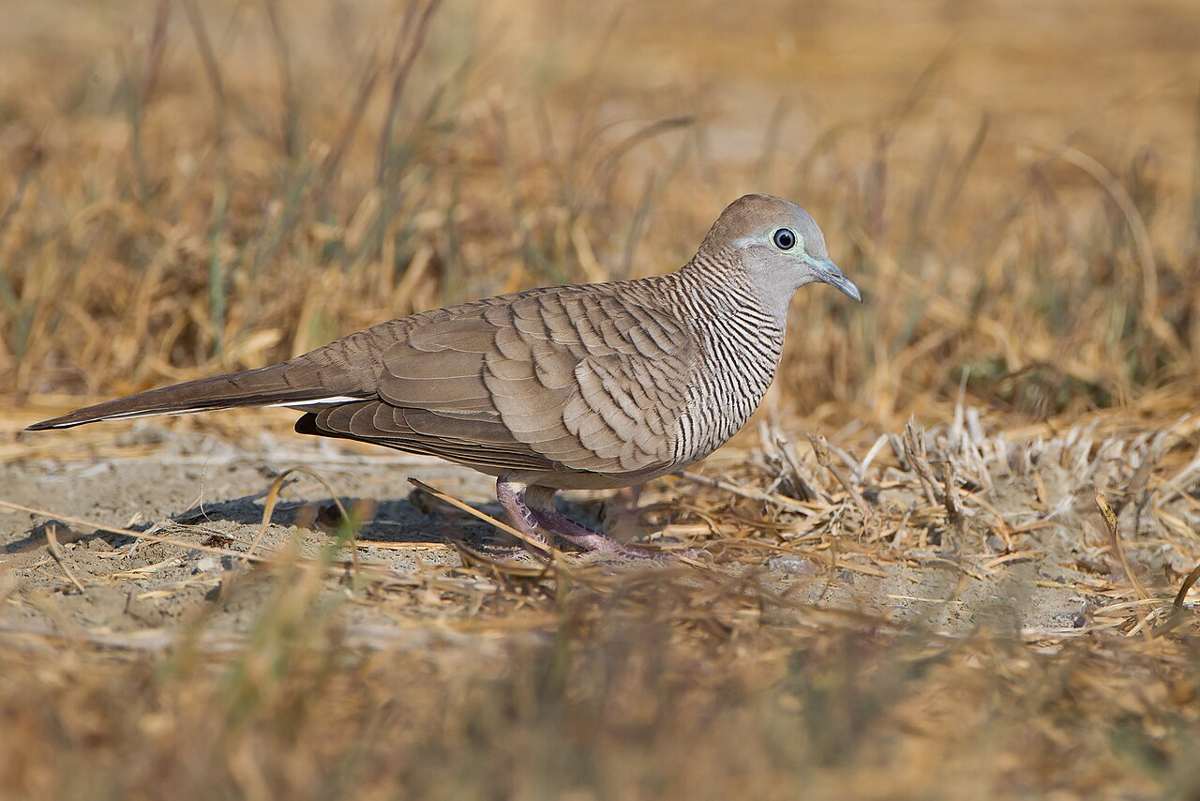
The zebra dove (Geopelia striata) is a slender, long-tailed dove from South-East Asia, named for the bold barring on its sides. It is 20.5 to 21.5 cm long and weighs 50 to 72 g. It is native from southern Myanmar to Sumatra and Java, and introduced populations live in Hawaii and on many other islands.
Zebra doves feed on small seeds on the ground and are common in open country, farmland, gardens and cities, usually in pairs or small groups. They have a blue-grey face and a ring of bare blue-green skin around the eye. The IUCN lists the species as Least Concern with a stable population. In Hawaii, where they were released in 1922, they are among the most common birds.
| Fact | Zebra dove (Geopelia striata) |
|---|---|
| Other names | barred ground dove; barred dove (former name in Hawaii); perkutut (Indonesia) |
| Length | 20.5 to 21.5 cm (8.1 to 8.5 in) |
| Weight | 50 to 72 g |
| Native range | southern Myanmar and the Thai-Malay Peninsula to Sumatra and Java |
| Introduced to | Hawaii, Tahiti, Borneo, Sulawesi, Madagascar, the Seychelles, St Helena and other places |
| Habitat | open country with some bushes or trees, mostly below 900 m |
| Diet | almost entirely small seeds |
| Eggs | usually 2, white |
| Incubation | about 14 days |
| Breeding season | September to June in the native range |
| Oldest known | at least 18.7 years (a ringed wild bird) |
| Conservation status | Least Concern, stable (IUCN 2025) |
How to identify a zebra dove
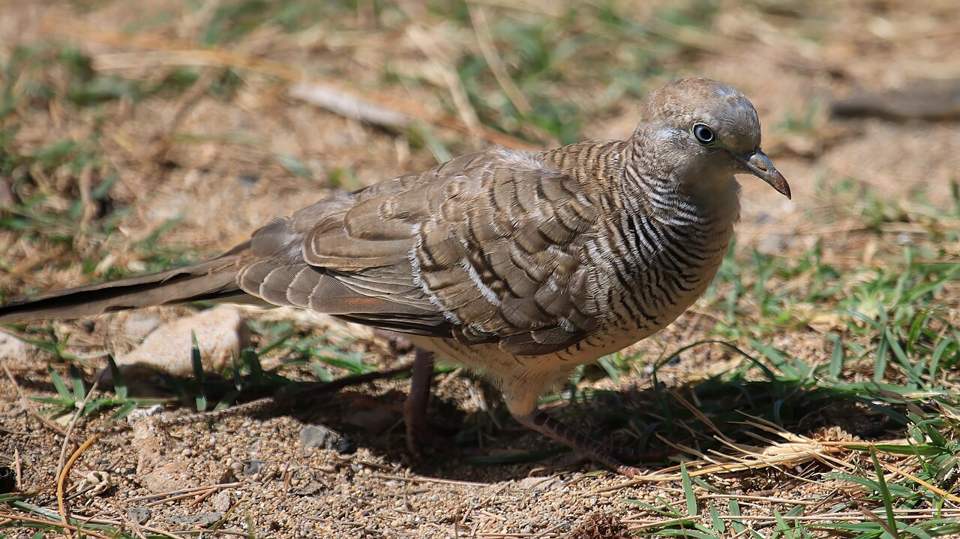
A zebra dove is a small, slim dove with a long, tapered tail. The upperparts are grey-brown with dark edges to the feathers, and fine black and white bars run across the neck, the sides of the breast and the flanks. The centre of the breast is plain pinkish and fades to a tan belly. At close range, All About Birds points to the blue-grey face and throat and the bare blue-green skin around the eye. The long tail is edged with black.
Males and females look alike. Zebra doves walk rather than hop when they feed, and they are often tame around people.
Zebra dove, diamond dove or spotted dove?
The zebra dove belongs to the genus Geopelia, which also includes the Australian diamond dove, bar-shouldered dove and peaceful dove. The spotted dove is included for scale: it is another Asian dove that has been introduced to several regions, and Cornell Lab compares the two calls.
| Zebra dove | Diamond dove | Spotted dove | |
|---|---|---|---|
| Scientific name | Geopelia striata | Geopelia cuneata | Spilopelia chinensis |
| Weight | 50 to 72 g | about 33 g | 144 to 171 g |
| Pattern | fine black and white barring on neck, breast and flanks | blue-grey with small white spots on the wings | brown, rosy breast, black nape patch with white spots |
| Native to | South-East Asia | inland Australia | much of Asia |
The peaceful dove of Australia and New Guinea and the barred dove of the Lesser Sunda Islands look very like the zebra dove. All three have grey-brown plumage barred darker almost all over and a fairly long tail, and Birds of the World notes that they have at times been treated as one species. Their songs are clearly different, and they are now kept as three. Our guide to Australian pigeons and doves covers the peaceful dove.
What does a zebra dove sound like?
All About Birds describes the call as a rapid series of short coos, higher-pitched and faster than the call of the spotted dove. Pairs also duet: a study of a nesting pair in Singapore heard a soft, repeated “kok-kurr-kurr” from both birds before and after nesting, and the sitting bird called back when its mate arrived to change shifts.
The voice is the reason for the bird’s popularity in South-East Asia. The same Singapore study, published in Nature in Singapore, notes that the zebra dove has long been a favourite songbird in the region, and that this has led to illegal trapping and to new populations from released and escaped cage birds.
Cage birds and cooing contests
In Java, where the zebra dove is called perkutut, members of the royal elite have raised the birds for centuries to compete in beauty and singing contests, according to Bubandt (2024) (opens in new tab). Cooing contests are also held in Thailand, Malaysia, Singapore and Brunei. The birds are hung in cages raised high on poles and judged on the quality of their voice.
In Chana District, in Songkhla Province in southern Thailand, breeding contest doves is a major local trade that supports cage makers and exports to Malaysia, Indonesia, Singapore and Brunei. A 2015 study (opens in new tab) of the district records a top price of 1.5 million baht, paid for one bird in 2002. The Thai name is nok khao chawa, the “Java dove”.
The demand affects wild birds. BirdLife International (opens in new tab) reports that the species is found in trade at high prevalence, and trapping for the cage-bird market has made it scarce in parts of Indonesia.
What do zebra doves eat?
Zebra doves feed on the ground and eat almost nothing but small seeds. All About Birds lists weed and grass seeds, rice and other cultivated grains. They often feed along roadsides early in the morning, and larger groups gather at water holes or wherever food is plentiful. In Hawaii, Pyle and Pyle record flocks of 1,000 or more at water holes in dry areas and at places where people feed them, such as Waikīkī and the Honolulu Zoo. They also take some insects and other small invertebrates, and usually forage alone or in pairs on bare ground, short grass or roads.
Breeding, nests and eggs
Males court females by bowing and cooing while raising and spreading the tail. The nest is a loose cup or platform of twigs and stems. It is usually placed in the horizontal fork of a tree or at the base of palms, and sometimes on the ground where there are no predators. The Singapore nest was a flat platform about 10 by 8 cm, 1.5 m up a small street tree beside a busy pavement.
The usual clutch is two white eggs, and both parents take turns to incubate. In Singapore the eggs probably hatched after about 14 days. A study of two captive pairs in southern Thailand found that they bred all year round, with two eggs in every clutch and incubation of 14 to 17 days. The young could fly and feed themselves about three weeks after hatching, and the female sometimes laid again when the chicks were two weeks old. Like other doves, the parents feed the chicks on crop milk.
Where zebra doves live
Birds of the World gives the native range as southern Myanmar, south through the Thai-Malay Peninsula to Sumatra and Java. People have taken the species to many other places, including Laos, Cambodia, Borneo, Sulawesi, Tahiti, Hawaii, St Helena, Madagascar and the Seychelles. Cornell Lab also lists Mauritius and French Polynesia.
It lives in open habitats with some bushes or trees: dry woodland, scrub, farmland, gardens and towns. It mostly stays below 900 m but has been found as high as 2,000 m, and it is not usually found in dense forest.
| Status | Countries and territories |
|---|---|
| Native | Brunei, Cambodia, Indonesia, Malaysia, Myanmar, Philippines, Singapore, Thailand |
| Introduced | USA (Hawaii), French Polynesia, Laos, Madagascar, Mauritius, Réunion, Seychelles, St Helena, Chagos Archipelago, Qatar |
Zebra doves in Hawaii
Zebra doves are not native to Hawaii. The state’s Hawaiʻi Birding Trails (opens in new tab) guide says they were introduced in 1922 and were common on all the main islands except the Big Island by the 1930s. They later colonised that island too. According to Pyle and Pyle (2009) (opens in new tab), published by the Bishop Museum, the first birds may have come from a dealer in Singapore, and a 1946 survey estimated 237,000 zebra doves across the islands. They are now among the most abundant birds in the state. Large numbers can be a problem. Pyle and Pyle report that more than 10,000 were shot around Līhuʻe Airport on Kauaʻi between January and May 1992 as part of damage control. Little hunting of the species takes place in Hawaii today.
Under Hawaii’s wildlife rules, the Department of Land and Natural Resources (opens in new tab) lists all members of the pigeon family, except domestic pigeons, as injurious wildlife. That makes it illegal to release zebra doves into the wild, to move them to islands where they are not already established, or to export them from the state, apart from limited cases covered by a permit.
Where to see zebra doves
- Hawaii: among the most abundant birds on all the main islands. Pyle and Pyle record flocks of 1,000 or more where people feed them, for example at Waikīkī and the Honolulu Zoo.
- Singapore, Malaysia and Thailand: gardens, parks, farmland and roadside verges, usually in pairs or small groups and often tame.
- When: early morning, when they feed along roadsides.
- Listen: a rapid series of short coos, higher and faster than the call of the spotted dove.
Conservation status
The IUCN Red List, which uses BirdLife International’s assessment, lists the zebra dove as Least Concern (assessed in 2025). The assessment (opens in new tab) says the world population has not been counted but the species is usually common across most of its range, and with no likely threats the trend is thought to be stable. Its extent of occurrence is estimated at about 6.96 million km². It has been rated Least Concern, or Lower Risk/Least Concern, in every assessment since 1988, and BirdLife gives a generation length of five years.
Zebra dove FAQ
Where do zebra doves come from?
South-East Asia. The native range runs from southern Myanmar through the Thai-Malay Peninsula to Sumatra and Java. The species has been introduced to Hawaii, Tahiti, Madagascar, the Seychelles, St Helena and several other places.
Are zebra doves native to Hawaii?
No. They were introduced in 1922, spread to all the main islands and are now among the most common birds there. Hawaii lists them as injurious wildlife, so releasing or moving them is restricted.
How big is a zebra dove?
It is 20.5 to 21.5 cm long and weighs 50 to 72 g, much smaller than a mourning dove or a spotted dove.
What do zebra doves eat?
Almost entirely small seeds, such as weed and grass seeds, rice and other grains, which they pick up from the ground.
What is the difference between a zebra dove and a diamond dove?
Both are small Geopelia doves. The zebra dove comes from South-East Asia, is barred black and white and weighs 50 to 72 g. The diamond dove comes from inland Australia, is blue-grey with white wing spots and a red eye-ring, and weighs about 33 g.
Are zebra doves endangered?
No. The IUCN lists the zebra dove as Least Concern with a stable population. It is common across most of its native range.
How long do zebra doves live?
A ringed wild zebra dove lived to at least 18.7 years, the record in the AnAge database. The typical lifespan in the wild has not been published.
Why are zebra doves kept as cage birds?
For their voice. In Indonesia, Thailand and nearby countries, males are entered in cooing contests, and a prize-winning bird in Thailand sold for 1.5 million baht in 2002.
Is the zebra dove the same as the peaceful dove?
No, though they were once treated as one species. The peaceful dove of Australia and New Guinea and the barred dove of the Lesser Sunda Islands are now separate species, mainly because their songs differ.
Sources
- Cornell Lab of Ornithology, All About Birds: Zebra Dove overview, identification and life history; Spotted Dove.
- Kirwan, G. M., Baptista, L. F., Trail, P. W., Horblit, H. M., Pyle, P., Hansasuta, C. and Boesman, P. F. D. (2026). Zebra Dove (Geopelia striata), version 1.1. In Birds of the World. Cornell Lab of Ornithology.
- BirdLife International (2025). Geopelia striata (opens in new tab). The IUCN Red List of Threatened Species.
- Hawaii Department of Land and Natural Resources, Division of Forestry and Wildlife: Injurious wildlife (opens in new tab) (Hawaii Administrative Rules chapter 13-124, exhibit 5).
- State of Hawaii. Hawaiʻi Birding Trails: zebra dove (opens in new tab).
- Pyle, R. L. and Pyle, P. (2009). The Birds of the Hawaiian Islands: Occurrence, History, Distribution, and Status: Zebra Dove (opens in new tab). B. P. Bishop Museum, Honolulu.
- Wee, Y. C. and Wang, L. K. (2008). Breeding behaviour of the zebra dove, Geopelia striata (opens in new tab). Nature in Singapore 1: 75–80.
- Breeding of zebra dove (Geopelia striata) in captivity (opens in new tab), Narathiwat, Thailand, 1994–95. FAO AGRIS record.
- BirdLife International (2025). Species factsheet: Geopelia striata (opens in new tab). BirdLife DataZone.
- Kirichot, A., Untaya, S. and Singyabuth, S. (2015). The culture of sound: a case study of birdsong competition in Chana District, Thailand (opens in new tab). Asian Culture and History 7(1).
- Bubandt, N. (2024). Birds after Geertz: the rise and fall of songbirds in Indonesia (opens in new tab). Indonesia 117.
- AnAge: The Animal Ageing and Longevity Database. Geopelia striata (opens in new tab).
Last updated 3 November 2026 · Types