
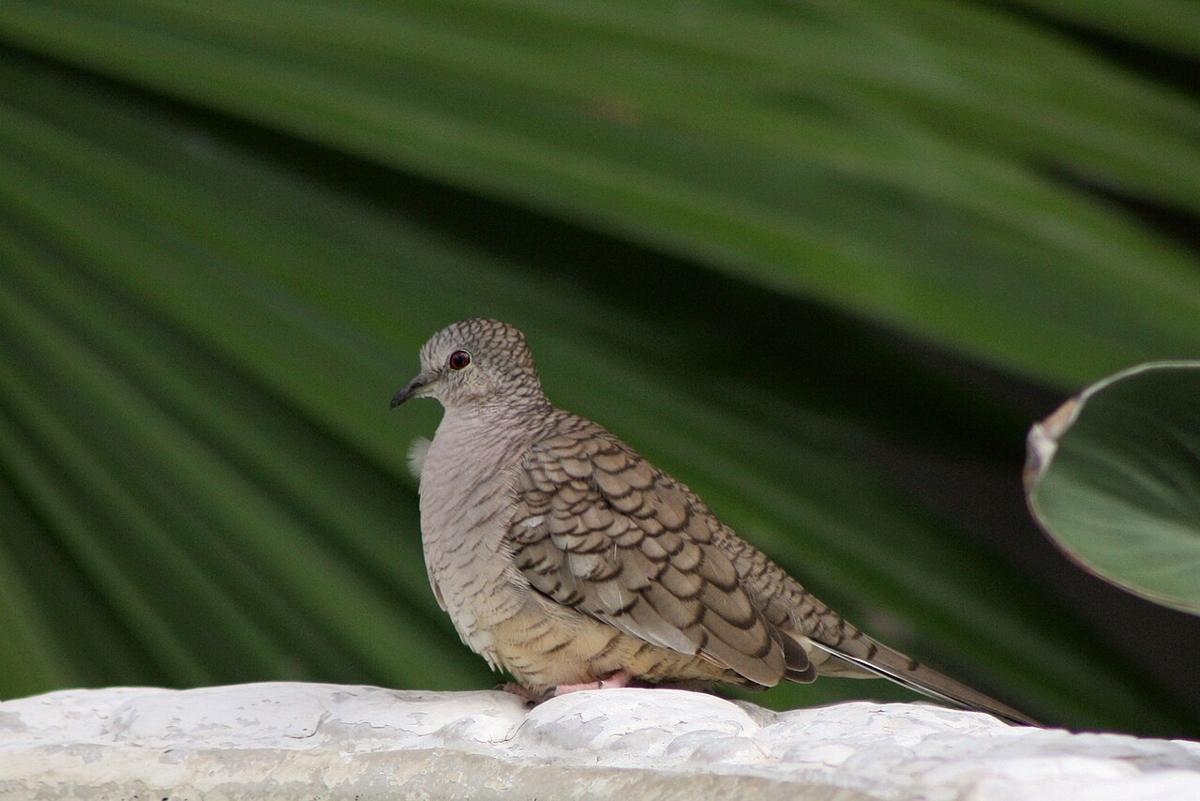
The Inca dove (Columbina inca) is a small, long-tailed dove of Mexico, Central America south to Costa Rica and the south-western United States. It is 18 to 23 cm long, weighs 30 to 58 g and has sandy grey-brown feathers edged in dark brown, giving it a scaly look. In flight it shows chestnut underwings and white outer tail feathers.
Most Inca doves live close to people, in towns, parks, farms and gardens, where they feed on seeds on the ground and visit bird feeders. The call is a two-note coo usually written as “no hope”. Over the past century the species has spread north and south, and it now reaches Colorado. The IUCN lists it as Least Concern.
| Fact | Inca dove (Columbina inca) |
|---|---|
| Length | 18 to 23 cm (7.1 to 9.1 in) |
| Weight | 30 to 58 g |
| Wingspan | 27 to 30 cm |
| Range | Mexico, Central America south to Costa Rica, south-western USA |
| Habitat | towns, parks, farms and gardens in dry, open country |
| Diet | almost entirely seeds |
| Eggs | 2, white |
| Incubation | 13 to 16 days |
| Time in the nest | 12 to 16 days |
| Broods a year | 2 to 5 |
| Oldest known | at least 10 years and 10 months |
| Conservation status | Least Concern, decreasing (IUCN 2025) |
| Population | about 4.7 million adults |
| Elevation | sea level to 3,550 m |
| Movements | resident, does not migrate |
How to identify an Inca dove
An Inca dove is a slim, small-headed dove with a long, square-tipped tail and short legs. Its plumage is the colour of desert sand. Every feather on the body is edged with dark brown, so the whole bird looks scaly, and the face and underparts are paler than the back. The eye is red. All About Birds notes that it looks even brighter when the bird is threatened.
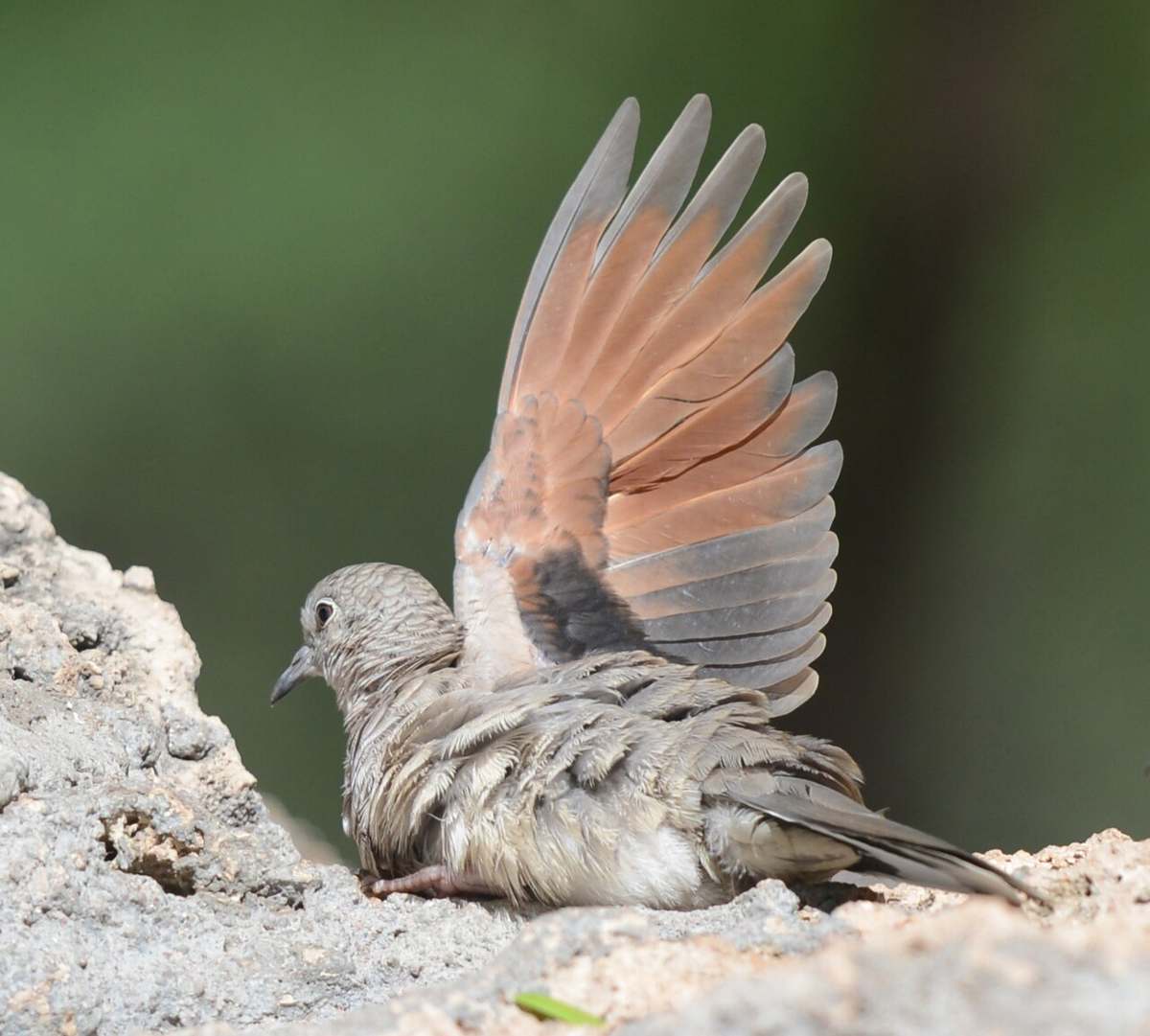
The scaly pattern hides the bird well on the ground. It is easier to see when it flushes: the wings make a dry rattle on take-off, the underwings flash rich chestnut and the white outer tail feathers show on each side of the tail. On the ground it walks with small steps, pushing its head forward and back as it goes.
Inca dove, common ground dove or mourning dove?
In the south-western US, the Inca dove is most often confused with the common ground dove, which also flashes chestnut in the wings, and with young mourning doves, which can look scaly too. The table uses the measurements and field marks given by Cornell Lab and Audubon.
| Inca dove | Common ground dove | Mourning dove | |
|---|---|---|---|
| Scientific name | Columbina inca | Columbina passerina | Zenaida macroura |
| Length | 18 to 23 cm | 15 to 18 cm | 23 to 34 cm |
| Weight | 30 to 58 g | 28 to 40 g | 86 to 170 g |
| Tail | long, square-tipped, white outer feathers | short, with tiny pale corners | long and pointed, white tips |
| Body pattern | scaly all over | scaling on neck and chest only; large dark spots on the wing | plain buff-brown with black spots on the wing; scaly only as a juvenile |
| Wings in flight | chestnut underwings | rich rufous patches | plain, with black spots on the wing |
| Bill | thin, slightly drooping | pinkish-red with a dark tip | small |
The tail is the quickest clue. A common ground dove is stockier and has a stubby tail, while the Inca dove’s tail is long and narrow. A mourning dove is much larger, about three times the weight of an Inca dove, with a pointed tail and black spots on the wing rather than scales.
What does an Inca dove sound like?
The territorial call is a soft, two-syllable coo that birders write as “no hope” or “coo-coo”. Birds of the World describes it as monotonous and repeated over and over for long periods, even in the heat of the day, and All About Birds says Inca doves call at all hours and all year round.
The other sound is mechanical: the dry rattle of the wings when the bird takes off. Our guide to whether doves sing explains how cooing differs from birdsong.
What do Inca doves eat?
Inca doves eat almost nothing but seeds. They walk over bare soil and short grass, picking up seeds of grasses, flowers and shrubs, and flick loose vegetation aside with the bill to uncover more. Audubon adds waste grain and the occasional fruit, such as cactus fruit, and notes that they swallow small grit to help grind hard seeds.
They also come to feeders. All About Birds lists black oil sunflower seed, cracked corn, millet and nyjer, and recommends ground or platform feeders. Audubon suggests that feeders may be important in keeping city flocks going.
Breeding, nests and eggs
In parts of its range the Inca dove breeds all year round. Males defend a territory: they walk towards an intruder in a zigzag, raise one wing over the back and, if that fails, strike with the wings and bill. In courtship the male bobs his head and then raises and fans his tail to show the black and white pattern. The pair stay together for the breeding season and preen each other.
The nest is a rough, flimsy platform of twigs, grass, leaves, rootlets and strips of bark, about 5 cm across. The male carries material to the female, often climbing onto her back to hand it over, and she builds. Construction takes about three days. Nests can be anywhere from about 15 cm to 15 m above the ground, in trees and shrubs or on utility poles, ledges and other structures. Pairs often reuse the same nest, which becomes cemented together with the chicks’ droppings, and they sometimes take over old nests of mourning doves, northern mockingbirds, cactus wrens or northern cardinals.
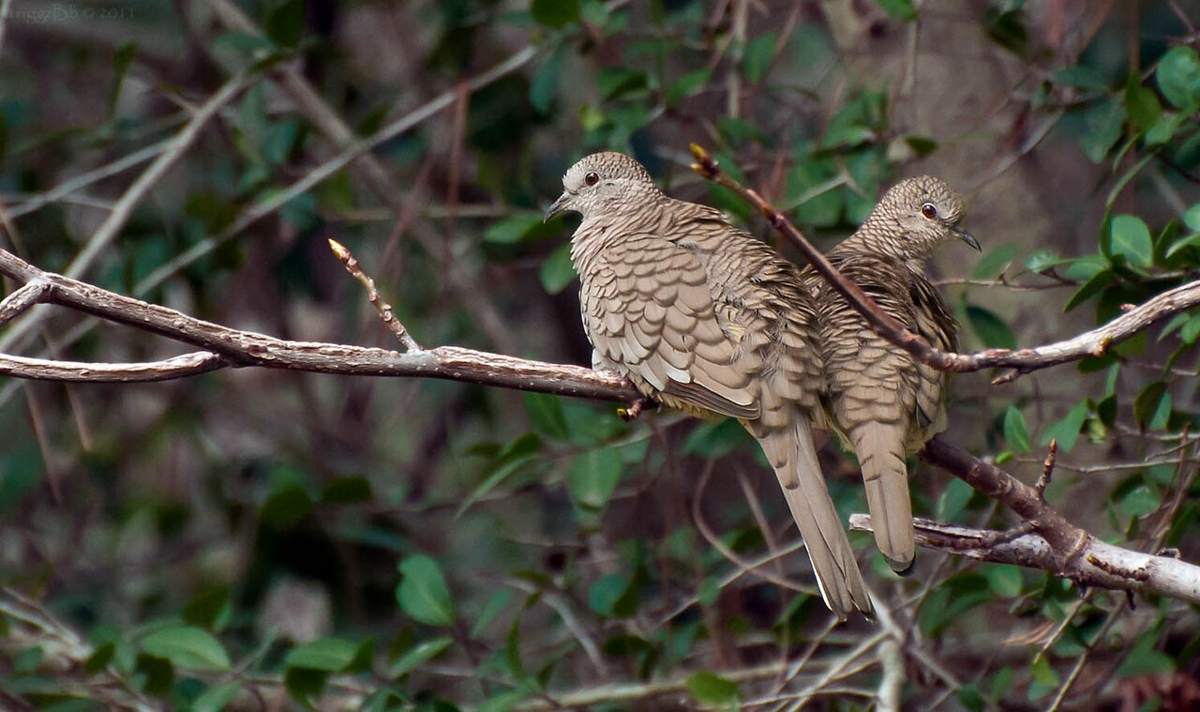
The clutch is two white eggs. Both parents incubate, the male mostly in the middle of the day, and the chicks hatch after 13 to 16 days, naked apart from sparse down. Like all pigeons and doves, the parents feed them on crop milk. The young leave the nest at 12 to 16 days old and are looked after for about another week. A pair can raise two to five broods a year.
Pyramid roosting and the cold
The Inca dove copes badly with cold. According to All About Birds, when the temperature falls to about −7 °C (20 °F), the birds huddle together in the sun to keep warm, sometimes piling on top of each other in a “pyramid” up to three birds high. Birds of the World describes groups of 5 to 12 doves roosting in two or three rows in sheltered, sunny spots, mostly by day but sometimes at night.
When cold weather comes with a shortage of food or water, Inca doves can also let their body temperature drop at night by 5 to 12 °C. Birds of the World expects this sensitivity to cold to set a limit on how far north the species can spread.
Where Inca doves live
The Inca dove lives in Mexico, Central America south to Costa Rica and the south-western US. In the US it is found mainly in the Southwest, and in towns it favours open ground with scattered trees and shrubs such as palo verde and oak. It generally avoids forest. Away from settlements it sometimes nests along lowland streams and rivers.
The species was probably absent north of Mexico originally, and Audubon links its spread to the growth of towns in the Southwest. Birds of the World notes that it first relied on towns for water in arid country, but it has since moved into wetter regions too. All About Birds records it as far north as Colorado, where it was absent before the early 1990s. Most birds are resident, though some wander north in autumn and winter and stay to breed.
BirdLife International lists the Inca dove in these countries:
| Country | Status |
|---|---|
| Mexico | native, resident |
| Guatemala, El Salvador, Honduras, Nicaragua, Costa Rica | native, resident |
| United States | native, resident, mainly in the Southwest |
| Belize, Canada | vagrant only |
Where and when to see Inca doves
Inca doves do not migrate, so they can be seen all year in the same places. Outside the breeding season they often gather in flocks, which can reach about 100 birds.
- Where: towns, parks and gardens in Mexico and the US Southwest, especially where there is bare ground, water and a ground or platform feeder.
- Listen: the two-note “no hope” coo, which they give at all hours and all year, even in the heat of the day.
- Cold mornings: check sunny, sheltered spots for birds huddled in rows.
- When flushed: a dry wing rattle, chestnut in the wings and white edges to the tail.
Population and conservation
The IUCN Red List lists the Inca dove as Least Concern, but its 2025 assessment by BirdLife International (opens in new tab) classes the population as decreasing. BirdLife puts the world population at about 4.7 million mature birds, including about 620,000 in the United States and Canada (Partners in Flight 2024). Partners in Flight estimates a rapid decline in North America over ten years. Most of the birds live in Mexico and Central America, where eBird data suggest a fall of only about 3% between 2011 and 2021, so the overall decline is judged slow to moderate.
The decline is recent. All About Birds, citing the North American Breeding Bird Survey (opens in new tab), reports that US numbers rose by more than 1.5% a year between 1966 and 2015, while the species spread north with the growth of towns. The range covers about 4.56 million km².
The oldest known Inca dove was ringed in Texas in 1979 and killed by a cat in the same state in 1989, at least 10 years and 10 months old.
Why is it called the Inca dove?
The French naturalist René Lesson described the species in 1847 and gave it the name inca. The name is misleading: the Inca dove does not live anywhere in the former Inca Empire, which lay in the Andes of South America. It is also called the Mexican dove, and older books place it in the genus Scardafella.
Inca dove FAQ
Where do Inca doves live?
In Mexico, Central America south to Costa Rica and the south-western United States, mostly near people in towns, parks, farms and gardens. In the US they are found mainly in the Southwest, and the range has spread north as far as Colorado.
How big is an Inca dove?
It is 18 to 23 cm long and weighs 30 to 58 g, a little bigger than a common ground dove and much smaller than a mourning dove.
What does an Inca dove sound like?
A soft, two-note coo usually written as “no hope”, repeated many times. The wings also make a dry rattle when the bird takes off.
How can you tell an Inca dove from a common ground dove?
Look at the tail. The Inca dove has a long tail with white outer feathers and is scaly all over. The common ground dove has a short tail, scaling only on the neck and chest, and a pinkish-red bill with a dark tip.
What is pyramid roosting?
In cold weather, Inca doves huddle together in a sunny, sheltered place, sometimes sitting on top of each other in rows two or three birds high, to save heat.
Are Inca doves endangered?
No. The IUCN lists the Inca dove as Least Concern, with about 4.7 million mature birds. Its 2025 assessment does class the population as decreasing, mainly because of losses in North America.
How long do Inca doves live?
The oldest ringed Inca dove on record was at least 10 years and 10 months old. Cornell Lab and Audubon do not give a typical lifespan for wild birds.
Do Inca doves live in Peru?
No. Despite the name, the species lives from the south-western United States to Costa Rica and is not found in the Andes, where the Inca Empire was.
Do Inca doves migrate?
No. They stay in the same area all year. A few wander north in autumn and winter, and some of them stay to breed.
Sources
- Cornell Lab of Ornithology, All About Birds: Inca Dove overview, identification and life history; Common Ground Dove and Mourning Dove identification.
- Mueller, A. J. (2020). Inca Dove (Columbina inca), version 1.0. In Birds of the World. Cornell Lab of Ornithology.
- National Audubon Society. Inca Dove, Guide to North American Birds.
- USGS. North American Breeding Bird Survey (opens in new tab). Trend for 1966 to 2015 as reported by All About Birds.
- BirdLife International (2025). Species factsheet: Columbina inca (opens in new tab). BirdLife DataZone. IUCN Red List assessment, 2025.
Last updated 3 November 2026 · Types