
The Arabian Trumpeter is a small, clean-legged fancy pigeon kept for its voice. The call is a laughing, drumming sound, not the usual coo and not the “wak-wak-wak” drum of most other trumpeter breeds.
It has a smooth, uncrested head, dark eyes in every colour, and a small dewlap at the throat. The National Pigeon Association (NPA) standard compares the body to a very small field pigeon. In German the breed is the Arabische Trommeltaube; the French name is Tambour d’Arabie. In Germany it has been recognized since 1964.
Like other domestic breeds, it descends from the rock pigeon (Columba livia). Today it is kept as a show and voice bird. It sits in the trumpeter group with the English Trumpeter and the Bokhara Trumpeter, but it looks quite different from both: it has no crest, no rose and no muffs.
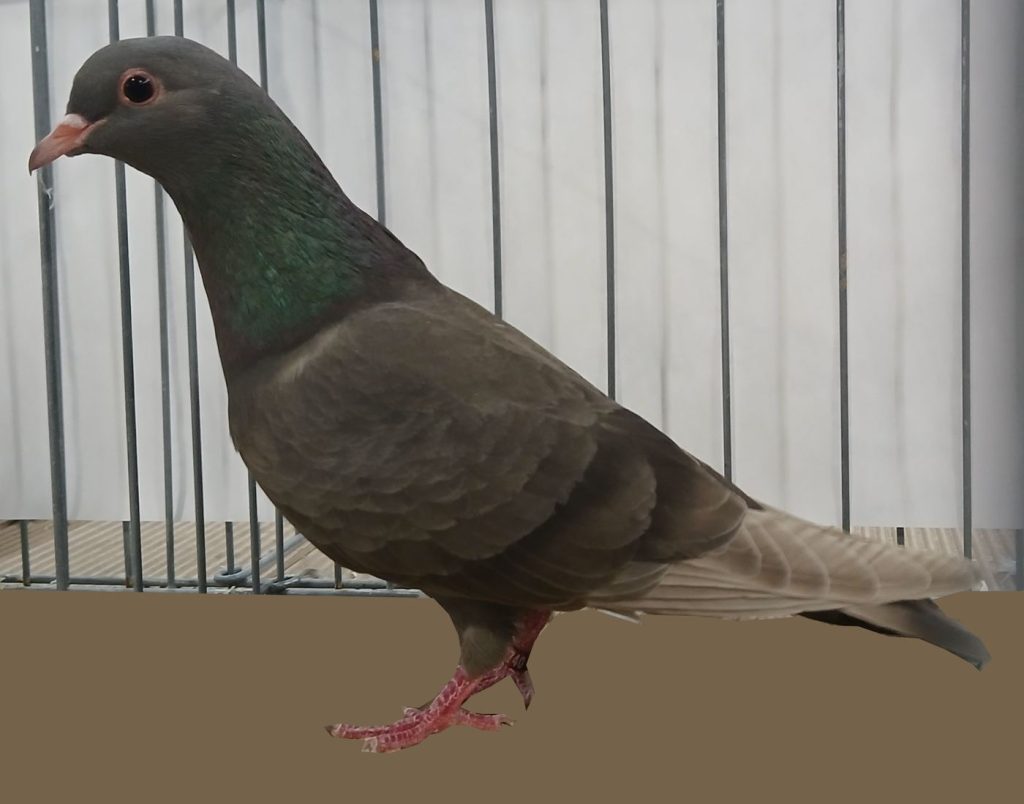
Arabian Trumpeter at a glance
| Feature | Arabian Trumpeter |
|---|---|
| Species | Domestic rock pigeon (Columba livia) |
| Names | Arabische Trommeltaube (German); Tambour d’Arabie (French) |
| Type | Trumpeter / voice pigeon (EE group 0500; breed no. 0514) |
| Standard authority (EE) | Germany (country code D) |
| Origin in the German standard | Saudi Arabia (Mecca), as worded in the September 2010 text |
| Head | Smooth and uncrested; a crest or rosette is a fault |
| Neck | A visible dewlap at the throat is wanted |
| Eyes | Dark in all colours; cere small, grey to pale flesh |
| Feet | Clean-legged; feathers on the legs or toes are a fault |
| Stance | Nearly horizontal, in the German standard |
| Voice | A laughing trumpet or higher, varied drum, unlike the usual trumpeter “wak-wak-wak” |
| Band size | EE list: 7 mm. UK National Pigeon Association: size A (7 mm) |
| German club | Sonderverein der Züchter Arabischer Trommeltauben von 1998 (opens in new tab) |
Origin and history
The EE list of fancy pigeon breeds, in the revision of 1 October 2018, gives Germany as the country responsible for the standard, not as a historic birthplace. The country code is printed in bold when that country is the standard-defining authority. The same list numbers the breed 0514 and sets the ring size at 7 mm.
The German standard, in the September 2010 text, gives the origin as Saudi Arabia (Mecca) and describes the breed as the domestic form of an extinct wild “rock trumpeter”. Matthias Holler brought the first birds that established the breed in Europe from Saudi Arabia, according to a 2008 report for the German specialist club by Roy Arbeider. The same report says the breed has been recognized in Germany since 1964, under a description Holler had published.
Holler’s own account, as retold by Arbeider, traces the bird to an ancestral “field trumpeter” that had already died out about a thousand years ago. That story is the origin wording still used in the German standard, but it is not a finding from modern ornithology. Like other fancy pigeons, the Arabian Trumpeter is a domestic form of the rock pigeon.
Arbeider also notes that later imports from the Middle East can look similar while sounding different, and that European breeders have put more weight on visible points, such as the dewlap and head shape, than breeders in the region of origin, who select mainly for the voice.
The specialist club, the Sonderverein der Züchter Arabischer Trommeltauben (opens in new tab), was founded in 1998. It is a member club of the Verband Deutscher Rassetaubenzüchter (VDT), listed as SV-196.
Dates in the record
- 1964The breed is recognized in Germany, under a description published by Matthias Holler, according to Arbeider (2008).
- 1998The German specialist club, the Sonderverein der Züchter Arabischer Trommeltauben, is founded.
- 2010The German standard text in current circulation is dated September 2010.
- 2018EE list: breed no. 0514, Germany as the standard authority, ring size 7 mm.
Appearance
The NPA standard wants a very small field-pigeon type, lively but calm with people. The German standard describes a small, compact bird with a nearly horizontal stance. Arbeider, writing for the specialist club, calls it the smallest member of the trumpeter group and warns against both a weak, narrow body and a heavy, dumpy one.
The head is smooth, small and oval-rounded. The NPA text likens it to a turtle dove. The German standard asks for a clear angle between the beak and the forehead, with the highest point of the skull above the eyes. The head should fit the body and not look coarse or oversized. Any sign of a crest or rosette is a fault.
The eyes are dark in every colour. The cere is small and should match the colour, from grey to pale flesh; a large or red cere is a fault. The beak is of medium length: flesh-coloured on whites, horn-coloured on other colours, with a slightly darker tip allowed on dark birds. A dark beak is a fault in the NPA standard.
The neck is of medium length. A well-defined dewlap, a fold of skin at the throat, is strongly wanted. Arbeider describes this dewlap as starting at the base of the beak and reaching into the throat, and he distinguishes it from the much heavier wattles of true dewlap breeds. A bird with no dewlap is a serious fault.
The breast is broad, rounded and well filled. The back is broad, of medium length and slightly sloping. The wings are of medium length, cover the back, and rest on the tail without crossing. The tail is of medium length and well closed. The legs are of medium length and clean, with no muffs; nail colour does not matter. The plumage should lie tight and close.
NPA order of evaluation
The standard gives no points scale. Judges work through the bird in this order. The voice should also be heard.
Both the NPA and the German standard ask judges to hear the voice when they can. The NPA note says that judges of this breed should know what an Arabian Trumpeter ought to sound like.
Colours
The two published colour lists are close, but they are not identical.
The NPA names: self-white; black; blue with a black bar, or barless; blue checker; red and yellow with light-coloured flights; dominant red; dominant yellow; mealy; pied in black, blue, dominant red and dominant yellow; red atlas; and yellow atlas.
The German standard of September 2010 names: white; black; dun; blue with black bars; blue checker; red atlas; yellow atlas; dominant red; dominant yellow; bar-marked ash-red (Rotfahl) and ash-yellow (Gelbfahl); and pied in black, blue with black bars, blue checker, dominant red and dominant yellow.
Self colours should be clean and even. Blues may be light or dark. Red atlas has a red neck and upper breast, grey-blue wing shields with darker bars, and a darker tail bar; yellow atlas follows the same pattern in yellow. Pieds should show a fairly even mix of white and colour; a bird with only a few white or coloured feathers is not classed as pied.
The photograph at the top of this page is a brown bird, as labelled by the photographer at the 2026 NPA National. Brown is not named as a class in the NPA list quoted above. Our guide to pigeon colours and genetics explains bars, checkers and the atlas-type neck markings in more detail.
Voice
The voice is the point of the breed. The NPA standard calls it a “laughing trumpet voice” that does not sound like any other breed. The German standard uses the same idea: a peculiar laughing drum that, in this form, occurs in no other pigeon breed. Arbeider says the usual trumpeter “wak-wak-wak” is not what this bird produces. The sound sits higher, and the phrases vary more.
In the September 2023 Pigeon Genetics Newsletter, Gary Young, writing from his own breeding tests, separates this drum from the voice of laugher pigeons. He describes the Arabian Trumpeter’s drum as a rough, starting-engine sound, and the laugher’s call as a squeeze-toy note with a warbling laugh. Both cocks and hens can drum, so the call alone does not tell the sex. In his tests the drumming behaved as an autosomal recessive: first-generation crosses with other breeds did not drum, and back-crossing was needed to recover the voice.
The specialist club still runs a German drumming championship at its main show. Arbeider wrote in 2008 that the contest first measured the length of the drum, not yet its quality. The club’s current programme still lists the championship beside the breed show.
Our page on what sound a pigeon makes covers the ordinary coo.
Arabian, English and Bokhara Trumpeters
All three belong to the trumpeter group, but the Arabian is a plain, clean-legged field pigeon, while the other two are heavily feathered show birds.
| Feature | Arabian Trumpeter | English Trumpeter | Bokhara Trumpeter |
|---|---|---|---|
| Type | Small field pigeon, nearly horizontal | Medium, cobby; back at about 45 degrees | Large and full-bodied, low stance |
| Head | Smooth, uncrested | Crest with rosettes and a tuft over the beak | Large rose over the face and a large shell crest |
| Feet | Clean-legged | Large muffs | Muffed |
| Eyes | Dark in all colours | Orange, or dark in white-headed birds | Pearl, or dark in whites |
| EE ring size | 7 mm (no. 0514, Germany) | 12 mm (no. 0508) | 12 mm (no. 0501, Great Britain) |
Some older accounts, including Holler’s as retold by Arbeider, lumped this breed with laugher pigeons under names such as “Lacher” or “Knock-Kwock”. The official French name in the EE list is Tambour d’Arabie. Some French writers also use Rieur du Soudan, but that label is not the EE name. In the UK the National Pigeon Association ring list for 2019 enters Arabian Trumpeters and Arabian Laughers as two separate items, both in ring size A. Young’s 2023 note argues that the two voices should not be treated as the same breed if the quality of the drum is to be kept.
Care
The breed is clean-legged, so loft floors do not have to be kept dry for the sake of muff feathers, as they do for the English and Bokhara Trumpeters. Birds kept for show should be handled often enough that they stay calm in the pen and will drum when asked. Our types of pigeon guide places the breed among the voice pigeons, and the page on pigeon shows explains how a show is judged.
Frequently asked questions
What is an Arabian Trumpeter pigeon?
It is a small, clean-legged fancy pigeon in the trumpeter group, kept for a laughing, drumming voice. It has a smooth head, dark eyes and a dewlap at the throat, and no crest or muffs.
Where does the Arabian Trumpeter come from?
The EE list assigns the European standard to Germany. The German standard text of September 2010 gives the origin as Saudi Arabia (Mecca). Arbeider’s 2008 club report says Matthias Holler brought the first European stock from Saudi Arabia, and that the breed has been recognized in Germany since 1964.
What does an Arabian Trumpeter sound like?
The NPA and German standards describe a laughing trumpet or laughing drum that does not match other pigeon breeds. Arbeider says it is not the usual trumpeter “wak-wak-wak”: the pitch is higher and the phrases vary more.
How is it different from the English and Bokhara Trumpeters?
Those two are muffed, crested show birds with much heavier head decoration. The Arabian Trumpeter is a small, uncrested, clean-legged field pigeon. The EE list gives it a 7 mm ring; the English and Bokhara Trumpeters are listed at 12 mm.
Is the Arabian Trumpeter the same as a laugher pigeon?
Not in current UK or US breed practice. The UK ring list treats Arabian Trumpeters and Arabian Laughers as separate entries. Gary Young, writing in 2023, describes two different voices and advises against crossing them if the drum is to be kept. Some older European accounts did use laugher names for this breed.