
The English Trumpeter is a fancy pigeon with a crest, a tuft of feathers over the beak and very large muffs on its feet. It is also a trumpeter, one of the pigeon breeds known for a drumming voice instead of a normal coo.
The name says English, but the breed as it is shown today was largely shaped by breeders in the United States. The NPA standard describes a medium-sized, cobby bird with a gentle temperament that breeds freely.
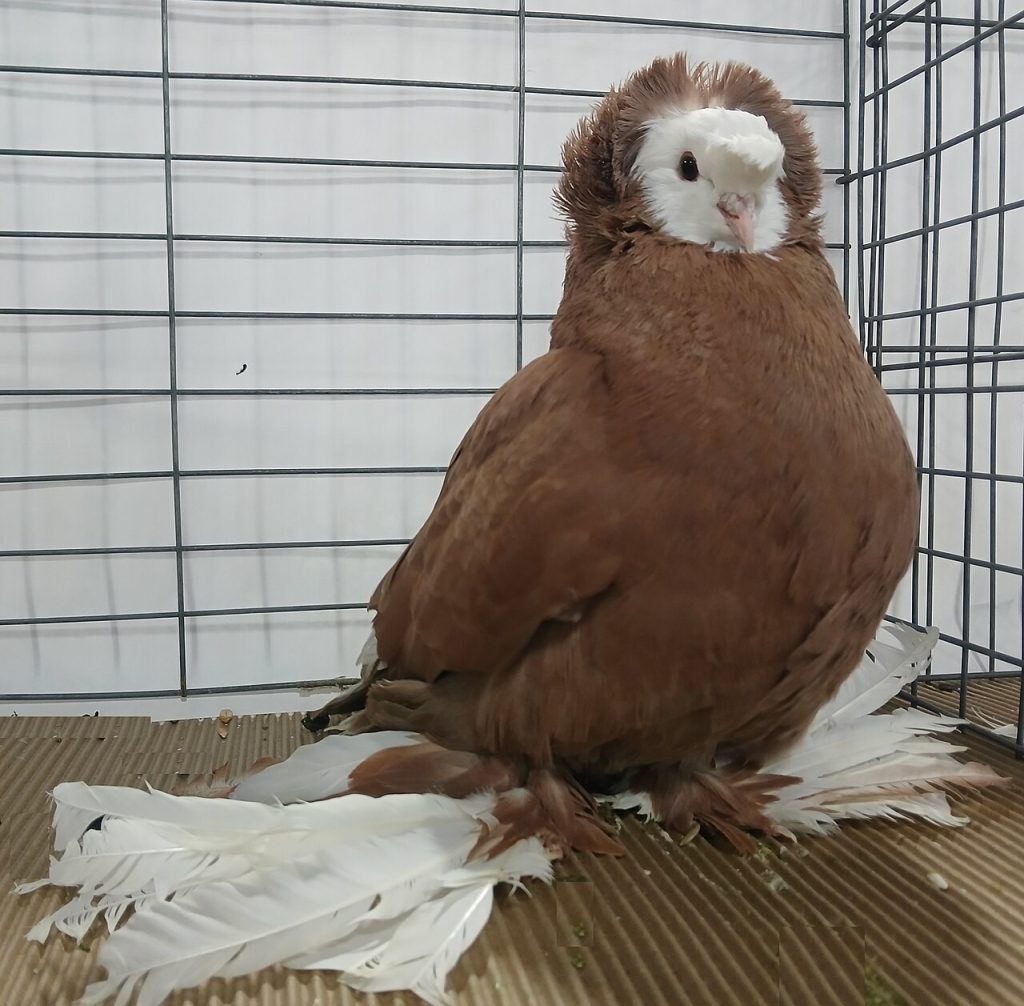
English Trumpeter at a glance
| Feature | English Trumpeter |
|---|---|
| Species | Domestic rock pigeon (Columba livia) |
| Origin | England; the modern show type was developed in the United States |
| First described | John Moore’s Columbarium, 1735 |
| NPA group | Trumpeter Pigeons |
| Size | Medium; the standard compares it with the Show Racer |
| Head | Crest with a rosette at each end, plus a narrow tuft over the beak |
| Feet | Large round muffs in three layers of feathers |
| Patterns | Self, splash, barred and marked |
| Voice | A “drumming” call |
| US breed club | English Trumpeter Club of America, founded 1947 |
Origin and history
The first English description of a trumpeter is in John Moore’s Columbarium (opens in new tab) of 1735. Moore describes a pigeon that was “very feather-footed and legged”, with a crest and “a tuft of feathers growing at the root of the beak”. He wrote that the name came from the bird “imitating the sound of a trumpet”.
The Bokhara Trumpeter reached Britain in the mid-1800s. A history of the breed (opens in new tab) by an American breeder, written in the 1980s, says the older English Trumpeter then went into a steep decline. The same history finds the breed in American show records by 1870.
The modern breed took shape in the US Midwest in the 1940s. Paul Stefanson of Illinois gathered birds sold as English Trumpeters, many of them crossed with other trumpeters, and bred them towards one type. The English Trumpeter Club of America was formed in 1947, and its first detailed standard was written the same year.
English Trumpeter timeline
- 1735John Moore describes the Trumpeter in Columbarium.
- Mid-1800sBokhara Trumpeters reach Britain and the old English type declines.
- 1870English Trumpeters appear in American show records.
- 1923A. B. Warder of Ontario draws up an early standard, published in the American Pigeon Journal.
- Late 1930s to 1940sPaul Stefanson of Illinois breeds mixed stock towards one type.
- 1947The English Trumpeter Club of America is founded, and the first detailed modern standard is written.
- 1964The English Trumpeter Club of Canada is formed.
- 1979The National English Trumpeter Club is formed.
The crest, the tuft and the muffs
The crest sits on the highest point at the back of the head. Seen from above, it wraps around the head in a half circle and ends in a rosette on each side, near the ear. The NPA standard gives each rosette a diameter of about half an inch.
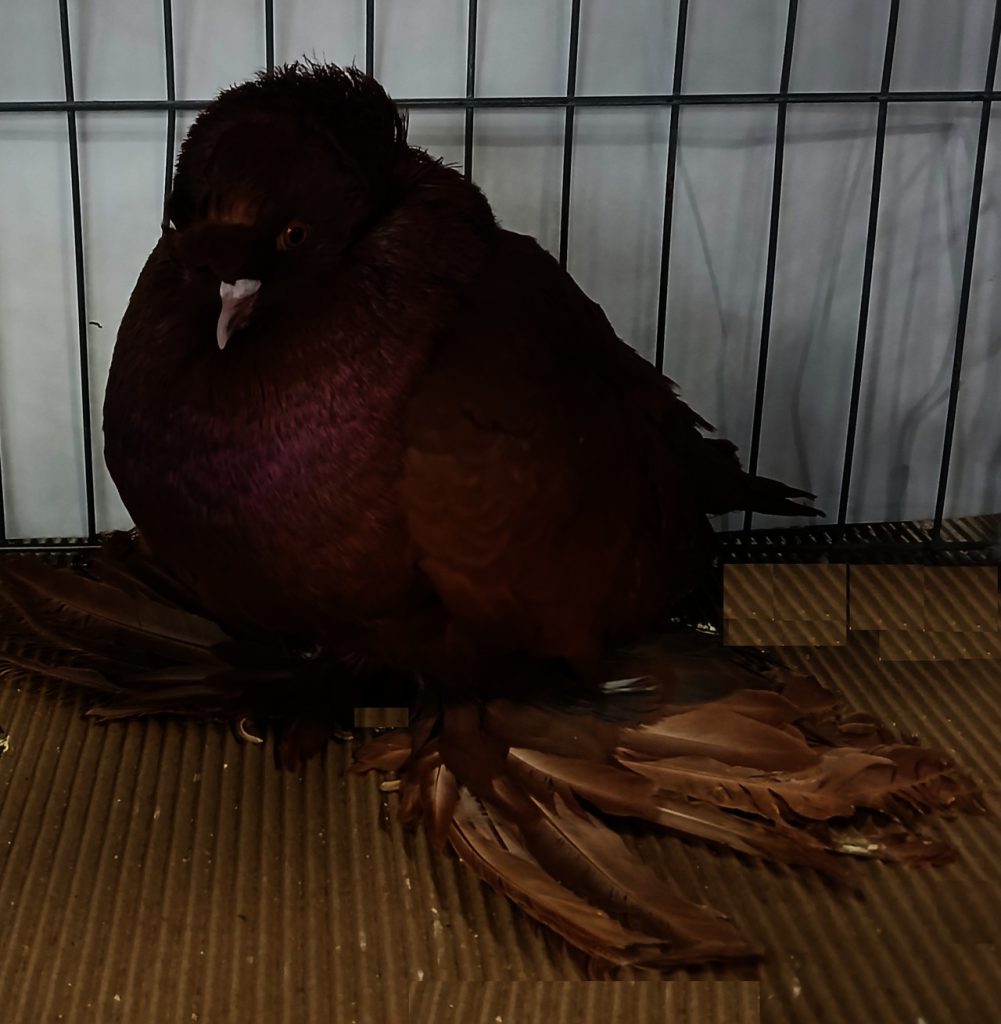
The tuft grows from the front of the head and curves over the wattle. Dense feathers on each side of the beak, called sideboards, hold it in place. The standard wants a neat, narrow tuft. A round, rose-shaped tuft like the Bokhara’s counts as a fault.
The muffs are made of three layers of feathers in circular rows. They should be round, dense and lie flat on the floor, with the feet and toes completely hidden. The bird must still be able to walk without stumbling.
Body and stance
The body is short, cobby and heart-shaped when seen from behind, with broad shoulders. The back sits at 45 degrees to the ground and the tail tip should almost touch the floor. The chest is full and deep, so no daylight shows between the legs.
Measurements in the standard
Figures from the NPA standard, in inches, with centimetres in brackets.
The back should sit at 45 degrees to the ground, and the tail should be 1 to 1.5 feathers wide.
The standard also scores style. It describes the ideal bird as one unit with a slight “S” curve, rather than a set of separate parts. A bird that sits listlessly in the pen loses points, however good its feathers.
Scale of points
Out of 100 points, 38 go to the crest, tuft, rosettes, mane, muffs and hocks. Body carries the biggest single score, with 20 points.
Where the 100 points go
- Crest, tuft, rosettes, mane, muffs and hocks: 38
- Body, neck, station and style: 40
- Head and eyes: 12
- Colour: 10
Disqualifications include signs of crossbreeding, a stained beak in a white bird, plucking or scissoring feathers, and three or more flights or tail feathers that are missing or not fully grown.
Colours and eye colour
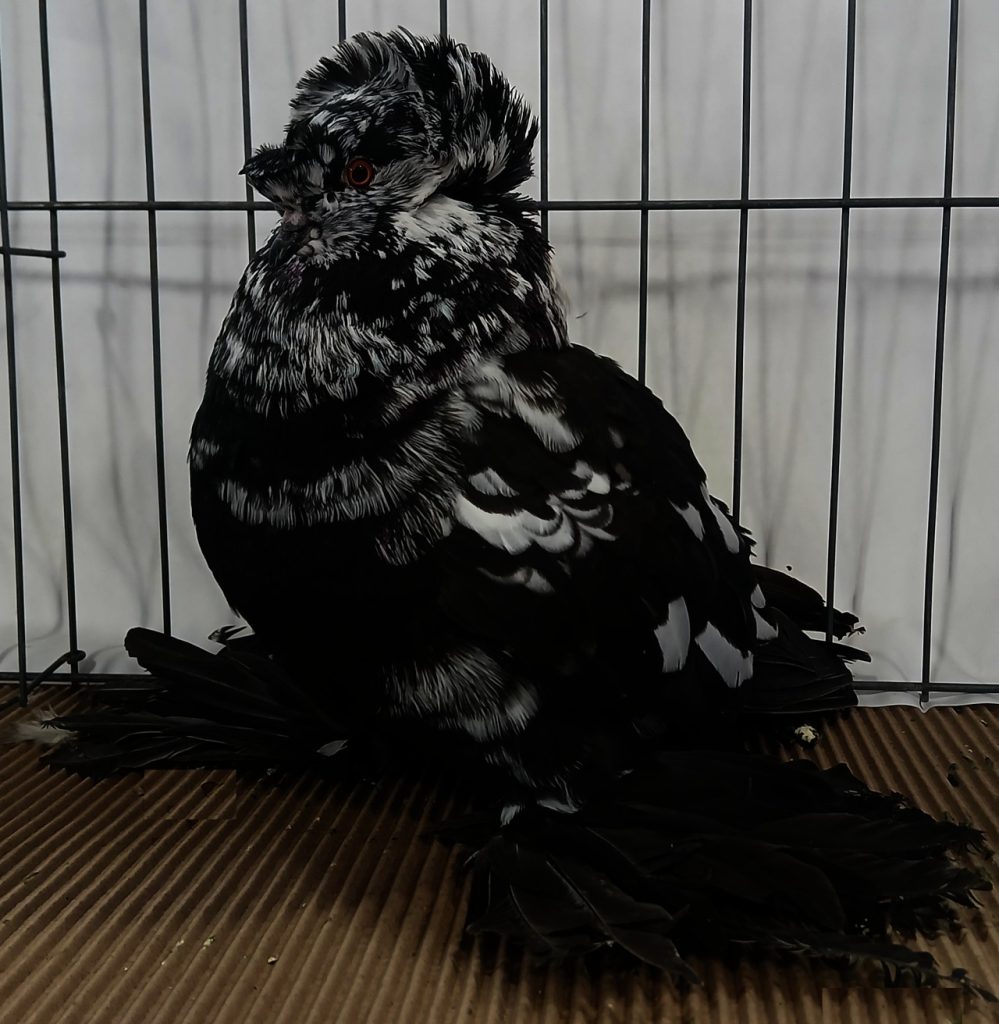
English Trumpeters come in four basic patterns: self, splash, barred and marked. The NPA standard names these colour classes.
Self and barred colour classes
- Black
- White
- Red
- Yellow
- Dun
- Lavender
- Blue bar
- Silver
- Mealy
- Cream
Other classes
- Andalusian
- Almond
- Splash
- Whiteside
- Mottle
- Baldhead
- Barless
- AOC self
Eye colour
- Deep orange: most colours
- Dark bull eye: whites, baldheads, saddles and other white-headed birds
Swatches are approximate and only show the general shade.
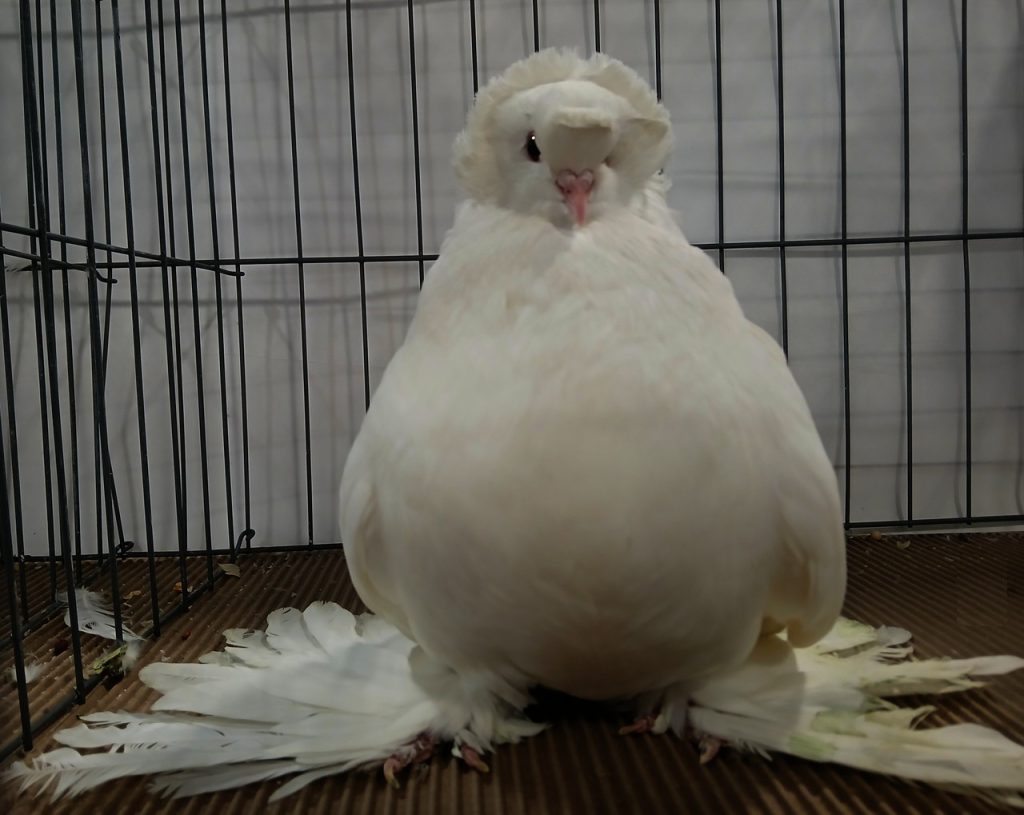
Eye colour follows the head feathers. Most colours should have deep orange eyes. Whites, baldheads, saddles and other birds with white heads should have dark “bull” eyes. Our guide to pigeon colours and genetics explains how these colours are inherited.
English Trumpeter and Bokhara Trumpeter
Both breeds have feathered feet and a decorated head, and they share trumpeter ancestry. The NPA standards describe two quite different birds.
| Feature | English Trumpeter | Bokhara Trumpeter |
|---|---|---|
| Size | Medium, compared with the Show Racer | Large and full-bodied |
| Stance | Back at 45 degrees to the ground | Low, close to parallel with the ground |
| Front of head | Narrow tuft held by sideboards | Large, flat, round rose that covers the eyes and beak |
| Back of head | Half-circle crest ending in rosettes | Very large shell crest reaching to the throat |
| Feathering | Hard, dense feathers | Profuse, soft, long feathers |
Voice
Trumpeters are kept partly for their call. The NPA standard calls the English Trumpeter’s voice a rich “drumming”. The University of Utah’s Genetic Science Learning Center (opens in new tab) notes that the trumpeter song is inherited, not learned. Our page on pigeon sounds covers the normal coo.
Care and breeding
The standard describes the breed as gentle and a prolific breeder. The heavy muffs are the main care point. Keep loft floors dry and clean, because wet or dirty floors spoil the foot feathers.
Feed a seed mix suited to fancy pigeons, with grit and clean water. Our guide to what pigeons eat has the details. Regular baths help keep feathers in show condition.
Quick facts for keepers
- Gentle temperament
- Prolific breeder
- Large muffs: keep floors dry
- Orange or bull eyes, by colour
- Exactly 12 tail feathers
- Drumming voice
The hen usually lays two eggs, which take about 17 to 19 days to hatch.
Clubs and shows
The English Trumpeter Club of America has promoted the breed since 1947. The NPA standard is in the NPA Book of Standards (opens in new tab). Our guide to pigeon shows explains how judging works.
For other feather breeds, see the Jacobin and our types of pigeon guide. The West of England Tumbler is another muffed show breed.
English Trumpeter FAQs
What is an English Trumpeter pigeon?
It is a fancy pigeon with a crest, a tuft over the beak and large muffed feet. It belongs to the trumpeter group, known for a drumming voice.
Why is it called a trumpeter?
The name refers to its call. In 1735 John Moore wrote that trumpeters were named for “imitating the sound of a trumpet”.
Is the English Trumpeter from England?
The old breed was English, but the modern show type was developed mainly in the United States from the 1940s, after the English Trumpeter Club of America was founded in 1947.
How many points do the muffs get?
Muffs and hocks together get 14 of the 100 points in the NPA standard. Only the body, with 20, scores higher.
What is the difference between an English Trumpeter and a Bokhara Trumpeter?
The English Trumpeter is medium-sized, with a narrow tuft and a half-circle crest. The Bokhara is larger and lower, with a big round rose over the beak and a shell crest.
What eye colour should an English Trumpeter have?
Deep orange in most colours. Whites, baldheads, saddles and other birds with white heads should have dark bull eyes.