
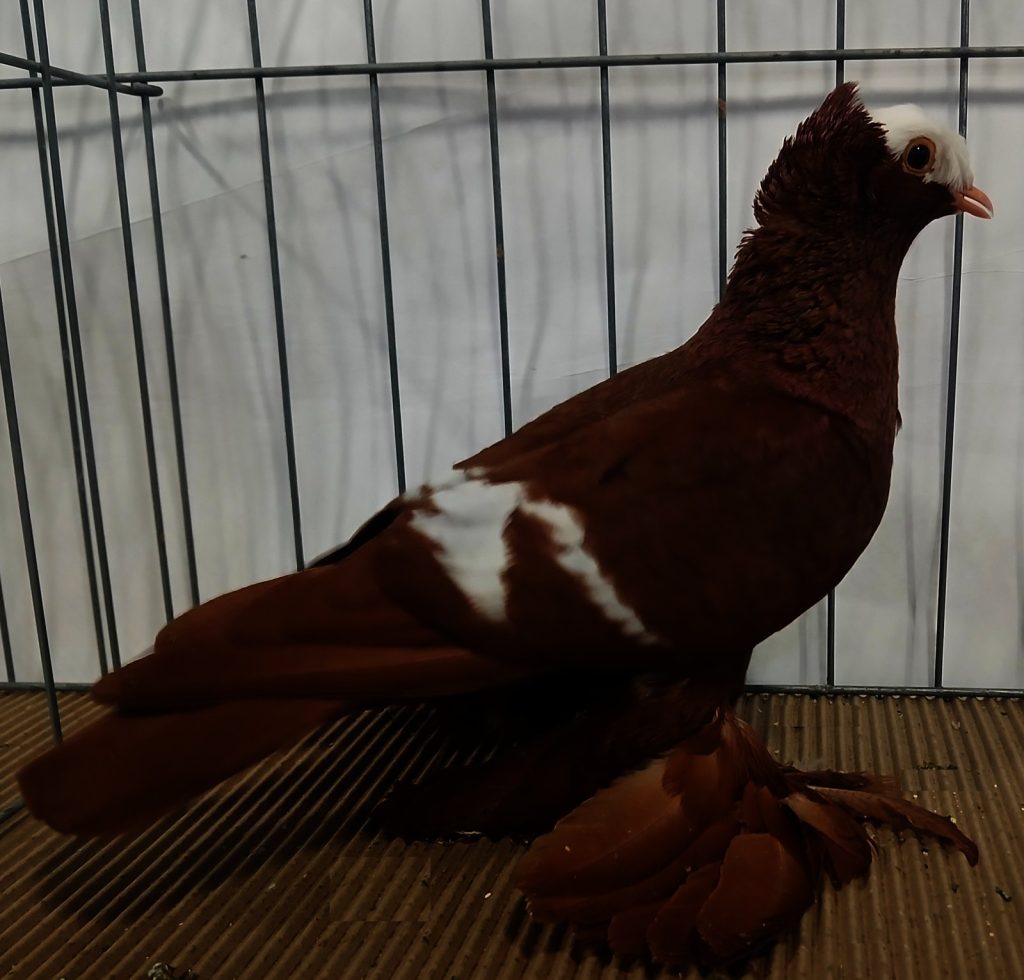
The Saxon Priest is a German colour pigeon from Saxony. It is a strong, low-standing bird with long muffs on its feet, and it always has two crests: a shell crest at the back of the head and a small crest over the beak. In German it is called the Sächsische Pfaffentaube.
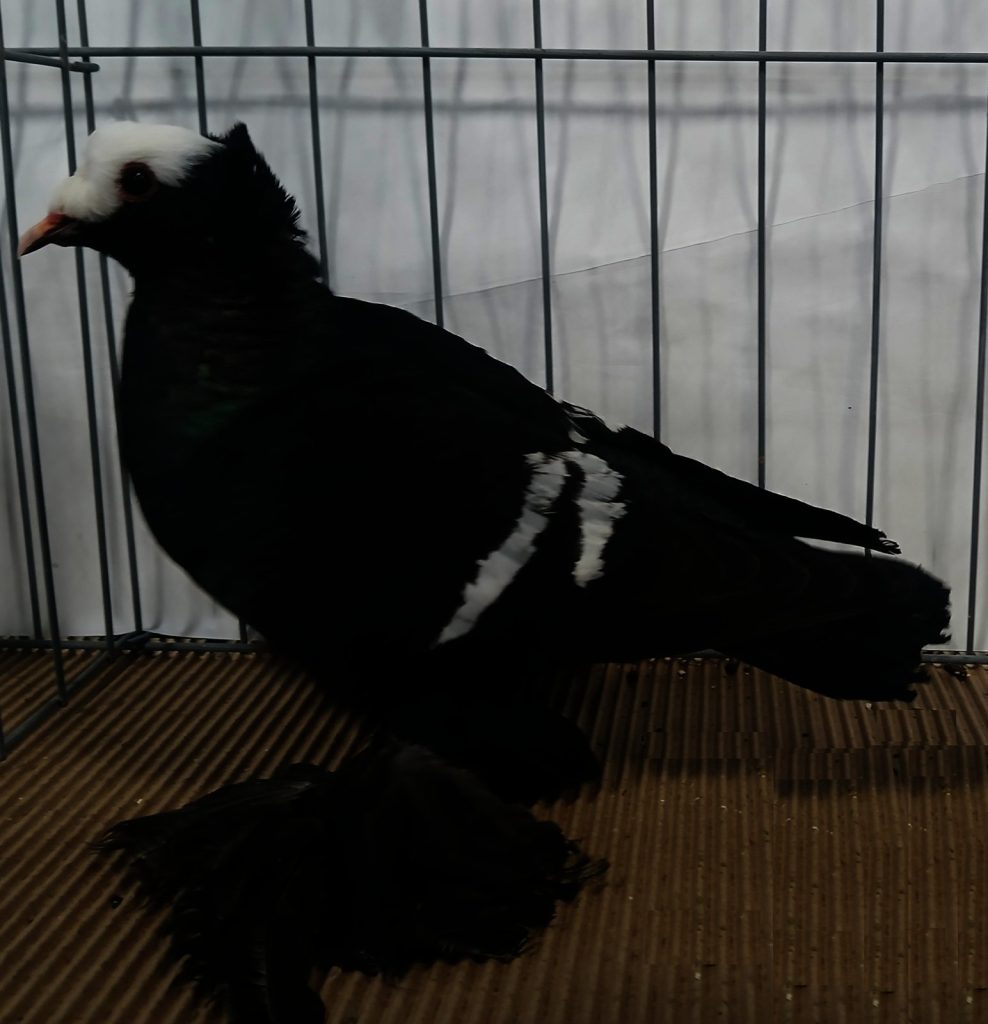
The top of the head is pure white and the rest of the plumage is coloured, with white bars or white spangles on the wings. It is one of the Saxon Colour pigeons, a group of breeds with the same field-pigeon build and different markings.
Saxon Priest at a glance
| Feature | Saxon Priest |
|---|---|
| Species | Domestic rock pigeon (Columba livia) |
| Origin | Saxony, Germany |
| Probable ancestors | Blaze pigeons (Blassen) and trumpeter pigeons |
| NPA group | Colour pigeons |
| Head | Always double crested: shell crest plus beak crest |
| Colours | Black, red, yellow, blue and silver, with white bars or spangles; blue also barless |
| Eyes | Dark |
| Feet | Long, curved muffs and well-developed hock feathers |
| Band size (NPA) | 11 |
| German club | Sonderverein der Züchter Sächsischer Farbentauben von 1895 (opens in new tab) |
Origin and history
The NPA standard gives Saxony as the home of the breed and says it was probably bred from blaze pigeons and trumpeter pigeons. The German breed description from the VDT, the German association of fancy pigeon breeders, says the same.
The breed is old. Gottlob Neumeister’s book Das Ganze der Taubenzucht has a colour plate titled Die Pfaffen-Taube, and the plate dates from 1876 at the latest. Gustav Prütz included the Pfaffentaube in his Illustrirtes Mustertauben-Buch in the mid-1880s, and Emil Schachtzabel painted it among his breed plates of 1906.
In Germany the Saxon Colour pigeons have had their own specialist club since 1895. The club looks after ten Saxon Colour breeds, of which the Priest is one.
Saxon Priest timeline
- By 1876Gottlob Neumeister’s Das Ganze der Taubenzucht includes a plate titled Die Pfaffen-Taube.
- 1884 to 1886Gustav Prütz’s Illustrirtes Mustertauben-Buch shows the Pfaffentaube on a colour plate.
- 1895The specialist club for the Saxon Colour pigeons is founded in Germany.
- 1906Emil Schachtzabel’s colour plates of pigeon breeds include the Saxon Priest.
- 2022Date of the Saxon Priest page in the current NPA Book of Standards.
- January 2026Saxon Priests are shown at the NPA National show in the United States.
The double crest
The head is what makes a Priest. The shell crest sits across the back of the head and ends in a rosette on each side. Over the beak there is a second crest, shaped like a carnation. It should stand up far enough that it never hides the eyes.
The head, feature by feature
What the NPA standard asks for on the head, the part of the bird that gives the breed its look.
The white cap is part of the marking. Only the top of the head is white, from the beak line back to the base of the crest, and the beak crest is white too. Everything else on the bird is coloured, apart from the white wing bars or spangles.
The English Trumpeter is another breed with a crest at the back of the head and a tuft over the beak, and it also has large muffs. Our English Trumpeter guide covers that breed.
Body, muffs and stance
The standard asks for a strong field-pigeon shape with a low station. The back is long and slopes gently down from broad shoulders. The wings are long and well closed over the back, and the tail is long and closed.
The legs are set low, with long, well-curved muff feathers and well-developed hock feathers. A weak body, a drooping attitude or standing too high are all listed as bad faults.
Colours and markings
Priests come in five colours: black, red, yellow, blue and silver. Every colour can have white bars or white spangles, and blues can also be barless.
Colours and patterns in the standard
A dot means the colour is listed with that pattern.
| Colour | White bars | Spangle | Barless |
|---|---|---|---|
| Black | ● | ● | – |
| Red | ● | ● | – |
| Yellow | ● | ● | – |
| Blue | ● | ● | ● |
| Silver | ● | ● | – |
Swatches are approximate and only show the general shade.
The standard wants blacks, reds and yellows as glossy and rich as possible. Blues and silvers should be a light, soft tone, with darker shading only on the neck, flights and tail bar. White bars should be long, narrow and well separated. Spangles should be small triangles spread evenly over the wing covers.
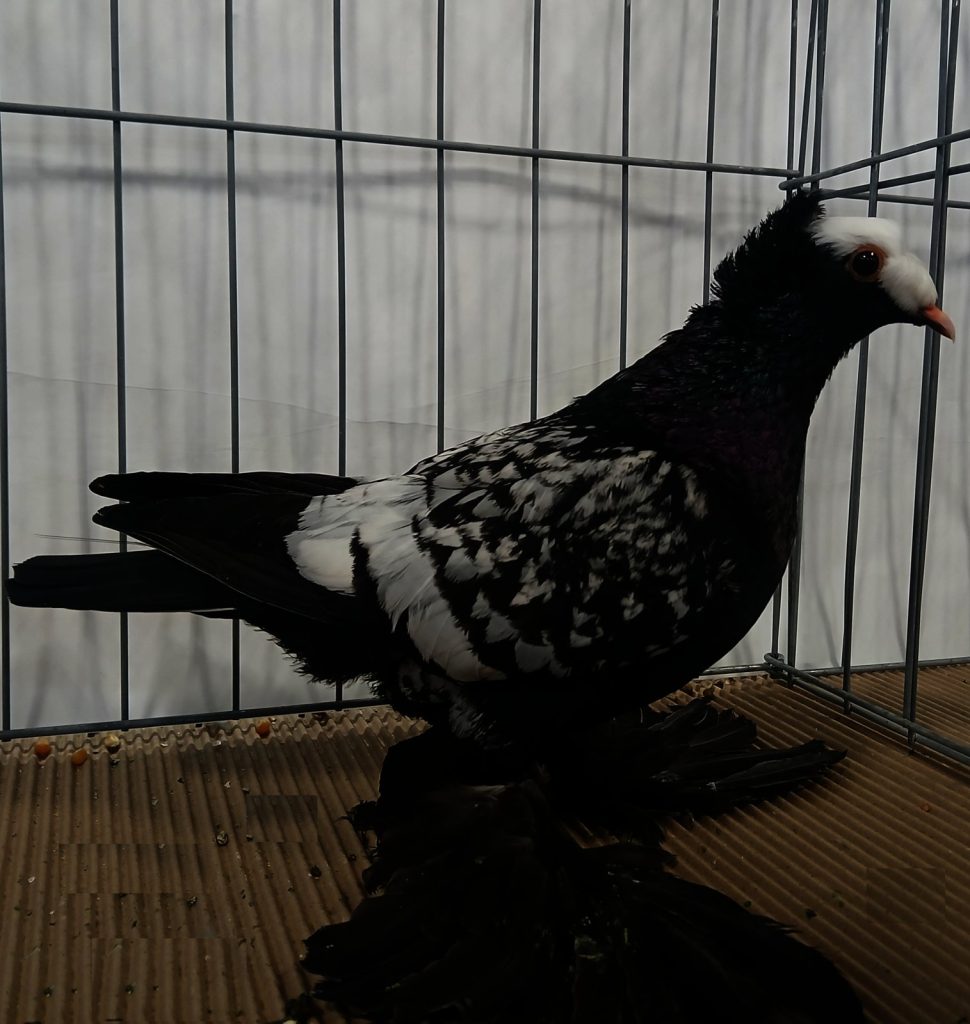
Bad colour faults include rusty or peppered bars, dark beaks on reds or yellows, and blues with a copper-coloured chest. Our guide to pigeon colours and genetics explains bars, spread colours and other patterns.
How a Priest is judged
The NPA standard gives no points scale for this breed. Instead it sets an order of evaluation, so the judge looks at the overall bird first and the eye and beak colour last.
How judges assess a Saxon Priest
The order of evaluation in the standard, from first to last.
A narrow or capping crest is a bad fault, and so is a beak crest that blocks the bird’s view. Small dark marks on the upper beak under the beak crest are not treated as bad faults, especially in older birds.
The Saxon Colour family
The Priest is one of several Saxon Colour breeds in the NPA book. They share the same strong, muffed field-pigeon type and differ mainly in head shape and markings.
| Breed | Head | Main marking |
|---|---|---|
| Saxon Priest | Always double crested | Coloured bird with a white cap; white bars or spangles |
| Saxon Monk | Smooth | White head, white flights, tail and muffs; coloured body |
| Saxon Shield | Plain, shell crested or double crested | White bird with coloured wing shields |
| Saxon Spot | Crested or smooth | White bird with a coloured forehead spot and tail |
| Saxon Whitetail | Always smooth | Coloured bird with a white tail |
| Saxon Breast | Smooth | Coloured head, neck and breast; the rest white |
Source: NPA Book of Standards, Saxon Colour pigeon standards.
The Archangel is another German colour pigeon, kept for its metallic colours rather than its feathering. Our Tiger Swallow guide explains why some swallow pigeons are called Saxon fairy swallows.
Care
A Priest needs what most fancy pigeons need: a dry, airy loft, clean water, a good seed mix and grit. Our guide to what pigeons eat covers the diet.
Quick facts for keepers
- Always double crested
- Low station
- Long, curved muffs
- Dark eyes
- Flesh-coloured beak
- Band size 11
- One of 10 Saxon Colour breeds
The long muffs are the part that needs most care. Keep loft floors dry and clean so the foot feathers do not soil or break, and give the birds regular baths. Short or damaged muffs count against a bird at a show.
Clubs and shows
In Germany the breed is looked after by the Sonderverein der Züchter Sächsischer Farbentauben von 1895 (opens in new tab). In the UK the National Pigeon Association lists Saxon breeds in the colour section of its judges list and show guidance (opens in new tab).
The American standard is in the NPA Book of Standards (opens in new tab). Our guide to pigeon shows explains classes and judging, and our types of pigeon guide lists other breeds.
Saxon Priest FAQs
What is a Saxon Priest pigeon?
It is a German colour pigeon from Saxony with a low, strong body, long muffs and two crests. The top of the head is white and the rest of the bird is coloured, with white wing bars or spangles.
Why does the Saxon Priest have two crests?
The double crest is a fixed feature of the breed. The standard asks for a shell crest at the back of the head and a carnation-shaped beak crest, and a bird without both is not a correct Priest.
What colours do Saxon Priests come in?
Black, red, yellow, blue and silver, each with white bars or spangles. Blues are also accepted without bars.
What eye colour should a Saxon Priest have?
Dark eyes, with a narrow cere that is pale to reddish.
Is the Saxon Priest a good flyer?
It is kept as a show bird. The standard describes a field-pigeon shape with low station and heavy muffs, and it says nothing about flying ability.
How is the Saxon Priest related to other Saxon pigeons?
It belongs to the Saxon Colour pigeons, a group of breeds from Saxony with the same muffed field-pigeon type. The Priest differs from the others by its double crest and white cap.