
The Archangel is a colour pigeon, called the Gimpel in Germany, known for a metallic bronze head and body set against black, blue or white wings. Cocks weigh 12 to 16 oz (about 340 to 450 g) and hens 10 to 14 oz (about 280 to 400 g). Birds may be peak crested or plain headed.
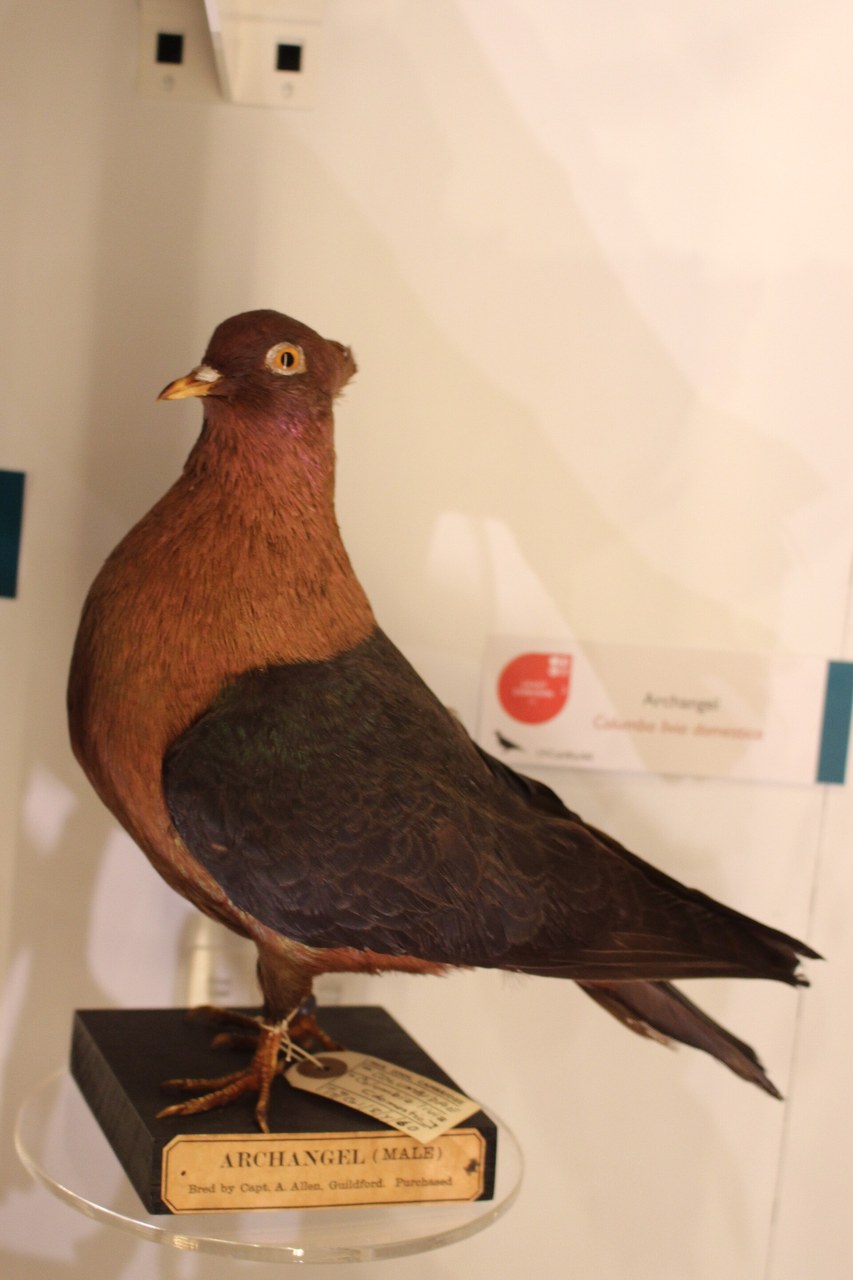
What an Archangel looks like
The NPA standard describes a hardy, sprightly, closely feathered bird of medium build. The chest is fairly broad and the body tapers back to the tail, which gives a long, slender look.
Cocks are somewhat larger and bolder than hens. The stance is fairly upright, and the tail is carried just below horizontal and should never touch the floor.
Head, crest, eyes and beak
The head is long, narrow and slightly arched, with a fairly flat forehead. In crested birds the peak starts at the back of the shoulders and rises to a sharp cone set high and centred on the back of the head.
The eyes are dark orange, though bull eyes are allowed in monk and priest marked birds. The beak is fairly long, slightly bent down at the tip, and horn coloured in black-wings.
Wings, tail and legs
The wings are fairly long, held tight and rest above the tail without crossing. The narrow tail has twelve feathers, is about two feathers wide and is held about half an inch off the floor.
The legs are clean, coral red to brown and not too long. Long-legged or squatty birds are faulted.
Weight in the NPA standard
Ounces, with grams in brackets.
Cocks are a little larger and bolder looking than hens.
Bronze and wing colours
The Archangel bronze pattern covers the head, neck, breast, belly, shanks and undertail wedge. The wings, back, rump and tail carry the base colour, and the line between the two should be sharp.
| Colour | What the NPA standard asks for |
|---|---|
| Dark bronze | Deep, brilliant copper bronze with a copper to pink iridescent sheen; no green or plum tones |
| Light bronze | Even golden yellow on the bronze areas |
| Black wing | Dense black with as much beetle-green sheen as possible |
| Blue wing | Even blue shield with dark flight tips and a blue tail bar |
| White wing | Pure white wings, back, rump and tail |
Bars, no bars, chequers, T-pattern and solid shields are all accepted. Any other base colour is allowed too, but the standard reminds breeders that poorly coloured birds are heavily faulted.
White markings
- White flights: the same number in each wing, from 5 to 10
- Priest marked: a white cap with a line through the centre of the eye and between the mandibles (the Saxon Priest, a German colour pigeon from Saxony, has a similar white cap)
- Monk marked: a white head reaching below the beak, plus white flights and tail
- White tail: white main tail feathers with bronze kept on the belly and undertail
The bronze colour itself is not the same as the bronze on wild bronzewings such as the common bronzewing. It is a domestic pattern, and our guide to pigeon colours and genetics explains how base colours and modifiers work.
Colours, patterns and white markings
- Dark bronze
- Light bronze
- Black wing
- Blue wing
- White wing
Wing patterns
- Bars
- No bars
- Checkers
- T-pattern
- Solid shield
White markings
- 5 to 10 white flights, the same in each wing
- Priest marked
- Monk marked
- White tail
Eyes
- Dark orange
- Bull eyes are allowed in monk and priest marked birds
Swatches are approximate and only show the general shade.
How Archangels are judged
The American Archangel Club standard, approved in August 2020, tells judges to put 80% of the weight on colour and 20% on structure.
The club grades each bird on its own merit. “Excellent” is 97 points, “Highly Superior” 96, “Superior” 93 to 95 and “Good” 91 to 92, and the club says most entries at a show should get Superior. The recommended band is 7 mm.
How the American club grades a bird
- 97Excellent
- 96Highly superior
- 93–95Superior: most entries at a show should get this grade
- 91–92Good
Each bird is graded on its own merit. The recommended band size is 7 mm.
Origin and names
The German breed association (VDT) gives the probable origin as Dalmatia or Illyria in the Balkans. It says the copper black-wing, known in English as the Archangel, was refined in England, and the other colours in Germany.
The German breed club, the Sonderverein der Gimpeltaubenzüchter, dates from 1910. The French national breed list calls the breed Bouvreuil and gives Germany as the country of the standard.
In 1868 Darwin listed Archangels among the “toy-pigeons”, breeds that he said differ from the rock pigeon “in little except in colour”. Today the breed is kept mainly for pigeon shows.
Keeping Archangels
The Archangel is one of the pigeon breeds bred for exhibition. Like other pet pigeons, it needs a dry, clean loft, fresh water, grit and a grain mix.
Because sheen and colour count for so much, feather condition matters at show time. The standard asks judges to heavily fault any bird in poor condition.
Archangel pigeon questions
What is an Archangel pigeon?
A colour pigeon with a metallic bronze head and body and black, blue or white wings. It is called the Gimpel in Germany and Bouvreuil in France, and is shown mainly for its colour and sheen.
How big is an Archangel pigeon?
The NPA standard gives 12 to 16 oz (about 340 to 450 g) for cocks and 10 to 14 oz (about 280 to 400 g) for hens. The body is medium in build, long and slender.
Where does the Archangel pigeon come from?
The German breed association gives its probable origin as Dalmatia or Illyria. The copper black-wing was refined in England and the other colours in Germany.
What colours do Archangel pigeons come in?
The bronze is dark or light. Wings are black, blue or white, with bars, chequers or solid shields, and white flight, priest, monk and white-tail markings are all recognised.
Do all Archangels have a crest?
No. The NPA standard allows both peak-crested and plain-headed birds. A crest should be a sharp, centred point with no breaks, and a shell crest is a fault.
Sources
This page follows these breed standards and breed organisations:
- National Pigeon Association, Book of Standards (April 2025 edition), Archangel standard (2022): weights, head, crest, eyes, tail, bronze pattern, base colours and white markings (opens in new tab)
- American Archangel Club, The Archangel Standard (approved August 2020): 80/20 judging weight, grading points and 7 mm band (opens in new tab)
- Verband Deutscher Rassetaubenzüchter, Gimpeltauben: probable origin, refinement in England and Germany, breed club of 1910 (opens in new tab)
- Société Nationale de Colombiculture, list of recognised breeds: Bouvreuil, Germany, colour pigeon group (opens in new tab)
- Charles Darwin, The Variation of Animals and Plants under Domestication, vol. 1 (1868): Archangels among the toy-pigeons (opens in new tab)
Last updated 15 November 2026 · Fancy breeds, Types