
The West of England Tumbler is a fancy pigeon from Bristol and the West Country of England. It was bred as a high-flying tumbler, and today most birds are kept for showing. Breeders usually call it the “West”.
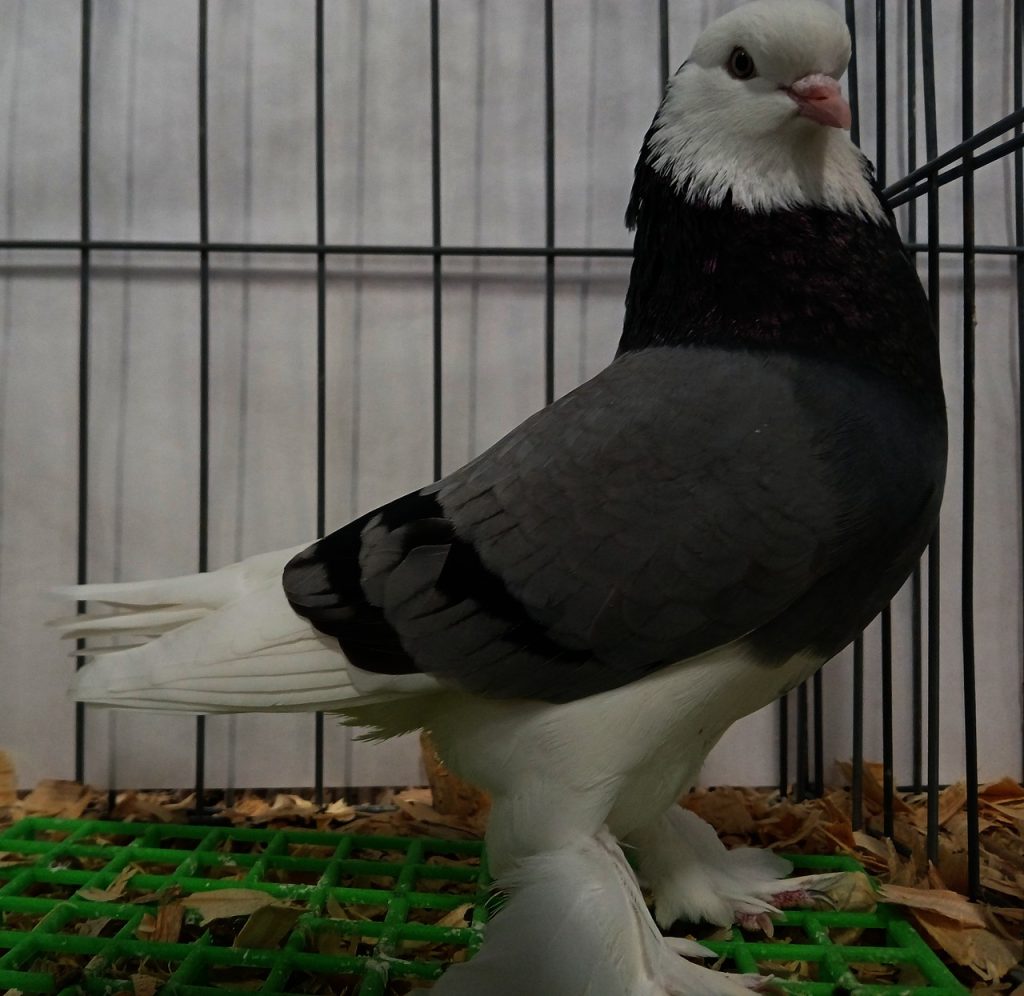
A good West stands upright at about 45 degrees, with a full chest, pearl-white eyes and medium muffs on its feet. It comes in a long list of colours and markings, from black selfs to baldheads and mottles.
West of England Tumbler at a glance
| Feature | West of England Tumbler |
|---|---|
| Species | Domestic rock pigeon (Columba livia) |
| Origin | Bristol and the West Country, England |
| Named as a breed | Late 1880s to 1890s |
| Bred from | The old English Flying Tumbler |
| NPA group | Tumblers, Rollers and High Flyers |
| Weight (NPA) | Cocks about 11 to 12 oz (310 to 340 g); hens about 9 to 10 oz (255 to 285 g) |
| Height (NPA) | Cocks about 9 in (23 cm); hens about 8.5 in (22 cm) |
| Eyes | Pearl to white; any other colour disqualifies |
| Feet | Medium muffs, about 3 to 3.5 in (8 to 9 cm) long |
| US breed club | National West of England Tumbler Club (opens in new tab) |
Origin and history
The West comes from the same root as the Birmingham Roller and the Tippler. All three were bred from the old English Flying Tumbler, and until around 1890 they were all simply called tumblers. Bristol fanciers then selected their own line for high flying and tumbling.
Chuck Zeller, a long-time member of the National West of England Tumbler Club, wrote a history of the breed in America in 2008. He dates the name West of England Tumbler to the late 1880s or 1890s. He also lists the Dutch Tumbler, the Cumulet and Oriental and Persian Rollers in the background of the old flying tumbler.
According to Zeller, the first Wests reached Southern California in 1913. Three more imports followed in 1916, 1920 and 1925, mostly baldheads plus some red and yellow mottles. American fanciers later crossed them with other tumblers and rollers to add colours, performance or bigger muffs.
West of England Tumbler timeline
- Mid to late 1800sEnglish flying tumblers split into the lines that became the West, the Birmingham Roller and the Tippler.
- Late 1880s to 1890sThe name West of England Tumbler comes into use for the Bristol birds.
- 1913The first Wests are imported to Southern California.
- 1916, 1920, 1925Three more imports, mostly baldheads plus red and yellow mottles.
- Early 1950sLeslie F. Stroud develops a separate Show West in California. It fades out after 1968.
- 1969The Southern California Flying West of England Tumbler Club holds its first show.
- 1972The club is renamed the National West of England Tumbler Club.
- 1999The NPA accepts an updated written standard.
- 2023The club approves a new standard drawing.
From flying tumbler to show bird
The West was bred to fly high and tumble. Zeller writes that from about 1975 it became mainly a show breed in America. City rules on pigeon keeping and smaller gardens made flying harder, and new fanciers often met the breed at shows rather than in the air.
He also notes that Wests in Britain were becoming more of a show breed. Some keepers still fly them, but the written standards now describe a show bird. Our guide to why tumbler pigeons tumble covers what is known about the tumbling itself.
Size and weight
The NPA standard describes a medium bird that should not look bulky or heavy. Cocks weigh about 11 to 12 oz and hens about 9 to 10 oz. The chart compares those weights with other flying breeds on our site, using the weights in each breed’s NPA standard.
Standard weights compared
Weight ranges from each breed’s NPA standard, in ounces. Highlighted rows are the West.
The West sits between the light Parlor Roller and the heavier Oriental Roller. It is much lighter than a racing homer.
What judges look for
The standard asks for a wedge-shaped body with broad shoulders and a full, rounded chest. Standing at attention, the body should be at about 45 degrees to the floor, with the tail tip about half an inch from the floor and the eyes over the front toes.
Measurements in the standard
Figures from the NPA standard, in inches, with centimetres in brackets.
Standing at attention, the body should be at about 45 degrees to the floor.
The head is oval, of medium size, with a fairly high, rounded forehead. The eyes must be pearl to white. A bull or cracked eye, or a yellow, orange or red eye, disqualifies the bird. So does a tail with 13 or more feathers, since the standard allows exactly 12.
The muffs should be full but not too profuse, and should not form a half circle. The front toes are covered by short feathering, and there should be a clear break between the muffs and the hock feathers.
Scale of points
The NPA standard gives 100 points. Body and condition carry the most, with 15 points each. Colour and markings together make up 20.
Where the 100 points go
- Body, carriage and condition: 40
- Head, eyes, beak and neck: 24
- Colour and markings: 20
- Flights, tail, legs, muffs and hocks: 16
Major faults include refusing to stand properly in the show pen, flights held below the tail and “razor back” flights that stick up above the wing shield.
Colours and markings
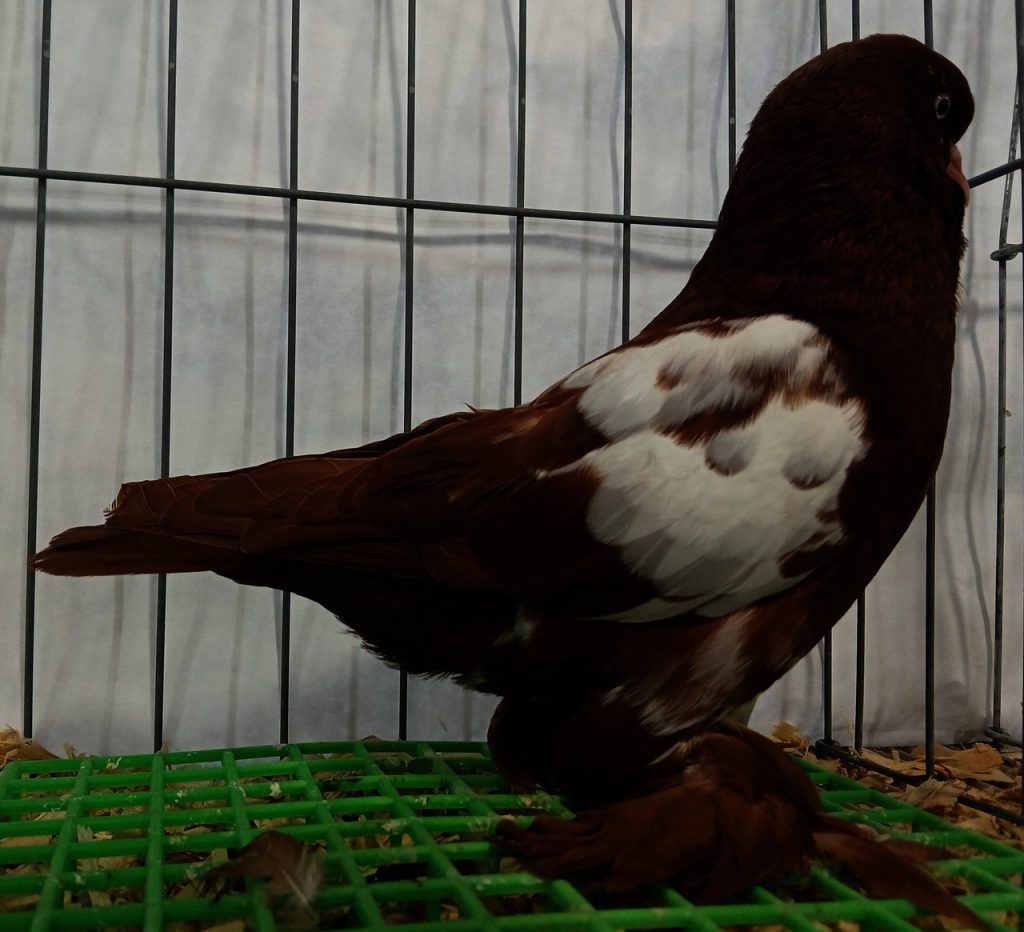
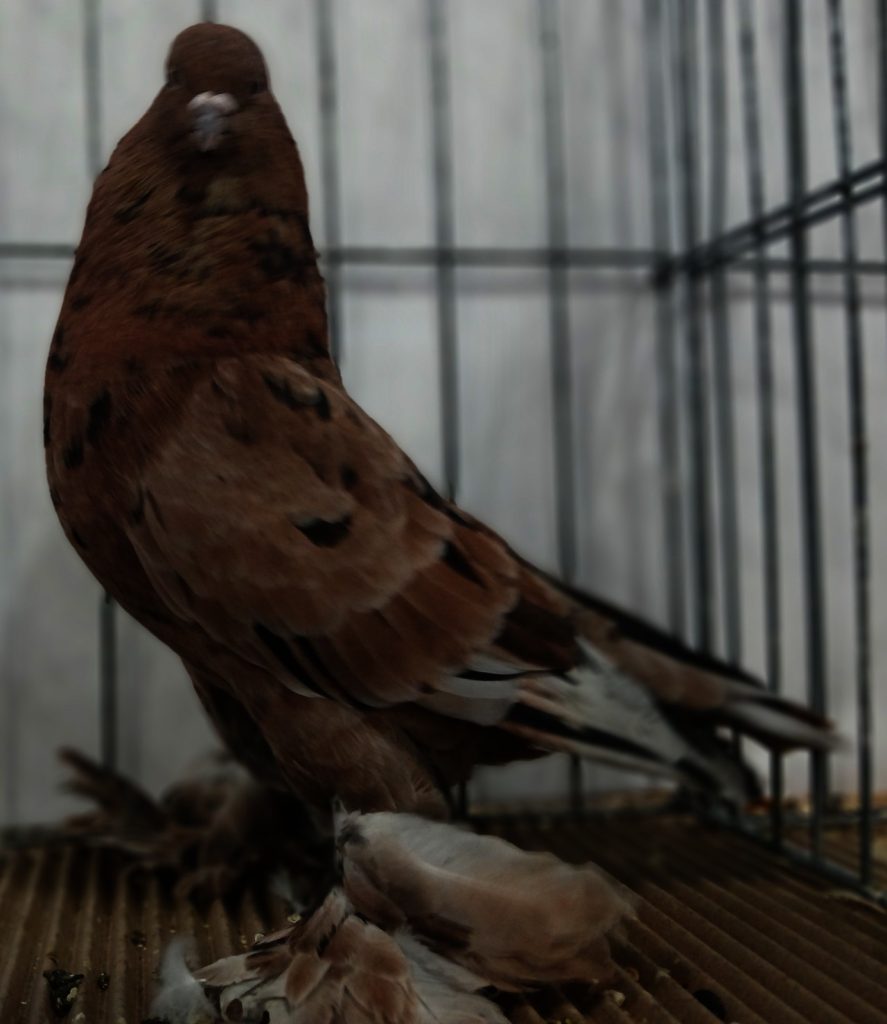
The standard covers bars, checks, velvets and barless birds in blue, silver, red, brown and khaki, plus almond, grizzle, indigo, kite, opal and many other patterns. Self colours run from black to white.
Self colours in the standard
- Black
- Dun
- Red
- Gold
- Yellow
- Brown
- Khaki
- Lavender
- Mauve
- White
Markings
- Baldhead
- Badge
- Beard
- Saddleback
- Mottle
- Splash
- Shield mottle
- Rosewing
- Whitesides
Patterns
- Bar
- Check
- Dark check
- Velvet
- Barless
- Almond
- Grizzle
- Indigo
- Kite
- Opal
- Reduced
- Tortoiseshell
Swatches are approximate and only show the general shade.
Baldheads are the best-known marking. The head, rump, tail, underbody, thighs, muffs and primaries are white, and the neck, chest and wing shields are coloured. Ideally the white bib forms a V just below the beak. Mottles are more than half coloured, with white feathers spread evenly, and splashes are more than half white.
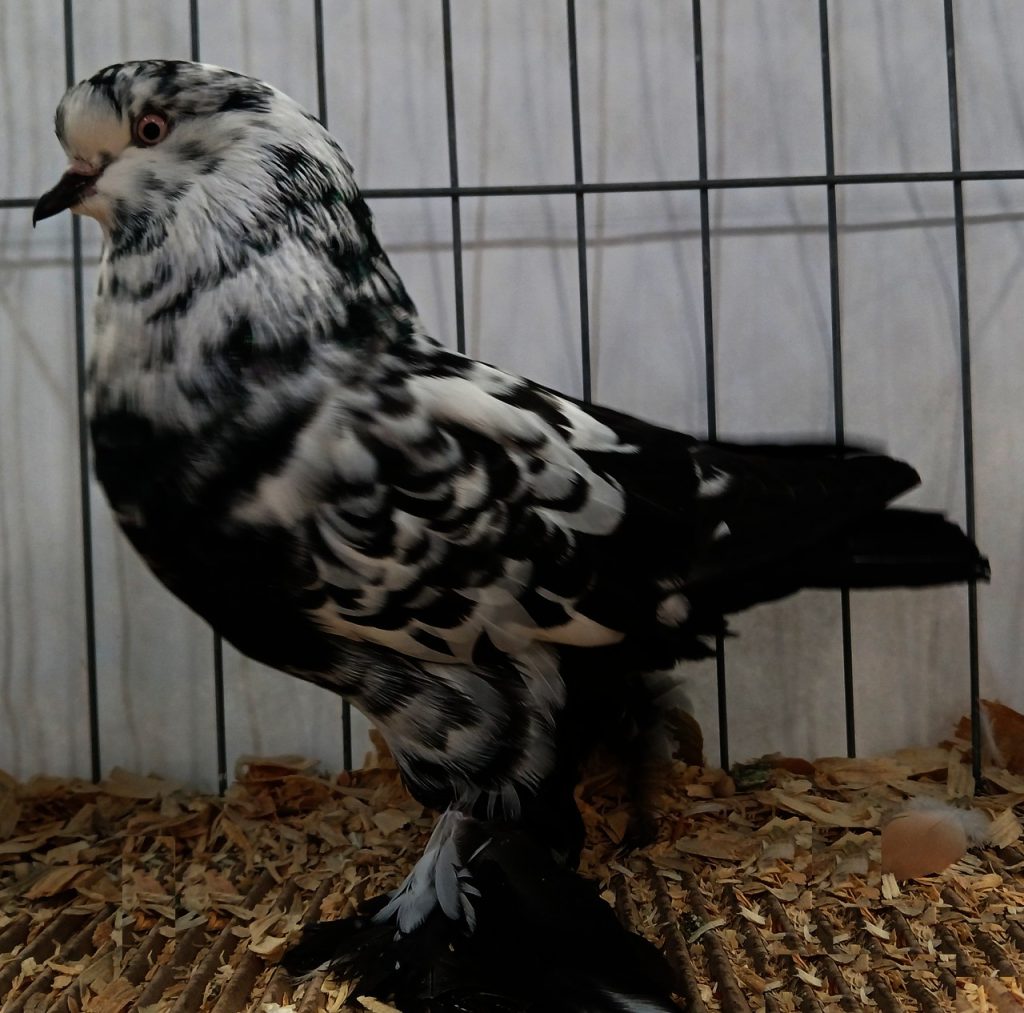
Our guide to pigeon colours and genetics explains how bars, checks and spread colours are inherited.
Care and breeding
In his 2008 history, Zeller wrote that new fanciers liked the West because it needed no special handling to breed. The birds did not need trimming before breeding and raised their own young, with no need for feeder pairs.
They need the usual basics for fancy pigeons: a dry, airy loft, clean water, a good seed mix and grit. Our guide to what pigeons eat covers the diet. Keep loft floors dry, because the muffs soil easily, and offer regular baths.
Quick facts for keepers
- Rears its own young
- No trimming needed before breeding
- Muffs about 3 to 3.5 in long
- Pearl to white eyes
- Exactly 12 tail feathers
- Bred to fly and tumble
The hen usually lays two eggs, which take about 17 to 19 days to hatch. If you fly your birds, watch for hawks, which are a risk for any flying breed. Our page on natural predators of pigeons has more.
Clubs and shows
In the United States the breed is looked after by the National West of England Tumbler Club (opens in new tab), which took that name in 1972. It started in 1969 as the Southern California Flying West of England Tumbler Club. Under the constitution it adopted in 1991, the club holds its annual meeting and show at the NPA Grand National.
The NPA standard is in the NPA Book of Standards (opens in new tab). Our guide to pigeon shows explains classes and judging, and our types of pigeon guide lists other breeds. For another show breed with feathered feet, see the English Trumpeter.
West of England Tumbler FAQs
What is a West of England Tumbler?
It is a fancy pigeon from Bristol and the West Country of England, bred from the old English Flying Tumbler. It was developed as a high-flying tumbler and is now kept mostly for showing.
How big is a West of England Tumbler?
The NPA standard gives cocks about 11 to 12 oz (310 to 340 g) and about 9 inches tall. Hens weigh about 9 to 10 oz (255 to 285 g) and stand about 8.5 inches tall.
What eye colour should a West have?
Pearl to white. A bull eye, a cracked eye, or a yellow, orange or red eye disqualifies the bird at a show.
Can West of England Tumblers still tumble?
The breed was developed as a flying and tumbling breed. Most Wests are now bred for the show pen, but some keepers still fly them.
When did the breed reach America?
The first imports reached Southern California in 1913, followed by more in 1916, 1920 and 1925.
Are Wests easy to breed?
Breeders describe them as straightforward. In his 2008 history of the breed, Chuck Zeller wrote that they needed no trimming to breed and raised their own young, with no need for feeder pairs.