
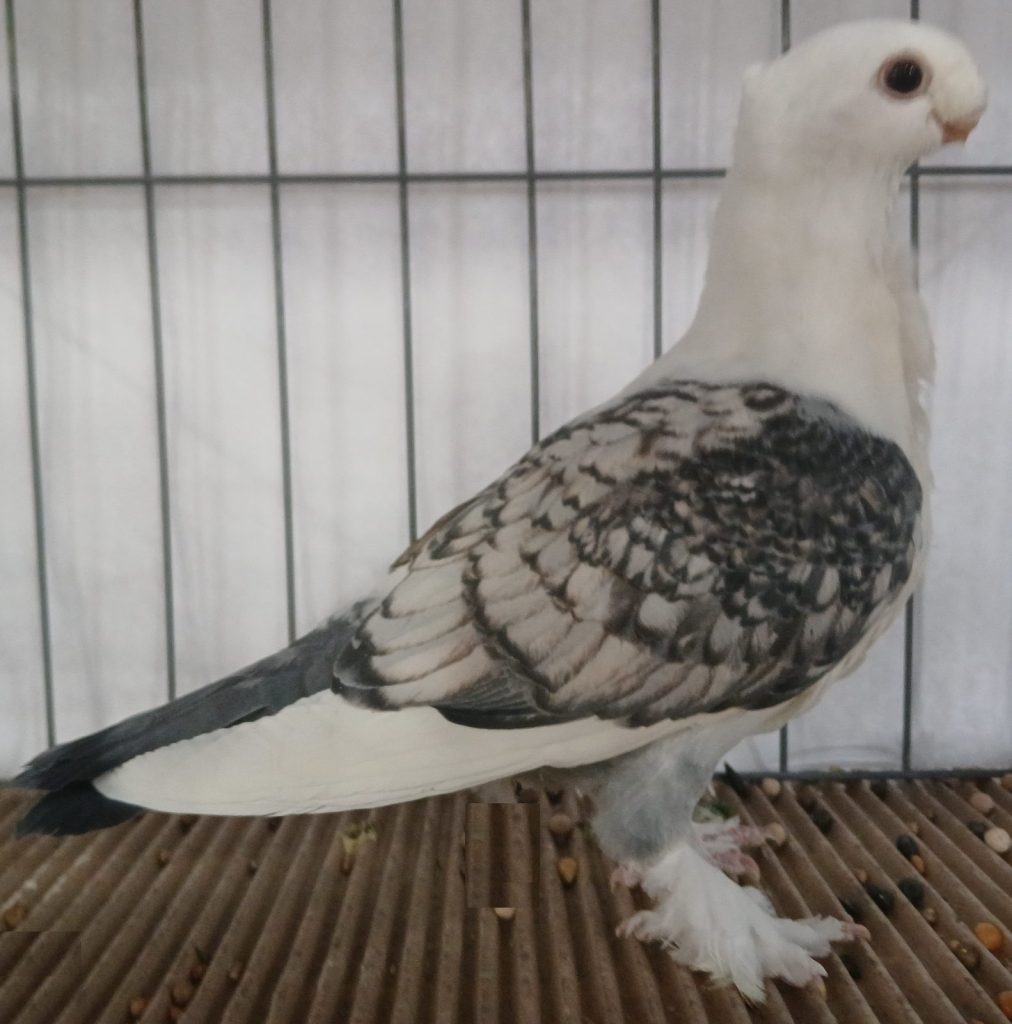
The Oriental Frill is a fancy pigeon from Turkey, kept for exhibition. It has a ruffle of feathers on the chest, a pointed crest at the back of the head, a short beak and feathered feet.
Most birds belong to one of two colour groups. Satinettes have a white head and body with a coloured wing shield and tail. Blondinettes are coloured all over. Breeders also keep two types: the classic bird, close to the 19th-century form, and the modern show bird with a much shorter beak.
Oriental Frill at a glance
| Feature | Oriental Frill |
|---|---|
| Species | Domestic rock pigeon (Columba livia) |
| Origin | Turkey; it reached England from Smyrna (now İzmir) around 1864 |
| Turkish name | Hünkari |
| NPA group | Owl and Frill Pigeons |
| Main colour groups | Satinette and Blondinette |
| Other varieties in the NPA standard | Vizor, Domino and Turbiteen |
| Key features | Chest frill, needle-point peak crest, short thick beak, muffed feet |
| Classic weight | About 11 to 12 oz (310 to 340 g) on average |
| Raising young | Classic birds feed their own squabs; modern short-beaked birds are often reared by feeder pairs |
Origin and history
Breed histories place the Oriental Frill in Turkey or a neighbouring part of the Middle East, but the exact country of origin is not known. Wendell Levi’s Encyclopedia of Pigeon Breeds, as quoted by the National Classic Frill Club, traces the breed in Smyrna back to about 1740. H. P. Caridia brought birds from Smyrna to England around 1864.
In Turkey the breed is called Hünkari, which is usually translated as “the bird of the Sultans”. A Turkish tradition, repeated by breed clubs, links it to pigeon keepers at the Ottoman palace in Manisa. The same tradition calls the white spots on the tail “the seal of the Sultan”. Treat these stories as breed lore rather than documented history.
The breed was shown in America in 1879, at a National Columbarian Society show in New York, where the birds were entered as “Crested Turbiteens”. An American Oriental Frill Club followed in 1893. Oriental Frills also reached Germany around 1870 and probably played a part in the development of the Old German Owl.
The frill, the crest and the muffs
The frill is a strip of feathers that grow outwards, to both sides, down the front of the neck and chest. The NPA’s modern standard asks for a frill that covers as much of the chest as possible. The classic standard gives an ideal length of about 2 inches (5 cm) and prefers a short, full frill to a long, thin one.
Above it is the gullet, a fold of skin that runs from under the beak down the throat into the frill. At the back of the head sits a needle-point peak crest. It should stand upright and in the centre, and rise from a mane of feathers down the back of the neck.
The feet are grouse-muffed, with feathers running down the shanks to the toenails. The modern standard asks for a large, round, well-arched head, full cheeks, and a beak that is short, thick and wide at the gape.
The frill links the breed to the Turbit and the owl pigeons, such as the African Owl and the Chinese Owl. It is a different feature from the curled wing feathers of the Frillback, which has no chest frill.
Satinettes and Blondinettes
The two names describe where the colour sits. The wing and tail markings are the same in both groups. What changes is the white.
| Feature | Satinette | Blondinette |
|---|---|---|
| Head, neck and body | White | Coloured |
| Wing shield | Coloured, laced or barred on a white ground | Coloured, laced or barred on a white ground |
| Tail | Coloured, with white “moon” spots or lacing | Coloured, with white “moon” spots or lacing |
| Primary flights | White, ideally ten on each wing | Coloured; in the modern standard each has an oblong white spot at the tip |
| Beak | Pale flesh | Black, horn or flesh, depending on colour |
Satinettes have their own colour names. A Bluette is a blue-bar Satinette, a Silverette is a silver-bar Satinette, and in the NPA’s modern standard a Brunette is a brown-laced Satinette. A Sulphurette has a pale sulphur ground with darker sulphur edging.
Laced feathers can be edged all round, arrow-pointed or ticked. On “spot tail” birds each tail feather carries a round white spot. On “laced tail” birds the tail feathers are edged instead, and in Blondinettes the lacing often spreads over most of the body.
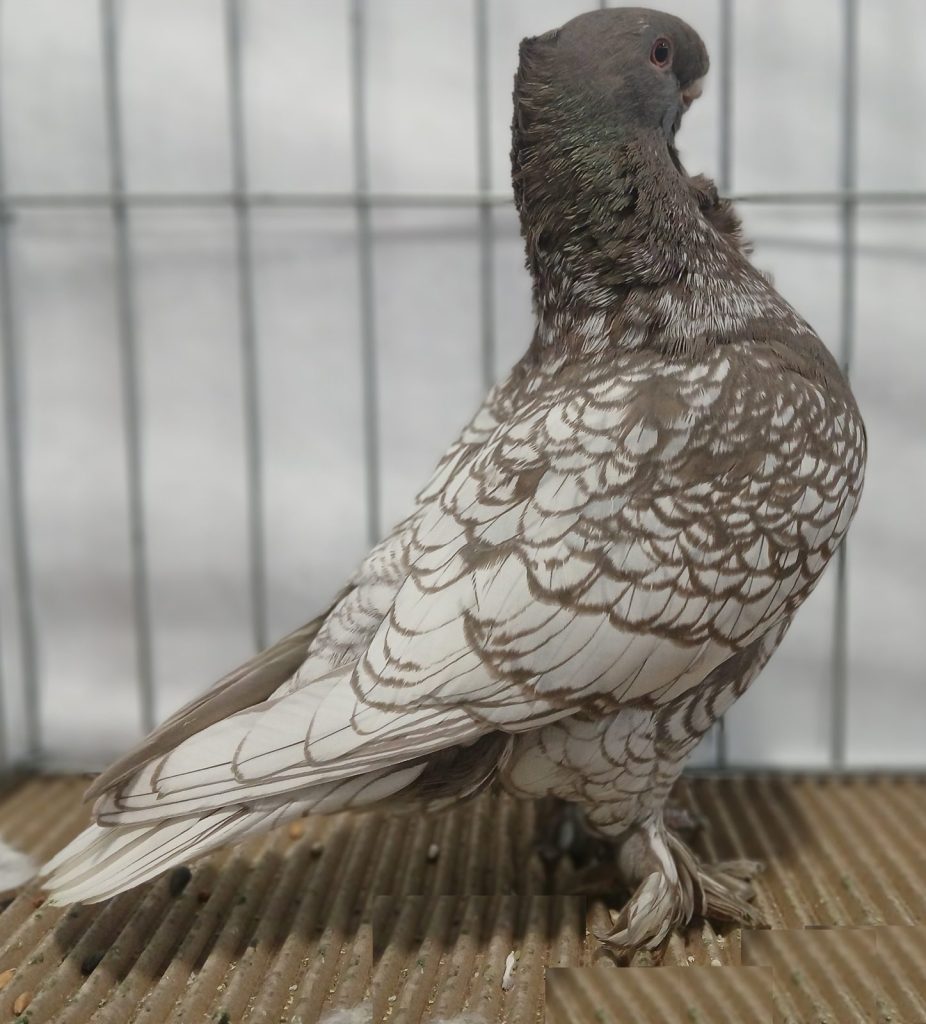
The classic standard explains the white areas as the result of two genes working together, Toy Stencil and Frill Stencil. Without the right combination, the bars and laces come out in normal colour or in bronze and sulphur shades. Our guide to pigeon colours and genetics covers the basic colours these patterns are built on.
The NPA standard also covers Vizors, which are marked like Satinettes but have a coloured head, and Dominoes, which have a coloured head, a white body and clean, unfeathered feet. Turbiteens have a white body, coloured shoulders and three coloured spots on the head.
Classic and modern Oriental Frills
Breeders in the United States now treat the two types as separate breeds. The National Classic Frill Club uses the name Classic Frill for the older type, which has also been called the Classic Old Frill, the Old Fashioned Oriental Frill and the Old Style Oriental Frill. The NPA publishes separate standards for the Classic Old Frill and the Oriental Frill.
According to the club, the modern Oriental Frill was developed from the older birds by crossing them with Oriental Owls and Turbits. Selection gave it a larger body and a much shorter, blunter beak.
| Feature | Classic (old-fashioned) type | Modern Oriental Frill |
|---|---|---|
| Beak | Medium-short and thick | Very short, thick and wide at the gape |
| Size | Small to medium; about 11 to 12 oz (310 to 340 g) | Larger |
| Stance | Stands at close to 45 degrees, tail just clearing the floor | Erect and alert |
| Rearing | Can feed its own young | Often reared by feeder pairs |
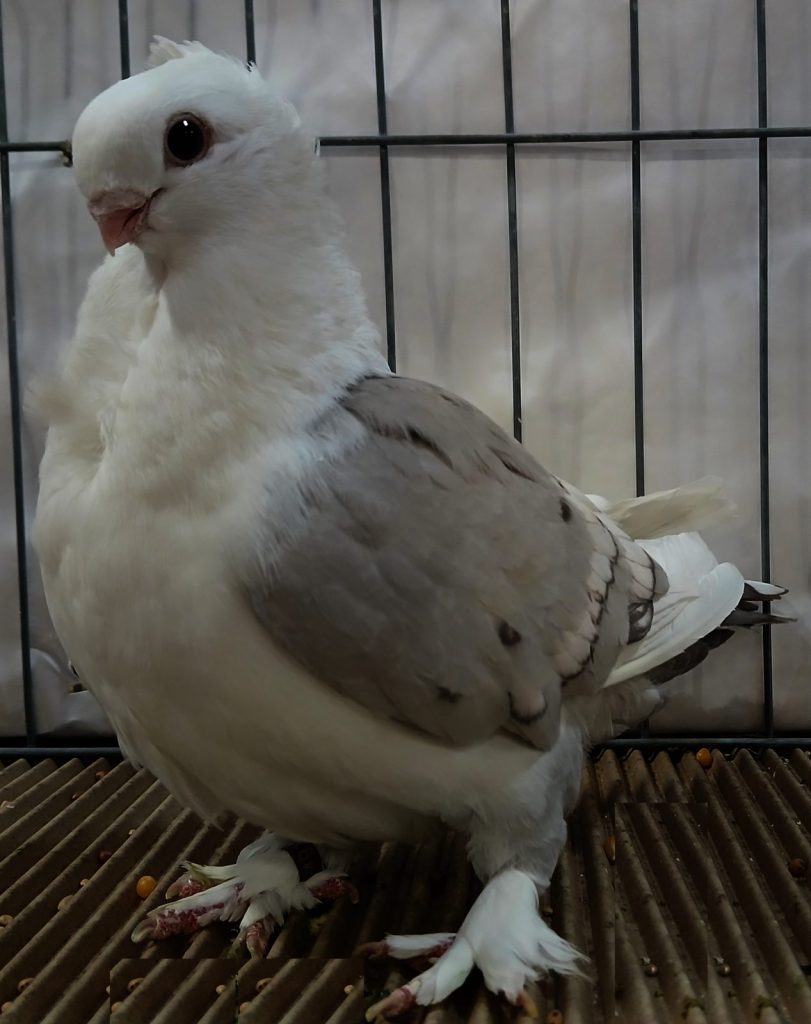
Beak length is the practical difference. Pigeon parents feed their squabs by regurgitating crop milk and softened food into the youngster’s mouth. The NPA’s classic standard says that Classic Old Frills can feed their young and do not need feeders. The club says the very short beak of the modern type often makes that difficult.
Temperament
The NPA’s classic standard describes the bird as having a “jaunty disposition”. The National Classic Frill Club says the Classic Frill is calmer than some pigeon breeds and makes a good pet.
Like any pigeon, they need a quiet loft and time to settle after a move.
Care and housing
Oriental Frills need the same basics as other fancy pigeons: a dry, draught-free loft with good ventilation, clean water, a seed mix suited to fancy breeds, and grit. Our guide to what pigeons eat covers the diet.
Muffed feet need extra attention. Wet or dirty floors soil the foot feathers, so keep floors dry and clean them often. Regular baths, often once a week, help keep the feathers in show condition.
Classic birds are still capable flyers. A loft with an attached aviary gives show birds fresh air and sun without the risks of free flight, such as hawks and damaged feathers.
Breeding and feeder pairs
Oriental Frills breed like other domestic pigeons. The hen usually lays two eggs, and the eggs take about 17 to 19 days to hatch.
Breeders of the modern short-beaked type often keep a few pairs of a long-beaked breed, such as homers, as feeders. The Frill’s eggs go under a feeder pair that laid at about the same time, and that pair raises the squabs. Classic birds can rear their own young, which is one reason some keepers prefer them.
The Seraphim came from this breed. It was developed in Illinois from Classic Oriental Frills that moulted to white, and the NPA recognised it in 1995.
Showing
In the NPA’s modern standard, the head and beak carry the most weight. For laced Satinettes and Blondinettes, the scale of points is:
| Section | Points |
|---|---|
| Head, beak, wattle, eye, crest and mane | 40 |
| Markings and colour | 30 |
| Size, feather quality, type, shape and carriage | 20 |
| Frill | 5 |
| Legs, feet and foot feathering | 5 |
Judges mark down a twisted beak, a flat head, a low or twisted peak, a missing frill, bare toes and white in the frill or rump of a Blondinette. The classic standard also penalises a long or thin beak, a thin frill and a break between the crest and the mane.
The NPA standards are in the NPA Book of Standards (opens in new tab), and the National Classic Frill Club (opens in new tab) lists shows for the classic type. Our guide to pigeon shows explains how classes and judging work. For other breeds in the group, see our types of pigeon guide.
Oriental Frill FAQs
What is an Oriental Frill pigeon?
It is a domestic fancy pigeon from Turkey, kept for exhibition. It has a frill on the chest, a pointed peak crest, a short beak and feathered feet. Most birds are Satinettes or Blondinettes.
What is the difference between a Satinette and a Blondinette?
A Satinette has a white head, neck and body, with a coloured wing shield and tail. A Blondinette has the same wing and tail markings but is coloured all over.
Can Oriental Frills raise their own young?
Classic birds can. The NPA’s classic standard says they can feed their young and do not need feeders. Modern Oriental Frills have a much shorter beak, and breeders often place their eggs under feeder pairs of another breed, such as homers.
Is a Classic Frill the same as an Oriental Frill?
They share an origin. The Classic Frill is the older, medium-beaked type, also called the Old Fashioned Oriental Frill. The modern Oriental Frill was developed from it and has a larger body and a much shorter beak. The NPA has a separate standard for each.
Where does the Oriental Frill come from?
Turkey. It reached England from Smyrna, now İzmir, around 1864 and was shown in New York in 1879. In Turkey it is called Hünkari.
How big is an Oriental Frill?
The classic type is a small to medium pigeon, about 11 to 12 oz (310 to 340 g) on average. The modern Oriental Frill is larger.