
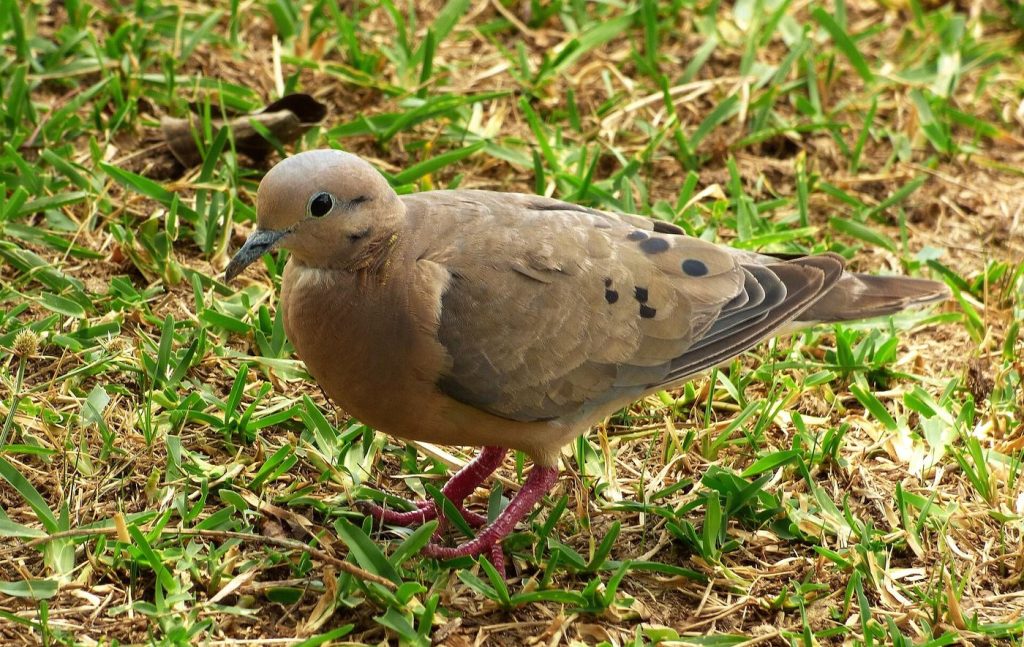
The eared dove (Zenaida auriculata) is a medium-sized New World dove. It is the common open-country dove over most of South America, from Colombia and Venezuela south to Tierra del Fuego, and it also lives on Trinidad and Tobago, the southern Lesser Antilles and the Dutch Caribbean islands.
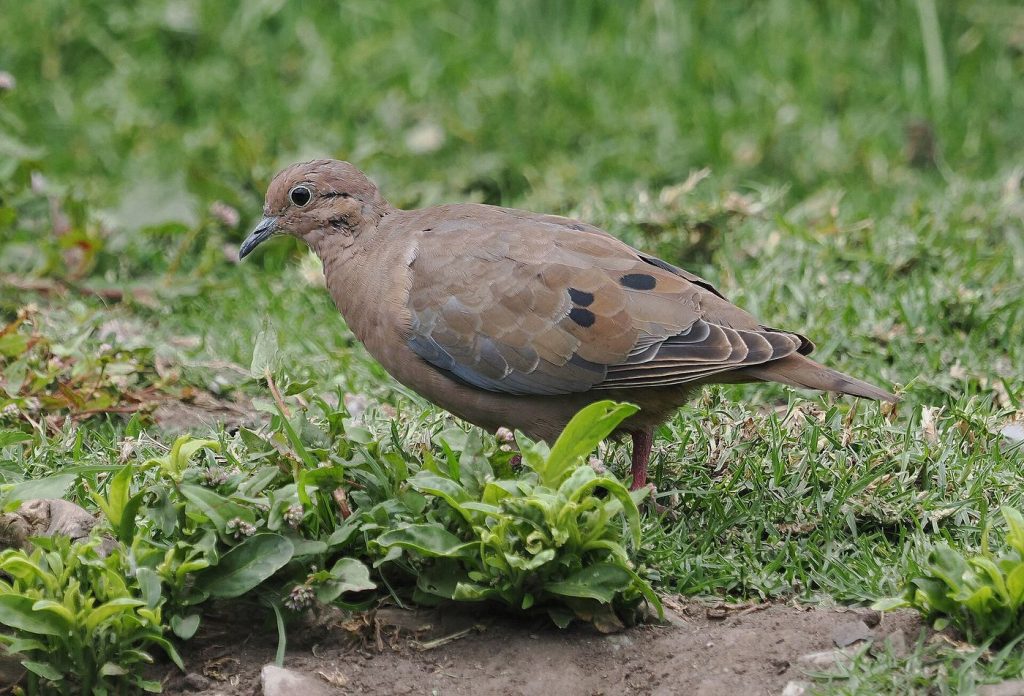
Two small black marks on the side of the head give the bird its English name: one streak behind the eye, and a second spot on the ear coverts. In the field it can look like a short-tailed mourning dove, with grey-brown upperparts, a pinkish breast, black spots on the wing and red or pink legs. BirdLife International treats the global population as Least Concern and increasing.
Eared dove at a glance
| Fact | Eared dove (Zenaida auriculata) |
|---|---|
| Scientific name | Zenaida auriculata (des Murs, 1847) |
| Family | Columbidae, the pigeons and doves |
| Length | About 21 cm (Sick 1997, cited by Fontoura and Orsi 2013) |
| Weight | Mean 120 g in a large Córdoba sample, after the crop was emptied; extremes 84 to 161 g (Bucher, Gómez, di Tada and Reati 1977) |
| Telling marks | Two black marks on the side of the head; black wing spots; pink to vinous breast; red or pink legs; short wedge-shaped tail |
| Range | South America from Colombia to southern Argentina and Chile; Trinidad and Tobago; southern Lesser Antilles and the Dutch Caribbean |
| Habitat | Open and semi-open country, dry scrub, farmland, pasture, gardens and towns; not continuous rainforest |
| Elevation | Up to 4,730 m (IUCN 2024) |
| Diet | Seeds and grain taken from the ground |
| Eggs | Usually two, white and oval |
| Incubation | 16 days in a closely watched nest in Ecuador (García-Loor and others 2025) |
| Time in the nest | 15 days in that Ecuador study; other reports, cited there, give 12 to 15 days |
| Movements | BirdLife International classifies the species as a full migrant. In Córdoba, part of a colony left after a severe dry season, which the authors treated as a migratory or nomadic movement |
| Status | Least Concern (IUCN, assessed 12 June 2024); population trend increasing, size not quantified |
Length comes from Helmut Sick’s 1997 Brazilian handbook, as cited in Fontoura and Orsi (2013). A later compilation, Dunning (2008), also cited there, gives a mean weight of 136 g, higher than the Córdoba mean. The 4,730 m ceiling is the upper elevation in the 2024 IUCN assessment.
How to identify an eared dove
The two black marks on the side of the head are the field mark that gives the bird both its English name and the scientific name auriculata, “eared”. One narrow streak sits just behind the eye. A second, often slightly larger, dark spot sits lower, on the ear coverts.
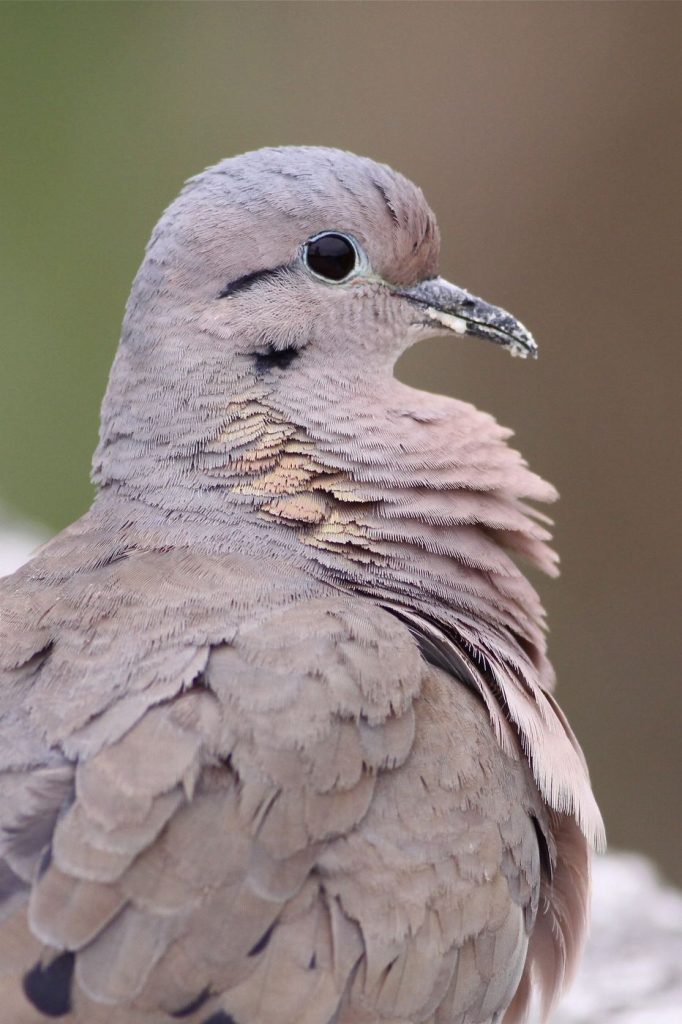
The rest of the plumage is grey-brown to olive-brown above, with a greyer crown, and pink to vinous on the breast and belly. Black spots mark the wing coverts. The bill is dark, and the legs are red or pink. The tail is fairly short and wedge-shaped, with paler tips on the outer feathers. In good light the sides of the neck can show a pink or bronze sheen.
Males and females are difficult to tell apart by eye. A spectrophotometric study of birds in Córdoba found that males were, in general, brighter and had higher ultraviolet chroma, including on the crown, even though the two sexes share the same grey and pink tones (Valdez and Benitez-Vieyra 2016).
How heavy is an eared dove?
Weights in grams from a Córdoba study of Zenaida auriculata chrysauchenia. The crop was emptied before weighing. The mean row is marked.
Eared dove or mourning dove?
The mourning dove is the usual comparison for people who already know that species. The two are close relatives in the genus Zenaida, and they look alike until you check the tail and the head.
- The eared dove has a shorter, wedge-shaped tail. The mourning dove has a long, graduated tail with large white sides that flash in flight.
- The eared dove has two dark marks on the side of the head. The mourning dove has a single dark spot on the ear coverts.
- Their ranges barely meet. The mourning dove breeds from North America south to Panama. The eared dove is a South American and southern Caribbean bird.
In the Lesser Antilles the zenaida dove (Zenaida aurita) is the other similar species. It shows a white band on the wing and a more rounded tail with white corners. The ruddy ground dove is much smaller, with a short square tail, and it does not have the eared dove’s paired head marks.
Range and habitat
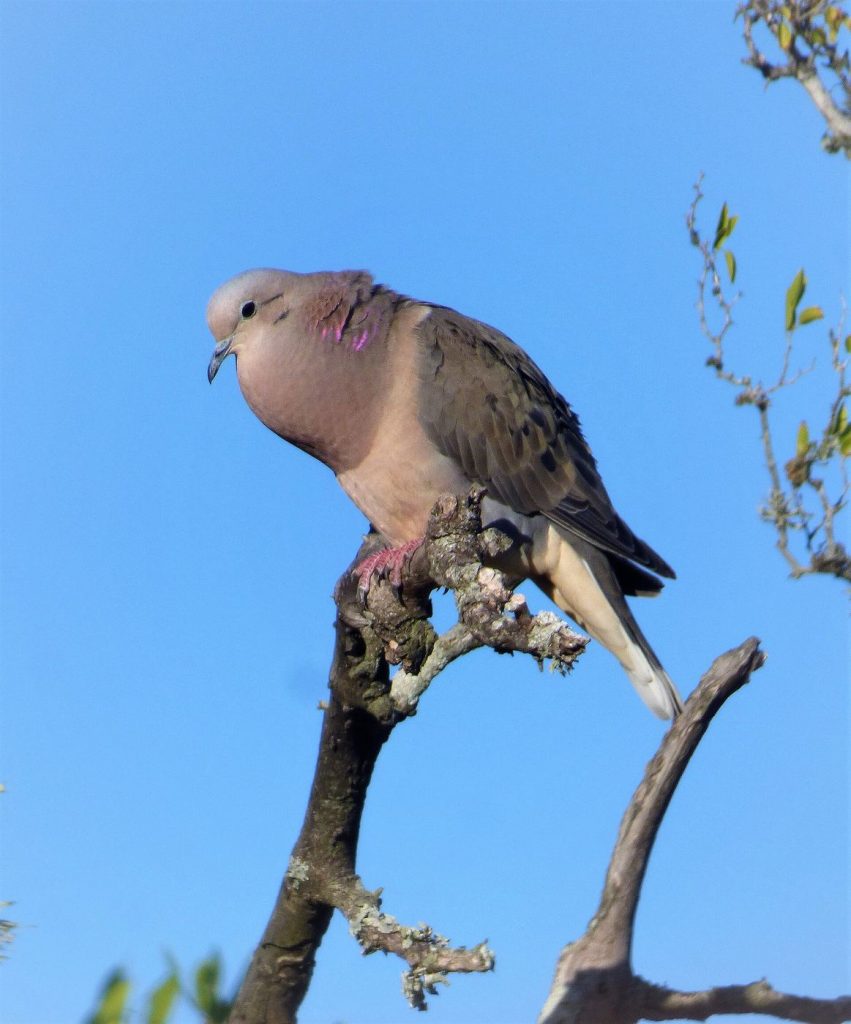
The eared dove is widespread in South America from Colombia, Venezuela and the Guianas south through Brazil, Ecuador, Peru, Bolivia, Paraguay, Uruguay, Argentina and Chile, including Tierra del Fuego. IOC World Bird List 15.2 also places subspecies on Trinidad, in the Lesser Antilles, in the Netherlands Antilles, and on Fernando de Noronha off north-eastern Brazil.
BirdLife International estimates the resident and breeding extent of occurrence at 24.3 million km². The same datasets list the Falkland Islands and South Georgia. Independent checklists treat those records as rare or accidental, so they are not part of the regular range.
It uses open and semi-open habitats: dry and moist shrubland, savanna, pasture, arable land, rural gardens and towns. BirdLife lists both breeding and non-breeding use of urban areas and of heavily degraded former forest. Continuous rainforest is not typical habitat. A 2025 study in Ecuador describes the species as one of the most common South American birds except in the Amazon rainforest.
The 2024 IUCN assessment gives an upper elevation of 4,730 m. Nests have been watched at 3,015 m in the Quito area (García-Loor and others 2025).
Diet and movements
Eared doves feed mainly on seeds and grain picked from the ground. Fontoura and Orsi (2013), watching birds in northern Paraná, found that they spent longer at a foraging site than two smaller ground doves, often fed on bare soil, and sometimes foraged in groups or pairs.
In farming regions they can become a pest. Bucher and colleagues studied Z. a. chrysauchenia in Córdoba, Argentina, where the bird had become a serious agricultural problem. Food supply appeared to be the main control on the sexual cycle, with day length playing a smaller part.
BirdLife International classifies the species as a full migrant. The Córdoba work gives a more local picture: after an extremely dry season in 1972, fat reserves peaked and part of the colonies left the area, which the authors read as a migratory or nomadic movement. BirdLife lists towns as both breeding and non-breeding habitat, so urban birds are not only passage visitors.
The IOC list recognises 11 subspecies. The most widespread in the south is chrysauchenia, from eastern Bolivia and central Brazil to Tierra del Fuego. The nominate race lives in central Chile and west-central Argentina. Other named forms include vinaceorufa in the Netherlands Antilles, stenura from the Lesser Antilles and Trinidad across northern South America, and noronha in north-eastern Brazil and on Fernando de Noronha.
Breeding
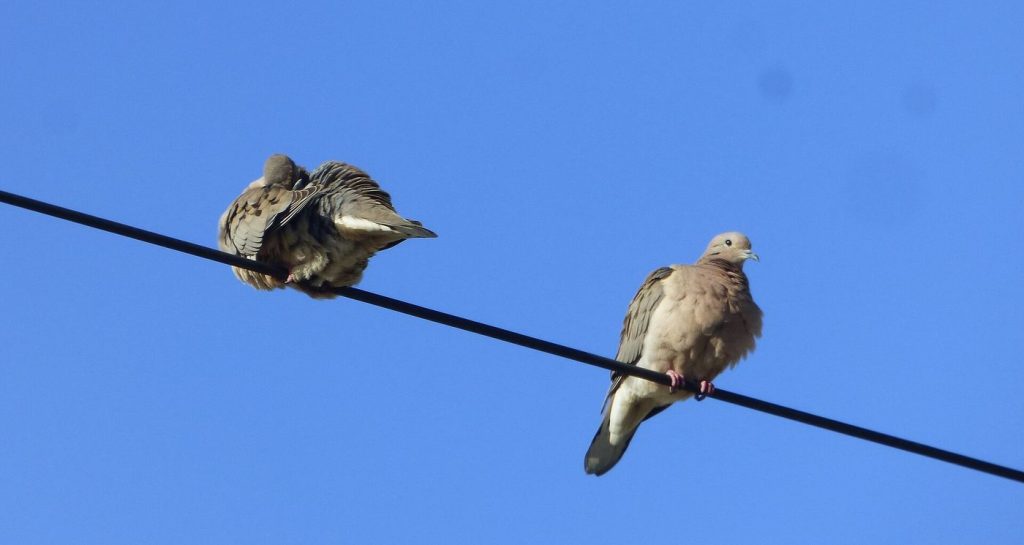
Eared doves nest as pairs over most of their range, and they also form breeding colonies in some agricultural parts of Argentina. Bucher and colleagues already recorded colonies in Córdoba in the early 1970s. The nest is a small platform of twigs, often in a shrub or tree.
A close study of three nests in Pichincha Province, Ecuador, is the most detailed recent account (García-Loor, Trujillo, Trujillo and Alarcón 2025). One nest took five days to build. Each of the nests held two unmarked white, oval eggs. In the nest whose laying was watched, the eggs were laid on consecutive days. Both adults incubated and later brooded the young. Measured eggs were 28 × 22.5 mm and 27.5 × 23 mm.
Incubation in that nest lasted 16 days. The young left at 15 days, and the fledglings stayed near the nest for another three days. The authors note that nestling periods of 12 to 15 days have been reported in other studies (Bucher and Nores 1973; Dardanelli and others 2011; Barco and others 2024). Hatchlings are fed crop milk at first, then increasing amounts of seed, as in other pigeons.
Breeding can run through much of the year where food is steady. In the Ecuador study, eBird records and field observations showed nesting activity in every month, though not every stage in every month. In Córdoba, males producing sperm were found throughout the year, and the researchers could not show a clear annual cycle in females.
From nest to fledgling, in one Ecuador study
Conservation
BirdLife International assessed the eared dove as Least Concern on 12 June 2024. The range is extremely large, the global population has not been quantified, and the trend is thought to be increasing, because new open habitat keeps appearing as forest is cleared. Stotz and others (1996) already described the species as common.
The Red List records use as human food and as a cage or display bird at subsistence and national scales, and a 2024 trade review found the species in three of seven datasets examined (Donald and others 2024). It is not subject to international trade controls. Those uses have not pushed the species towards a threatened category.
People usually find eared doves in a park, a farm or a town square, often on a wire or on bare ground. Nests should be left alone. In countries where the species is hunted, local seasons and bag limits apply.
For a wider view of wild and domestic forms, see our types of pigeon guide, and the page on the difference between doves and pigeons. The related conservation question is covered in are pigeons endangered?.
Frequently asked questions
How do you identify an eared dove?
Look for the two black marks on the side of the head, black spots on the wing, a pinkish breast and a fairly short, wedge-shaped tail. The legs are red or pink. It is larger than a ruddy ground dove and has a shorter tail than a mourning dove.
What is the difference between an eared dove and a mourning dove?
They are close relatives, but the eared dove has a shorter tail and two dark marks on the side of the head, not one. The mourning dove’s long tail shows broad white sides in flight. The mourning dove is a North and Central American species; the eared dove lives in South America and the southern Caribbean.
Where do eared doves live?
They are widespread in South America from Colombia to southern Argentina and Chile, and they also live on Trinidad and Tobago, in the southern Lesser Antilles and on the Dutch Caribbean islands. They use open country, farmland and towns, including high Andean cities.
How many eggs does an eared dove lay?
Usually two white, oval eggs. In a watched nest in Ecuador the eggs were laid on consecutive days, incubated for 16 days, and the young left at 15 days.
Is the eared dove endangered?
No. The IUCN listed it as Least Concern in 2024, and BirdLife International suspects the population is increasing as more open habitat is created.
Sources
- Gill, F., Donsker, D. and Rasmussen, P. (eds). 2026. IOC World Bird List (opens in new tab) (v15.2). doi:10.14344/IOC.ML.15.2.
- BirdLife International. 2024. Zenaida auriculata (opens in new tab). The IUCN Red List of Threatened Species 2024: e.T22690747A263686133. Assessed 12 June 2024.
- BirdLife International. Eared Dove Zenaida auriculata factsheet (opens in new tab). Extent of occurrence, habitats, trend and use.
- Bucher, E.H., Gómez, E., di Tada, I.E. and Reati, G.J. 1977. Ecología de la reproducción de la paloma Zenaida auriculata. I. Variaciones estacionales en peso corporal, gónadas, reservas de lípidos y muda. Ecosur 4(7): 47–67.
- García-Loor, J., Trujillo G., F., Trujillo G., J. and Alarcón, I.P. 2025. Notas sobre la biología reproductiva de la Tórtola Orejuda Zenaida auriculata (opens in new tab). Revista Ecuatoriana de Ornitología 11(2): 114–123.
- Valdez, D.J. and Benitez-Vieyra, S.M. 2016. A spectrophotometric study of plumage color in the eared dove (opens in new tab). PLoS ONE 11(5): e0155501.
- Fontoura, P.M. and Orsi, M.L. 2013. Ecological partitioning of three Columbidae species in northern Paraná (opens in new tab). Biota Neotropica 13(3). Cites Sick (1997) for length and Dunning (2008) for a mean weight of 136 g.
- Stotz, D.F., Fitzpatrick, J.W., Parker, T.A. and Moskovits, D.K. 1996. Neotropical Birds: Ecology and Conservation. University of Chicago Press. Cited by BirdLife for the description “common”.
- Donald, P.F. and others. 2024. Assessing the global prevalence of wild birds in trade. Cited on the IUCN factsheet.