
Pigeons can cause problems whether it’s pooping all over your property, nesting under your solar panels or scavenging in your rubbish bins.
Thankfully there are plenty of methods and deterrents you can use to keep them away, here are 9 methods worth trying:
1. Netting
You can use netting over your flowerbeds and vegetable patches to deter them from nicking the seeds and fruits and causing other damage.

It’s an option but may look unsightly and does nothing for the aesthetics for the rest of your property.
2. Scarecrows
There is the option of scarecrows and decoys.
Scarecrows are easy to make, but unfortunately, pigeons are smart birds. Seeing a scarecrow may warn them off once or twice.

Pigeons are persistent and may observe the scarecrow from a distance.
Noting that the scary person standing in your yard doesn’t move, they will conclude that it isn’t a danger to them and return.
What you need is one that moves, on a swivel, or at least the clothes you dress it in flaps about to give the illusion of movement.
Fine on windy days, but when it’s calm? Better to get one that plugs in with a motor that keeps it moving.
3. Decoys
You can buy these at garden centres, DIY stores or online.
They come in the guises of all the dreaded predators of pigeons, namely falcons and hawks of all kinds, owls, and even snakes.
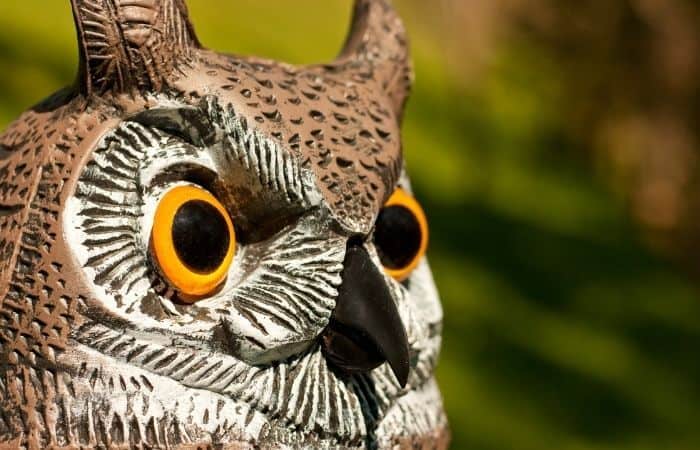
They aren’t particularly convincing to humans, but they can deter pigeons.
However you will probably have the same problems with decoys as you do with scarecrows.
If they don’t move or look animated, the pigeons figure out, quite correctly, that they aren’t a danger.
4. Water
Water deterrents work in a similar way to a sprinkler system. Like sprinklers, they can be programmed.
These rotate and squirt water at regular intervals.
All you have to do is position them to cover the favorite perches of the pigeons.
Although pigeons aren’t averse to water, getting a jet in the face at regular intervals is enough to put them off hanging around.
Also Read:
How To Keep Pigeons Out Of Your garden
How To Keep Pigeons Away From Your Bird Feeder
How To Keep Pigeons Away From Your Balcony
How To Keep Pigeons Away From Your Plants
How To Get Rid Of Pigeons From Trees
5. Sound
Audio deterrents are another solution. Like the water option, it’s a bit high tech.
Sudden, loud noises at random can scare pigeons away, although they often get used to them over time.
It only really suits places where no people nearby will be disturbed.
This is bound to be just as annoying to humans as it is to pigeons.
6. Electrical
Electrical wires or fencing can prove efficient.
On contact, the pigeon receives a mild electrical shock.

It is designed not to kill or harm it, but to be enough to give the bird an unpleasant shock and scare it off.
The trick with using these wires or mesh is not only to put them in the places where the pigeons congregate but make sure that there aren’t any other alternate roosting places.
7. Use Pigeon Birth Control
Pigeon birth control is one of the most effective long term methods of getting rid of pigeons.
OvoControl uses a chemical called nicarbazin which reduces the chance that eggs laid will hatch. It is sold mainly in the US and its use depends on local rules.
Over a two-year period, a few breeding pairs can in theory grow to a few hundred pigeons if the environment can support them, so birth control often works better in the long term than culling, because numbers tend to bounce back while food and shelter remain.
8. Low Tech
A cheaper, simpler option is stringing together shiny objects and hanging them around obvious perching points to act like wind chimes.
You can use old CDs, bits of glass and shiny metal.

The flashes of sunlight on these objects may scare off pigeons, at least for a while.
Alternatively, you can place plastic or metal spikes and repellent gel, all of which are easily purchased.
9. Call-In The Pigeon Control Specialists
If you’ve tried everything in our list and the pigeons are still as prevalent as ever then it is worth getting professional help.
If you’ve got a serious pigeon problem the best solution is to get professional help, click the relevant image below (U.S or UK) to find a pigeon control specialist near you:


Keeping pigeons off a bird feeder
Pigeons feed mostly on the ground, so spilt seed is what draws them in. Use a feeder with a seed tray or sweep up underneath it, and avoid ground feeders and open bird tables.
A feeder inside a wire cage lets small birds in and keeps pigeons out. So do “pigeon-proof” feeders that close when a heavier bird lands, and small tube feeders with short perches.
If pigeons already know where the food is, take the feeder down for a week or two. They usually move on, and smaller birds soon come back once you refill it.
Pigeons on roofs and under solar panels
Pigeons like the warm, sheltered gap under solar panels, and droppings and nest material build up there. The usual fix is a mesh guard clipped around the edge of the panels. Ask your installer first, as some fixings can affect the warranty.
Chimney stacks and ridges can be fitted with spikes or wire, and gaps in eaves and roof spaces can be blocked so birds can’t get inside. Check for eggs or chicks before you block a gap or clear a nest. In the UK it is an offence to damage or destroy an active wild bird nest, and many other countries have similar rules.
Gardens and new grass seed
In gardens, pigeons go for seeds, young brassicas and peas. Netting or fleece over crops works best. Keep netting taut and check it every day, because loose netting can trap birds, as the RSPCA (opens in new tab) points out.
Freshly sown lawn seed is a feast for pigeons. Cover it with fine grass-seed netting or light horticultural fleece until the grass is up, making sure the cover lets light through. Cover compost bins and keep food scraps out of open heaps.
Spikes, wire and repellent gel
Spikes and tensioned wire stop pigeons landing on ledges, sills and signs. They work by taking away the landing spot and don’t hurt the birds when fitted properly.
Sticky repellent gels are a different matter. Small birds can get stuck in them and be unable to fly or preen, and the SPCA in New Zealand (opens in new tab) has recorded birds killed this way. If you use a gel at all, choose an optical gel in small dishes and follow the instructions exactly. Spikes, wire and netting are kinder options.
What Attracts Pigeons?
Pigeons are attracted mainly to food and shelter.
Pigeons can also be attracted to people.
They can remember people that are kind to them.
Usually, that means people who feed them.
Of course, being wild animals, one of their greatest concerns is safety. So, places where they feel secure are important and will attract pigeons.
That is probably why pigeons are seen clustered around our old and ornate buildings within our inner cities.
The old architectural styles provide places where it is safe to roost or nest.
Ledges, overhangs, recesses, gargoyles, statues and even solar panels can all provide shelter from the elements.
Hard to get to corners and cracks offer secure and hidden nesting sites in which to hatch and raise their young.
Pigeons’ other major concern is food.
Pigeons are always on the lookout for food.
If you wish to attract pigeons, then lay out seeds, grains, and water.
If you are wondering why pigeons find your backyard or your building attractive, it is probably because you have some or all of the essentials that pigeons seek.
Wood pigeons nest and roost in trees and bushes.
Your garden probably has enough of both and it may also be surrounded by a fence, which is added protection.
Your garden may be full of seed bearing flowers, which is always a draw.
If you are a bird lover, then you are already putting out bird feed for whatever species of birds that inhabit the area and pigeons will take advantage of that.
Bird feeders will attract pigeons just as well as other birds. Providing clean water will also attract them.
What Do Pigeons Hate?
Pigeons generally hate things that pose a danger to them such as cars, cats and more.
They hate predatory or domineering birds, such as birds of prey like hawks.
Some people say pigeons dislike strong smells such as cleaning fluids, but there is little evidence that smells keep them away, and birds are not bothered by chilli heat the way mammals are.
If you have a pigeon problem you can use some of these things to your advantage.
Falcons and other birds of prey would probably come at the top of the hate list. These are natural predators of pigeons.
Although you won’t find many in urban settings, some have emulated their smaller avian cousins and have moved into the cities.
With their flying abilities, they can actually live in rural areas and nip into the city to see the sights and get a bite to eat.
Some places also use trained falcons and hawks for bird control.
Why wouldn’t pigeons hate them?
Cats are natural predators and love to hunt birds of all species. Of course, pigeons, because of their abundance will be their targets too.
The problem with cats is that they can and do climb.
They are expert silent stalkers and can turn up almost anywhere.
Just imagine that you are a pigeon, sitting on some supposedly safe perch, out of reach and suddenly a cat pounces on you.
Traffic isn’t a problem for rural pigeons, but you would imagine it is for those city slickers.
Although pigeons are creatures of the air, they do spend a lot of their time on the ground.
Pigeons are always looking for the next seed or scrap to eat and the ground is a great place to find food.
Last updated 24 October 2026 · Problems