
Pigeons rarely kill their own babies, but it does happen. The usual cause is “scalping”, where a parent pecks at the head of an older squab, most often because the pair are ready to lay again and want the youngster out of the nest.
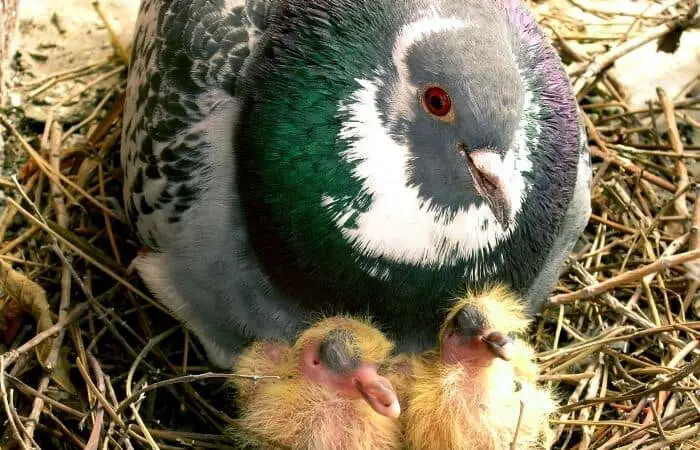
Typically pigeons are very attentive parents who don’t leave their babies unattended and guard them fiercely, so pigeons killing their babies is very rare.
1. Pigeons Sometimes Scalp Malformed Or Ill Babies
It is known that in many animal species, malformed or sickly youngsters are either driven out or killed.
Some animals neglect or kill young that are weak or deformed, and keepers report that pigeons sometimes do the same, but this hasn’t been studied closely in pigeons.
If this is the case with pigeons, a malformed or weak chick may be killed by scalping, that is pecked to death.
2. Baby Pigeons That Aren’t Ready To Fly May Be Killed
Another scenario may be that chicks that aren’t quite ready to fly the nest and become independent, are forced out of the nest.
One that resists leaving may be killed in frustration.
3. Baby Pigeons May Be Killed If They Fall From The Nest To Avoid Attracting Predators
If a baby pigeon is unfortunate enough to fall out of the nest, some fanciers report that the parents may attack it rather than care for it.
One suggested explanation is instinct: a squab calling from the ground could attract predators to the rest of the brood. This has not been proven.
It has been reported in both wild pigeons and those kept in a loft.
4. Pigeons Kill Babies From Other Families If They Wander Into The Wrong Nest
Fanciers often report that a squab that wanders into the wrong nest may be attacked, sometimes fatally, by the adults of that nest.
This all points to the territorial nature of pigeons.
If you do keep pigeons and they are breeding, it is a good idea that nest sites have clear demarcation and are also constructed so that little ones cannot easily leave the nest.
5. Human Handling May Cause Pigeons To Kill Their Babies
One theory says that babies or eggs being handled by humans may be the reason parents kill a squab.
This is a myth. As the Cornell Lab of Ornithology (opens in new tab) explains, most birds recognise their young by sight and sound, and won’t abandon a chick just because a person has touched it.
That said, keep handling to a minimum. Disturbing a nest again and again can stress nervous parents, especially young pairs.
6. Baby Pigeons May Be Killed Over Territorial Disputes
Another reason could be a territorial dispute between parent birds.
One pair of birds decides that another pair’s nest is too near and attacks the squabs instead of the adult birds.
7. A New Partner May Kill The Babies
One other reason may be if a female attracts another male because her mate is lost (this is rare as usually pigeons mate for life), the new male may attack and kill the squabs of the other male.
This happens in some other species of birds and mammals.
How to stop pigeons attacking their young
Most attacks happen when a pair wants to nest again while the last round of squabs is still in the nest, usually at around three to four weeks old. If you keep pigeons, you can cut the risk:
- Give each pair two nest bowls or a nest box with room for a second nest, so they can lay again without pushing out the older squabs.
- Move squabs to a separate young bird section once they are eating and drinking on their own, usually at around 25 to 30 days.
- Avoid overcrowding, and keep one more nest box than you have pairs, so birds don’t fight over space.
- Watch for bald, bloody or scabbed patches on a squab’s head. Separate it straight away and treat the wounds. See what to do with an injured pigeon.
If you find a squab on the ground in the wild, see do pigeons leave their babies before you move it.
Is it normal?
Pigeons are usually devoted parents, so if it happens more than once in your loft, look at space, nest boxes and timing first. See famous pigeon fanciers for more on how experienced keepers manage their birds.
Sources
- Cornell Lab of Ornithology: If I handle a baby bird, will the parents abandon it? (opens in new tab)
Last updated 30 October 2026 · Baby Pigeons, Behavior