
No. Pigeons do not explode if they eat rice or baking soda. Uncooked rice swells far too slowly to hurt a bird, and when 60 doves and pigeons were fed nothing but instant rice and water for 12 hours in a 2005 University of Kentucky test, none showed any ill effects. A pigeon’s body is also nowhere near hot enough to make baking soda release a burst of gas.
If a pigeon somehow swallowed calcium carbide or magnesium silicide, the chemical would react inside its body and give off gas, which could badly injure or kill it. There is no good evidence that either would actually make a pigeon explode, and the chances of a pigeon getting hold of them are extremely low.
Pigeons & Rice Explosions
It seems that the reasons baking soda and rice have gripped the popular imagination as indiscriminate killers of our feathered friends, are for their properties.
The idea is that dry rice soaks up water quickly.
The theory is that pigeons greedily gulp down lots of grains of dry rice, which go straight down to their tiny stomachs.

They get thirsty and so take a nice long drink of water. What happens next is inevitable.
The rice is then supposed to swell up and burst the bird.
The facts are that rice absorbs water very slowly, even the easy/fast cook kind.
Rice can absorb water at a fast rate, but only at high temperatures.
Swallowed grain goes first into the crop, a stretchy pouch in the neck, where it softens slowly. It then passes to the gizzard, a muscular stomach that grinds it up. Neither is hot enough to cook rice, and the crop can stretch to hold far more than a few grains.
The other reason is that pigeons scoop up grit and swallow it with their food.
Pigeons can’t chew as they don’t have teeth, so they swallow their food whole.
Along with their food, the grit ends up in their gizzards and acts as grindstones that pulverize the food into even tinier pieces so it can be absorbed.
As you can observe, in any setting around pigeons, the waste is expelled promptly and frequently.
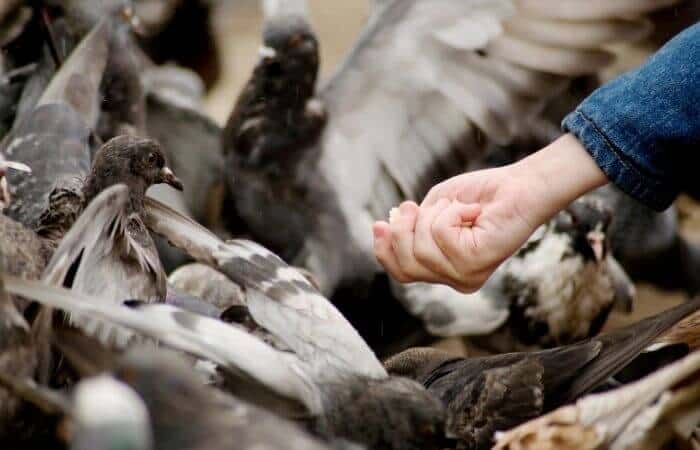
In fact, many pigeon keepers mix rice with their pigeon’s food and no one has ever said they have seen any adverse effects from doing so.
Ornithologists have rejected the idea for decades. After Ann Landers repeated it in 1988, she printed a reply from Steven Sibley of the Cornell Lab of Ornithology (opens in new tab) pointing out that rice has to be boiled before it expands, and that birds grind their food with grit in the gizzard.
Wild ducks, geese and many other birds feed in rice fields every year without harm.
Pigeons & Baking Soda Explosions
The case of baking soda is even stranger.
The implication of baking soda or bicarbonate of soda as an exploding agent is because baking soda also expands rapidly.
Whereas rice just needs the application of water, baking soda gives off gas when it is heated or mixed with an acid.

It is a normal everyday household and commercial product used in baking. When heated it expands and produces gas.
The rapid gas expansion is supposed to cause an explosion within the pigeon’s tiny gut.
Normally, it isn’t seen lying around in large quantities in either city streets or the countryside.
Even if a pigeon did manage to find some, a bird’s body is nowhere near hot enough to break it down: that takes temperatures of around 176°F (80°C) or more. Baking soda does react with stomach acid and release some carbon dioxide, but nowhere near enough to make a pigeon explode, although a large amount of it would not be good for a bird.
Where Did The Rice & Baking Soda Myths Come From?
The rice myth was made famous by the American advice columnist Ann Landers in 1988, although the idea is older. Ornithologists and bird charities have rejected it, but it still persists today.
The story got a boost in 1985, when a Connecticut state legislator proposed a bill to ban throwing uncooked rice at weddings, as Snopes (opens in new tab) reports.

Nobody is quite sure where the baking soda idea came from. It may have started as a DIY pigeon deterrent solution. Someone probably had a pigeon problem and wanted to get rid of them.
As poisoning pigeons is illegal or tightly restricted in many places, another, legal way was required. What can be more innocuous and innocent than baking soda?
Using the same principle as the expanding rice idea, they probably thought a pigeon’s temperature would produce gas and set off an explosion.
There is also a theory that feeding pigeons Alka Seltzer will make them explode due to the trapped gas in their stomachs, thankfully this too is a myth.
What Might Make a Pigeon Explode?
Calcium carbide is the chemical most often named in stories about exploding birds. In contact with water it gives off acetylene gas, so a swallowed lump could cause serious harm or death, but there are no reliable reports of it actually making a pigeon explode.
This is used in industry to make carbide lamps and acetylene gas, apart from other chemical products.
The other is magnesium silicide (opens in new tab), made from a mixture of magnesium and silicon, which can be toxic.
Again, it is used in industry to make certain alloys.
How a pigeon would get access to them or why they would ingest them is anybody’s guess.
Is it safe to give pigeons rice or baking soda?
A little plain rice, cooked or uncooked, is fine as part of a mixed diet, but it shouldn’t replace a proper seed mix. See the best food for pigeons. Don’t give pigeons baking soda, Alka-Seltzer or any other household chemical. They won’t explode, but the salt and other ingredients can make them ill.
If pigeons are a nuisance, use humane methods such as removing food sources and blocking ledges. Our guide to keeping pigeons away explains what works.
Sources
- Snopes: Is throwing rice at weddings bad for birds? (opens in new tab)
- Live Science: Does wedding rice make birds explode? (opens in new tab)
- Krupa, J. (2005), The American Biology Teacher: Does wedding rice cause birds to explode? (opens in new tab)
Last updated 24 October 2026 · Health