
The Parlor Roller is a domestic pigeon that somersaults along the ground instead of flying. Adults generally cannot fly. The rolling is a selected, progressive movement disorder, not a trick the bird chooses to perform. Show standards also cover Parlor Tumblers, which jump and somersault on the spot rather than travelling along the ground.
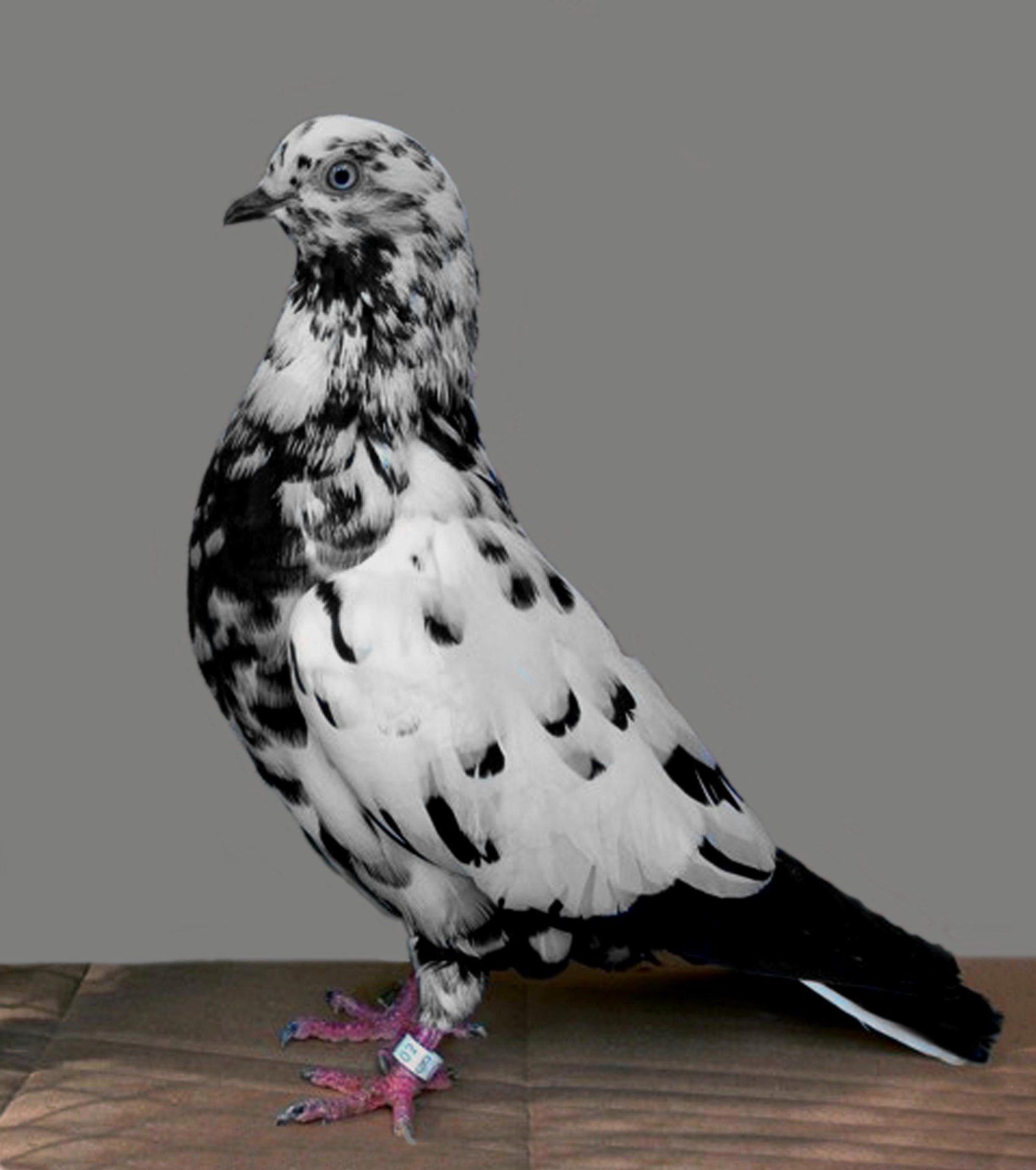
Parlor Roller vs Parlor Tumbler vs flying rollers
All of these birds are domestic breeds of the rock pigeon (Columba livia). They are not wild species, and they are not the same as Birmingham Rollers or Oriental Rollers, which still fly.
The National Pigeon Association Book of Standards (opens in new tab) lists two related entries in the tumbler and roller group: Parlor Tumbler (a 2018 standard) and Parlour Tumbler (Roller) (a 2022 standard). The second entry recognises two performance types: birds that jump and somersault on or around the same spot, and “Rolling Performers”, which roll along the ground in a straight line. In everyday use, “Parlor Roller” usually means the ground-rolling bird.
| Feature | Parlor Roller (ground-rolling type) | Parlor Tumbler (on-the-spot type) | Birmingham or Oriental Roller |
|---|---|---|---|
| Typical performance | Backward somersaults along the ground, often over a measured distance | A jump followed by one or more backward somersaults, landing near the take-off point | Aerial rolls or tumbles in flight, then the bird continues flying |
| Flight in adults | Generally cannot fly; a bird that rises more than two feet (about 60 cm) can be disqualified under the 2022 roller standard | Flight is not a Parlor Tumbler trait; the 2018 standard judges performance first in order to eliminate birds that may fly | These are flying breeds |
| Where it is shown | On a prepared ground or indoor surface, not in the air | Same kind of prepared surface | In the air, from a loft, often as a kit |
For the genetics and welfare of tumbling more widely, see why tumbler pigeons tumble.
Appearance
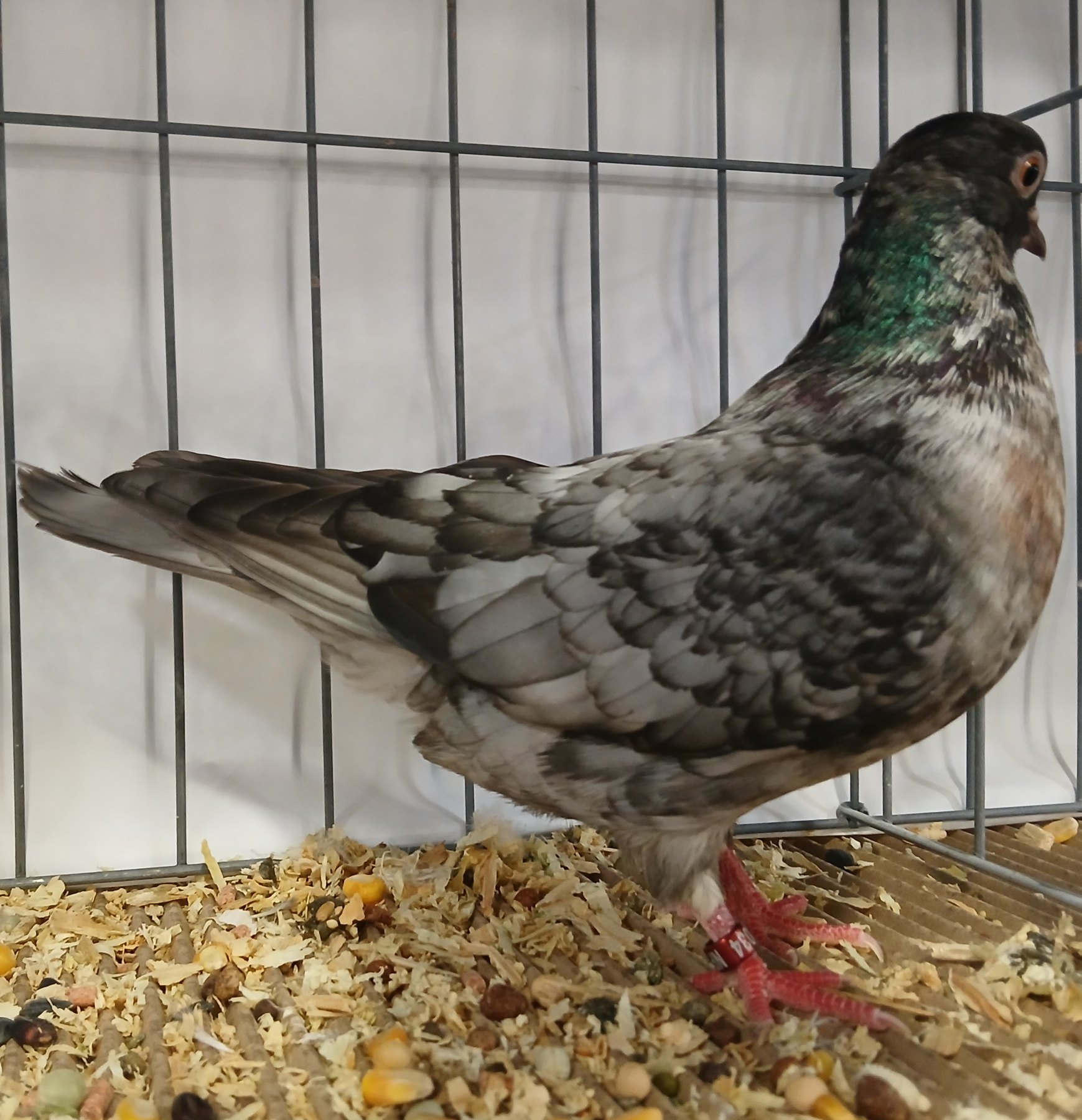
Parlor Rollers and Parlor Tumblers are compact, clean-legged pigeons with a short, stout, wedge-shaped body and an upright, sprightly carriage. The 2018 and 2022 NPA standards both give a weight of 7 to 12 ounces (about 200 to 340 g) and describe a pearl-coloured eye as the desired type. The 2022 roller standard lists black, red, yellow, dun, white, and any other colour that also meets the type and performance requirements.
Colour is not what defines the breed. A white bird and a dark almond-marked bird can both be parlor birds if they perform in the required way and match the body type.
What the rolling is, and why it happens
A Parlor Tumbler, in the 2018 standard, should jump straight up, complete one, two or three backward somersaults, and land on its feet as close as possible to the starting point. A ground-rolling Parlor Roller is started from the hand or from the ground, sometimes with a clap or a finger snap, and is judged on the distance it travels in a straight line. In the 2022 standard, the farthest bird in the class is the benchmark for the distance score, unless that winning distance is under 60 feet (about 18 m), in which case the top score is slightly lower and the others are scaled from it.
The behaviour is inherited. In work from the University of Utah reported by Science News in April 2024 (opens in new tab), Atoosa Samani and colleagues crossed racing homers with Parlor Rollers: none of the hybrid offspring rolled. When those hybrids were bred together, about four in ten of the next generation somersaulted when they were made to fly. Samani described the condition as a movement disorder with no good side to it. It is progressive: it appears soon after hatching and becomes more severe until the birds cannot fly.
A 1972 paper by Richard K. Entrikin and Lawrence C. Erway in the Journal of Heredity (opens in new tab) is the classic genetic study of roller and tumbler pigeons.
Welfare
Because adult Parlor Rollers generally cannot fly, they cannot leave the ground to escape a dog, a cat or a person, and they cannot reach a high perch or a hopper if that is the only way to get food or water. Anything that makes the rolling more violent, or that puts a hard or cluttered surface in the bird’s path, raises the chance of injury.
The NPA standard is direct about the surface used for performance. To reduce the risk of injury and to treat the birds humanely, indoor birds should be given a piece of short-nap indoor/outdoor carpet or a similar surface about 4 feet by 4 feet (about 1.2 m by 1.2 m). Outdoors, the same kind of surface can be used, or a flat, level, recently cut grassy area that has been checked for glass, sticks, stones and other hazards. Sand and dirt should be avoided, because they tend to get into the birds’ eyes. The standard says never to perform the birds on concrete, tile, asphalt, wood, plastic or similar hard surfaces, and never in their cage. The 2022 roller standard repeats the cage point: rolling in a cage can cause serious damage.
Food and water need to be reachable on or near the floor. Housing has to keep predators out, because the birds cannot drop from a loft or fly to safety. A flying-roller’s loft, built for birds that leave and return by air, is the wrong design.
Our tumbler article already notes that many people consider breeding birds that cannot fly normally to be a welfare problem, and that responsible breeders avoid it. Parlor Rollers are the furthest point of that selection: the performance the standard rewards is the same trait that removes flight.
History
The 2018 NPA standard says there is no certain documentation of how the modern Parlor Tumbler arose. It mentions earlier reports of similar, less refined performing birds in India before 1850, and “Inside” or “House” Tumblers being developed around 1850 in Scotland, England and the eastern United States. It suggests that the modern type was probably formed after 1850 in the Philadelphia area, from flying tumblers that tumbled in the yard as they took off. Those are the association’s own historical notes, not a separate archival study.
What is clear is the later split in how the birds are used. Flying rollers were kept for aerial performance. Parlor birds were selected for somersaults that happen on or just above the ground, until flight itself dropped out of the breed.
Parlor Roller FAQs
Can Parlor Roller pigeons fly?
Adult birds generally cannot. The 2022 NPA roller standard can disqualify a bird that rises more than two feet (about 60 cm) from the ground. Young birds may still get into the air for a time, but the movement disorder is progressive and flight is typically lost as they mature.
Why do Parlor Rollers roll?
They have been selected, over many generations, for a backward somersaulting trait. Research reported in 2024 found that the behaviour behaved as a recessive trait in crosses with racing homers, and described it as a progressive movement disorder, not a sign that the bird is playing or happy.
Is a Parlor Roller the same as a Birmingham Roller?
No. Birmingham Rollers are flying birds that tumble in the air and then continue flying. Parlor Rollers somersault on the ground and generally cannot fly.
What is the difference between a Parlor Roller and a Parlor Tumbler?
In the NPA’s 2022 standard, tumbling performers jump and somersault on or around the same spot, and rolling performers travel along the ground in a straight line. People often use “Parlor Roller” for the ground-rolling birds and “Parlor Tumbler” for the on-the-spot birds, but you will see the names used loosely.
Is it cruel to keep Parlor Rollers?
The rolling is a movement disorder that has been deliberately bred to the point where adults cannot fly. That has welfare costs: the birds cannot escape predators by taking wing, and they can injure themselves on a hard or cluttered surface. Anyone who keeps them needs a safe floor, ground-level food and water, and predator-proof housing. Many people consider breeding birds that cannot fly normally to be a welfare problem.
How far can a Parlor Roller roll?
It varies from bird to bird. The 2022 NPA standard scores a class by comparing each bird with the farthest roller in that class, and it uses 60 feet (about 18 m) as a threshold in the scoring method. Treat show-ring figures as the distances recorded under those rules, not as a biological limit, and be wary of informal “world record” claims that are not tied to a named, dated event.
Last updated 10 November 2026 · Types