
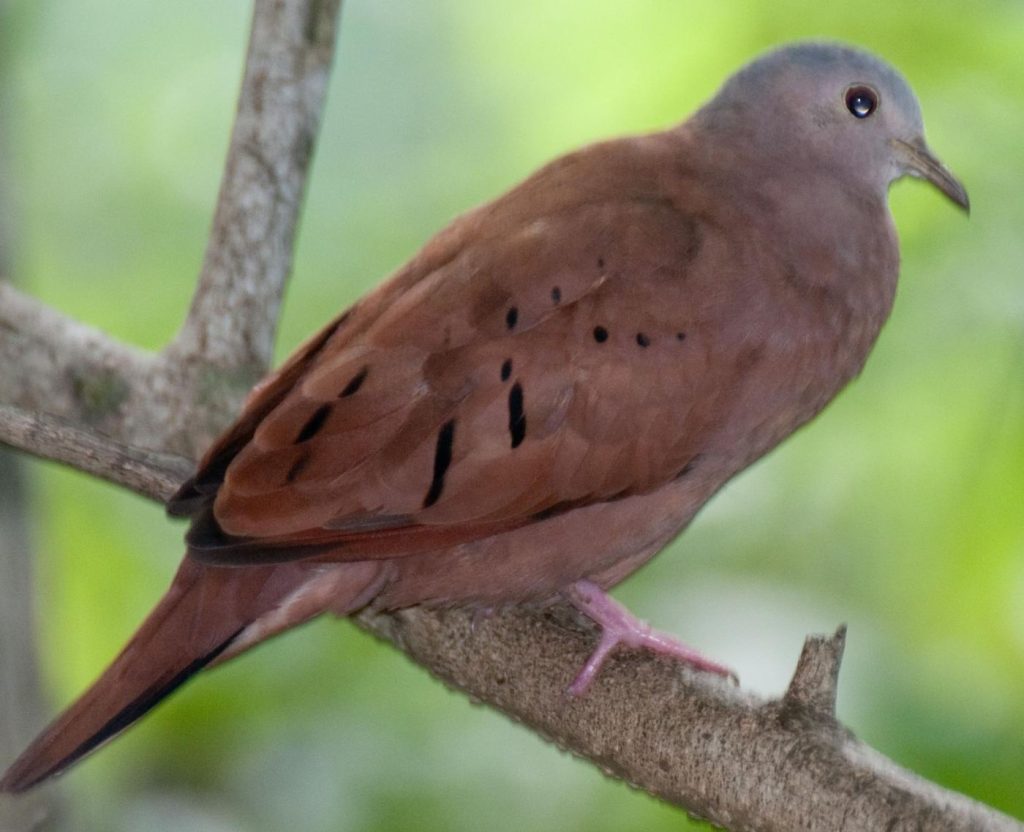
The ruddy ground dove (Columbina talpacoti) is a small, short-tailed dove of Mexico, Central America and South America. It is about 17 cm long and weighs 40 to 56 g. The male is easy to name: a cinnamon-red bird with a pale grey crown and a row of black spots on the wing. The female is a plainer grey-brown, and she is the one most often mistaken for a common ground dove.
It lives in open country, farmland, gardens and towns from northern Mexico to northern Argentina, and on Trinidad and Tobago. It does not migrate, but single birds now turn up most years in the south-western United States. The IUCN lists it as Least Concern, with a population that BirdLife International suspects is increasing.
Ruddy ground dove at a glance
| Fact | Ruddy ground dove (Columbina talpacoti) |
|---|---|
| Length | 16.5 to 18 cm (6.5 to 7.1 in) |
| Weight | 40 to 56.5 g (1.4 to 2.0 oz) |
| Male | cinnamon-red body, grey crown, pinkish face, black wing spots |
| Female | grey-brown, with less contrast between head and body |
| Range | northern Mexico to northern Argentina; Trinidad and Tobago |
| Habitat | open and semi-open land, farms, gardens, towns; not deep forest |
| Elevation | sea level to 1,200 m |
| Diet | mainly small seeds picked up from bare ground |
| Eggs | usually 2, white |
| Incubation | about 12 to 14 days |
| Time in the nest | about 9 to 18 days, usually 11 to 13 |
| Movements | resident; a rare visitor to the USA and Chile |
| Status | Least Concern (IUCN 2020), population thought to be increasing |
| Population | 5 to 50 million mature birds (a rough estimate) |
The length and weight are from Cornell Lab’s All About Birds. Breeding figures come from field studies in Surinam and Brazil, described below. Range, elevation, status and population are from BirdLife International.
How to identify a ruddy ground dove
A ruddy ground dove has the usual dove shape in miniature: small head, short bill, plump body and a short, square tail. It walks on the ground to feed but also spends a lot of time perched in shrubs and trees, and on wires in towns.
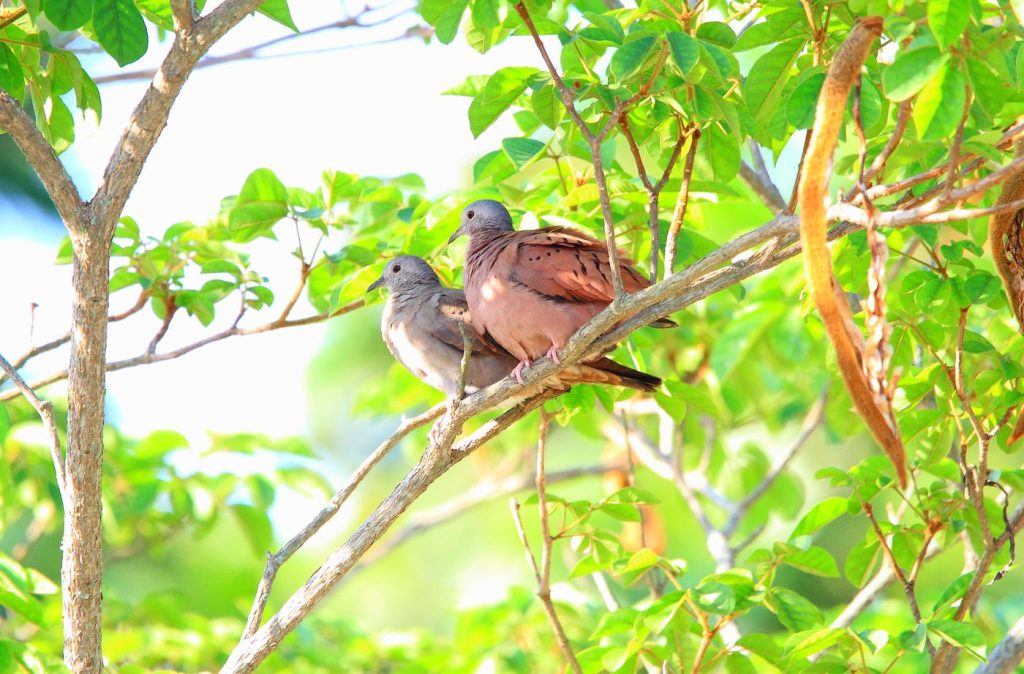
The adult male has rich cinnamon upperparts that fade to a pinkish face and neck, a grey crown and deep red eyes. Black spots cross the wing coverts and also reach the scapulars, the feathers at the top of the wing. The female is grey-brown with a hint of cinnamon above and greyer underparts, and her head contrasts much less with her body. In flight both sexes show bright rusty patches in the wings, and the underwings are black and brown.
Colour varies across the range. Birds of the World notes that birds in the drier west are paler than those in the wetter east, and All About Birds says males in western Mexico are much paler than the deep red birds further south.
Ruddy ground dove, common ground dove or Inca dove?
In Mexico and the south-western United States, the ruddy ground dove is most often confused with two other small doves of the same genus. A male ruddy is red all over and hard to mistake. The female needs a closer look.
| Ruddy ground dove | Common ground dove | Inca dove | |
|---|---|---|---|
| Scientific name | Columbina talpacoti | Columbina passerina | Columbina inca |
| Length | 17 to 18 cm | 15 to 18 cm | 17 to 23 cm |
| Weight | 40 to 56.5 g | 30 to 40 g | 30 to 60 g |
| Breast and head | plain | scaly | scaly, like the rest of the body |
| Bill | no pink | pink base | – |
| Black wing spots | on the wing and the scapulars | on the wing only | none; scaly instead |
| Tail | short, square, a little longer than a common ground dove’s | short, square, pale corners | long, white outer feathers |
Sources: Audubon Field Guide (lengths, ground dove and Inca dove weights, field marks); All About Birds (ruddy ground dove weight).
The bill and the breast are the safest marks on a female. A common ground dove has a pink or orange base to the bill and scaly feathers on the head and breast. A female ruddy ground dove has no pink on the bill and a plain breast. An Inca dove is scaly all over and has a much longer tail. Further south, the plain-breasted ground dove (Columbina minuta) is another lookalike. According to All About Birds it is smaller, with purple wing spots and less spotting overall, and its female is darker and greyer than a female ruddy.
How heavy is a ruddy ground dove?
Weights in grams. Ruddy ground dove rows are orange; grey rows are the two lookalikes.
Calls and displays
The song is a fast series of two-note coos. Field guides write it in different ways: “cu-WHOOP” in All About Birds, and “kitty-woo”, “per-whoop” or “p-ter-woo” in the Audubon guide. In Surinam, F. Haverschmidt heard the male start with a “hoo” and speed up until each note sounded more like “boo”. While he coos, the male thickens his neck and his tail moves up and down with each note.
Haverschmidt also described a display flight. After cooing, the male flies up a short way, claps his wings loudly a few times and then glides down with the wings held out before flying on normally. He saw this even with no female nearby.
Pairs stay very close. Haverschmidt called a pair “almost inseparable” and once saw two birds pressed so tightly together in a downpour that they looked like a single mass. All About Birds says pairs rest side by side and preen each other. Males fight other males by striking with the wings. When a person or another bird comes too near, a ruddy ground dove raises the nearer wing towards it and leans its body away.
Where ruddy ground doves live
The species is a resident across a huge area. BirdLife International puts its range (extent of occurrence) at about 24.1 million km², and lists it as native in 22 countries and territories from Mexico and Belize to Uruguay and Argentina, including Trinidad and Tobago and the Dutch Caribbean islands. It is a vagrant to Chile and the United States. It lives from sea level to about 1,200 m.
It is a bird of open ground. BirdLife’s habitat list is led by heavily degraded former forest, followed by pasture, arable land and tropical shrubland, and it says the species does not normally occur in forest. Birds of the World describes it using open, wet places from riverbanks to suburban yards, where bare ground makes seeds easy to find. In Surinam, Haverschmidt found it on open sandy ground, in cultivated land and in gardens, nesting even in the middle of Paramaribo.
Four subspecies
The IOC World Bird List recognises four subspecies:
| Subspecies | Described by | Range |
|---|---|---|
| C. t. eluta | Bangs, 1901 | western Mexico |
| C. t. rufipennis | Bonaparte, 1855 | south-eastern Mexico to northern Colombia, northern Venezuela, Trinidad and Tobago |
| C. t. caucae | Chapman, 1915 | western Colombia |
| C. t. talpacoti | Temminck, 1810 | eastern Ecuador and Peru to the Guianas, Brazil and central Argentina |
Source: IOC World Bird List, version 15.2.
Ruddy ground doves in the United States
North of Mexico the ruddy ground dove is a rare visitor. All About Birds gives the first US record as Texas in 1975 and says the species has since been found in eight states and now turns up in Arizona every year. The Audubon guide says most visitors arrive in autumn and often stay through the winter, and that they have been found from southern California to southern Texas, often in the company of Inca doves.
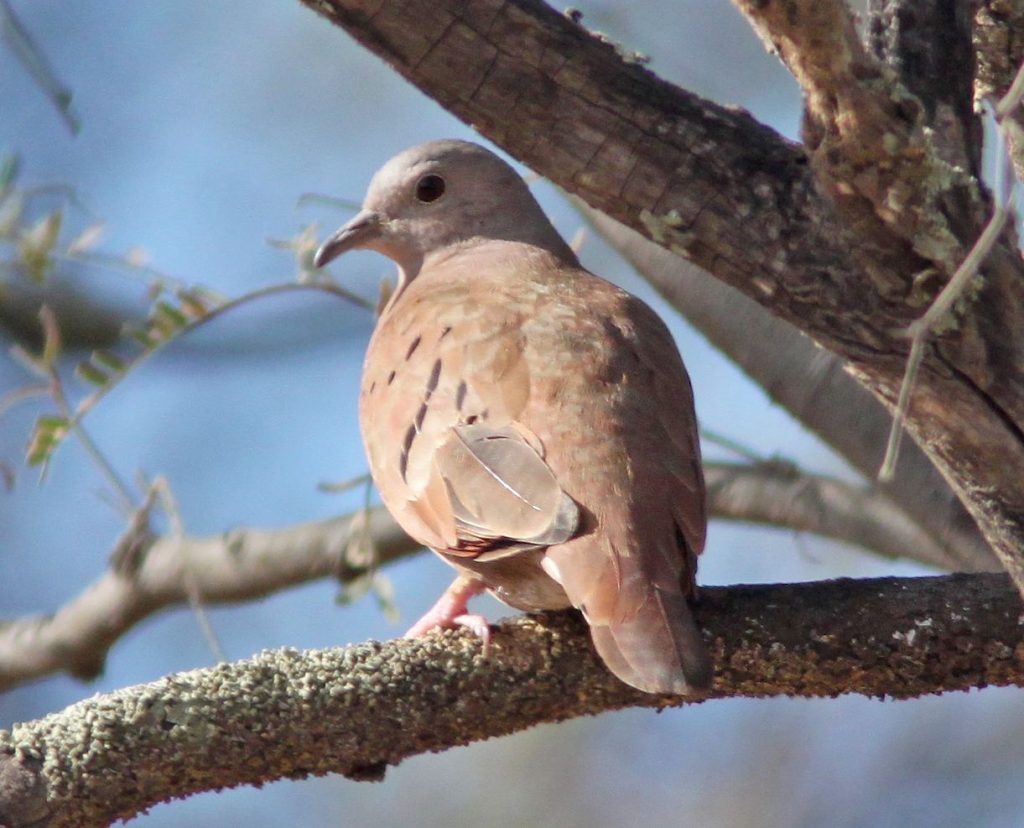
If you think you have found one, check the bill and breast against the comparison table above. A bird with a pink bill base or a scaly breast is a common ground dove. Most American records are single birds or small groups mixed in with other doves, so look through any flock of small doves at a feeder or on a path.
What do ruddy ground doves eat?
Ruddy ground doves eat seeds, picked up one at a time from bare or sparsely grassed ground. Renato Cintra studied a population on a farm near Brasília in 1982 and 1983. He found them taking seeds from about 2 mm long (wild Paspalum grass) up to grains of maize 15 mm long. In the crops of 15 fledglings and 35 adults found dead, he found seeds and, apart from those, only two snails and one insect. Their main foods there were an introduced grass, Brachiaria plantaginea, and a native Paspalum grass.
Feeding flocks can be large. Haverschmidt often saw 20 or 25 birds feeding together, and All About Birds says single-species flocks outside the breeding season can number more than 200.
Breeding, nests and eggs
Ruddy ground doves can breed in almost any month. In Surinam, Haverschmidt found nests with eggs in practically every month of the year. In central Brazil, Cintra saw nest building in every month except October, with most nesting from January to September.
The nest is a small, shallow cup or pad of grass stems, small sticks and roots. Cintra found 218 nests in 19 kinds of plant, from ground level to 7.5 m up, and 90% of them sat in forks of horizontal branches. Four were on the ground, the first ground nests recorded for the species. Accounts of who builds differ. Haverschmidt saw both sexes collect material, one stick or grass stem at a time. Cintra saw only males carrying it, up to 13 trips a minute, while the female arranged it in the nest. Building took about four days.
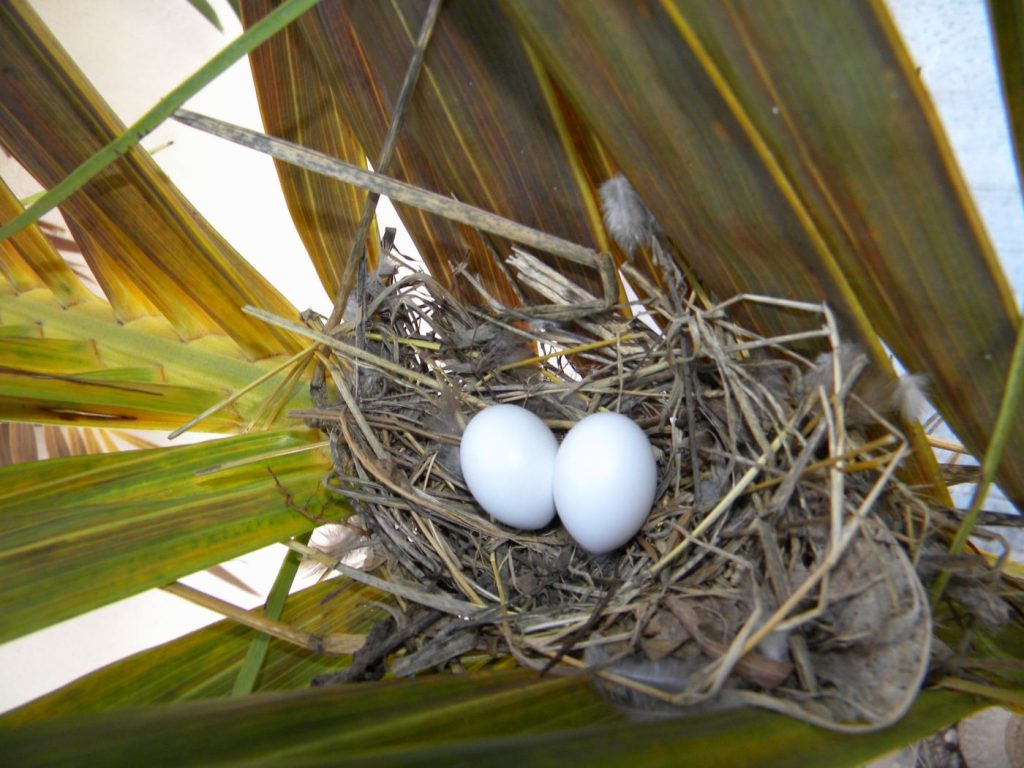
The clutch is almost always two white eggs, laid on consecutive days. Of Cintra’s 218 nests, 91.7% held two eggs or chicks and 7.8% held one. His 85 measured eggs averaged 22.4 by 16.8 mm and 3.41 g.
Both parents incubate. In Surinam the female sat from the afternoon through the night and the male took over in the late morning. Cintra worked out that the female sits for about 18 hours a day and the male for about 6. Like all pigeons and doves, the parents feed their young on crop milk at first, and Cintra saw seed fragments in the chicks’ crops from the second day.
How long do eggs and chicks take?
Ranges in days from three field studies and one reference guide.
Incubation
Time in the nest
Average time in the nest: 11.8 days in Cintra’s study and 12.9 days in the study by Marini and others.
The chicks grow fast. Haverschmidt weighed three broods every day and found they left the nest at 11 or 12 days old, still well below adult weight but able to fly. In the one family Cintra followed after fledging, the two young stayed with their parents for 25 days. One young male he had ringed as a nestling was incubating eggs of his own at three months old.
A pair can raise several broods a year, sometimes in the same nest. Haverschmidt watched one pair use the same nest in his garden for three broods between October 1951 and February 1952. Cintra recorded up to four broods in a year.
How many eggs survive?
Losses are high. Cintra followed 422 eggs. 67.3% hatched and 32.7% were lost, and predators took most of those. He saw curl-crested jays eating eggs and chicks, and American kestrels, aplomado falcons and a snake taking nestlings. From laying to leaving the nest, the chance of a chick surviving was 36.7%.
What happened to 422 eggs
Name and classification
Coenraad Jacob Temminck described the species in 1810 as Columba talpacoti, in his book Les Pigeons. It has been placed in other genera since: Haverschmidt wrote about Columbigallina talpacoti in 1953, and the 1915 plate below calls it Chamaepelia talpacoti. Today it sits in Columbina with the other American ground doves, including the common ground dove and the Inca dove. According to All About Birds, the species name comes from the Nahuatl word tlapalcocotli, “red dove”.
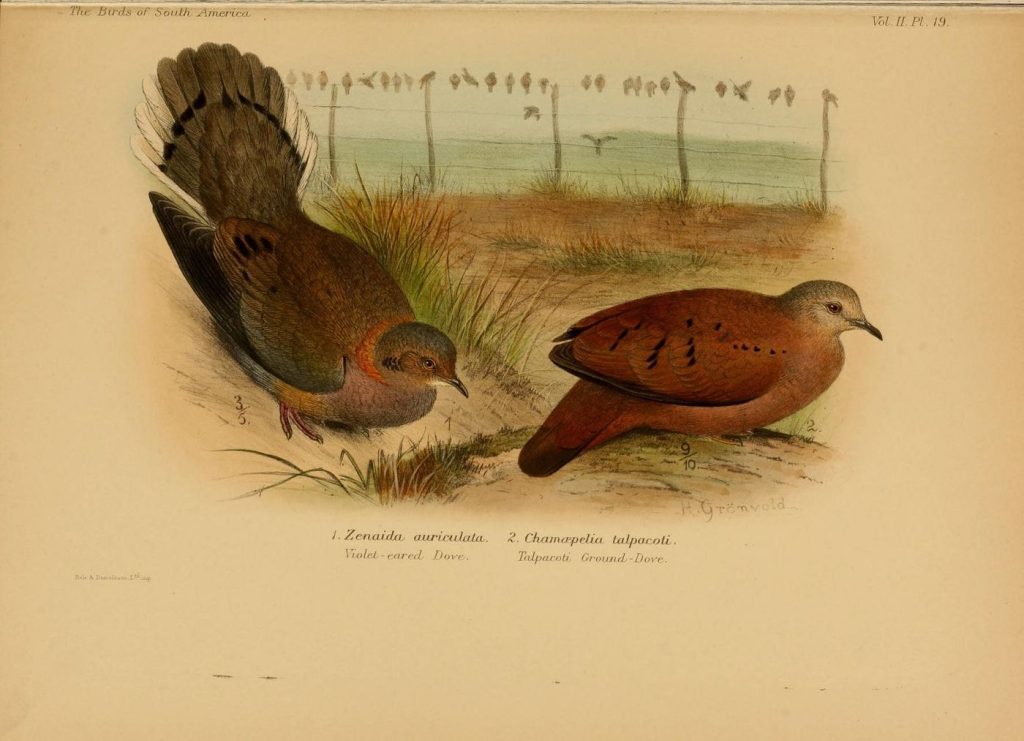
Its names in other languages often describe the same colour: colombe rousse in French, columbina colorada or tortolita rojiza in Spanish, and rolinha-roxa in Brazilian Portuguese.
The ruddy ground dove on record
- 1810Temminck describes the species as Columba talpacoti.
- 1855Bonaparte names the subspecies rufipennis.
- 1901Bangs names the west Mexican subspecies eluta.
- 1915Chapman names caucae from western Colombia, and Grönvold paints the bird for The Birds of South America.
- 1953Haverschmidt publishes his nesting notes from Surinam.
- 1975First record in the United States, in Texas.
- 1982–83Cintra studies 218 nests near Brasília.
- 1988First IUCN Red List assessment, as Lower Risk/Least Concern.
- 2020Latest assessment: Least Concern, population thought to be increasing.
Is the ruddy ground dove endangered?
No. BirdLife International assessed it for the IUCN Red List in 2020 as Least Concern. It has been listed as Least Concern, or under the older label Lower Risk/Least Concern, in every assessment since 1988. The reasons given are its very large range, a very large population and a trend that appears to be increasing. The population estimate of 5 to 50 million mature birds comes from Partners in Flight, and BirdLife rates the data quality as poor, so treat the numbers as a rough guide.
It does well on land that people have changed: most of the habitats BirdLife lists for it are farmland, pasture and degraded former forest. BirdLife also records that ruddy ground doves are taken for food and kept as pets in parts of their range, at local and national scale. Our guide to endangered pigeons and doves covers the species that are in real trouble.
Ruddy ground dove FAQs
Is a ruddy ground dove a pigeon?
Yes. It belongs to the pigeon and dove family, Columbidae. “Dove” and “pigeon” are not separate groups in science; small species tend to be called doves. Our page on the difference between doves and pigeons explains the names.
How big is a ruddy ground dove?
It is about 16.5 to 18 cm long and weighs 40 to 56.5 g, between a house sparrow and an American robin in size. A mourning dove weighs about twice as much or more.
What is the difference between a male and a female ruddy ground dove?
The male is cinnamon-red with a grey crown and a pinkish face. The female is grey-brown with only a hint of cinnamon, and her head contrasts much less with her body. Both have black wing spots and show rusty patches in the wings in flight.
Where can you see a ruddy ground dove in the United States?
It is a rare autumn and winter visitor, recorded from southern California to southern Texas. It now appears in Arizona every year, often with flocks of Inca doves.
How many eggs does a ruddy ground dove lay?
Usually two white eggs, laid on consecutive days. They hatch after about 12 to 14 days, and the chicks leave the nest at about 9 to 18 days old, most often at 11 to 13 days.
Is the ruddy ground dove related to the diamond dove?
Both are small ground-feeding doves, but they are not close relatives. The ruddy ground dove belongs to the American genus Columbina. The diamond dove is an Australian species in the genus Geopelia.