
The German Beauty Homer is a show pigeon from Germany, bred in the early 1900s from racing homers and related breeds. In German it is the Deutsche Schautaube, “German show pigeon”. It is a form pigeon, judged on shape, carriage and head rather than on speed or homing.
The club calls the head its most striking feature. It is broad over the eyes, and the beak and forehead form one smooth, gently curved line that peaks above the eye. A small white wattle lies flat on the beak. Like every domestic breed, it descends from the rock pigeon (Columba livia).
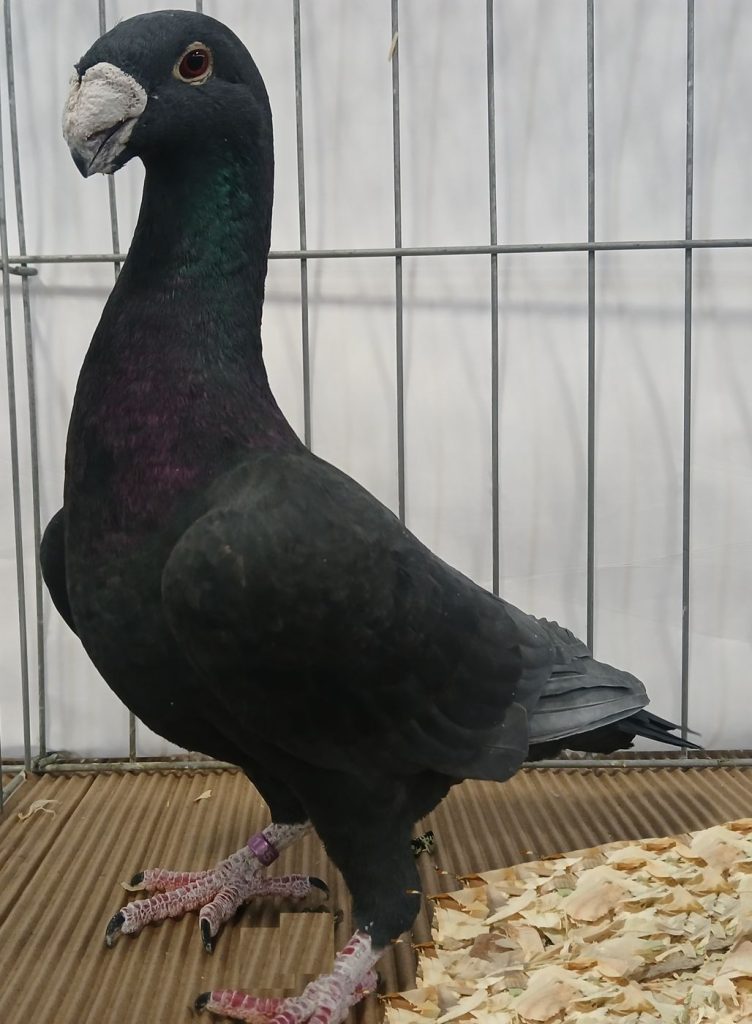
German Beauty Homer at a glance
| Feature | German Beauty Homer |
|---|---|
| Species | Domestic rock pigeon (Columba livia) |
| German name | Deutsche Schautaube, earlier Deutsche Schönheitsbrieftaube |
| Origin | Germany, early 1900s |
| Group | Form pigeon (EE list number 0032) |
| Ring size | 9 mm |
| Colours | 46 recognised by the German breed club |
| Weight | Not stated in the NPA standard or the club’s EE standard |
| Breed club | Sonderverein der Züchter Deutscher Schautauben, founded 1908 |
What the standard asks for
The German standard asks for a short, strong bird with a wedge-shaped body carried almost level. The NPA adds a tall, elegant stance. The outline should flow, and no single feature should dominate. A Dutch breed club describes the proportions this way: neck, body and legs each make up about a third of the bird’s height, and a well-built bird fits inside a circle that touches the skull, the soles of the feet and the tail tip.
Seen from the front, the head is broad over the eyes and narrows towards the beak. In profile, beak and forehead run in one unbroken line with the highest point above the eye. The NPA warns against a coarse head and a “ram-headed” look. The eye is large and expressive with an intense red iris, although white birds have dark eyes. The eye cere is narrow and fine, pale grey to white.
The beak is of medium length, blunt and well closed. The German standard asks for a fine, smooth wattle powdered white, with a slightly heart-shaped cut. The NPA says it should cover about two thirds of the beak and should not stand proud of the skull.
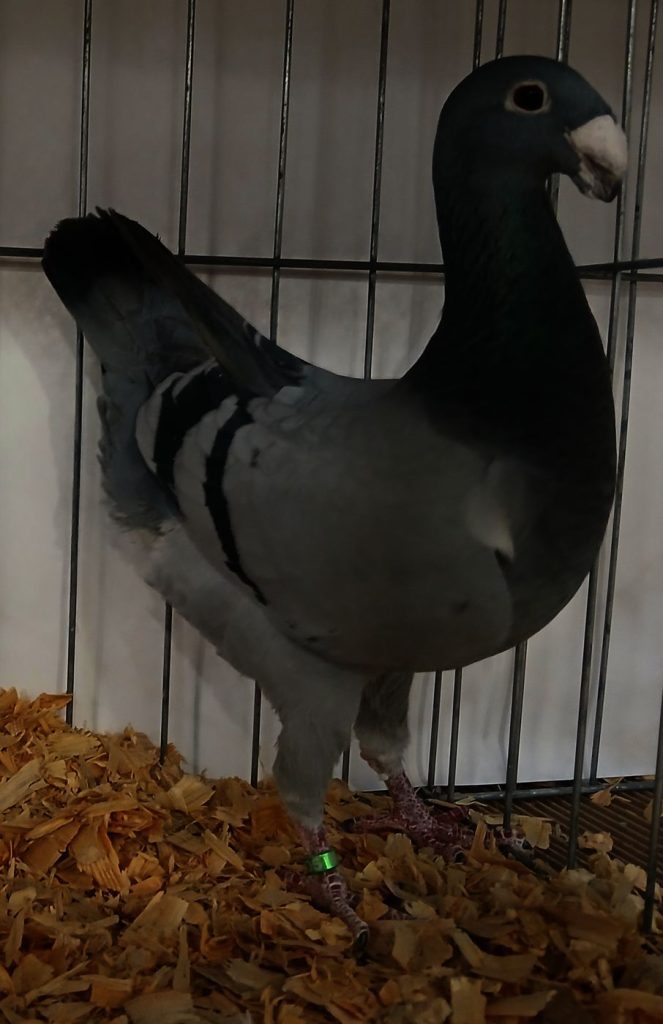
The neck is broad at the shoulders and narrows cleanly to the head, with a clean throat and no sign of a protruding gullet. The breast is broad and rounded, short and compact but not massive or plump. The wings are held tight with broad primaries, and the wing butts stand slightly forward, as if ready for take-off. The tail is short and narrow, and the NPA wants the wing tips to come within an inch of its end. The legs are of good medium length and unfeathered, with tight feathering on the thighs.
Colours
The German club recognises 46 colour varieties. Its colour page groups them into base colours, white and white-barred birds with schimmels (a white-flecked pattern), and tigered birds. Pied birds can occur in any base colour and are shown together as “Gescheckt”. The Andalusian colour was recognised in 2022 and indigo-dark in 2023.
Colour varieties on the German club’s list
Number of named varieties in each group on the colour page of the Sonderverein der Züchter Deutscher Schautauben.
These groups list 45 names. The club counts 46 varieties in all, and pied birds (“Gescheckt”), which occur in every base colour, are shown as one group.
Where it came from
The EE list, the European breed list for fancy pigeons, gives Germany as the country of origin. The German standard says the breed was created there at the start of the 20th century from racing homers and related breeds by planned selection. A Dutch breed club’s history says that around 1900 a few German breeders began producing beauty homers that could be used both in the show cage and in the travelling basket. Breeders later crossed in Show Homers and other breeds, among them the Show Antwerp, the Dragoon, the Modena and tumblers.
The breed club was founded in 1908 as the Verband der Deutschen Schönheitsbrieftaubenzüchter. According to the Dutch history, refining the head was the main aim until about 1920. A federation of local breed clubs, started in 1921 on Otto Herbst’s initiative, had more than 2,000 members by 1925. In 1938 the club became the Verband Deutscher Schautaubenzüchter, and the breed’s name changed from Schönheitsbrieftaube to Schautaube. The history says the racing-pigeon federation no longer allowed the word Brieftaube, “homing pigeon”.
German Beauty Homer history in dates
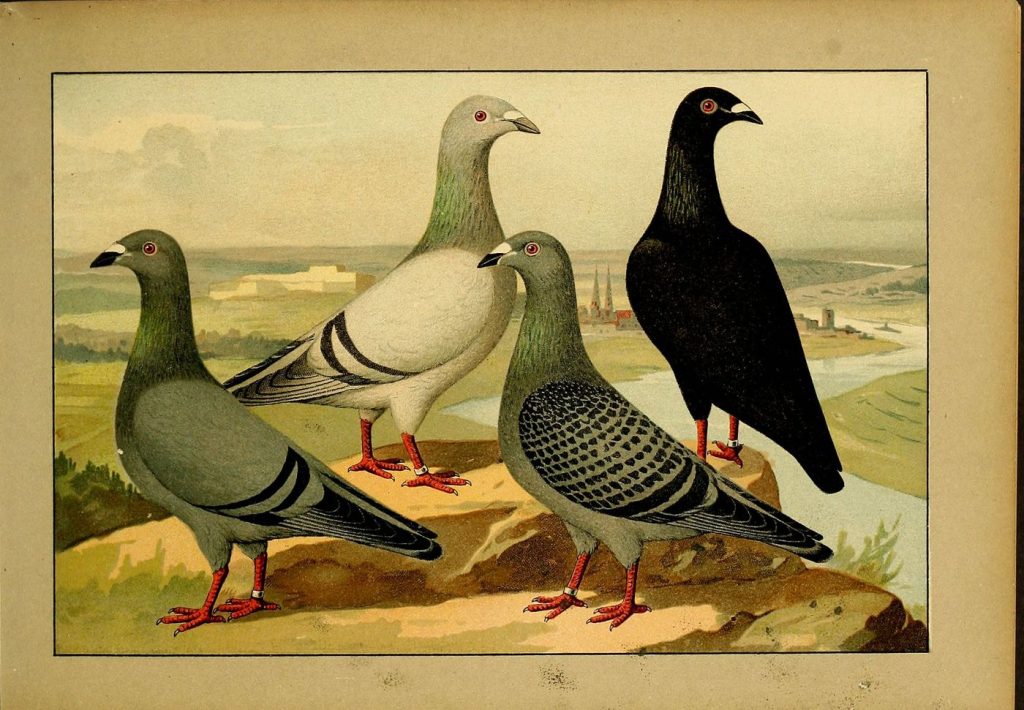
The plate above comes from a 1906 German pigeon book. The letterpress for it asks for a short, sturdy, slightly upright bird, with a cock measuring no more than 36 to 38 cm from beak to tail tip and a hen no more than 35 to 37 cm.
In the mid-1930s the breed had to show utility value, and the weight of young birds was set at 500 g. The Dutch history says the birds became heavier and larger and flew worse. Shows resumed soon after the Second World War, and by 1947 more than 1,100 German Beauty Homers were on show again.
After German reunification, West German breeders thought that East German birds had an older type, with heavy, low-set beaks and thick necks, but they valued the beak substance. Birds were swapped, and within a few years the two types had merged.
Other beauty homers in the EE list
The EE list includes several other homer-type show breeds. The table gives the country each is credited to and its ring size, which is a band size and says nothing about the bird’s weight.
| Breed | Country in the EE list | Ring size |
|---|---|---|
| German Beauty Homer | Germany | 9 mm |
| Dutch Beauty Homer | Netherlands | 9 mm |
| Belgian Beauty Homer | Belgium | 9 mm |
| Hungarian Beauty Homer | Hungary | 12 mm |
| Show Homer | Great Britain | 11 mm |
| Show Antwerp | Great Britain | 11 mm |
| Genuine Homer | Great Britain | 10 mm |
How it is judged
The NPA and the German club judge in the same order, and the NPA states it as the “order of importance”.
Order of importance when judging
The NPA lists these among its faults:
- A body that is plump, long, oversized or too heavy, or one that is too small and slight
- A coarse head, or a head that is too narrow with too little skull
- A beak that is not straight or not well closed
- A wattle that is too short, or not white, smooth and fine
- A thick, crooked or swan-like neck
Its serious faults include flying (racer) type, a pointed breast, an open beak, red or coarse eye ceres, a dewlap and signs of a third wing bar.
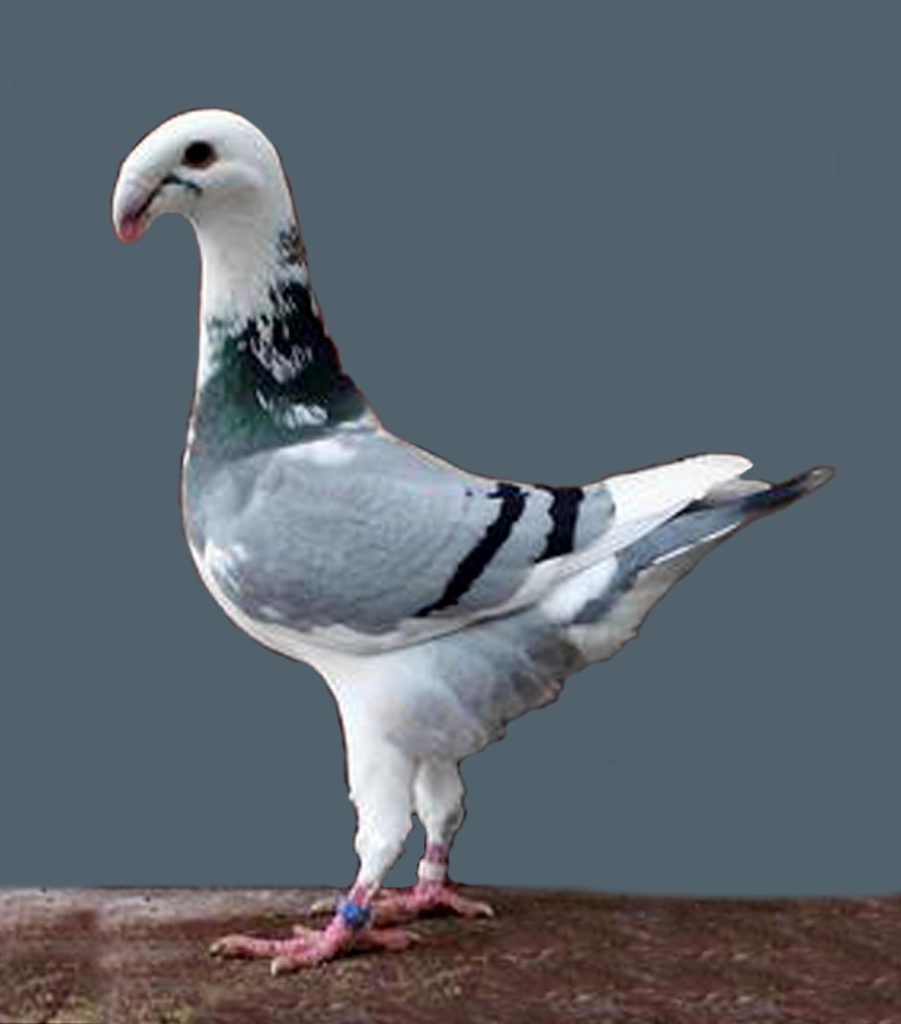
The NPA also sets one clear rule for pied birds: about half colour and half white. A bird with too little of either is not classed as pied or tigered.
Keeping and showing
The NPA describes the breed as lively but tame and friendly, and excellent both for breeding and showing and for flying free. The German club also calls it a lively bird that is keen to breed and fly, although the breed is selected for form, not flying performance.
The club held its 61st main show in Straßkirchen, Bavaria, on 19 to 22 November 2026. It says the main show draws between 1,000 and 1,500 German Beauty Homers, depending on the venue. For the basics of showing, see pigeon shows, and for rings see pigeon banding. For other kinds of domestic pigeon, see the types of pigeon guide.
Frequently asked questions
What is a German Beauty Homer?
It is a German show pigeon, bred in the early 1900s from racing homers and judged on its shape, stance, head and colour. The German name is Deutsche Schautaube.
Is it a racing pigeon?
No. It descends from racing homers, but the NPA lists flying type, or racer form, as a serious fault. Both the NPA and the German club still call it a lively bird that flies freely.
How big is a German Beauty Homer?
Neither the NPA standard nor the German club’s standard gives a weight. Both treat an oversized bird as a fault, and a Dutch breed club calls the breed medium-sized. A 1906 German description of the early exhibition homer put the cock at no more than 36 to 38 cm from beak to tail tip.
How many colours does it come in?
The German breed club recognises 46 colour varieties, and pied birds can occur in every base colour.
What does Schautaube mean?
Schau means show and Taube means pigeon, so Schautaube is “show pigeon”. The older name, Schönheitsbrieftaube, means “beauty homing pigeon”.