
The black-naped pheasant pigeon (Otidiphaps insularis) is a ground-living pigeon found only on Fergusson Island in Papua New Guinea. Scientists had no confirmed record of it between a specimen collected in 1896 and camera-trap images taken in September 2022. A follow-up survey in June and July 2025 did not find it again, though the work was cut short by poor weather. The IUCN Red List treats it as Critically Endangered.
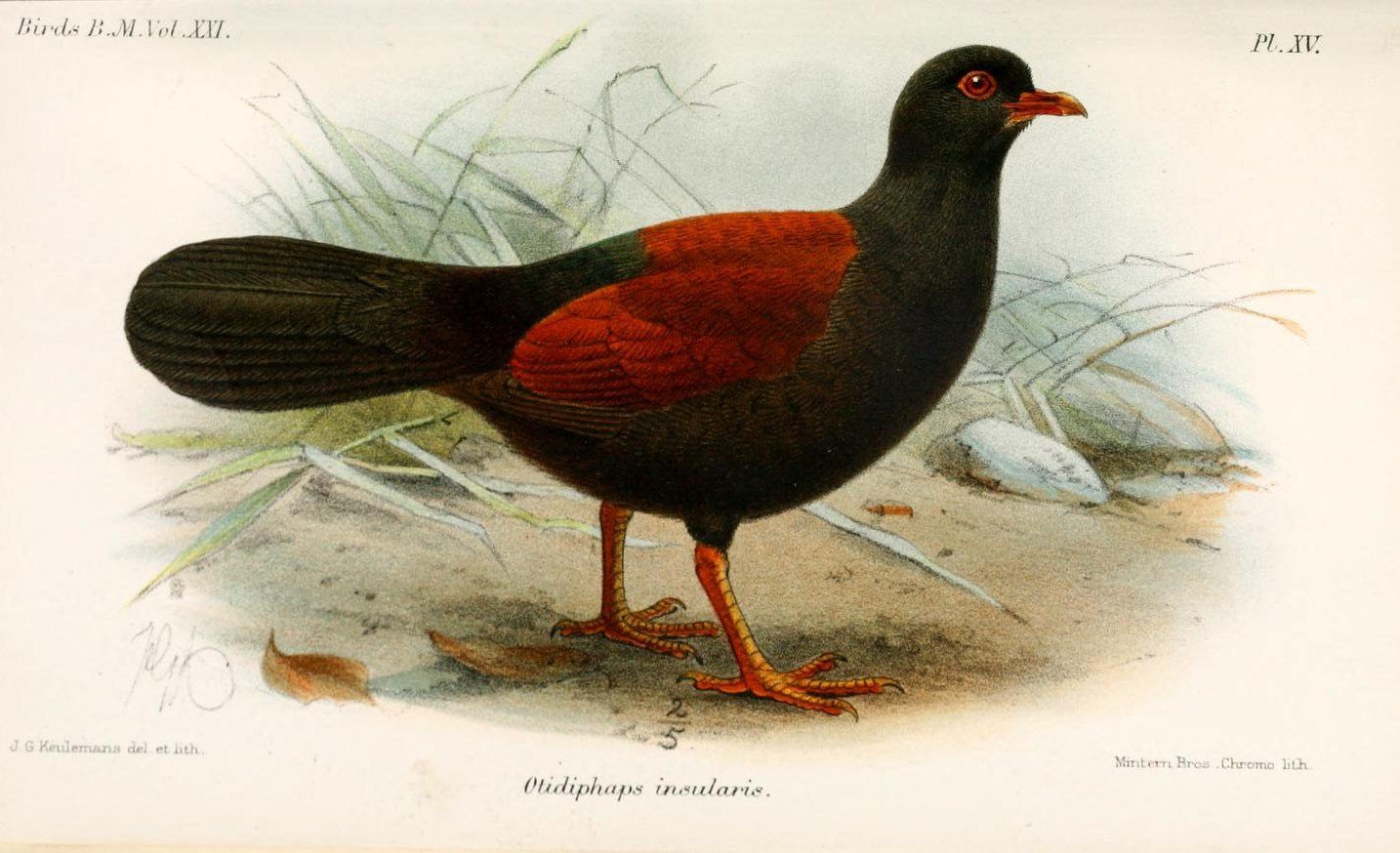
What it is, and what it looks like
Pheasant pigeons are large, long-tailed, mostly terrestrial pigeons in the genus Otidiphaps, which is confined to New Guinea and a few nearby islands. They walk on the forest floor rather than perching in the open like a town pigeon. Compared with the other members of the genus, the black-naped bird has no backward-facing crest, no obvious contrasting colour on the nape, less colour on the underparts, and brighter, cadmium-orange wings. Those comparisons come from the 2022 expedition team, writing in a 2024 preprint by Jason Gregg, Jordan Boersma and colleagues (opens in new tab).
The plate above is not a photograph of a living bird. It is J. G. Keulemans’s 1893 illustration of Otidiphaps insularis, published as Plate XV in the Catalogue of the Birds in the British Museum. It shows the dark body, orange wings, orange legs and bill, red eye and long tail that distinguish the taxon in museum specimens.
BirdLife International and the IUCN Red List (opens in new tab) treat the black-naped bird as a full species, following a split of the four Otidiphaps forms in the 2014 HBW and BirdLife checklist. Some other checklists still treat it as a subspecies of the pheasant pigeon Otidiphaps nobilis. There is not yet a molecular study that settles the matter. The account below follows the IUCN usage, while noting the disagreement.
Where it lives
The species is known only from Fergusson Island, the largest island in the D’Entrecasteaux Archipelago, in Milne Bay Province, Papua New Guinea. The island covers about 1,437 km² and rises to 2,073 m. Andrew Goldie, who collected the first specimens, described an “exceedingly rough range of mountains” above 600 m (about 2,000 ft). The 2022 cameras that recorded the bird were placed on the eastern side of the island, in hill forest around the Mt. Kilkerran massif.
Whether the bird also lives in Fergusson’s other mountain ranges, or on neighbouring Goodenough or Normanby, has not been confirmed. Gregg and colleagues recommended surveys there, because the islands share a similar bird fauna and were connected in the Pleistocene. Until those surveys are done, the only documented home is Fergusson.
Specimens, then a long gap
Guy Kirwan and Hein van Grouw, writing in 2023 in the Bulletin of the British Ornithologists’ Club (opens in new tab), reviewed the early museum material. The name Otidiphaps insularis was introduced by Osbert Salvin and Frederick Godman in 1883. It rests on two syntypes collected by Andrew Goldie in 1882, now in the Natural History Museum at Tring (NHMUK 1889.2.12.119 and 1889.2.12.484). A third specimen, a female, was collected by Albert Stewart Meek on 25 May 1896 and is in the American Museum of Natural History (AMNH 616494). After that, the species dropped out of the scientific record.
It was not shown to be extinct in that interval. It was lost to formal documentation. The Search for Lost Birds (opens in new tab) project later listed it among birds without conclusive documentation for a decade or more. Local people on Fergusson still knew the bird.
Goldie, quoted in the 1883 description, gave the only early note on the voice: “a sort of ké-o, the ‘o’ being prolonged.” There is still no published recording of the species’ own call. The 2025 team used calls of the grey-naped pheasant pigeon, a related form, when they tried playback.
The 2022 rediscovery
In September 2022, a month-long expedition on eastern Fergusson obtained the first scientific documentation since 1896. The work combined hunter interviews, walking surveys and camera traps, and is described in the Gregg and Boersma preprint. A survey paper on the same trip appeared in 2025 in the Bulletin of the British Ornithologists’ Club (opens in new tab).
The cameras recorded the bird twice, more than 5 km apart, and the authors judge that these were two individuals. One camera, set along an elevational gradient without local guidance, recorded photographs and video on 22 September. A second camera, placed with the help of hunters who had seen the bird within the previous year, recorded it on 28 September. Seventy walking surveys during the trip did not record it at all.
The team interviewed 29 hunters in ten locations around Mt. Kilkerran. Eleven of them (38%) picked out the bird from an illustration; five (17%) identified a related pheasant pigeon’s call in playback; two said they had seen it in the previous year. In three eastern villages people named it Auwo, a name taken from its call. Some also described legends, chants and ceremonial use. Most of the hunters interviewed could not confirm a recent sighting. The scarcity of records, even with that help, is part of why the Critically Endangered listing still fits the facts that are known.
The 2025 survey that did not find it
In June and July 2025 the same research group returned, in a trip reported in a March 2026 EcoEvoRxiv preprint by Boersma, Gregg and colleagues (opens in new tab), which has not been peer-reviewed. They placed cameras on Oya Nai and in the Kwama river area, the second of which had produced a detection in 2022, and they walked hill and montane forest between about 570 and 1,250 m.
The cameras ran for 30.5 camera-days, including nearly 400 hours in an area already known to hold the species. They recorded other forest birds and rats, but no black-naped pheasant pigeon. Walking surveys and playback did not find it either. Heavy rain shortened the work and left the forest unusually quiet; the team recorded about half as many camera-trap detections per day as on the earlier trip. They saw no obvious habitat change at the Oya Nai or Kwama sites themselves.
A missed detection in bad weather is not evidence that the bird has gone, and the authors do not present it as a change in status. It does show how hard the species still is to document, even in a place where it was filmed three years earlier.
Population, status and threats
The IUCN assessment (opens in new tab), written by BirdLife International, lists the species as Critically Endangered under criterion C2a(ii). It was assessed on 9 July 2021, with an errata version in 2022, which means the figures predate the September 2022 camera-trap records.
| Measure | Published figure | What it means |
|---|---|---|
| IUCN category | Critically Endangered, C2a(ii) | A very small, declining population in one subpopulation, under IUCN rules |
| Number of mature individuals | 50–249 | A 2021 estimate, not a count of birds seen in 2022 or 2025 |
| Population trend | Decreasing | The 2021 assessment; not a new trend calculated after the rediscovery |
| Range as documented | Fergusson Island only | Other islands and other ranges on Fergusson remain unconfirmed |
| Population after 2022 | Unknown | Stated as unknown in the 2026 preprint on the 2025 survey |
Do not multiply or “update” the 2021 numbers with later guesses. Two camera-trap records confirm that the species survived; they are not a census.
The 2021 assessment lists habitat loss from farming and logging, together with hunting and invasive species, as threats. The 2022 team noted logging roads built to within 3 km of one detection, and hunters reported feral cats in the forest. The 2026 preprint on the 2025 trip adds more recent pressure: locals had spoken of signed timber agreements, alluvial gold had been found in the Kwama area, and a mining camp had been set up at the coastal village of Gameta shortly before the team arrived in June 2025. Those later points come from an unreviewed preprint and should be read as the authors’ field report, not as a new Red List assessment.
Any further survey or conservation work has to be done with the permission of customary landowners on Fergusson. The 2022 documentation itself depended on that permission, and on hunters who still knew the bird as Auwo.
For how this species sits among other threatened pigeons, see are pigeons endangered?.
Black-naped pheasant pigeon FAQs
Was the black-naped pheasant pigeon extinct before 2022?
No. It was lost to scientific documentation after 1896, which is not the same as extinction. Local people on Fergusson continued to know the bird, and two hunters in 2022 said they had seen it in the previous year. The camera traps then confirmed it for science.
When and how was it rediscovered?
In September 2022, on eastern Fergusson Island, by camera traps. One recorded the bird on 22 September, another on 28 September, more than 5 km apart. Walking surveys on the same trip did not see it.
Did the 2025 survey prove that it has disappeared again?
No. The June–July 2025 trip did not detect it, but the work was cut short by heavy rain. The authors do not treat the missed detections as evidence that the species has gone.
How many black-naped pheasant pigeons are left?
Nobody has a current count. The IUCN’s 2021 estimate was 50–249 mature individuals. After the 2022 records, the 2025 team still described the population size as unknown.
Where does it live?
The only documented range is Fergusson Island, Papua New Guinea, in hill forest. It has not been confirmed on the island’s other ranges, or on Goodenough or Normanby.
Is it a separate species or a subspecies?
BirdLife and the IUCN treat it as a species, Otidiphaps insularis. Some other checklists still place it as a subspecies of Otidiphaps nobilis. Both views are in use; the account above follows the IUCN treatment and notes the split.