
To keep pigeons off a balcony, first look for an active nest. Then take away food, and block the places they sit: the railing, the floor edge, the soffit above the door, and any flat ledge. A tight net across the opening, or spike strips and a sloped cover on the rail, does the lasting work.
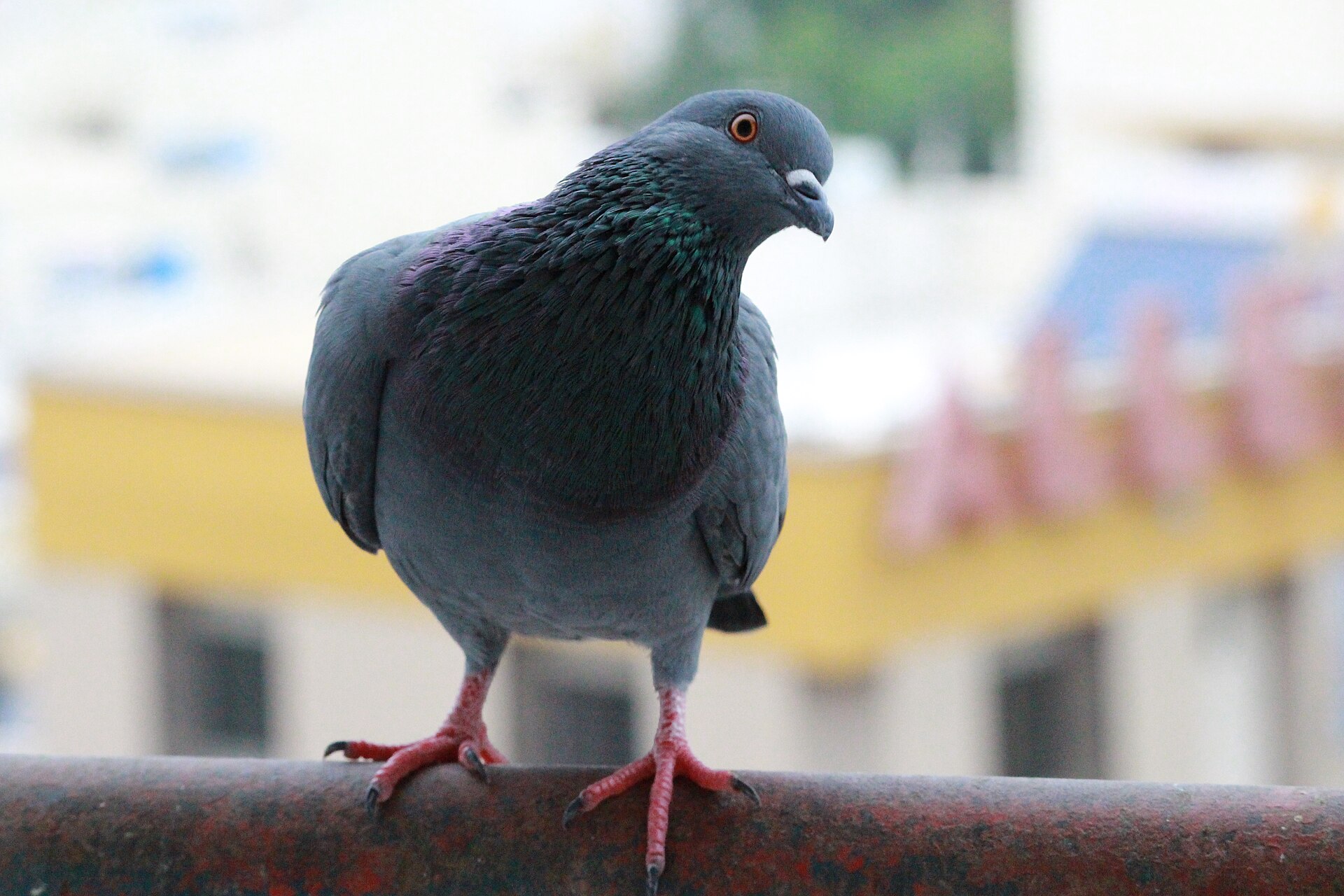
Where pigeons sit on a balcony
Pigeons pick a balcony for the same reasons they pick a ledge: it is high, dry and close to food. The RSPCA notes that roofs, windowsills, chimneys and balconies are the usual elevated spots. On a typical balcony the useful perches are easy to point to.
The rail is the first perch, especially a wide flat handrail or a rusted pipe they can grip. The soffit or the underside of the balcony above can hide a nest. A step at the door, a window sill, or the lip of the floor slab is a ledge. Pots and stored boxes give cover. If the opening is left open, the whole balcony becomes a roost.
Work in this order
The fittings are the same ones compared in our guide to pigeon deterrents. On a balcony the order of work matters more than the brand of spike.
If there is already a nest
An active nest changes the plan. In England, Scotland and Wales the Wildlife and Countryside Act 1981 makes it an offence, except under licence, to damage or destroy a nest that is in use or being built, or to take or destroy an egg. The RSPCA is blunt: you should not move a pigeon nest without a licence, and you should leave it until the eggs have hatched and the young have fledged. Feral pigeons can breed in any month, so it is worth looking carefully, not only in spring.
If no licence applies, wait, then proof the corner so the nest is not rebuilt. For public health or public safety, an authorised person in England may be able to rely on general licence GL41, which for 2026 includes feral pigeons. The licence has conditions, and it does not apply in the same form in Scotland, Wales, Northern Ireland or other countries. When in doubt, wait until the young have left.
Food on the balcony
A balcony with spilled seed, a pet bowl, a bread board or an open bin is a feeding tray. Take that away and the balcony is less worth the flight. If the birds are coming from a neighbour who feeds them, our page on a neighbour’s pigeons covers what you can try. The general guide to keeping pigeons away starts with food for the same reason.
Proofing the rail, ledges and opening
For the rail and any sill, use a physical barrier. Blunt spike strips, a sloped metal or plastic cap, or a tight coiled wire will do, if they cover the full length. A 2008 Basel study found that a ledge 4 cm wide was too narrow for a feral pigeon to sit on, and that a smooth slope of 25°, or a steeper slope on rougher material, stopped perching. A short strip with a bare end is still a perch. The RSPCA lists safely fitted, non-lethal spikes as one of the more humane ways to keep pigeons off a roof or balcony.
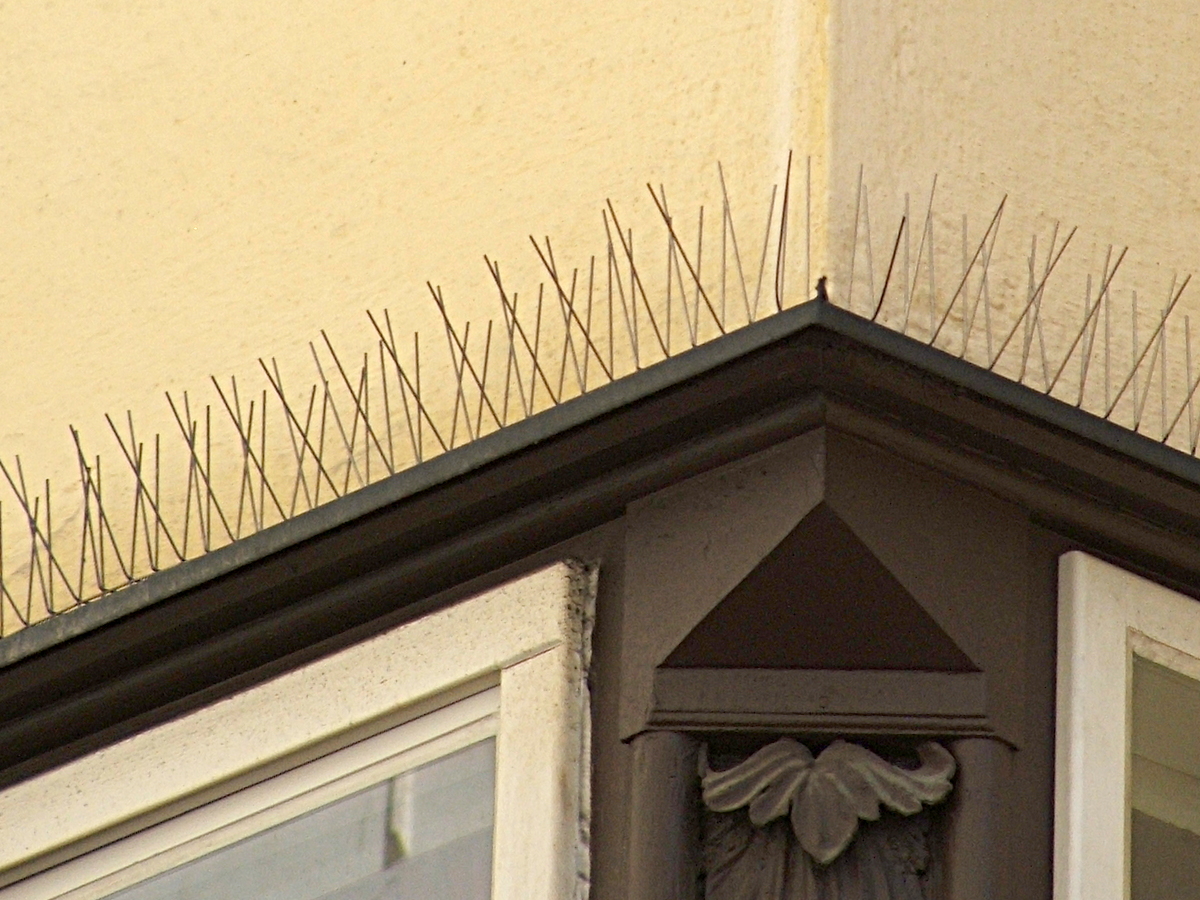
If pigeons are using the whole space, not just the rail, a net across the opening is the cleaner fix. The net has to be taut, fixed tight at every edge, and checked so that a bird cannot slip behind it. UK wildlife-management advice gives a mesh size of no more than 50 mm, on a square mesh, for pigeons. The RSPB says netting put up to stop birds nesting should be inspected at least daily. A flimsy, sagging net is a trap, not a deterrent.
If you rent the flat, ask before you drill. Many spike strips can be stuck with a recommended outdoor adhesive, and some nets can be tensioned on hooks or eyes, but a landlord or managing agent may still need to agree, especially on a shared facade or a listed building.
Droppings and leftover mess
Clear the droppings once the birds are off the perch, and before you stick spikes or a slope down, or the fittings will not hold. Our page on how to clean pigeon poop covers the job. The RSPCA notes that casual contact with pigeons themselves is a low risk for most people, but that droppings can hold bacteria, so you should avoid touching them and wash your hands if you do.
What is not worth buying for a balcony
Owl statues, hanging CDs, phone apps and ultrasonic plug-ins are sold for balconies because they are cheap and easy to put out. They are a weak answer. In University of Basel tests of 11 deterrent systems, ultrasound and a scent device had no effect, and motivated pigeons got past every system once they wanted the site. Visual scare objects fade as the birds learn that nothing happens. They can be a short pause while you wait to fit netting or spikes. They will not hold a balcony on their own.
Frequently asked questions
How do I keep pigeons off my balcony?
Check for an active nest, take food off the balcony, then proof the rail, ledges and opening. A tight net, or spike strips and a sloped cover on every perch, is what lasts. Scare gadgets are a poor substitute.
Can I remove a pigeon nest from my balcony?
Not while it is in use or being built, unless a licence applies. In England, Scotland and Wales that is an offence under the Wildlife and Countryside Act 1981. The RSPCA says you should wait until the young have fledged, then proof the site so the nest is not rebuilt.
Do I need to net the whole balcony?
Not always. If the birds only sit on the rail or a sill, a complete spike strip or a sloped cap may be enough. Net the opening when they are using the floor, the soffit or the space behind furniture, or when a rail strip keeps failing.
Will an owl decoy or an ultrasonic device keep pigeons off a balcony?
Not for long, if at all. Ultrasound had no effect in a published Basel test, and decoys and other visual tricks wear off as pigeons learn that they are harmless.
What if I rent and cannot drill the balcony?
Ask the landlord or agent first. Some spike strips and sloped caps can be fixed with outdoor adhesive, and a net can sometimes be tensioned without new holes, but you may still need permission, especially on a shared or listed building.
Sources
The claims on this page come from the sources below. For a comparison of the fittings themselves, see guide to pigeon deterrents. For the wider method, see guide to keeping pigeons away.
- RSPCA. Pigeons nesting in gardens and balconies: what to do. (opens in new tab)
- Historic England (2023). Bird deterrents. (opens in new tab)
- Haag-Wackernagel, D. and Geigenfeind, I. (2008). Protecting buildings against feral pigeons. European Journal of Wildlife Research 54: 715–721. (opens in new tab)
- Haag-Wackernagel, D. (2000). Behavioural responses of the feral pigeon (Columbidae) to deterring systems. Folia Zoologica 49(2): 101–114. (opens in new tab)
- RSPB. The use of netting to stop birds nesting. (opens in new tab)
- Defra / Natural England. Wildlife management advice note: legal measures to resolve conflict with wild birds (WML-GU01). (opens in new tab)
- Natural England (2026). GL41: general licence to kill or take certain species of wild birds to preserve public health or public safety (England, 1 January to 31 December 2026). (opens in new tab)
- GOV.UK. Wild birds: protection and licences. (opens in new tab)
Last updated 20 November 2026 · Problems