
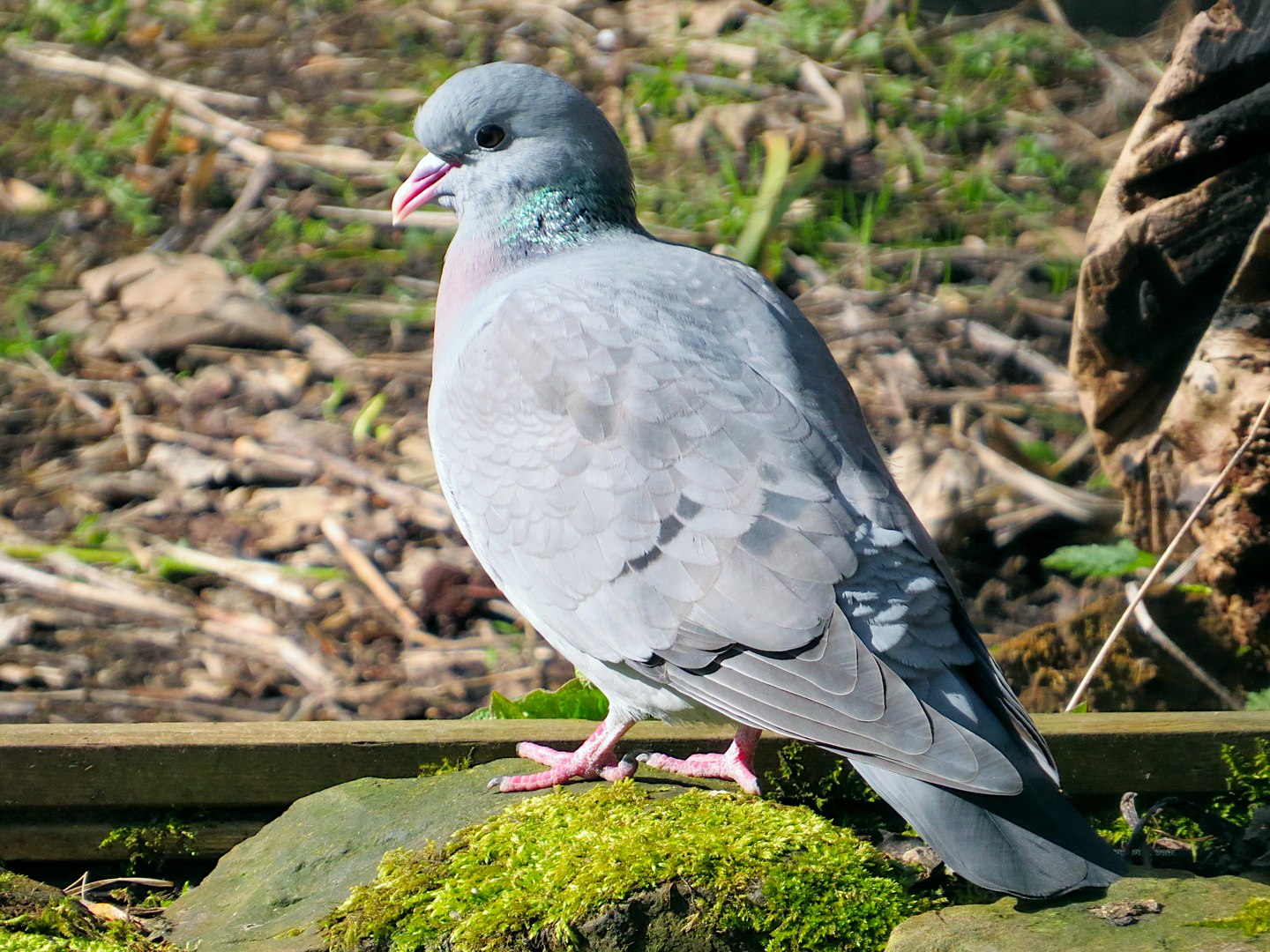
The stock dove (Columba oenas) is a blue-grey wild pigeon with a dark eye, a green neck sheen and no white neck patch. In Britain, look for it near mature trees and farmland. It is smaller than a woodpigeon and nests in holes rather than on an open branch.
How to identify a stock dove
Start with the plain blue-grey body, pinkish breast and glossy green patch on the side of the neck. The eye looks dark, and the folded wing has two short black bars. In flight, look for dark wing edges without the broad white flashes of a woodpigeon. The RSPB identification guide (opens in new tab) also points out the lack of a pale rump.
Use several features together. Feral pigeons vary enormously, and a young woodpigeon has no adult white neck patch yet. The white wing band is a better clue to a young woodpigeon’s identity than the neck alone.
Stock dove vs woodpigeon vs feral pigeon
| Feature | Stock dove | Woodpigeon | Rock dove / feral pigeon |
|---|---|---|---|
| Scientific name | Columba oenas | Columba palumbus | Columba livia |
| Build | Smaller and neater than a woodpigeon | Largest of these three | Similar size to a stock dove; variable build |
| Neck | Green sheen; no white patch | Adults have a white side patch; juveniles lack it | Often green/purple sheen; colours vary |
| Wing in flight | Dark edges; no broad white band | Broad white band, including in juveniles | No woodpigeon-style white band; plumage varies |
| Wing bars and rump | Short dark bars; rump not pale | White wing band is the easier field mark | Wild-type birds have broad dark bars and a pale rump; feral birds vary |
| Usual nesting site | Tree hole or other cavity | Open twig platform | Ledge, building or cliff cavity |
For the larger species, see our woodpigeon guide. Our pigeon guide puts these birds alongside Britain’s other pigeons and doves. A grey town pigeon is usually feral: colour alone cannot establish that it is a wild rock dove.
What does a stock dove sound like?
Listen for a low, hollow, drawn-out coo, repeated from cover. BTO compares the sound to blowing over a jam jar. It does not have the woodpigeon’s familiar five-note phrase. Written versions of bird calls are only a rough aid: listen to the stock dove recording on the RSPB page (opens in new tab) and compare it with the bird you heard. Avoid playing calls to draw birds towards you near a nest.
Where to see stock doves in the UK
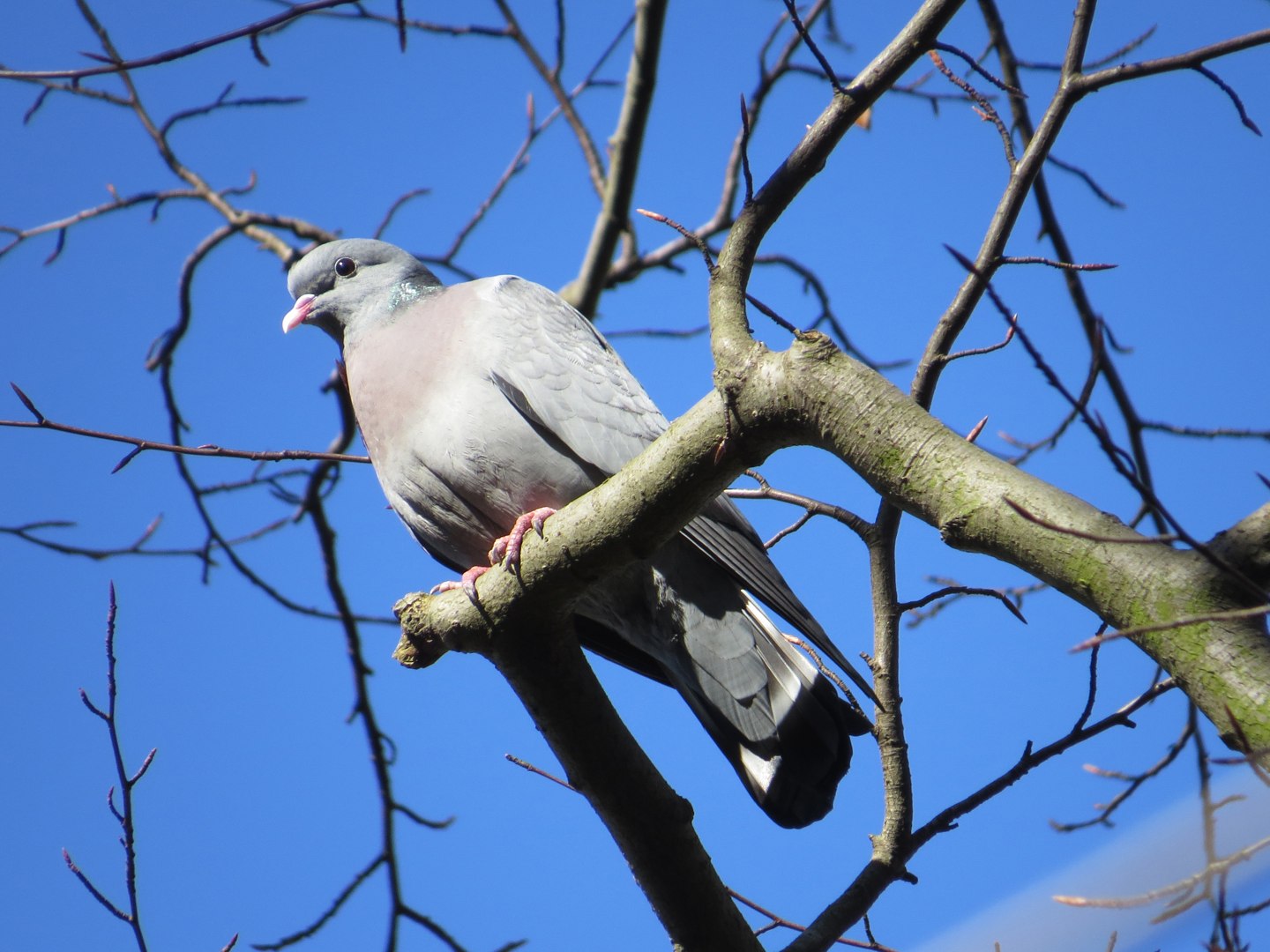
Look along woodland edges, in parkland with old trees, and over arable fields. Large rural gardens can attract them too. They are present throughout the year, although a local feeding flock may move between fields. Much of north-west Scotland is outside their regular range; in Ireland, they are scarce or absent across much of the north and west. BTO’s distribution account (opens in new tab) gives the regional picture.
Watch from a distance rather than approaching a nest cavity.
Diet: what do stock doves eat?
Stock doves feed mainly on the ground. Seeds and grain are important, with green leaves, buds, flowers and some invertebrates also eaten, according to BirdLife’s species account (opens in new tab). Winter seed supplies matter. Seed-rich field margins and retained stubbles can offer food without turning a nesting site into a feeding station.
Nesting, eggs and young
Unlike the woodpigeon, a stock dove normally nests inside a cavity. Old trees with natural holes are useful, and the birds also use nest boxes. The RSPB records occasional nesting in rabbit burrows. The nest is made from twigs and roots.
BTO nest records (opens in new tab) give a typical clutch of two eggs, incubation of 21–22 days shared by both parents, and fledging at 28–29 days. The eggs are white. Birds can nest repeatedly, so do not assume a box is empty because one brood has left.
UK population, trend and conservation status
| Measure | Published figure | What it means |
|---|---|---|
| UK breeding population | 320,000 territories, estimate for 2016 | Territories, not individual birds or a new census |
| UK breeding trend | +57%, 1995–2024 | BTO BirdFacts trend; not a population total |
| Latest BBS report summary | Increase of over 40% in the last ten years | Headline in the 2025 survey report, published in 2026 |
| UK conservation category | Amber, BoCC5 (2021) | International importance of the UK breeding population |
| Global IUCN category | Least Concern, assessment 2024 | Global extinction-risk category, not the UK traffic-light list |
The figures above come from BTO BirdFacts (opens in new tab), the BTO/JNCC/RSPB 2025 Breeding Bird Survey (opens in new tab), BoCC5 (opens in new tab) and BirdLife’s IUCN assessment (opens in new tab). The dates and measures differ; do not multiply the old territory estimate by a trend percentage to make a new population estimate.
Amber does not mean the stock dove is currently declining. Its BoCC5 criterion is breeding international importance: the UK holds at least 20% of the European breeding population. BTO describes a recovery after the effects of organochlorine seed dressings, followed by improved breeding performance. This contrasts with the continuing UK decline of the turtle dove, a different species.
How to help: stock dove nest boxes
Keep mature cavity-bearing trees where it is safe to do so. A nest box can provide an extra site near suitable feeding habitat, but a small tit box will not work.
National Nestbox Week (opens in new tab) recommends a very large box with an entrance at least 150 mm across, at least 3 m above the ground, on a woodland edge overlooking open fields. Those are entrance and siting measurements, not a complete construction plan. Have a competent installer handle work at height.
Our pigeon nest-box guide explains general construction, but domestic loft compartments are not a substitute for a stock dove cavity box. Keep the approach clear and the site quiet. Check occupancy before any maintenance; the breeding season can be long. Never open or clean an occupied box.
Stock dove FAQs
Are stock doves rare in the UK?
No. BTO describes them as common, with an estimated 320,000 breeding territories in 2016. They are easily overlooked among other pigeons, and their distribution is uneven. Amber status reflects the UK’s international responsibility, not rarity everywhere.
Is a stock dove the same as a woodpigeon?
No. They are different species. Stock doves are smaller, lack a white wing band and usually nest in holes. Adult woodpigeons have white neck patches as well as white wing bands; young woodpigeons lack the neck patch.
How can I separate a stock dove from a feral pigeon?
Look for the dark eye, neat blue-grey body, short dark wing bars and no pale rump. A wild-type feral pigeon has broader bars and usually a pale rump. Feral plumage varies, so check several marks rather than relying on one.
Do stock doves migrate?
They can be seen in Britain throughout the year. Across their wider range, northern European populations are migratory and populations farther south are more resident. A year-round UK presence does not mean every bird stays in the same place.
Will stock doves use a garden nest box?
They may use a suitable large cavity box, especially near mature trees and open feeding ground. A quiet rural or woodland-edge site is a better match than a busy small garden. There is no guarantee that a box will be occupied.
Why is it called a stock dove?
The RSPB traces stock to the Old English word stocc, meaning stump. The name refers to nesting in holes in trees, not to farm livestock or a domestic pigeon breed.
Last updated 7 November 2026 · Types