
The Victoria crowned pigeon (Goura victoria) is a ground-walking pigeon of northern New Guinea, Yapen and Biak. Adults are 73 to 75 cm long and average about 2.4 kg, making it the largest living pigeon. It has a white-tipped lacy blue crest, a maroon breast and a pale wing bar. It is Near Threatened and listed on CITES Appendix II.
How big is a Victoria crowned pigeon, and what does it look like?

Most adults are 73 to 75 cm (29 to 30 in) long, and adult mass averages about 2.39 kg (5.3 lb). That is roughly twice the length of a woodpigeon (40 to 42 cm according to the RSPB (opens in new tab)) and far heavier than a feral pigeon. On average it is the heaviest living pigeon, a little ahead of Scheepmaker’s crowned pigeon at about 2.25 kg; for how it compares with other species, see how big is a pigeon. The body is deep blue-grey, with a small black mask, a maroon chest, red irises, and a row of paler, maroon-tipped feathers that form a clear wing bar. The crest is the feature people notice first: a fan of lacy blue plumes, each tipped white, present in both sexes.
There are two subspecies. The mainland form, G. v. beccarii, is the larger one. The nominate race on Yapen, Biak and Supiori is smaller, with a slightly sparser crest and darker plumage. The sexes look alike. When they take off they make a loud clapping sound. The contact call is a deep, muffled ummm or hmmm; the display call is a repeated deep hoota-hoota, and a territorial call is often written as whup-up.
How do you tell the crowned pigeons apart?
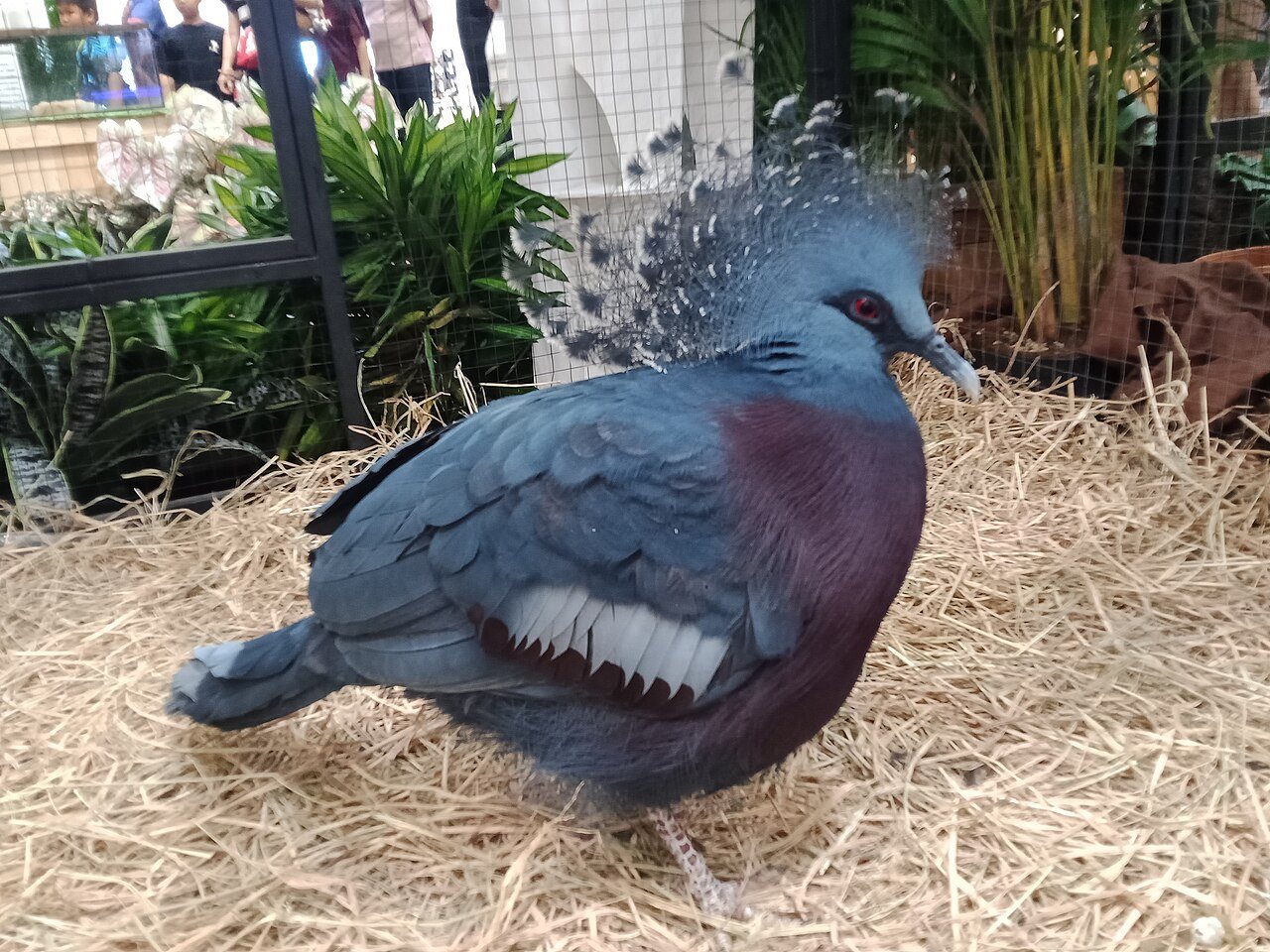
There are four living species of Goura, all on New Guinea and nearby islands. The Victoria is the only one with a clearly white-tipped, lacy crest and a maroon breast. The western crowned pigeon, which overlaps it in the north-west, has a scragglier, hair-like crest, a plain blue-grey chest and a weaker wing bar. Scheepmaker’s and Sclater’s crowned pigeons (often still grouped as the southern crowned pigeon) live further south and do not overlap with the Victoria. A 2018 genetic study found the Victoria to be closest to Scheepmaker’s, with the western and Sclater’s forms as the other pair (Bruxaux and colleagues (2018) (opens in new tab)). Crowned pigeons sit in the same island-pigeon group as the Nicobar pigeon.
Where does the Victoria crowned pigeon live?
It is a bird of lowland and swamp forest in northern New Guinea, from Geelvink (Cenderawasih) Bay in Indonesian Papua east to Astrolabe Bay, plus an isolated area around Collingwood Bay in eastern Papua New Guinea. It also occurs on Yapen, and on Biak and Supiori, where it may have been introduced (BirdLife International (opens in new tab)). The main remaining numbers are in the Mamberamo Basin and the Sepik Basin. It usually stays near sea level, in alluvial plains and sago forest, but may go up to about 600 m (2,000 feet). The gap between Astrolabe Bay and Collingwood Bay is probably natural, because there is little coastal plain there.
Open GBIF records for this species are few, so the map above shows where birds have been recorded, not the whole range. BirdLife also lists Yapen and Biak, which barely appear in the open records. The south of New Guinea is the range of the southern crowned pigeons, not this species.
How does it live?
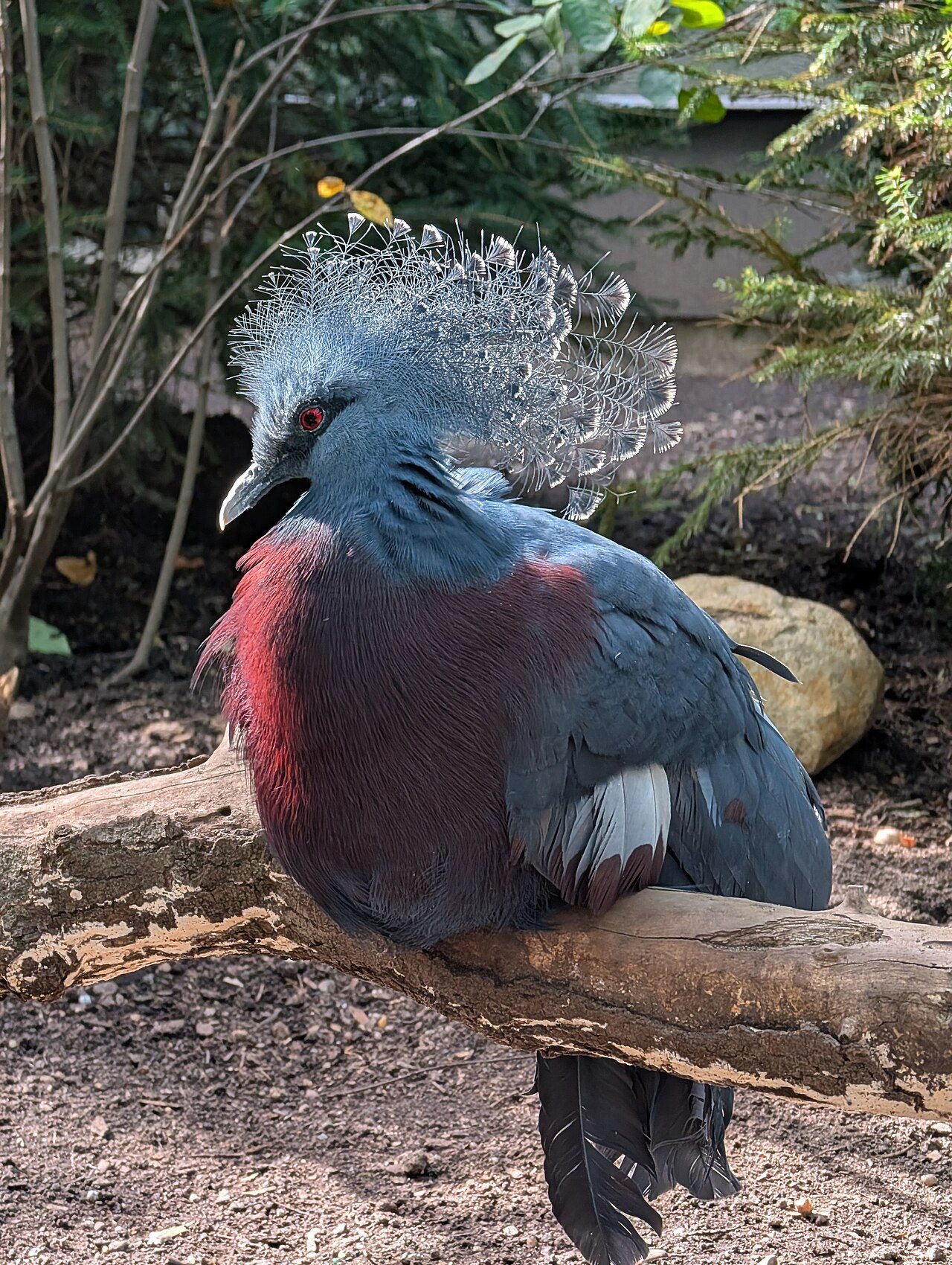
It walks the forest floor in pairs or small groups, taking fallen fruit (figs are a favourite in captivity), seeds and sometimes invertebrates. When disturbed it flies up into the canopy or onto a large horizontal branch and may sit there for some time, flicking its tail and calling. It is shyer than the western crowned pigeon in the wild, but can still be approached quietly in remote forest. Males puff up, raise their wings and make short dashes at rivals early in the breeding season; they rarely injure one another. For a general note on pigeon food, see what pigeons eat.
Breeding peaks late in the wet season and in the dry season. The male displays by lowering his head, stretching forward and swinging it up and down while fanning and wagging his tail; why pigeons bow covers the more familiar bow of other pigeons. He then brings stems, sticks and palm leaves, and the female builds a solid tree nest. The clutch is a single white egg, incubated for about 30 days, mostly by the female but with help from the male. Captive birds can breed from about 15 months old. The chick is fed on crop milk at first (crop milk) and leaves the nest when still much smaller than the adults, but the parents tend it for about 13 weeks in total. Most smaller pigeons hatch a little sooner; see how long pigeon eggs take to hatch.
Why is it Near Threatened?
BirdLife estimates 10,000 to 19,999 mature birds, and the population is thought to be decreasing (BirdLife International (opens in new tab)). It is listed as Near Threatened, not higher, because hunting is no longer thought to be causing a rapid decline. Logging and oil-palm plantations in lowland forest still reduce its habitat, and it remains scarce near settlements, where it is still shot for meat and plumes. Birds can be tame, which makes them easy to shoot. For a wider view of threatened pigeons, see are pigeons endangered?.
Trapping wild birds for collections is illegal but is thought still to occur. The healthiest populations that remain are in remote, undisturbed alluvial forest.
Can you keep a Victoria crowned pigeon?
It is a zoo and specialist-aviary bird, not a house pet. The species is listed on CITES Appendix II, so international trade is regulated and needs the proper permits (CITES (opens in new tab)). National law may be stricter. These birds need a lot of ground space, company of their own kind, and a diet of fruit, seeds and greens. They are long-lived: a bird hand-raised at Taronga Zoo in Sydney in 1979 lived for 37 years (Taronga Zoo (opens in new tab)). Our pigeons as pets page is written for ordinary domestic pigeons, not for a two-and-a-half-kilogram forest species.
We do not quote a price. Listings vary widely, and a price says nothing about whether a bird is legal. Before anything else, ask for the paperwork showing it was captive-bred and legally acquired, and check what your own country requires. Zoos already breed the species, so there is no case for taking birds from the wild.
Frequently asked questions
Is the Victoria crowned pigeon the largest pigeon?
Yes, on average. Adults weigh about 2.39 kg and are 73 to 75 cm long, slightly more than Scheepmaker’s crowned pigeon. The extinct dodo and Rodrigues solitaire, which also belonged to the pigeon family, were much heavier.
What does the Victoria crowned pigeon eat?
Mainly fallen fruit picked up from the forest floor, with seeds and sometimes invertebrates. Captive birds are especially fond of figs and are fed fruit, seeds and greens.
How can I tell it from other crowned pigeons?
Look at the crest and the breast. The Victoria is the only one with clearly white-tipped, lacy crest plumes and a maroon chest. The western crowned pigeon, which overlaps in north-western New Guinea, has a scragglier crest and a plain blue-grey chest.
Where does it live?
Lowland and swamp forest in northern New Guinea, plus Yapen and Biak. The main remaining numbers are in the Mamberamo and Sepik basins. The south of the island is the range of the southern crowned pigeons.
Is it endangered?
It is classed as Near Threatened, not Endangered. BirdLife estimates 10,000 to 19,999 mature birds, still decreasing because of habitat loss, with some local hunting and illegal trapping.
Can I keep one as a pet?
Not as a house pet. It is a large, ground-walking forest pigeon that needs space, company and the correct CITES and national permits. Zoos already breed the species. A bird offered cheaply online is unlikely to be legal or well housed.
Sources
Facts on this page follow these conservation, research and field sources:
- BirdLife International DataZone: Victoria crowned-pigeon factsheet (opens in new tab)
- IUCN Red List: Goura victoria (2021 assessment) (opens in new tab)
- CITES Appendices (Appendix II listing) (opens in new tab)
- Bruxaux et al. (2018). Recovering the evolutionary history of crowned pigeons. Molecular Phylogenetics and Evolution 120: 248–258 (opens in new tab)
- RSPB: Woodpigeon identification (length 40–42 cm) (opens in new tab)
- Taronga Zoo (2018): Gone but not forgotten (37-year-old Victoria crowned pigeon) (opens in new tab)
Last updated 22 November 2026 · Types, Wild pigeons & doves