
Pigeons bow mainly as part of the bow-coo, a display in which a male puffs out his neck, coos loudly, lowers his head and turns in a circle. Males use it to court a female and to assert themselves near a nest site or towards another pigeon. The nodding of a walking pigeon is a separate movement that keeps its view steady.
What a bowing pigeon is doing
The ornithologist Derek Goodwin described the full courtship version in detail. The male often flies up towards the female, claps his wings, lands near her and runs towards her, cooing loudly, with his neck inflated and the feathers of his neck, lower back and rump raised. Close to her he lifts his head high, then turns in a quick circle, bowing low and cooing, with his tail spread and lowered so that it sweeps the ground. He then raises his head and turns away. In pauses he makes quick little nods.
If the female walks off, he is likely to run in front of her and round her, displaying again. The puffed-up neck is the same inflation you see when a pigeon looks twice its size (see why pigeons puff up their chests), and the calls themselves are covered in what sound a pigeon makes.
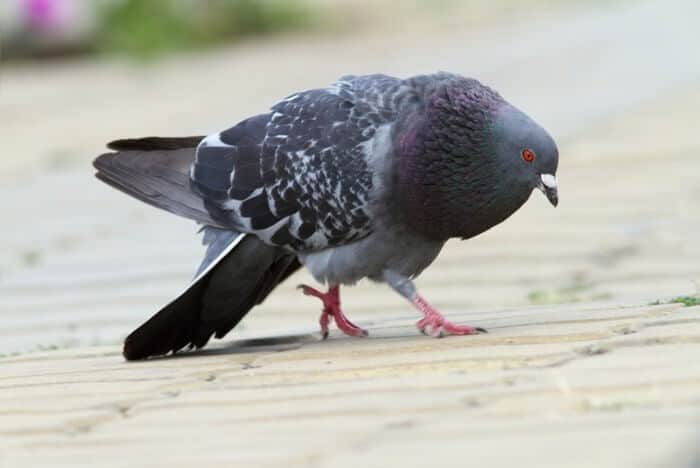
Three reasons a pigeon bows
Goodwin separated the display into three forms that blend into each other.
- Courtship: the full display above, given by a male in breeding condition to females, and also to strange pigeons of either sex.
- Claiming a place: the male turns round and round, cooing, with little lifting of the head or spreading of the tail. He does this when he lands in or near his nesting territory, or when a stranger or rival approaches it. A male returning home after time away may do it even with no other pigeon in sight.
- Defence: the bird simply lowers its head and coos at an opponent, facing it or turned partly away. This is a warning before a fight, and birds that are not breeding use it too.
What the female does
A female who is not interested often walks away or carries on feeding. One who is willing to pair may answer with nodding, a downward movement of the head that pairs also use when they meet at the nest. Females rarely give the full bow-coo. Goodwin saw a female use the turning display mostly at her own nest or roost, making only a part turn and back, and a short version of the courtship display when she joined her mate at the nest.
Because cocks bow far more than hens, a pigeon that bow-coos and turns in full circles is usually a male. It is not a perfect test, because hens sometimes display too. See how to sex a pigeon.
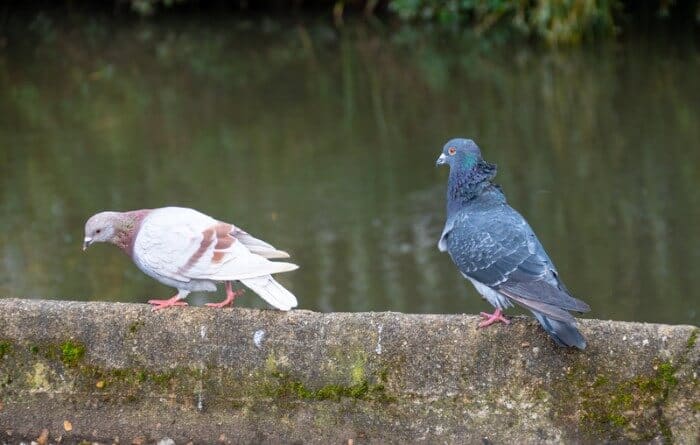
From bowing to a nest
Bowing is only the start. The timeline shows a typical order once a male and female are interested in each other. Steps can repeat or be skipped, and established pairs go through a shorter version before each nesting.
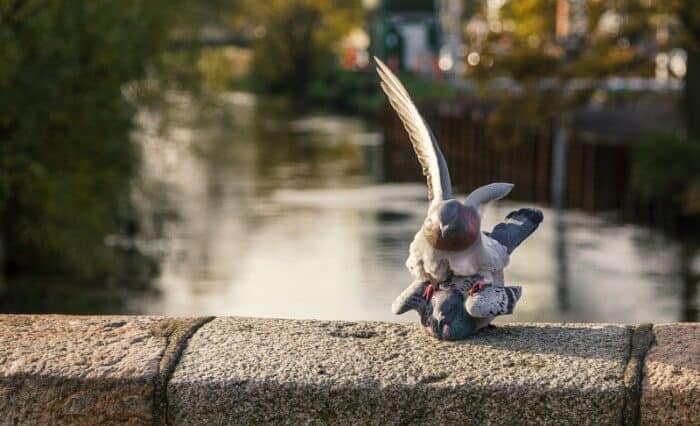
At the nest site, the male crouches with his tail raised and calls repeatedly while making shaping movements with his feet. When the female joins him, she often preens his head, and the two may call or nod together. Billing follows: she puts her bill inside his and he may pass her food from his crop, though Goodwin found that often nothing is passed at all (see the pigeon kiss). Billing usually leads straight to mating, with the female crouching to invite the male. Afterwards the male may stand tall and make a display flight, circling with loud wing claps, according to Johnston and Janiga.
While the female is receptive, the male also “drives” her. He follows close behind, sometimes pecking at the back of her head, and keeps her away from other males. Goodwin’s 1956 study (opens in new tab) showed that driving is about keeping rivals off rather than pushing the female to the nest, which is how it looks in a crowded loft. For the rest of the cycle, see how pigeons mate and where pigeons build their nests.
Why pigeons bob their heads when they walk
The head nod you see in a walking pigeon is a different thing from bowing. Its head moves in two phases: it is thrust forward quickly, then held still in space while the body catches up. Troje and Frost (2000) (opens in new tab) filmed walking pigeons and found that during the hold phase the head stays almost completely fixed, which keeps the image on the retina steady.
An earlier experiment by Barrie Frost in 1978 (opens in new tab) showed that the bob depends on what the bird sees. Pigeons walking on a treadmill, where the surroundings did not move relative to them, stopped bobbing their heads.
Why is a pigeon bowing at me?
A tame pigeon that bows and coos at you is treating you as a possible mate or rival. Goodwin noted that pigeons hand-reared by people often react socially and sexually to humans as adults, and a male that does so may also drive his owner or try to lead them to a nest site. More on this in do pigeons have feelings?.
Pigeon bowing: FAQs
Why do pigeons bow and coo?
Bowing and cooing together make the bow-coo, a male display used to court a female, to claim a nest area or to warn off another pigeon.
Do female pigeons bow?
Sometimes, but much less than males. Females mostly give a short or partial version, usually at their own nest site.
Why is my pigeon spinning in circles and cooing?
A pigeon that puffs up and turns in circles while cooing is giving the bow-coo. In a pet pigeon this often means it is in breeding condition and courting another bird, or you.
Why do pigeons bob their heads when they walk?
Head-bobbing keeps the pigeon’s view steady. The head is held still in space while the body walks forward, then thrust ahead, and pigeons on a treadmill stop doing it.
What is driving in pigeons?
Driving is when a paired male follows his mate closely, sometimes pecking at her head, to keep her away from other males while she is receptive.
Sources
References used for this page:
- Goodwin, D. (1983). Pigeons and Doves of the World, 3rd edition. British Museum (Natural History) and Cornell University Press.
- Johnston, R.F. and Janiga, M. (1995). Feral Pigeons. Oxford University Press.
- Goodwin, D. (1956). The significance of some behaviour patterns of pigeons. Bird Study 3: 25-37. (opens in new tab)
- Troje, N.F. and Frost, B.J. (2000). Head-bobbing in pigeons: how stable is the hold phase? Journal of Experimental Biology 203: 935-940. (opens in new tab)
- Frost, B.J. (1978). The optokinetic basis of head-bobbing in the pigeon. Journal of Experimental Biology 74: 187-195. (opens in new tab)
Last updated 11 November 2026 · Behavior