
The fantail is a domestic pigeon bred for its tail. A wild rock pigeon has 12 tail feathers. A good fantail has 30 or more, spread into an upright fan and carried so high that the head can touch it.
The name covers a small family of breeds rather than one bird. The show bird that the US National Pigeon Association (NPA) calls simply the Fantail is small, round and clean-legged. The Indian Fantail is larger, with a crest and feathered feet. The Syrian Fantail carries its tail almost flat, and in Britain the Garden Fantail is listed as a breed of its own. This guide covers the whole family: where fantails came from, how the types differ, what judges look for and how to keep them.
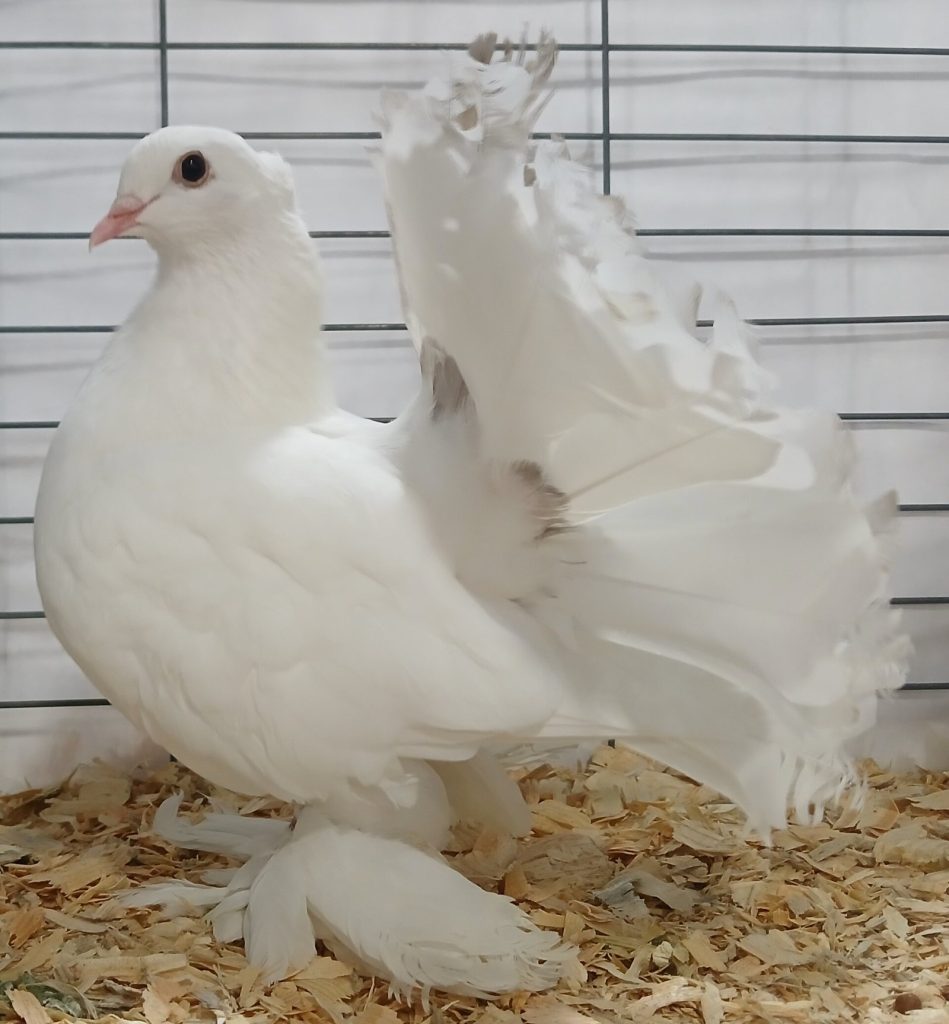
Fantail pigeon at a glance
| Feature | Fantail pigeon |
|---|---|
| Species | Domestic rock pigeon (Columba livia) |
| First record | India, before 1600 |
| Tail feathers | “Thirty or even forty”, in Darwin’s words; counts from 14 to 42 are on record |
| Oil gland | Absent in European fantails |
| Main types | Fantail (show type), Indian Fantail, Mindian Fantail, Syrian Fantail, Garden Fantail |
| NPA groups | Structure pigeons; the Syrian Fantail is in the Syrian group |
| UK breed clubs | Fantail Club (founded 1889) and British Indian Fantail Club |
| Old English name | Broad-tailed Shaker |
What makes a fantail
Charles Darwin kept and dissected fantails while he worked on The Variation of Animals and Plants under Domestication (opens in new tab). He found the tail feathers set in an irregular double row on a wider base than in other pigeons. The birds he examined had one or two extra tail vertebrae, and he found no trace of the oil gland at the base of the tail, which most birds have.
He also thought the number of feathers mattered less than the way they are carried. In his words, their “permanent fanlike expansion and their upward direction are more remarkable characters than their increased number”.
How many tail feathers?
Tail feathers counted or claimed in the sources. The wild rock pigeon has 12.
In England, Darwin wrote, fanciers valued the position and spread of the tail more than the count.
The rest of the bird changed with the tail. Darwin described a thin neck bowed backwards, a broad breast and small feet. Fantails trembled a lot, and their necks made an “apparently convulsive” movement backwards and forwards. That habit gave the breed its old English name, the Shaker.
History: from India to Darwin’s lofts
The oldest record Darwin could find was in the Ayeen Akbery, an account of the court of the Mughal emperor Akbar written before 1600. The court kept about 20,000 pigeons. At that date, Darwin wrote, the fantail seems to have been unknown in Europe.
By the 1670s it was known in England. Francis Willughby described a fantail with 26 tail feathers. In 1735 John Moore’s Columbarium (opens in new tab) called it the Broad-tailed Shaker. Moore said its tail had “seldom less than four-and-twenty” feathers, spread “like the tail of a turkey cock”, so that “the head and tail frequently meet”. He added that some people called these birds fantails, and that he once saw one with 36 feathers.
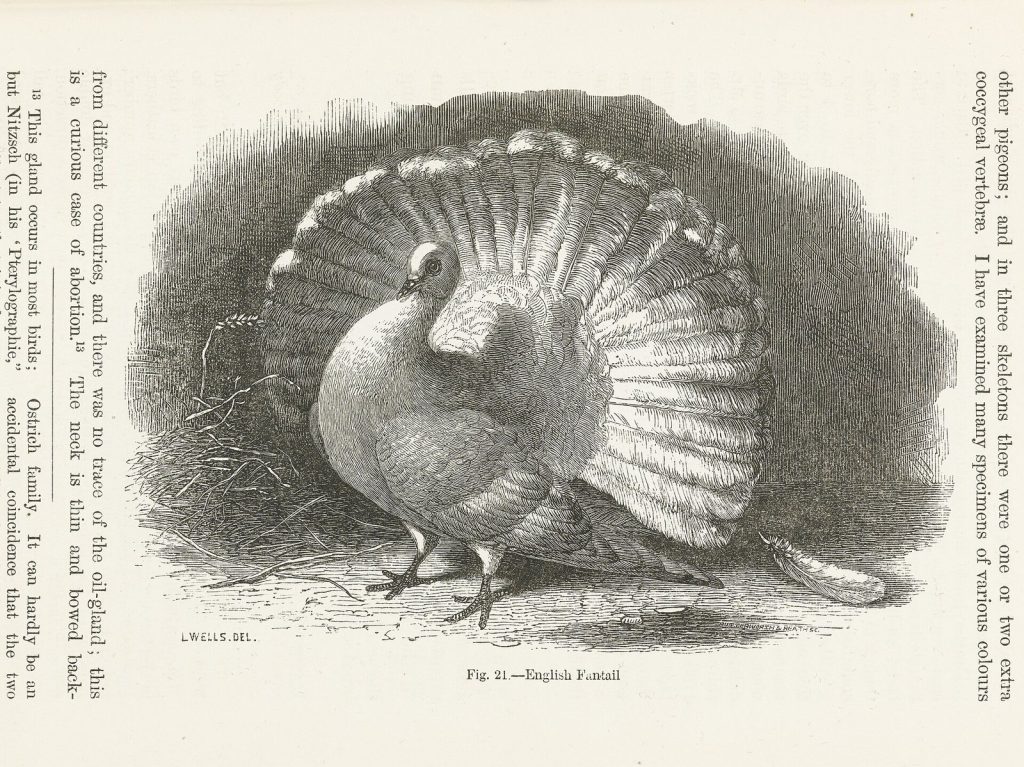
Moore also gave one of the first warnings about over-breeding the tail. Too many feathers, he wrote, made the birds “lop their tails”, so the head and tail no longer met, “which is a very great fault”. In France, Boitard and Corbie claimed in 1824 that birds with 42 tail feathers were easy to find.
Darwin used the fantail on the first pages of On the Origin of Species (opens in new tab) in 1859. He crossed white fantails with black barbs and bred the mottled young together. One grandchild came out slate blue, with a white rump, two black wing bars and a barred tail, “as any wild rock-pigeon”. For Darwin, that throwback was evidence that every breed came from the rock pigeon.
Fantail timeline
- Before 1600The Ayeen Akbery describes pigeon keeping at Akbar’s court in India, the oldest fantail record Darwin found.
- 1670sFrancis Willughby describes a fantail with 26 tail feathers.
- 1735John Moore’s Columbarium describes the Broad-tailed Shaker, “called by some Fantails”.
- 1824Boitard and Corbie say French birds with 42 tail feathers are easy to find.
- 1847Edward Blyth counts 34 feathers in an imperfect tail in Calcutta.
- 1859Darwin opens On the Origin of Species with domestic pigeons, the fantail among them.
- 1868Darwin describes European and Java Fantails in The Variation of Animals and Plants under Domestication.
- 1889The Fantail Club is founded in Britain.
- 2022Date of the current NPA Fantail and Indian Fantail standards.
Fantail types
Fanciers use “fantail” for several breeds that share a spread tail but differ in head, feet, size and the way the tail is held. The NPA has separate standards for four of them.
Fantail (the show Fantail)
This is the bird most people picture. The NPA standard, dated 2022, calls it just “Fantail”. Breeders often say American or English Fantail to tell it apart from the Indian. The standard describes “primarily a bird of type and action”: 80 points go to its shape standing still and 20 to how it moves.
The body should be “round like a ball when viewed from any angle”. The tail is circular and slightly concave, made of broad feathers that overlap well. Measured against the body, the height of the tail should come close to two to one. The small, smooth head sits in a “pocket” at the base of the cushion feathers. From the front, the head should not show above the chest.
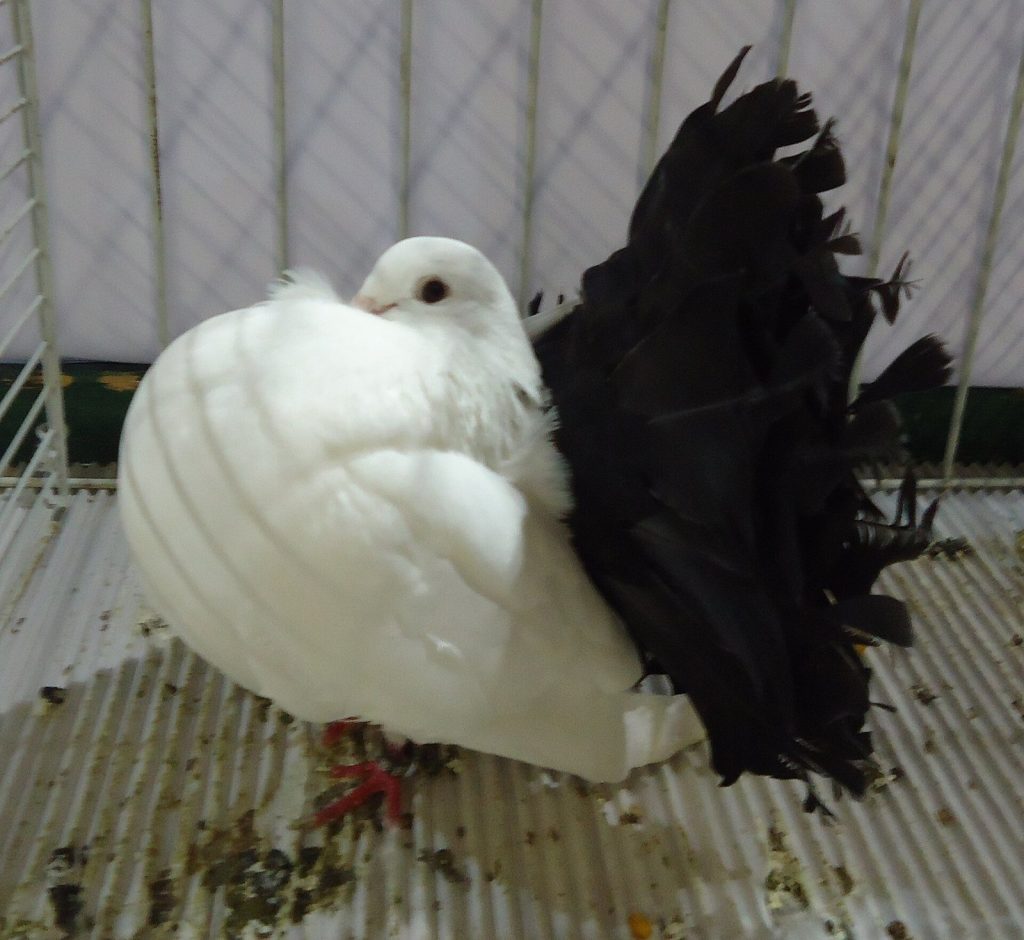
The feet are clean, neat and bright red. The bird stands on its front toes with the ball of the foot just off the floor. Eyes are dark in white-headed colours. Other colours have pearl or yellow to orange-red eyes, and pearl is preferred. When two birds score the same, the standard prefers the smaller one.
Three ways to carry a fan
Indian Fantail
The Indian Fantail is a bigger, sturdier bird with a small peak crest and muffs that cover the toes. It stands almost level. The saucer-shaped tail wraps around about three-quarters of a circle and tilts slightly away from the head. Unlike the show Fantail, an Indian should not shake its neck. The NPA counts frequent, nervous shaking as a fault.
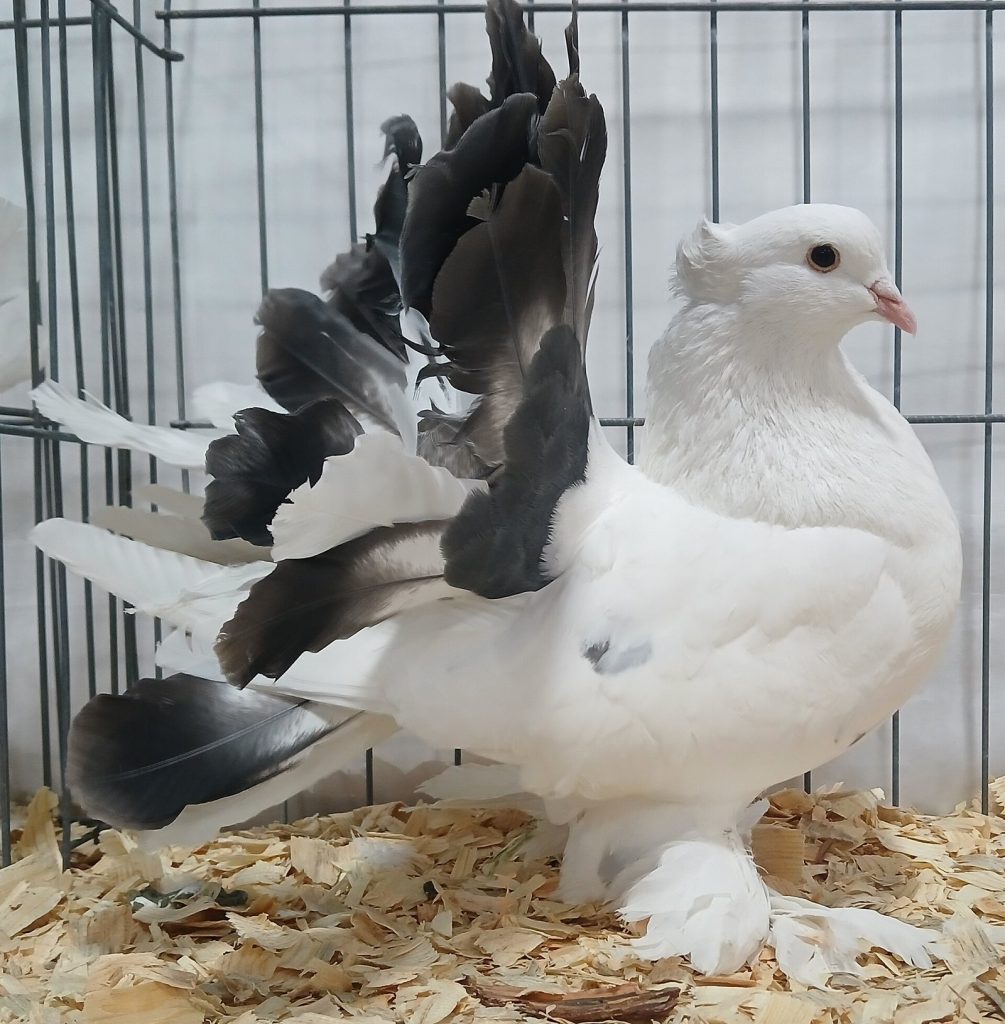
The NPA gives a guide weight of about 16 to 20 ounces and tells judges not to use scales. Our Indian Fantail guide covers that breed’s standard, points and colours in detail.
Mindian Fantail
The Mindian is a miniature Indian Fantail. Its NPA standard is the same as the Indian’s in every respect except size. It should measure 7 inches (about 18 cm) from the feet to the top of the head, and when all else is equal the smaller bird wins.
Syrian Fantail
The Syrian Fantail, in the NPA’s Syrian group, holds its tail very differently. The tail is carried level with the floor and should look like an upside-down V. The top of the tail should never rise above horizontal. The standard says 16 to 22 feathers “make a good tail combination”. More feathers tend to spoil the shape.
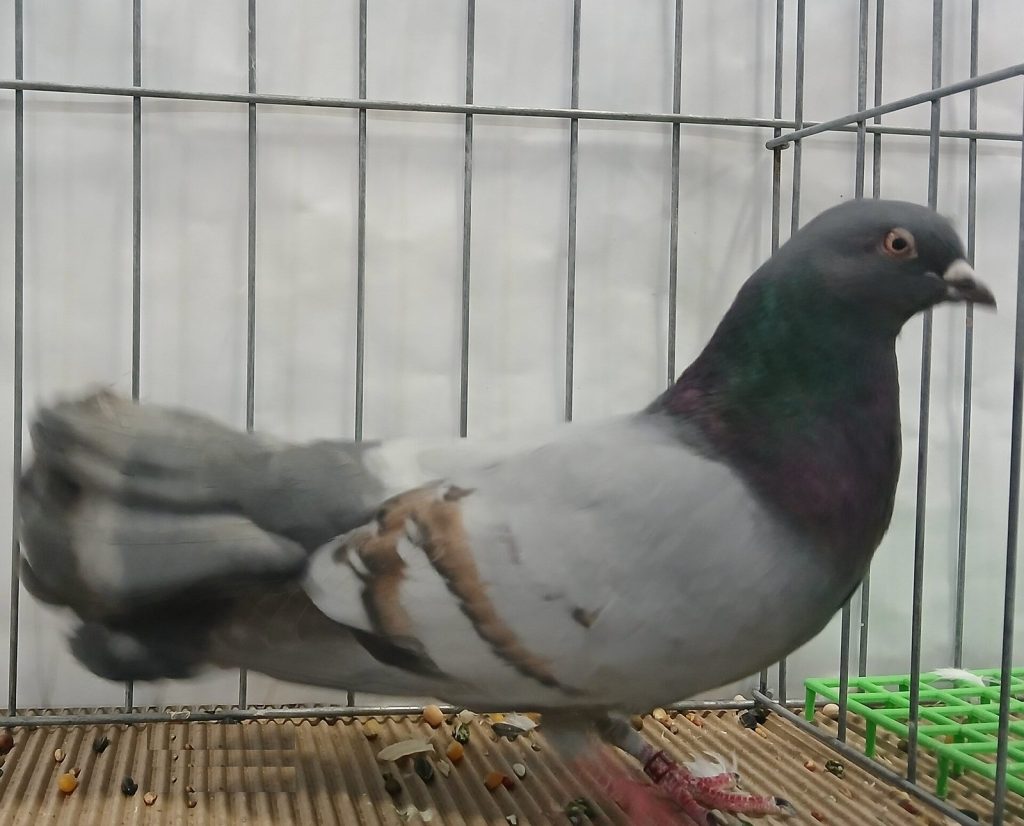
It is a plain-headed bird of 12 to 15 ounces, with gravel to pearl eyes and clean red legs. It keeps some of the old neck trembling, but the NPA says this should not be excessive. Do not confuse it with the Karakandi. The NPA notes that this Aleppo tumbler has also been called the Syrian Fantail, or Gümüşkuyruk (“silver tail”) in Turkish. It is a flying breed of its own lineage, not a fantail.
Garden Fantail
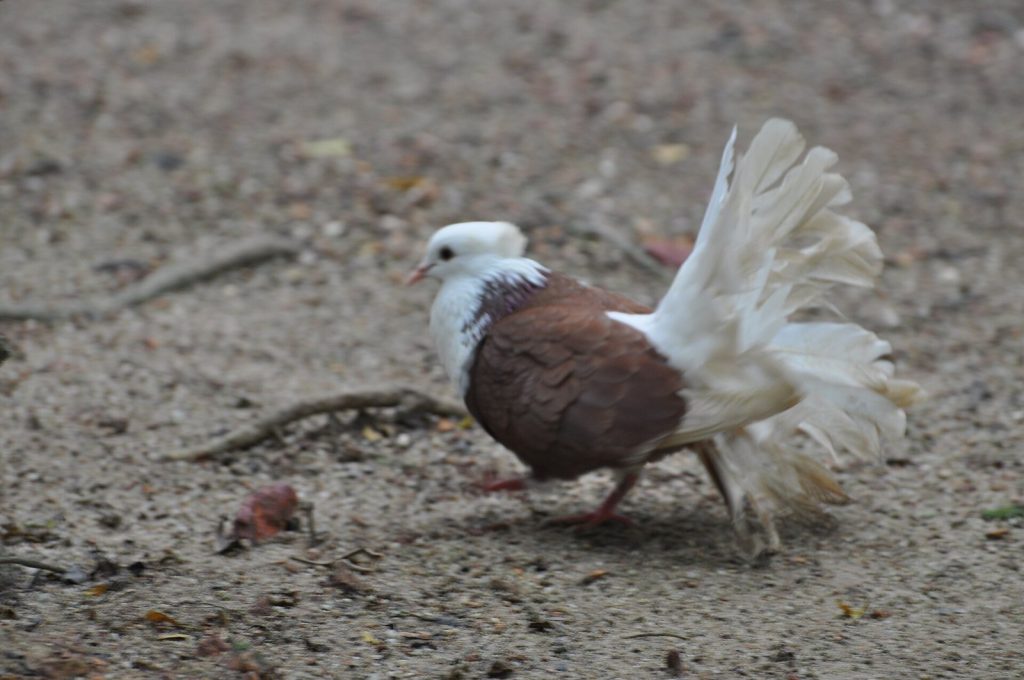
In Britain the National Pigeon Association lists Garden Fantails separately from Fantails, with a larger ring size. We could not find a written show standard for them. Keepers use the name for fantails kept in gardens and dovecotes rather than show pens. They describe a less extreme bird, with a smaller fan and a longer body, that flies better than the show type. Darwin saw the same split in 1868, noting “a vast difference” between the best English fantails and common ones in tail size, carriage and movement.
Java Fantail and the silk fantail
Darwin examined the skin of a Java Fantail sent from Amoy in China. It had only 14 tail feathers, a well-developed oil gland and a tail that was less spread and less upright than in “even second-rate European Fantails”. He took it to show the breed “in its earlier and less improved condition”.
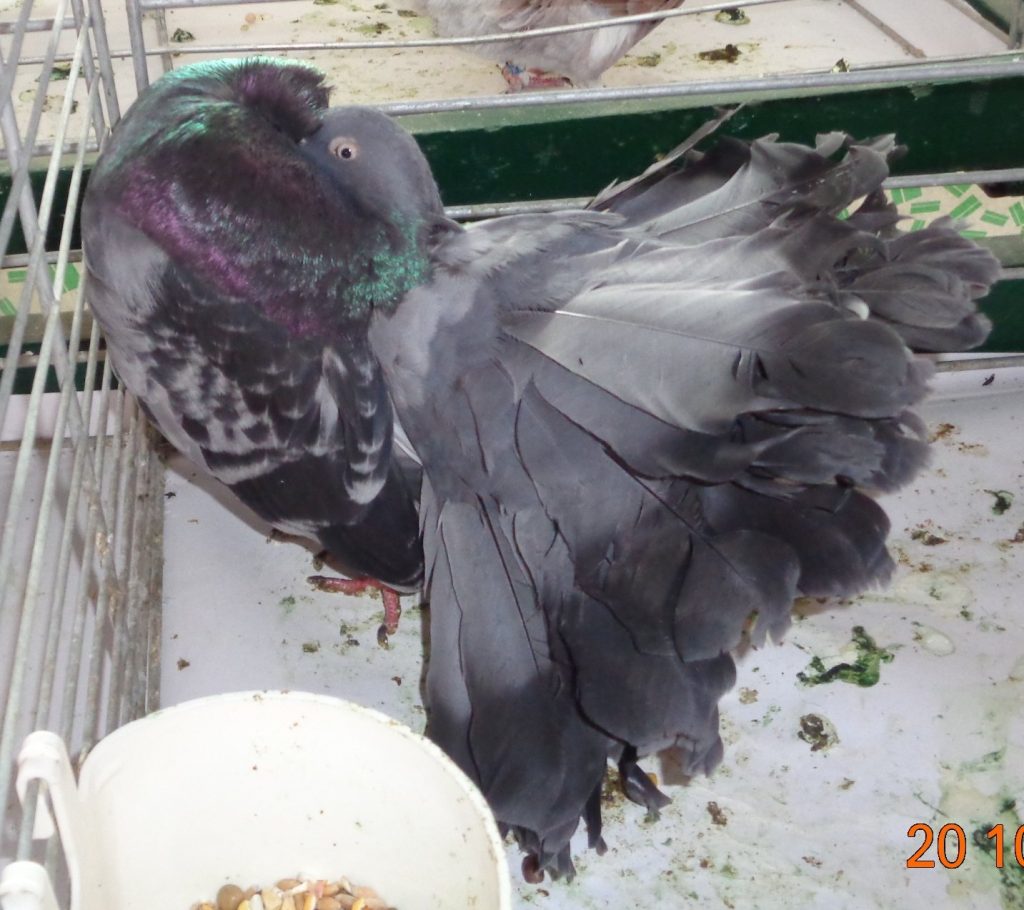
He also mentioned a silk sub-variety of the fantail, with feathers like those of the Silk fowl. Citing Boitard and Corbie, he wrote that this silky plumage was always passed on when the bird was crossed with other small breeds. Fanciers now call these birds silky or lace fantails.
| Type | Head | Feet | Tail | Size guide | Standard |
|---|---|---|---|---|---|
| Fantail | Small and smooth, no crest | Clean and bright red | Upright and circular, about twice the body’s height | No weight; smaller bird wins a tie | NPA, Structure group |
| Indian Fantail | Small peak crest | Muffed, toes covered | Upright saucer, about 3/4 of a circle | About 16–20 oz (450–570 g) | NPA, Structure group |
| Mindian Fantail | As the Indian | As the Indian | As the Indian | 7 in (18 cm) feet to head | NPA, Structure group |
| Syrian Fantail | Plain, sometimes crested | Clean and red | Level, upside-down V | 12–15 oz (340–430 g) | NPA, Syrian group |
| Garden Fantail | No written standard found | Varies | Smaller fan than show birds | UK ring size C | Listed by the UK National Pigeon Association |
How a Fantail is judged
In the NPA Fantail standard, the single biggest score is carriage in motion. Judges watch the bird walk in a pen. It should take short “jaunts” with its head thrown back and its tail upright, with “a slight upheaval of the chest with each step”.
Where the 100 points go: NPA Fantail
- Carriage in motion: 20
- Body, wings and plumage: 30
- Tail, cushions, rump and ratio: 20
- Legs and feet: 20
- Head, neck, beak and eyes: 10
Legs come next, with 15 points. The tail itself gets only 10 points, but with the cushions, rump and tail-to-body ratio the tail area adds up to 20. Colour is not part of the 100. Instead, judges may give up to 5 extra points for colour in selfs, and in saddles, tailmarks and bodymarks up to 5 for markings plus 5 for colour. Whites, pieds and non-classified colours get no colour allowance. Our guide to pigeon shows explains how classes and judging work.
Size and weight
The NPA Fantail standard gives no weight at all. The other fantail standards do, and they show how much the family varies in size.
Fantail weights compared
Weights from each standard, in ounces with grams. The NPA Fantail standard gives no weight. Fantail rows are shown in orange.
Darwin noticed that dark-coloured fantails were generally larger than white ones. For comparison, he weighed a wild rock pigeon from the Shetland Islands at 14.5 ounces.
Colours and markings
White has always been the classic fantail colour. Moore wrote in 1735 that they were “most commonly all white”, with the best carriage, though he had also seen black, blue, red and yellow pieds. More than a century later, Darwin wrote that he had “never heard of white Fantails throwing any other colour”.
Fantail colours and classes
- White
- Black
- Blue
- Red
- Yellow
- Powder blue
- Silver
Classes in the NPA Fantail standard
- Solid selfs
- Patterned selfs
- Saddles
- Tailmarks
- Bodymarks
- Whites
- Pieds
- Non-classified colours
Colours Moore saw in 1735
- All white
- Black pieds
- Blue pieds
- Red pieds
- Yellow pieds
Swatches are approximate and only show the general shade.
The NPA’s general colour notes add one fantail detail. The “powder blue and silver” Fantails are milky blue and silver bars, the bird looking as if it had been “soaked in milk”. Our guide to pigeon colours and genetics explains how these colours are inherited.
Behaviour and temperament
Show Fantails walk in a distinctive way. Darwin wrote that good birds walked “as if their small feet were stiff” and that “owing to their large tails, they fly badly on a windy day”. The NPA wants them to walk forward “in an airy carefree manner while maintaining graceful control”.
Fantails are often kept by flyers of other breeds as droppers. These are tame birds put out on the loft to bring a flying kit down. Our tippler guide explains how flyers use them.
The British Indian Fantail Club calls the Indian “a truly amazing, friendly and quiet species”. Whatever the type, a fantail is a domestic pigeon and needs the same basic care as any other.
Keeping fantails
The tail is the part most likely to be damaged. In good birds, Darwin noted, the head touches the tail feathers, “which consequently often become crumpled”. Give fantails room so they do not crowd each other, low and wide perches, and dry, clean floors. Show birds lose points for dirty or broken feathers, and the Indian standard also marks down signs of parasites. Our guide to pigeon lice covers the usual culprits.
Offer a bath regularly, because clean water helps keep the fan in condition. Our page on how to bathe a pigeon shows how. Feed a grain mix with grit and fresh water. Our guide to what pigeons eat has the details.
Quick facts for keepers
- 30 to 40 tail feathers
- No oil gland in European birds
- Clean red feet in the show Fantail
- Pearl eyes preferred
- 80 points standing, 20 moving
- Weak flier in wind
Show Fantails are best kept in a loft with an aviary, because a big fan makes them weak fliers. Garden Fantails are the type kept at liberty around a dovecote. Pairs breed like other pigeons: the hen lays two eggs, which take about 17 to 19 days to hatch. The Indian standard also marks down birds still in the moult with missing or broken feathers, so plan shows around it.
Buying a fantail
Decide first which fantail you want. A show Fantail, an Indian and a Garden Fantail suit very different lofts. Shows are the best place to see good birds and meet breeders. In Britain the National Pigeon Association lists both the Fantail Club and the British Indian Fantail Club, and it sets a different ring size for each type.
UK ring sizes for fantails
Ring sizes run from A for the smallest breeds to F for the largest.
- A
- BFantail
- CGarden Fantail
- D
- EIndian Fantail
- F
Check the tail first. The NPA disqualifies Indian Fantails for a split tail, a tail that has been laced together, a badly crooked tail, eyes of different colours, a missing crest and cut feathers. In a show Fantail, look for clean red feet with no feathers on the legs, a round body and a head that sits back against the tail. Keep any new bird apart from your own for a few weeks before it joins the loft.
For more ornamental breeds, see our types of pigeon guide, the Jacobin and the Frillback.
Fantail pigeon FAQs
What is a fantail pigeon?
A domestic pigeon bred for a large, upright, fan-shaped tail of 30 or more feathers. The name covers several breeds, including the show Fantail, the Indian Fantail and the Syrian Fantail.
How many tail feathers does a fantail have?
Darwin wrote “thirty or even forty”, against 12 in the wild rock pigeon. Recorded counts run from 14 in an old Java Fantail to 42 claimed in France in 1824.
What is the difference between a Fantail and an Indian Fantail?
The show Fantail is small and round, with a smooth head and clean red feet, and carries its head back against the tail. The Indian Fantail is larger, with a peak crest, muffed feet and an almost level stance.
Can fantail pigeons fly?
Yes, but show Fantails fly poorly. Darwin noted that they “fly badly on a windy day” because of their large tails. Garden Fantails fly better and are the type kept around dovecotes.
Where do fantail pigeons come from?
The oldest record is from India before 1600, in the Ayeen Akbery. The breed reached England by the 1670s, and the modern show standards come from clubs in Britain and the United States.
Do fantails have an oil gland?
Darwin found no trace of it in the European fantails he examined. A Java Fantail he studied did have one.