
The Maltese is a tall, very upright exhibition pigeon with a short, broad body, a long thin neck and long, clean legs. Despite the name, the German breed standard gives the origin as northern Italy, with the breed brought to Austria and southern Germany around 1850. That text wants a hen-like outline, with the head and tail carried high.
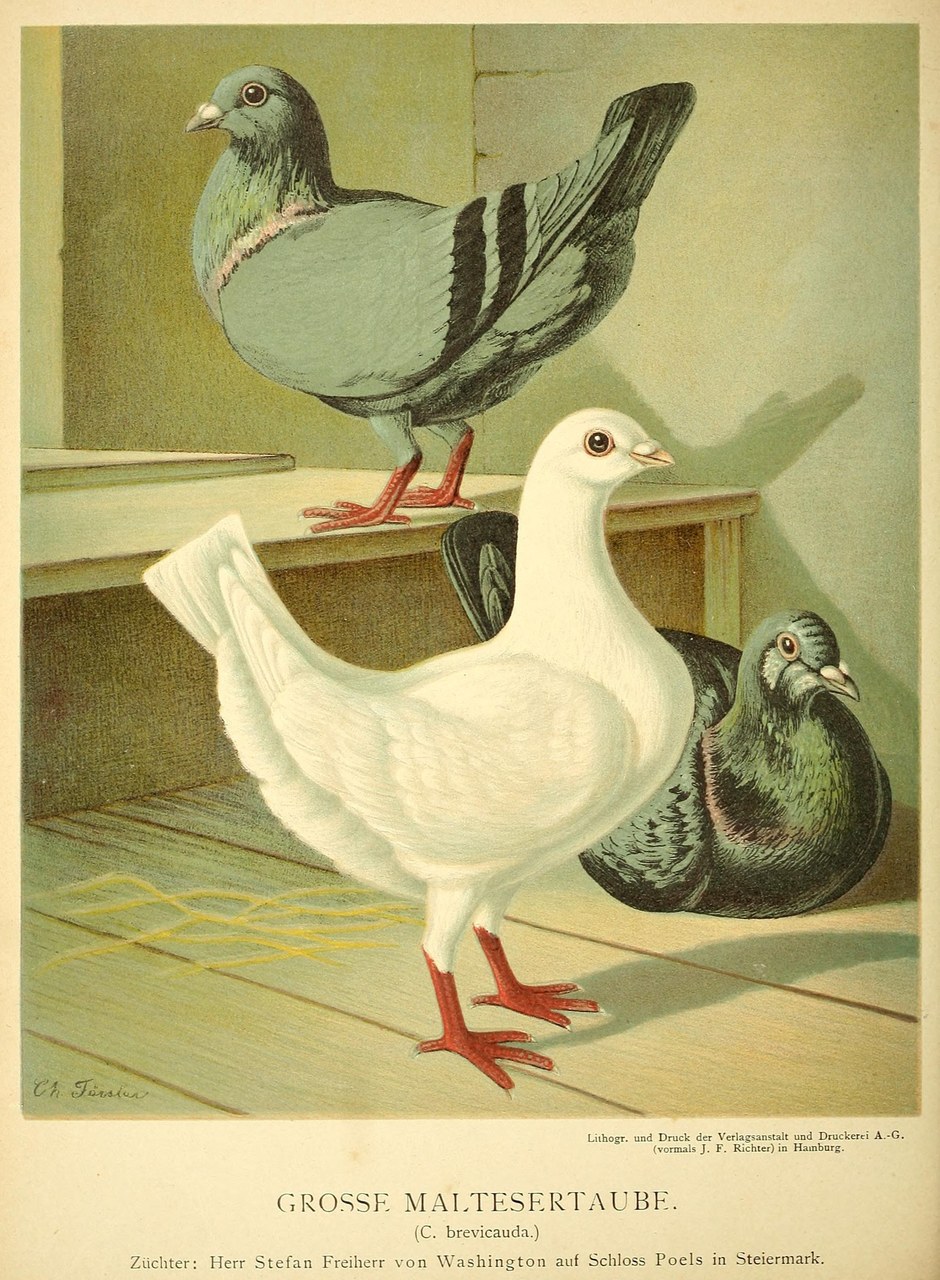
Form and station
The standard asks for a hen-like bird, standing very high, with the head and tail carried high, looking proud and bold. The body should be short and broad, almost as broad as it is long, and strong without losing elegance.
The neck is very long, only slightly curved, carried vertically, and almost the same width throughout, though the join with the breast should not look too sharp. The throat is deeply cut. The head is long, only slightly rounded, and the forehead should not be too narrow.
The back is short and broad, forming a horizontal line and rising toward the rump. The tail is very short, wider at the base and narrower at the tip, looking as if it had been cut off, and it forms a right angle with the back. The undertail should be well feathered and cushion-like.
The thighs are long, prominent and strong. The legs below the hock are very long, strong and unfeathered, with slightly angled hock joints, and the toes are long, strong and well spread. The wings are short, with short, narrow flights carried high and crossed in front of the tail.
| Feature | German Malteser standard |
|---|---|
| Origin | Upper Italy; brought to Austria and southern Germany around 1850 (Sbl-A) |
| Outline | Hen-like, very upright; head and tail carried high |
| Body | Short and broad, almost as broad as long |
| Neck | Very long, carried vertically, nearly even in width |
| Tail | Very short, at a right angle to the back |
| Eyes | Dark in whites; orange to red in the other colours |
| Ring | D 9 |
Eyes, beak and colours
In white birds the eyes are dark and the eye cere a lively red. In the other colours the eyes are orange to red, with a lighter shade allowed in brown birds. The cere is grey or flesh-coloured according to the plumage, and a reddish cere is allowed in all colours.
The beak is medium in length and strong. It is wax-coloured in white, recessive red and recessive yellow, light to dark horn in brown, and dark in the other colours. The standard lists these colour classes, among others:
- White, black, brown, recessive red and recessive yellow.
- Blue with bars, and blue hammered (chequer).
- Dilute brown (brown-fawn) with bars, and dilute brown hammered.
- Tigered or mottled birds, and frost-headed birds, in several of those colours, with the flights and tail coloured as the standard sets out.
Name and origin
The Maltese is a domestic form of the rock pigeon (Columba livia), kept for exhibition among the types of pigeon. The name can suggest the island of Malta, but the standard used here does not support that.
It gives the origin as upper Italy, with the breed introduced into Austria and southern Germany around 1850, and classifies the breed under Austria (Sbl-A). This page does not repeat unsourced stories about a French Baghdad cross, or viral claims that the bird is a pigeon-chicken hybrid.
Keeping Maltese pigeons
The standard describes a show bird, not a feeding programme or a lifespan. Daily care is like that of other pigeons kept as pets: a dry loft, grit, clean water and a grain mix.
The long, unfeathered legs and the high station need a dry, uncrowded floor and a perch they can use comfortably. Judging puts general impression first, then type and size, height of station, head, neck and colour.
Maltese pigeon questions
What is a Maltese pigeon?
A tall, very upright exhibition pigeon with a short, broad body, a long thin neck, a short tail held at a right angle to the back, and long, clean legs. The outline is hen-like.
Does it come from Malta?
The name suggests the island, but the German standard used here traces the breed from upper Italy to Austria and southern Germany around 1850.
How is it different from a typical pigeon?
It stands much higher, with a longer, thinner neck, a body that is almost as broad as it is long, and a very short tail carried up at a right angle to the back.
What colour are the eyes?
Dark in white birds, and orange to red in the other colours. Brown birds may have a lighter eye.
What ring size does it take?
The German standard gives ring size D 9.
Sources
This page follows this standard:
Last updated 13 November 2026 · Types, Utility breeds