
Male and female pigeons look almost alike, so claws, eyes and wings are not reliable guides. A DNA test from blood, an oral swab or a feather can sex a pigeon at any age. In adults, courtship, nest shifts and one sex-linked colour pattern are useful clues, and a bird that lays an egg is female.
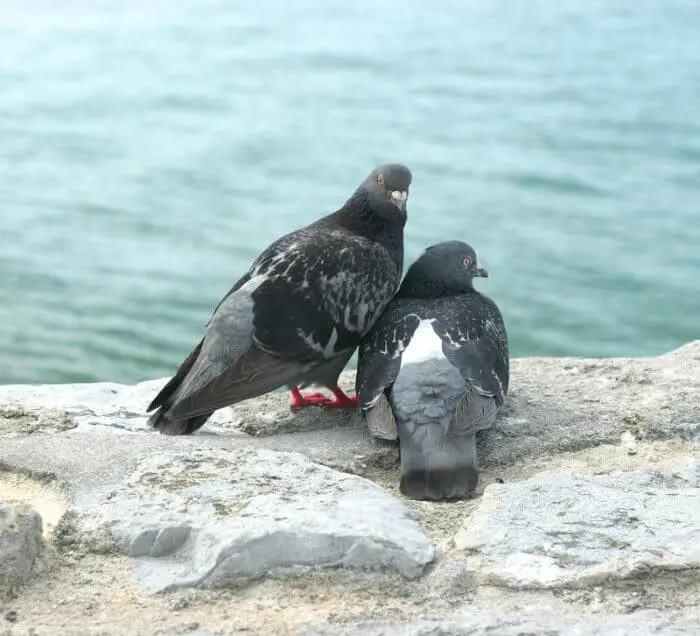
Why male and female pigeons look the same
Pigeons are almost sexually monomorphic: both sexes have the same plumage, and differences in build are slight. A 2026 veterinary comparison of 25 domestic pigeons found that sex could not be told from external appearance, even in adults (Turcu and colleagues (opens in new tab)).
Males are, on average, a little heavier. In a feral flock in Lawrence, Kansas, 41 breeding males averaged 368.7 g and 37 breeding females 340.1 g, but the ranges overlap enough that weight or body measurements cannot consistently separate the sexes (Johnston and Johnson (1989) (opens in new tab)). Johnston and Janiga later put the usual difference at about 3% to 10%, again with a great deal of overlap.
Ways to sex a pigeon, from certain to unreliable
DNA testing
The only method that is reliable at any age is a DNA test. In birds the male has two Z sex chromosomes and the female has one Z and one W, the opposite of mammals. Laboratories look for a gene called CHD1 that sits on both sex chromosomes. A male shows one form of the gene; a female shows two (Griffiths et al. (1998) (opens in new tab)).
In the 2026 study, DNA tests identified the sex of every bird, including juveniles and a week-old squab whose gonads were too poorly formed to be read by endoscopy or by examining the organs after death. Blood samples always produced a result; oral swabs worked in 88% of birds and feathers in 80%. An avian vet or a bird-sexing laboratory can run the test from a small blood sample, a mouth swab or a plucked feather. Endoscopy under anaesthetic can show the gonads in adults, but it is invasive, and in that study it left 7 of the 25 birds unsexed, mostly juveniles. Cloacal or vent sexing is rarely used in pigeons because the difference is so small, and it is easy to injure a bird, so it is not a method to try at home.
Courtship, nest sitting and eggs
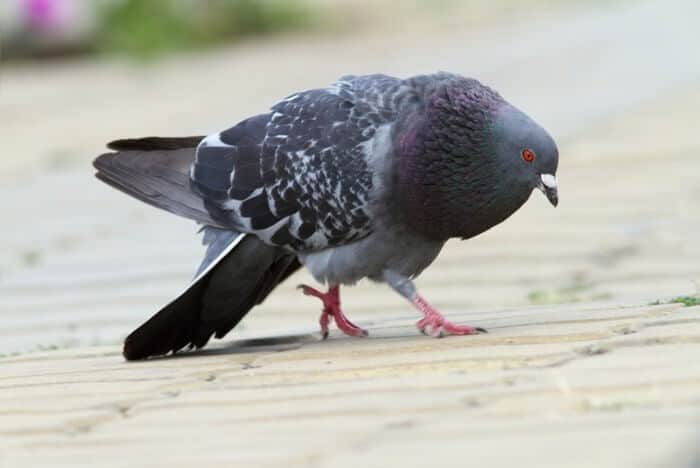
Watching an adult pigeon is often the most practical first step, though it is not certain. The male’s courtship display, the bow-coo, is the usual giveaway: he inflates his neck, bows, coos loudly, turns in a circle and may spread his tail so that it sweeps the ground. Females coo too, but they rarely give the full bow-coo. A bird that only nods, walks away or crouches to invite mating is usually the female. Derek Goodwin described this in detail; see why pigeons bow and how pigeons mate.
These clues can mislead. Females sometimes show a short or incomplete version of the display, especially at their own nest, and pigeons kept with too few birds of the other sex may form female-female pairs and show some behaviour usual in the opposite sex (Jankowiak et al. (2018) (opens in new tab)).
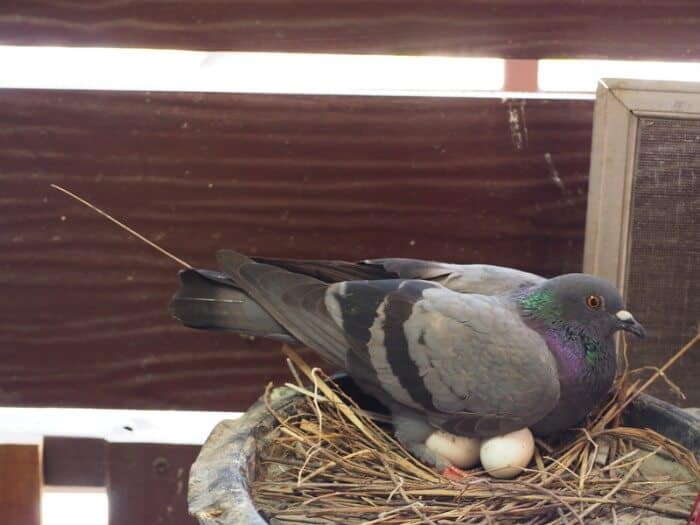
If a pair is sitting eggs, the shifts are a strong clue. The hen usually occupies the nest from about 4pm until 10am, and the cock takes the middle of the day (Oregon State University 4-H pigeon guide (opens in new tab)). The shifts can occasionally be mixed up, so this works best when you can watch the same pair over several days.
A bird that lays an egg is female. That does not prove its partner is male. In the absence of a cock, two hens may pair and both lay infertile eggs in the same nest (Oregon State University 4-H pigeon guide (opens in new tab)). In experimental flocks with too few males, some female-female pairs even raised chicks (Jankowiak et al. (2018) (opens in new tab)). Pigeons typically lay two eggs; see how many eggs a pigeon lays.

New to pigeon keeping?
A Beginner’s Guide to Pigeon Keeping. Practical care for pets, lofts and first-year keepers.
Price: $2.95.
Sex-linked colour, when it can tell you the sex
The gene for the three base colours, ash-red, blue/black and brown, sits on the Z sex chromosome (Domyan et al. (2014) (opens in new tab)). With one pairing you can sex the young in the nest once their feathers show. If a blue cock is paired with an ash-red hen, every ash-red squab is a cock and every blue squab is a hen. The opposite pairing, an ash-red cock with a blue hen, produces ash-red young of both sexes, so colour does not tell you which is which. Our guide to pigeon colours and genetics explains the other sex-linked crosses, including how a brown squab from two blue parents is always a hen.
Tests that do not work
Several popular tests have no published evidence behind them and should be ignored. One says a male’s hind claw is as long as his front claws, while a female’s is shorter. Another, sometimes called the wing test, claims that a male held in the hand keeps his tail level and a female holds it up. A third says female eyes look rounder and male eyes more oval, or that males have rounder heads. None of these has been shown to work, and the overlap in size already makes small differences in claws or head shape a poor guide. The Oregon State University 4-H pigeon guide (opens in new tab) advises beginners to buy proven mated pairs, rather than trying to sex birds by eye.
Sexing baby pigeons
Young pigeons cannot be sexed by looking at them. In the 2026 study, juveniles and a newly hatched squab could be sexed only by DNA; endoscopy and examination of the gonads often failed because the organs were still small and poorly formed. Once a bird is sexually mature and starts to court or sit a nest, the behavioural clues above can be used. Until then, a DNA test is the practical option. Adult males are called cocks and females hens; see pigeon terminology.
How to sex a pigeon: FAQs
How can you tell if a pigeon is male or female?
A DNA test is certain at any age. In adults, the bow-coo, who sits the nest and, in some pairings, colour are the best clues. A bird that lays an egg is female.
Are male pigeons bigger than females?
Usually slightly, but the overlap is large enough that weight or measurements are not a reliable test.
Do female pigeons coo?
Yes. They generally coo less than males and rarely give the full bow-coo display.
Can two female pigeons live as a pair?
Yes. Two hens may pair, share a nest and both lay. The eggs are infertile unless a male has also mated with them. In experiments, some female-female pairs raised chicks.
When can you sex a baby pigeon?
By appearance, not until it is mature and courting or sitting a nest. A DNA test can be done on a very young squab, including in the first week.
What is a male pigeon called, and a female?
A male is a cock and a female is a hen. Young in the nest are squabs. See pigeon terminology.
Sources
References used for this page:
- Turcu, M.-C., Vetere, A., Pastiu, A.I., Ablondi, M., Bel, L.V. and Pusta, D.L. (2026). Molecular vs. endoscopic sexing of domestic pigeons (Columba livia domestica). Frontiers in Veterinary Science 13: 1936668. (opens in new tab)
- Griffiths, R., Double, M.C., Orr, K. and Dawson, R.J.G. (1998). A DNA test to sex most birds. Molecular Ecology 7: 1071-1075. (opens in new tab)
- Johnston, R.F. and Johnson, S.G. (1989). Nonrandom mating in feral pigeons. The Condor 91: 23-29. (opens in new tab)
- Johnston, R.F. and Janiga, M. (1995). Feral Pigeons. Oxford University Press.
- Oregon State University Extension: 4-H Pigeon and Dove Project (4-H 154). (opens in new tab)
- Jankowiak, Ł., Tryjanowski, P., Hetmański, T. and Skórka, P. (2018). Experimentally evoked same-sex sexual behaviour in pigeons. Scientific Reports 8: 1654. (opens in new tab)
- Domyan, E.T. et al. (2014). Epistatic and combinatorial effects of pigmentary gene mutations in the domestic pigeon. Current Biology 24: 459-464. (opens in new tab)
- Lea, S.E.G., McGregor, A., Haselgrove, M. and Ryan, C.M.E. Pigeons and doves. In: The UFAW Handbook on the Care and Management of Laboratory and Other Research Animals, 9th edition. (opens in new tab)
- Goodwin, D. (1983). Pigeons and Doves of the World, 3rd edition. British Museum (Natural History) and Cornell University Press.
Last updated 11 November 2026 · Keeping