
The Scandaroon is a large wattle pigeon, also called the Nuremberg Bagdad, bred for a long arched head and a beak that curves down in more than a half circle. Show standards ask for a tall, proud bird of 42 to 43 cm, with long red legs, short wings and a very short tail.
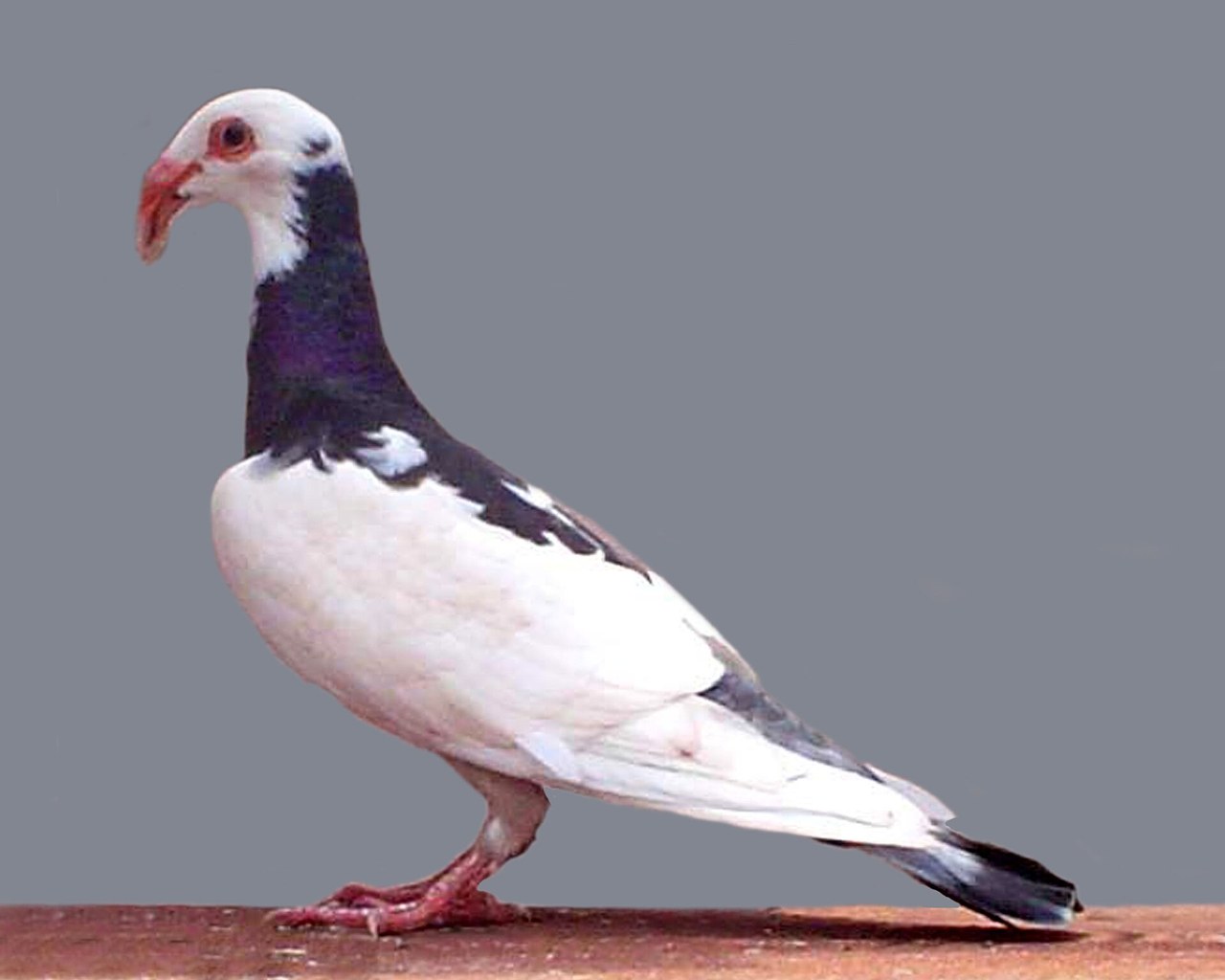
What a Scandaroon looks like
The NPA standard describes a powerful, very upright and proud bird, with a long neck and long legs in balance. The back is broad and level with the ground, and the breast is broad and pushed forward.
Head, beak and wattle
The head is long and narrow and arches smoothly into the neck, with no angle or flat spot. The beak measures about 40 mm from tip to forehead and continues the line of the head, so that head and beak together form more than a half circle.
Both mandibles are the same thickness, well closed and blunt at the tip. The beak is whitish rose in coloured birds. The wattle over the nostrils is small, level and heart shaped, with a powdered white look.
Eyes and cere
The eyes are large and fiery: dark in whites and pieds, yellow orange in the other colours. The bright red cere around each eye is 12 to 15 mm across.
Neck, wings, legs and tail
The neck is long and sharply curved, thin at the shoulders. The wings are short and lie loosely on the body, often held with a trembling look, and the primary flights are short.
The red, featherless legs are 11 to 12 cm long. The tail is very short and rounded, held closed, and should never touch the ground.
| Point | What the standards say |
|---|---|
| Other names | Nuremberg Bagdad; Nürnberger Bagdette (German); Bagadais de Nuremberg (French) |
| Origin | Asia (NPA); the Orient, bred to its present form in and around Nuremberg (Bavarian judges) |
| Standard country | Germany |
| Group | Wattle pigeons |
| Length | 42 to 43 cm |
| Legs | 11 to 12 cm, red, clean legged |
| Ring size | 10 mm |
Colours and markings
The NPA lists self colours in white, black, red, yellow, blue bar and blue chequer. Pied birds are the best known: the head and front of the neck are white, and the white should not go past the middle of the breast.
Below the eye a pied bird carries a small coloured spot called the “whiskers”. A larger spot is called the “beards”, and both sides should match. The standard says yellows, reds and blacks are usually the best marked.
In full-coloured pieds the wings are coloured, apart from the wing coverts and a narrow white edge along the lower side of the wing. Colour should stay deep and bright right to the end of the tail.
Colours, pied marking and eyes
- White
- Black
- Red
- Yellow
- Blue bar
- Blue checker
Pied marking
- White head and front of the neck, no lower than the middle of the breast
- A small coloured spot below the eye (the “whiskers”); a larger one is the “beards”
- Coloured wings, apart from the coverts and a narrow white edge
Eyes and cere
- Dark in whites and pieds
- Yellow orange in other colours
- Bright red cere, 12 to 15 mm across
Swatches are approximate and only show the general shade. The NPA says yellows, reds and blacks are usually the best marked.
Faults judges look for
The NPA divides faults into gross and minor. Most gross faults weaken the curve or the height of the bird.
- Gross faults: a flat head that dips between beak and forehead, a broad level head, a thin narrow beak, a short neck, short legs, an open beak, a small or weak build and poor beak colour
- Minor faults: weak markings, one or both “whiskers” missing, a drooping upper mandible, odd eyes, colour on the top of the head, a striped beak in pieds, and large wattles
Name and history
The NPA gives the origin as Asia. The Bavarian judges’ list says the Nürnberger Bagdette came from the Orient and was bred to its present form in and around Nuremberg.
The English name matches Scanderoon, the old European name for the port of Iskenderun on the Gulf of Alexandretta. No breed standard explains how the pigeon came to share it.
Darwin kept birds he called Scanderoons and wrote that “inextricable confusion” surrounded the naming of the large runt breeds, now covered on our Giant Runt page. He placed the German Bagadotten, with a beak “hooked or bowed downwards in a highly remarkable manner”, with the carriers instead.
German breeders now keep several related breeds. The Bavarian list puts the Nuremberg type alongside French, Franconian and Steinheim Bagdetten, each with its own standard.
Keeping Scandaroons
The Scandaroon is kept today as a show bird. Like the other pigeon breeds, it is a domestic form of the rock dove (Columba livia) and needs a dry loft, clean water, grit and a grain mix, as other pet pigeons do.
The standard asks for a well-closed beak, so a bird whose beak does not close, or that struggles to pick up food, needs checking by an avian vet.
Scandaroon pigeon questions
What is a Scandaroon pigeon?
A large show pigeon in the wattle group, also called the Nuremberg Bagdad. It is bred for an upright stance, a long arched head and a beak that curves down so that head and beak form more than a half circle.
Why does the Scandaroon have a curved beak?
The curve is a breed feature kept by selective breeding. The NPA standard asks for a long, powerful beak about 40 mm from tip to forehead that follows the line of the head.
How big is a Scandaroon pigeon?
The NPA standard gives a length of 42 to 43 cm, with legs 11 to 12 cm long. French and German breed lists give a 10 mm leg ring.
Is the Scandaroon the same as the Nuremberg Bagdad?
Yes. The NPA standard says the Scandaroon is also known as the Nuremberg Bagdad, and the French national breed list gives Scandaroon as the English name of the Nürnberger Bagdette.
What colours do Scandaroons come in?
Self white, black, red, yellow, blue bar and blue chequer, plus pieds with a white head and front of the neck. Pied birds should have a small coloured “whiskers” spot below each eye.
Sources
This page follows these breed standards and primary sources:
- National Pigeon Association, Book of Standards (April 2025 edition), Scandaroon standard (2022): size, head, beak, cere, legs, colours, markings and faults (opens in new tab)
- Société Nationale de Colombiculture, list of recognised breeds: names, country of standard and 10 mm ring (opens in new tab)
- Preisrichtervereinigung Bayern, wattle pigeon breed groups: origin of the Nürnberger Bagdette and related Bagdette breeds (opens in new tab)
- Charles Darwin, The Variation of Animals and Plants under Domestication, vol. 1 (1868): Scanderoons, runts and the Bagadotten (opens in new tab)
- Encyclopaedia Britannica (1911), “Alexandretta”: Scanderoon as the old name of Iskenderun (opens in new tab)
Last updated 15 November 2026 · Fancy breeds, Types