
Often described as ‘rats with wings’, pigeons seem to be mindless creatures that go through the survival circle of birth, feeding, and reproduction without thought or awareness.

However, pigeons are actually far smarter than we give them credit for.
In the mid-20th century, pigeons became one of the most common animals in psychology experiments, partly through the work of B. F. Skinner.
Comparative psychology studies how the behaviour and minds of different animals, including humans, compare.
Following closely behind that trend was interest in animal behaviour.
Animals of many kinds, including pigeons, were tested to see what kinds of learning and thinking they were capable of.
When testing pigeons they found many interesting things which indicate that pigeons are actually surprisingly intelligent; they can multi-task, they can learn things and make choices, they can recognize other pigeons and are capable of discrimination, they can tell the time and remember things!
Pigeons can multi-task
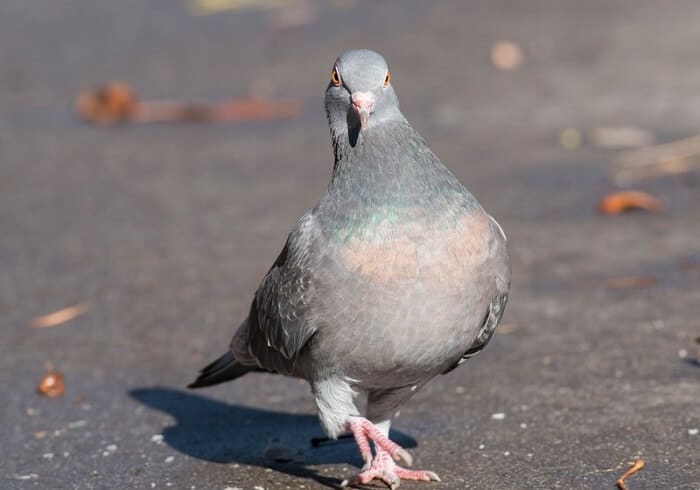
Pigeons can split their attention (opens in new tab).
They can observe different things and gain information about what is happening around them without concentrating on solely one thing at a time.
This is much like what we call multi-tasking in humans; like listening to the radio and cooking at the same time.
Like many birds, pigeons can rest one half of the brain at a time.
With eyes on either side of the head, a resting bird may keep one eye open and alert for danger.
Pigeons can acquire knowledge

Pigeons have learning abilities.
They can be taught to do different tasks outside of what they instinctively know.
They can also be trained to do things (such as sit on your shoulder) in a set sequence.
In experiments, pigeons have also learned to adjust when the order of a task is changed.
Pigeons can make choices
They can learn to make the appropriate response to a simple kind of stimulus (opens in new tab), but also learn not to respond to a different stimulus.
They can also learn to make responses to various other stimuli. In other words, they can recognise things and make choices.
Pigeons can recognise other pigeons
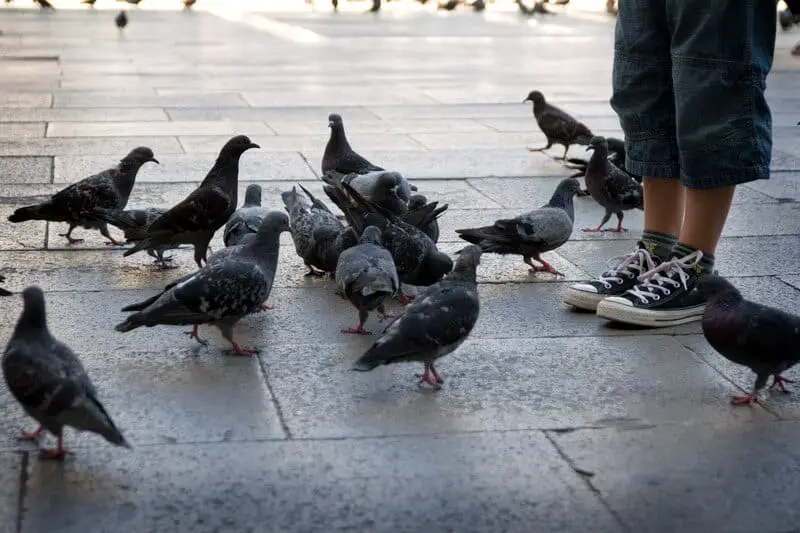
Pigeons can distinguish between other pigeons. (opens in new tab)
Like humans, they can recognise behaviour patterns.
Again, like humans, they can tailor their responses to the perceived behaviour of other pigeons.
Humans respond differently to others according to the situation and the comportment of other people. Pigeons have the same ability.
Pigeons can discriminate

They can learn to make choices on how they react to certain things.
On being shown different kinds of objects they can learn to discriminate (opens in new tab) between them and what is the correct response to make.
This is very much like the way children learn about the world around them, what to touch and what not to.
Pigeons can recognise words

Pigeons can learn to tell many letter combinations apart.
A study in 2016 (opens in new tab) showed that pigeons could learn to tell real English words from random strings of letters.
The pigeons could also judge words they had never seen before better than chance, which suggests they picked up on common letter patterns.
Pigeons can tell the time

They can also judge both time and space (opens in new tab).
In experiments, pigeons judged how long a stimulus lasted and how big it was, and the two judgements affected each other, as they do in people.
Pigeons seem to process this information in a similar way to humans, even though they lack the brain region (the parietal cortex) that humans use for it.
Pigeons can remember things
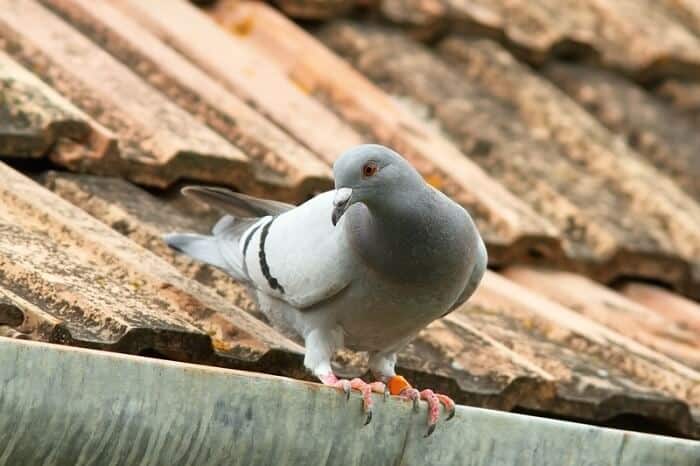
It has also been found that pigeons have very good memories. They can retain the memory of visual images like pictures or photographs for a long time.
This ability can cover hundreds of images over years of time span. They can even recognise the difference between two human figures in a photograph and also split them in categories.
That might explain why pigeons are ace navigators.
One theory is that they memorise the terrain they fly over, noting natural and man-made landmarks, and use them like a mental map.
Researchers in Japan found that pigeons can distinguish between paintings by famous artists. (opens in new tab) They can use shapes and colours as visual clues.
Disputed Tests
In 1981, Robert Epstein, Robert Lanza and B. F. Skinner tested pigeons with a version of the mirror test.
The pigeons were first trained to use a mirror to find a spot of light that they could only see in the mirror.
They had to turn around and peck the right place. The reward for getting it right was some food.
The researchers also trained the pigeons, without a mirror, to peck at dots stuck on their own feathers, again rewarding them with food.
Then they placed a dot on a pigeon’s body where the bird could only see it in a mirror, under a bib.
Without the mirror the pigeon didn’t react, but once the mirror was put back the pigeon tried to peck at the spot.
The aim was to see whether pigeons could recognise themselves in a mirror, which is often taken as a sign of self-awareness.
The researchers saw this as evidence of a kind of self-awareness, but other scientists disputed it because the pigeons had been trained to react to the mirror.
They argued that the pigeons had not behaved spontaneously, so the results could not count as evidence of self-awareness.
For many researchers, the test only counts if animals pass it without special training.
Later attempts to repeat the results have had mixed success, and most animal behaviourists do not think pigeons pass the mirror test.
Some fun facts about pigeon intelligence
- Pigeons can learn categories in ways that resemble how young children learn.
- There are reports of city pigeons riding subway trains, although it is unclear whether they get off at the same stop on purpose.
- In one study, they recognised people who had treated them badly, even after the people swapped coats.
- They have basic number skills, such as putting small groups of objects in order.
- B. F. Skinner famously taught pigeons to play a form of ping pong.
Conclusion
Whether or not you like pigeons, they are clearly far more capable than their reputation suggests.
In many tests they share abilities that were once thought to belong only to humans and other primates.
Top tip: If you keep them it’s a good idea to give them some toys for pigeons to keep their intelligent minds active!
Last updated 23 October 2026 · Behavior