
Baby pigeons, or squabs, usually leave the nest at about 25 to 32 days old in warm weather. Tennessee’s wildlife agency gives 25 to 26 days for leaving the nest; the BTO’s fledging figure for the rock dove is 35 to 37 days; and the Texas Breeding Bird Atlas notes that nest life can stretch to about 45 days in mid-winter. They stay hidden until they look almost like small adults, which is why people rarely see tiny pigeon chicks.
When do they start to fly?
Leaving the nest and making a strong first flight are not always the same event, which is why published figures differ. Cornell Lab of Ornithology gives a nestling period of 25 to 32 days. The Texas Breeding Bird Atlas, citing Harrison and Johnston, gives the same 25 to 32 days in summer and up to 45 days in mid-winter. Tennessee TWRA says the young leave the nest at 25 to 26 days. The BTO’s fledging duration for rock dove (the wild ancestor of city pigeons) is 35 to 37 days, a figure that better matches the time to stronger, independent flight.
Eggs usually hatch after 17 to 19 days of incubation; see how long pigeon eggs take to hatch. New squabs are helpless, with sparse yellow or white down, and both parents feed them crop milk at first (see crop milk and what a baby pigeon looks like). Feathers come through during the first two weeks. Before they leave, young birds flap and stretch in the nest to build wing strength. They do not “go to flight school”: the skill appears as the feathers and muscles catch up with their almost adult size.
Why you rarely see baby pigeons
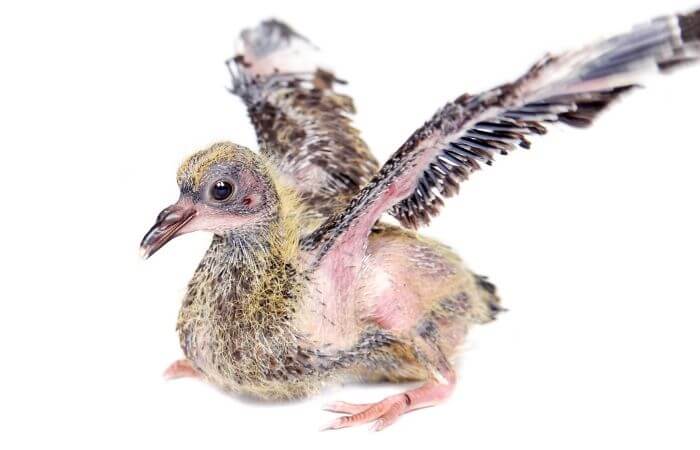
Squabs grow up on ledges, in roof spaces, under bridges and in other covered sites. They stay there until they are close to adult size, so the first young bird most people notice already has a full set of feathers and looks like a slightly scruffy small pigeon. That is the main reason “baby pigeons” seem scarce in streets and parks. A younger squab still showing yellowish down, as in the photo above, is usually still in or right beside the nest.

After they leave the nest
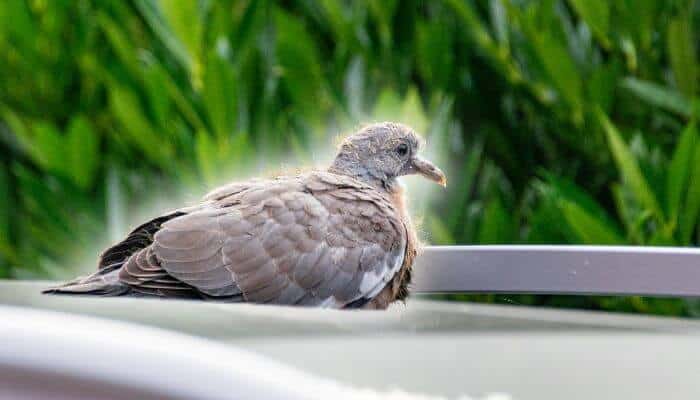
The Texas atlas notes that fledglings usually remain near their parents for one to two weeks and may be driven away after that if they do not leave. Parents often keep feeding them for a short time while the young bird learns to pick up grain and to return to a roost. A youngster sitting on a nearby roof or car, looking fully feathered but a little loose in the plumage, is often this age: out of the nest and already able to flutter or fly, not an abandoned hatchling.
Woodpigeons and other doves
These figures are for the rock pigeon (Columba livia), the species that includes feral city pigeons and most domestic breeds. The wood pigeon (Columba palumbus) has a BTO fledging duration of 33 to 34 days. Smaller doves can leave sooner. If you are looking at a slim brown young bird with a long tail, it may be a dove rather than a rock pigeon.
If you find a young pigeon
A fully feathered young pigeon on the ground or on a low ledge is often a fledgling still being fed nearby. If it is alert, not bleeding and not under immediate threat from a cat or traffic, the safest step is usually to leave it or move it a short way to a safer ledge and watch from a distance. Parents may not approach while people stand close.
A downy squab that is cold, injured, covered in flies, or clearly without parents needs a vet or a licensed wildlife rehabilitator; see how to care for a baby pigeon. In the UK it is an offence to take healthy wild birds or to damage an active nest. Do not try to teach a healthy fledgling to fly by throwing it.
Baby pigeon flight FAQs
When do baby pigeons start to fly?
Most rock pigeon squabs leave the nest at about 25 to 32 days in summer. Stronger independent flight may take a little longer (the BTO fledging figure is 35 to 37 days). Winter broods can stay up to about 45 days.
How long do baby pigeons stay in the nest?
About 25 to 32 days in warm weather, and longer when it is cold. See how long pigeon eggs take to hatch for the time before that, from egg to chick.
Why do I never see tiny baby pigeons?
They stay in hidden nests until they are almost adult-sized, so the first young birds people notice already look like small pigeons.
Do both parents feed the squabs?
Yes. Both produce crop milk at first, then mix in seed. See crop milk.
What if I find a young pigeon on the ground?
If it is already feathered and seems alert, and is not injured, it is often a fledgling still cared for nearby. Move it only out of immediate danger. A downy, cold or injured bird needs a rescue or vet.
Do woodpigeons fledge at the same age?
The BTO gives 33 to 34 days for woodpigeons, close to the upper end of the rock pigeon range.
Sources
Primary references used for this page:
- Texas A&M , Texas Breeding Bird Atlas: Rock Pigeon (25-32 days in summer, up to 45 in mid-winter; 1-2 weeks near parents) (opens in new tab)
- Tennessee Wildlife Resources Agency , Rock Pigeon (leave the nest at 25 to 26 days) (opens in new tab)
- Cornell Lab of Ornithology , Rock Pigeon life history (nestling period 25-32 days) (opens in new tab)
- BTO BirdFacts , Rock Dove (fledging 35-37 days) (opens in new tab)
- BTO BirdFacts , Woodpigeon (fledging 33-34 days) (opens in new tab)
Last updated 8 November 2026 · Baby Pigeons