
Pigeons do not go to a special place to die. Sick or old birds hide in sheltered spots such as roof spaces, ledges and dense cover, and predators such as peregrines and cats take many others. Bodies that do reach the ground rarely last long: in one urban study, scavengers removed two thirds of small bird carcasses within a week.

Pigeons die all the time
Wild and town pigeons live short lives. BTO figures for the rock dove give a life expectancy of three years for a bird that reaches breeding age. About two in three adults survive each year, and only a little over half of young birds survive their first year. The oldest ringed bird lived 7 years and 8 months (BTO (opens in new tab)).
So in any town with a large flock of feral pigeons, many birds die every year. The puzzle is not why they die but why we so rarely see the bodies. More on lifespans is in how long pigeons live.
Where sick and old pigeons go
Birds hide weakness by instinct, because a bird that looks ill is easier for a predator to pick out. Vets warn that by the time a bird shows signs of illness, it has often been sick for days or weeks (VCA Animal Hospitals (opens in new tab)). A pigeon that feels unwell tends to sit still somewhere sheltered and out of sight.
In towns that often means the places pigeons already use for roosting and nesting: roof spaces, ledges under bridges, gaps behind signs, ventilation shafts and chimneys. Many of these are high up, where nobody looks, and a bird that dies there stays there. There is no evidence that pigeons sense death coming or choose a place to die. Hiding is simply what a weak bird does. If you see a pigeon sitting puffed up and still, see signs of a sick pigeon, signs a pigeon is dying and what to do if you find an injured pigeon.
Many never die of old age
A large share of town pigeons are killed by predators. In Exeter, a 20-year study of the prey remains of a pair of urban peregrines found that feral pigeons made up a third of the birds eaten by number and just over half of the diet by weight (Dixon and Drewitt 2018 (opens in new tab)). Sparrowhawks, cats, foxes and gulls also take pigeons. A predator usually eats its kill on a ledge or in cover, or carries it away, so the most visible sign is a scatter of feathers. More in natural predators of pigeons.
Others die after hitting windows, wires or vehicles. These are the dead pigeons people do see, on pavements and roads, and they are a small fraction of the total.
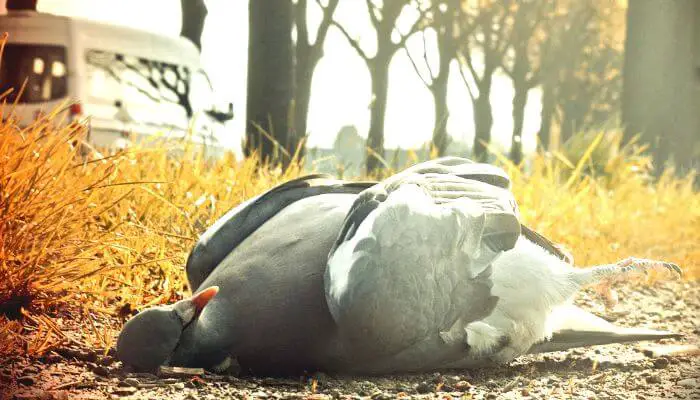
Scavengers clear up quickly
Even a body in the open does not last long. Researchers in Edmonton, Canada, put small bird carcasses outside 44 houses and filmed them. Scavengers took 67.5% of carcasses within seven days, on average after about three and a half days. Removal was fastest in spring and slowest in winter. Black-billed magpies took about 62% of the carcasses that were removed and cats about 16% (Kummer et al. 2016 (opens in new tab)).
In the UK, crows, magpies, gulls, rats, foxes and cats all scavenge in towns, and flies and beetles break down whatever is left. Street cleaners remove bodies on busy streets too.
What usually happens to a dead small bird in a town
Hours
Taken or hidden
Predators eat or carry off their kill. A bird that dies of illness is often already tucked away out of sight.
About 2 to 4 days
Most carcasses in the open are found
In Edmonton the average time before a scavenger took a carcass was 3.46 days: 2.37 in spring and 4.30 in winter.
By 7 days
About two thirds gone
67.5% of carcasses had been removed within a week, mostly by magpies and cats.
After that
Insects finish the job
Whatever is left is broken down by insects, leaving little more than feathers.

If you find a dead pigeon
Do not touch it with bare hands. Use gloves or a bag turned inside out, and wash your hands afterwards. Step-by-step advice is in how to dispose of a dead pigeon.
In England, Scotland and Wales, the government asks the public to report dead wild birds online or by phone on 03459 33 55 77, so that some can be collected and tested for bird flu and other causes of death. Report suspected wildlife crime to the police and suspected poisoning to the Wildlife Incident Investigation Scheme on 0800 321 600 (GOV.UK (opens in new tab)). Finding several dead pigeons in one place is worth reporting.
If you are thinking about what a dead pigeon means, see dead pigeon meaning. For how pigeons react to the loss of a mate, see do pigeons grieve.
Dead pigeon FAQs
Where do pigeons go to die?
Nowhere special. Sick or old pigeons hide in sheltered spots such as roof spaces and ledges, and many are killed by predators.
Why do you never see dead pigeons?
Most die out of sight or are eaten by predators, and scavengers remove bodies in the open within days.
How long does a dead pigeon stay on the ground?
Often only a few days. In an urban study, scavengers took small bird carcasses after about three and a half days on average.
How long do town pigeons live?
A bird that reaches breeding age lives about three years on average, though some live much longer.
Should I report a dead pigeon?
In Great Britain you can report dead wild birds to the government online or on 03459 33 55 77, especially if you find several together.
Sources
References used for this page:
- BTO BirdFacts: Rock Dove. (opens in new tab)
- VCA Animal Hospitals: Recognizing the signs of illness in pet birds. (opens in new tab)
- Dixon, N. and Drewitt, E.J.A. (2018). A 20-year study investigating the diet of Peregrines, Falco peregrinus, at an urban site in south-west England (1997–2017). Ornis Hungarica 26(2): 177-187. (opens in new tab)
- Kummer, J.A. et al. (2016). Use of bird carcass removals by urban scavengers to adjust bird-window collision estimates. Avian Conservation and Ecology 11(2): 12. (opens in new tab)
- GOV.UK: Report dead wild birds. (opens in new tab)
Last updated 10 November 2026 · Behavior