
Pigeons fly in circles for several reasons. A flock wheels together because each bird follows its neighbours, and sharp group turns help them escape falcons. Kept pigeons loop around the loft for exercise, homing pigeons sometimes circle after release while they gather local cues, and males circle and glide in a courtship display.
Flocks wheel together
A pigeon flock has no single plan. Each bird reacts to the birds around it, so when one turns, its neighbours turn too and the whole flock sweeps round in an arc. GPS tracking of flocks of up to 10 homing pigeons showed a clear order of influence: some birds’ changes of direction were copied by others a moment later, and the birds that led most often tended to fly nearer the front (Nagy and colleagues 2010 (opens in new tab)).
Turning together is also protection. When researchers flew a robotic falcon at pigeon flocks, the birds escaped with sudden collective turns and sometimes split into smaller groups. A sharp turn by one bird near the edge of the flock was more likely to split it, while turns that spread through the group carried everyone round together (Papadopoulou and colleagues 2022 (opens in new tab)). Wild rock pigeons are a favourite prey of peregrine falcons in cities (US National Park Service (opens in new tab)), and more on that in the natural predators of pigeons.
Kept pigeons loop around the loft
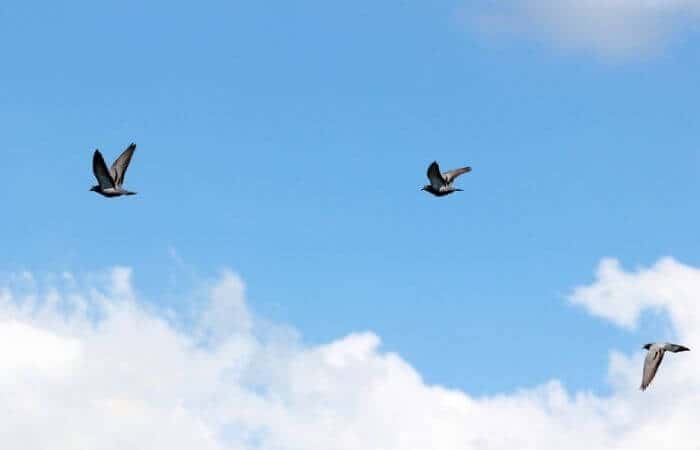
If you live near a pigeon loft you will often see a group circling the same patch of sky. Fanciers let their birds out to exercise, and the flock flies laps around home before dropping back in. Some breeds are kept for this kind of flying: tipplers are flown in kits for hours, and Birmingham rollers tumble backwards in flight. Feral pigeons in towns also make short circling flights around their roost, often after something has startled them (see feral pigeons).
Homing pigeons and circling after release
Racing and homing pigeons released far from home sometimes circle before they set off. The circling is not, as often claimed, the bird working out which way home is. In a study by Roswitha Wiltschko, most groups of pigeons headed in their final direction almost straight away; the young birds that flew around erratically were already known to use information gathered on the outward journey, so the circling had nothing to do with finding the home direction. Wiltschko suggested it may help the bird collect local information about the release site (Wiltschko 1992 (opens in new tab)).
GPS tracking supports the idea that circling is about gathering information. Pigeons that were not allowed to see familiar scenery for 5 minutes before release flew a more twisting path, with a lot of circling, over the first 1,000 metres. After that they flew as well as birds that had had the preview (Biro and colleagues 2002 (opens in new tab)). Company also matters: pigeons released as a small flock showed almost no circling around the start, rested less and homed faster than the same birds released alone (Dell’Ariccia and colleagues 2008 (opens in new tab)). How they then find their way is covered in how pigeons navigate.
Display flights
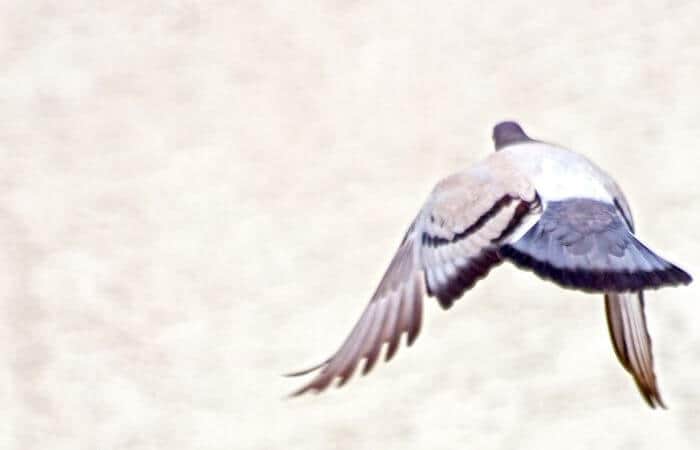
Some circling is courtship. A male rock pigeon climbs, claps his wings together and then glides slowly with his wings held up in a deep V (US National Park Service (opens in new tab)). On the ground he bows and turns in circles in front of a female. The wing claps make a sharp sound that you can hear from below; why pigeons make noise when they fly explains how.
Pigeons flying in circles FAQs
Why do pigeons fly in circles?
To stay together as a flock, to escape predators, for exercise around the loft, to gather local cues after release, and as part of a male’s display flight.
Why do pigeons circle in the sky before landing?
Flocks often make a few loops over their roost or loft before landing, especially after being disturbed. Each bird follows its neighbours, so the whole flock turns together.
Do homing pigeons circle to find their way home?
Not usually. Studies found most pigeons head in their final direction almost at once. Circling seems to help some birds collect local information, especially when they have not seen the surroundings before release.
Why do pigeons suddenly change direction together?
Each bird reacts to its neighbours, and GPS tracking shows some birds lead these turns. Sharp collective turns are also how flocks escape a falcon.
Do pigeons fly in circles when a hawk is near?
Often. Flocks make sudden collective turns when a falcon attacks, and sometimes split into smaller groups.
Sources
Studies used for this page:
- Nagy, M. et al. 2010. Hierarchical group dynamics in pigeon flocks. Nature 464: 890-893 (opens in new tab)
- Papadopoulou, M. et al. 2022. Emergence of splits and collective turns in pigeon flocks under predation. Royal Society Open Science 9: 211898 (opens in new tab)
- Wiltschko, R. 1992. The flying behavior of homing pigeons, Columba livia, immediately after release. Ethology 91: 279-290 (opens in new tab)
- Biro, D. et al. 2002. How the viewing of familiar landscapes prior to release allows pigeons to home faster: evidence from GPS tracking. Journal of Experimental Biology 205: 3833-3844 (opens in new tab)
- Dell’Ariccia, G. et al. 2008. Flock flying improves pigeons’ homing: GPS-track analysis of individual flyers versus small groups. Animal Behaviour 76: 1165-1172 (opens in new tab)
- US National Park Service: Rock pigeon (Columba livia) (opens in new tab)
Last updated 9 November 2026 · Behavior