
Tumbler pigeons are domestic pigeons, bred from the rock dove, that have been selected to flip over backwards in flight. The name now covers a large family of breeds. Some still tumble or roll in the air, some are flown for height and endurance, and some are show birds judged on the head and beak that seldom tumble at all.
This guide explains how the family is divided, where it came from and how the breed standards group it, with links to our guides on individual breeds. For the genetics and brain science behind the backflip, see why tumbler pigeons tumble.
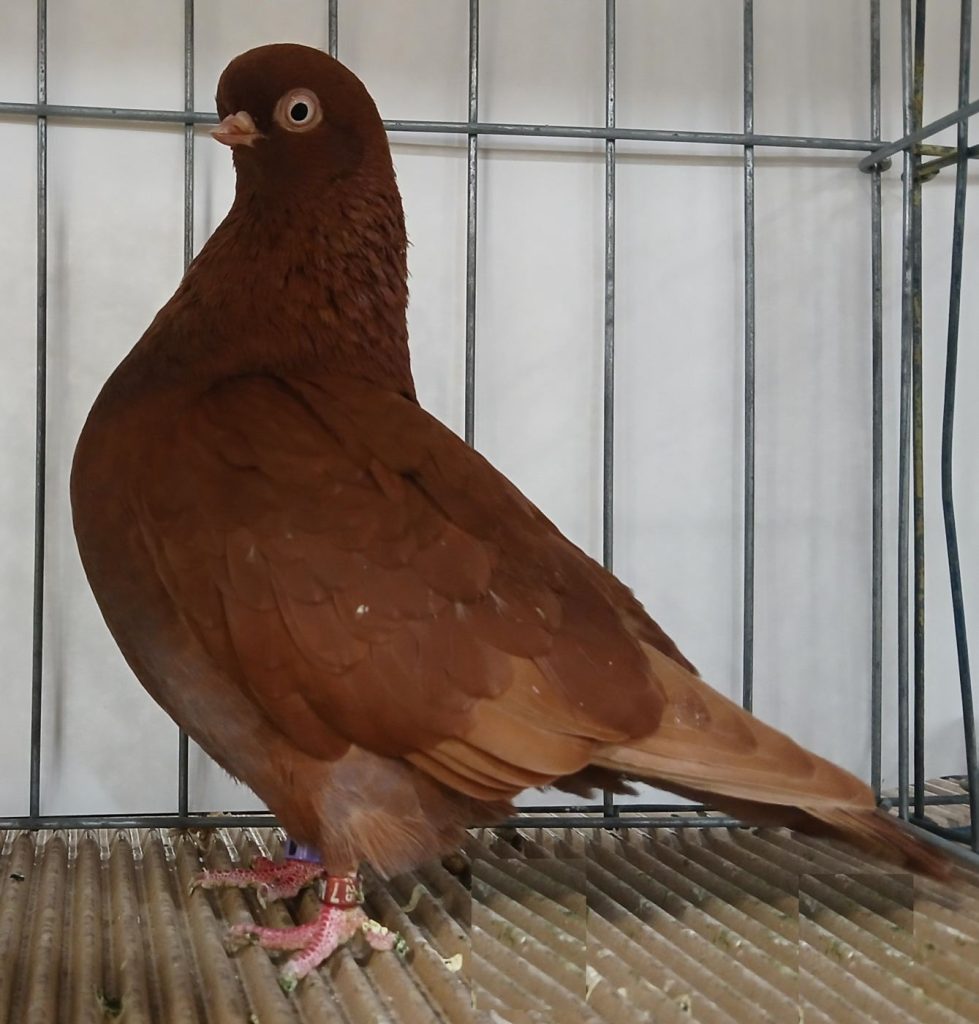
Tumbler pigeons at a glance
| Fact | Tumbler pigeons |
|---|---|
| Species | domestic rock pigeon (Columba livia) |
| Defining trait | backward somersaults in flight, fixed by selective breeding |
| Main kinds | flying tumblers and rollers, ground (parlour) tumblers, high flyers and tipplers, show tumblers |
| European list | 261 breeds in the Tumblers and Highfliers group (EE list, 2018 revision) |
| American standard | 88 breeds in the Tumblers, Rollers and High Flyers group (NPA Book of Standards) |
| Oldest record | an Indian ground tumbler described before 1600 |
| Size | mostly small; Darwin weighed short-faced tumblers at 179 to 198 g |
| Welfare concern | injuries from crashes, and breeds that can no longer fly |
The group totals come from the breed lists themselves, counted by us. The record before 1600 and the weights are from Charles Darwin’s 1868 book on domestic animals.
What makes a pigeon a tumbler
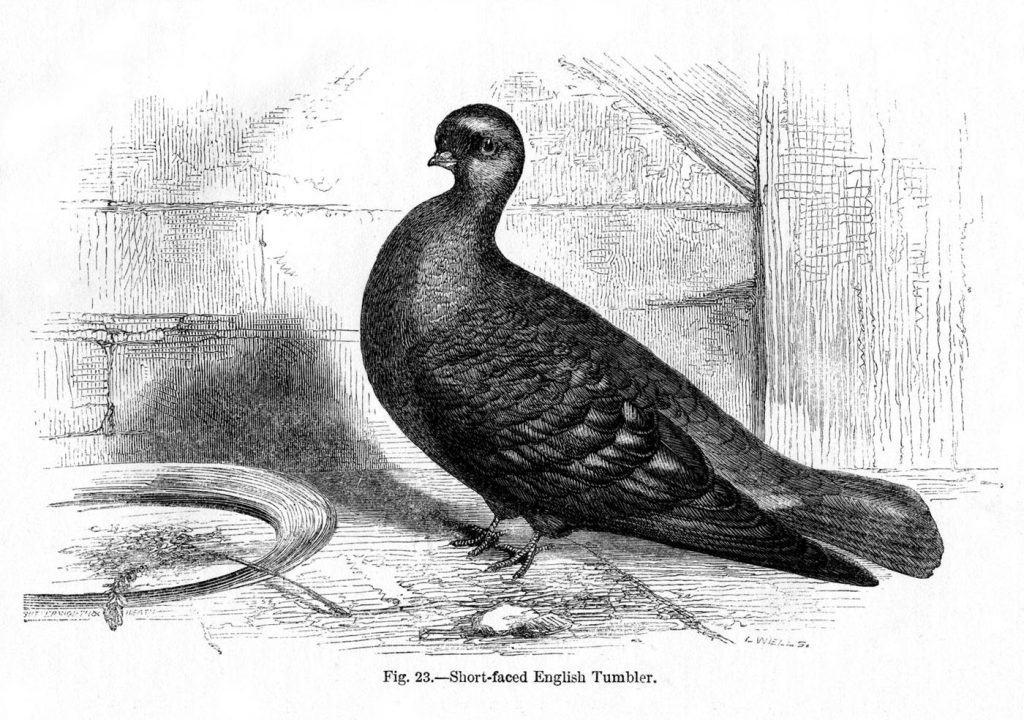
John Moore’s Columbarium of 1735, one of the first English books on fancy pigeons, gave the Tumbler the Latin name Columba revolvens. He wrote that the bird throws itself over backwards in the air, like an acrobat doing a back-spring. His Tumbler was a very small pigeon with a short body, a full breast, a thin neck, a slender beak and pearl eyes.
Darwin used the same features to define the group in The Variation of Animals and Plants under Domestication (1868). Tumblers, he wrote, tumble backwards during flight, and they have a generally small body and a generally short beak, sometimes extremely short. He split them into four sub-races: Persian tumblers, the Lotan or Indian ground tumbler, the common tumbler and the short-faced tumbler. Laid side by side, his specimens ran from the wild rock pigeon to the short-faced birds in steps no bigger than the differences between dovecote pigeons from different countries.
The main kinds of tumbler
Breed clubs and standards use different labels, but most tumbler breeds fit one of the groups below. Some breeds sit in two, because a flying breed can also have a show strain.
Flying tumblers and rollers
Flying tumblers fly with the flock and flip over now and then before flying on. Birds that turn many somersaults in a row are called rollers. The Birmingham Roller is the best known: a small English flyer that drops in a fast spin and then rejoins its kit. The Oriental Roller has both a show standard and a flying standard in the United States.
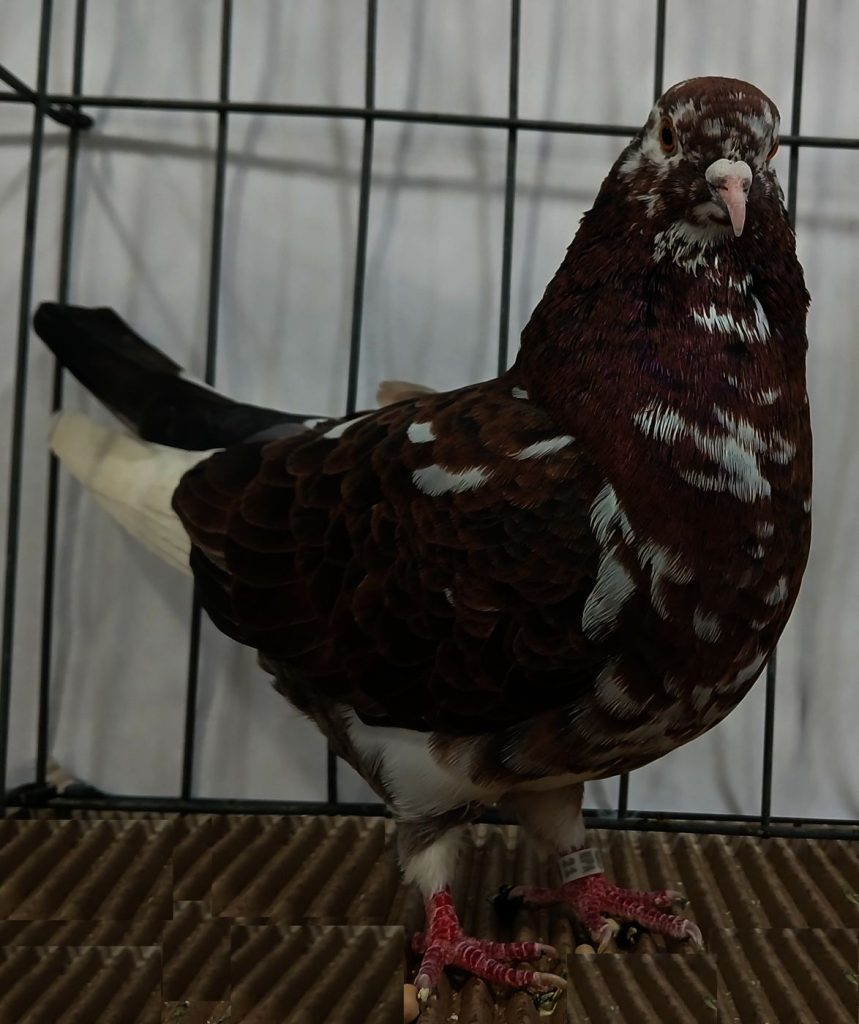
Darwin printed a fancier’s account of this behaviour. In 1861 Mr Brent wrote that his air tumblers threw 20 to 30 somersaults a minute, and that he once counted 40 in a minute from one red cock. Others went from single somersaults to a continuous roll that took them down to the ground. One of these killed herself and another broke a leg.
Ground or parlour tumblers
At the extreme end are birds that somersault on the ground. Darwin described the Lotan of India, which starts tumbling head over heels when it is gently shaken and placed on the ground, and keeps going until it is picked up. A sub-variety, the Kalmi Lotan, began to roll when touched on the neck with a rod. The modern Parlor Roller cannot fly at all. When it tries to take off, it rolls backwards along the ground.
High flyers and tipplers
Moore’s flying Tumblers were also high flyers. He described flights of a dozen birds that stayed together so closely you could cover them with a large handkerchief, rose until they looked no bigger than sparrows, and stayed up for two to five hours. He had heard of birds flying for nine hours. The best of them, he added, seldom tumbled at that height; they tumbled while rising and while coming down.
Several breeds were later selected for this endurance more than for the tumble. Tippler pigeons are flown in kits over their own loft and timed. The Cumulet is an all-white high flyer, and the Danzig Highflyer is one of the many highflier breeds in the European list.
Show tumblers
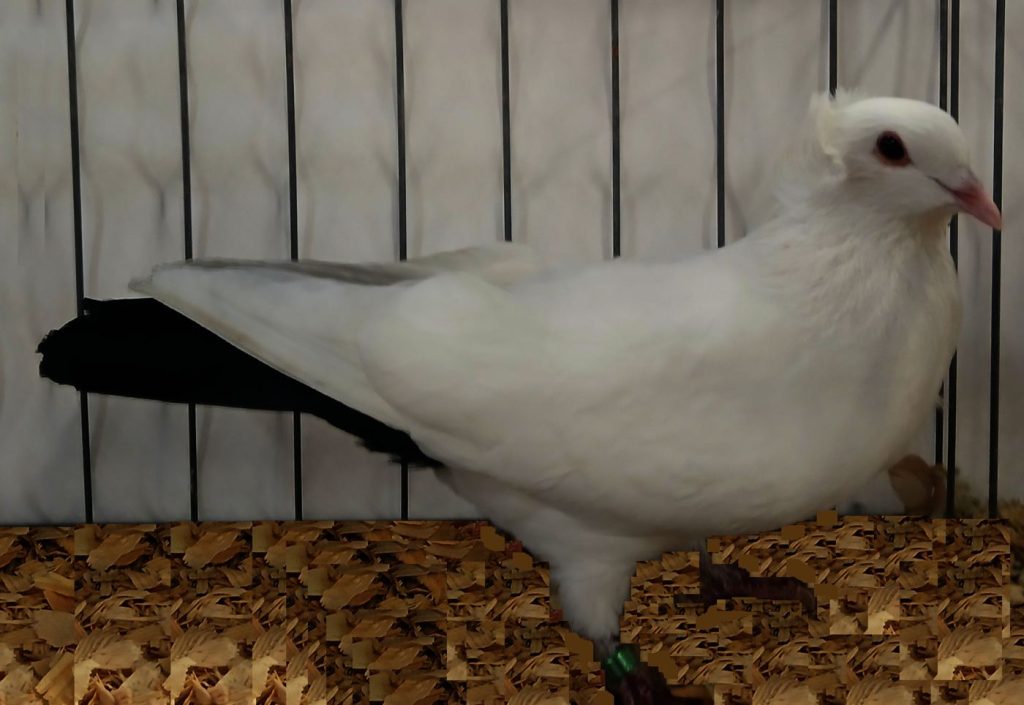
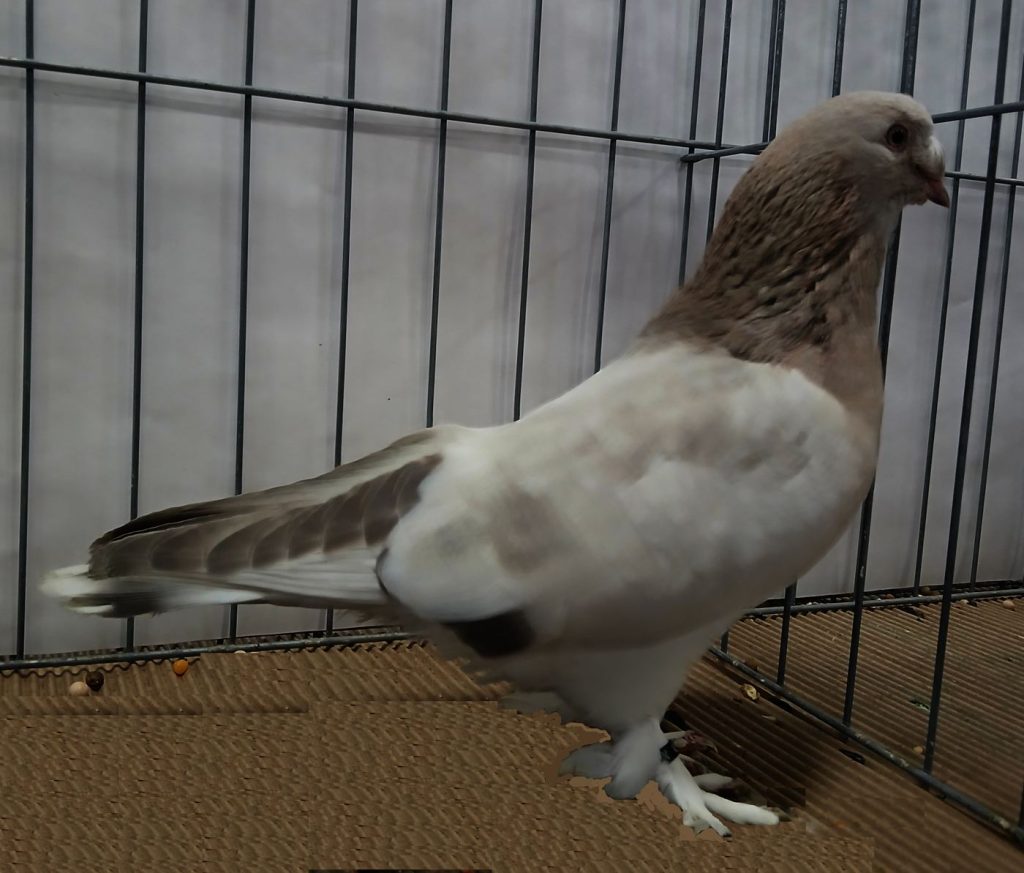
The short-faced tumblers are judged in the show pen on their tiny beak and round head. Darwin called them the smallest kind of pigeon and quoted fanciers who said the head should look like a cherry with a barley-corn stuck in it. He also noted that the improved short-faced birds had almost lost the power of tumbling. The present American standard for the English Short-Faced Tumbler asks for a bird as small as possible, no more than 7.5 inches (19 cm) high when showing, with a very short, fine beak. For Almonds, Mottles, Agates, Kites and self colours, the head and beak together carry 40 of the 100 points. The European list has many other short-faced breeds, among them the Budapest Shortbeak from Hungary, the Berlin Short-Faced Tumbler from Germany and the Viennese Short-Faced Tumbler from Austria.
Other show breeds came out of flying lines. The West of England Tumbler was bred around Bristol as a high-flying tumbler and is now mostly kept for exhibition. The European list also puts several breeds known mainly for their markings or other features in this family: the English Magpie, the Helmet, the Nun and the Mookee.
The Turkish Takla
The Takla is the tumbler of Turkey. Its name comes from the Turkish word for a somersault, and the American standard for the breed notes that Turkish cities have developed their own types, with birds from Urfa and Mardin the most popular performers. In regional competitions, their performance at very low heights is what judges look at most closely. They clap their wings during these low flights, so the standard tells judges never to mark a bird down for worn or broken flight feathers. The European list has three more breeds with a Turkish country code: the Bursa Tumbler, the Cakal Roller and the Anatolian Ringbeater.
How the breed standards group tumblers
The European list of fancy pigeon breeds, kept by the Entente Européenne (EE), puts tumblers, highfliers, rollers and ringbeaters into one group. In the 2018 revision that group had 261 numbered breeds, almost half of the 559 breeds on the list. No other group comes close.
How many breeds each EE group holds
Numbered breeds in each group of the European list (2018 revision), 559 in total.
Most of these breeds come from Central and Eastern Europe. Counting the country code given for each breed, Germany has 41, Poland and Romania 27 each, Hungary 25 and Bulgaria 24. Great Britain has 10, including the English Short-Faced Tumbler, the Birmingham Roller and the English Show Tippler.
The American National Pigeon Association (NPA) also has a group for tumblers, rollers and high flyers, with 88 breeds in its Book of Standards. Not every tumbling breed is in it. The NPA lists the Turkish Takla among its Middle Eastern breeds and the Syrian Coop Tumbler among its Syrian breeds.
How small are tumbler pigeons?
Darwin weighed several birds to show how far selection had changed the pigeon’s size. A blue Baldhead short-faced tumbler, two years old, weighed 6 oz 5 drams before its feed, and two others weighed 7 oz each. A wild rock pigeon weighed 14 oz 2 drams and a Runt 34 oz 4 drams. In the chart below, those weights are converted to grams.
Darwin’s weighings, converted to grams
Single birds weighed in the 1860s, not breed standards. Short-faced tumbler rows are orange.
The beak shrank too. In one good short-faced tumbler, Darwin measured the beak at 0.4 inch (about 10 mm) from the tip to the feathers, half the length of a wild rock pigeon’s. His other tumblers were bigger. The Persian birds were about the size of a common dovecote pigeon, and the Lotans a little smaller than a rock pigeon.
A short history of tumbler pigeons
Darwin wrote that the Lotan’s habit had been inherited since before 1600, because the breed was described in the Ayeen Akbery (Ain-i-Akbari), written at the court of the Mughal emperor Akbar. He was sent Persian tumblers whose beaks were so close to those of ordinary pigeons that only experienced Persian fanciers could tell them apart, and common tumblers from Madras.
In England, Moore described the English and Dutch Tumblers in 1735. By Darwin’s time, fanciers had developed short-faced strains with names such as Almonds, Baldheads, Beards and Mottles, and Darwin thought most of them had arisen after Moore’s book. The West of England Tumbler, the Birmingham Roller and the tippler all came from the old English flying tumbler, and until about 1890 they were all simply called tumblers. Today most of the breeds on the European list are regional tumblers and highfliers from Central and Eastern Europe.
Tumbler pigeons on record
- Before 1600The Indian ground tumbler (Lotan) is described in the Ain-i-Akbari, according to Darwin.
- 1735John Moore describes the English and Dutch Tumblers in Columbarium.
- 1859Darwin uses the tumbler in On the Origin of Species as an example of a habit fixed by selection.
- 1868Darwin divides tumblers into Persian, Lotan, common and short-faced sub-races.
- 1940O. H. Mowrer studies the tumbler pigeon and points to the balance centres of the brain.
- 1972Entrikin and Erway publish a genetic study of roller and tumbler pigeons.
- 2024University of Utah researchers report that rolling is recessive and linked to at least five regions of DNA.
Welfare and tumbling
The UK charity Science for Animal Welfare (UFAW) treats tumbling and rolling as an inherited welfare problem. Birds can hit the ground, trees or buildings during a roll, and ground-rolling breeds cannot escape danger in the normal way, by flying. UFAW recommends that tumbler breeds, and birds of any breed that tumble enough to risk hurting themselves, should not be used for breeding.
In 2024, researchers at the University of Utah reported that rolling is a recessive trait linked to at least five regions of DNA. Our guide to why tumbler pigeons tumble covers that research and the long debate over whether birds can control it.
Tumbler breeds with their own guides
| Breed | Kind | Guide |
|---|---|---|
| Birmingham Roller | flying roller, England | Birmingham Roller guide |
| Oriental Roller | flying and show roller | Oriental Roller guide |
| Parlor Roller | ground roller that cannot fly | Parlor Roller guide |
| Tippler | endurance flyer, England | Tippler guide |
| Cumulet | all-white high flyer | Cumulet guide |
| West of England Tumbler | flying tumbler now mostly shown, England | West of England Tumbler guide |
| English Magpie | show bird of tumbler descent, England | English Magpie guide |
| Helmet | marked show breed | Helmet guide |
| Nun | marked show breed | Nun guide |
| Mookee | shaking-neck breed from India | Mookee guide |
For other families of fancy pigeon, see our guide to types of pigeon and the overview of domestic pigeons.
Main sources: Darwin (1868), The Variation of Animals and Plants under Domestication, vol. 1 (opens in new tab); John Moore, Columbarium (1735); EE list of fancy pigeon breeds, 2018 revision (opens in new tab); NPA Book of Standards (opens in new tab); UFAW, Rolling and tumbling (opens in new tab); Science News (2024) (opens in new tab).
Tumbler pigeon FAQs
Are tumbler pigeons and roller pigeons the same?
Rollers are a kind of tumbler. A tumbler flips over now and then; a roller turns many somersaults in a row as it drops. Both are in the same group in the European and American breed lists.
Do all tumbler pigeons tumble?
No. Many tumbler breeds are now show birds. Darwin noted in 1868 that the improved short-faced tumblers had almost lost the power of tumbling.
How many tumbler pigeon breeds are there?
It depends on the list. The 2018 European list had 261 breeds in its Tumblers and Highfliers group, and the American NPA standards have 88 in their Tumblers, Rollers and High Flyers group.
Where do tumbler pigeons come from?
Like all domestic pigeons, they descend from the rock dove. Darwin traced tumbling breeds to Persia, India and Europe, and the Indian ground tumbler was described before 1600.
Is tumbling bad for the birds?
It can be. Crashes during a roll can injure or kill a bird, and ground-rolling breeds cannot fly. The welfare charity UFAW advises against breeding from birds that tumble badly enough to risk harm.