
Yes. Pigeons can learn to tell individual people apart, and the best evidence points to the head and face as the main cue. In a Paris park, feral pigeons kept avoiding a person who had chased them, even after that person swapped coats with a friendly feeder. Nobody has yet measured how long they remember one face.
That answer rests on a handful of small studies, and they do not all agree. Here is what each one tested and found.

The Paris park experiment
In 2011 a team from Paris Nanterre University and the National Museum of Natural History tested feral pigeons in an urban park in Paris. Two researchers of about the same age and skin colour fed the birds, each wearing a coat of a different colour.
During training one feeder stood still and let the pigeons eat. The other chased them away. Within six to nine sessions the pigeons had learned to tell the two apart, and they kept their distance from the unfriendly one.
Then both feeders became neutral, and later they swapped coats. The pigeons still avoided the person who had chased them, so they were not going by coat colour. The study was published in Animal Cognition (Belguermi and colleagues, 2011) (opens in new tab).
How the Paris experiment worked
Two feeders, A and B, fed the same pigeons. Only A ever chased them.
- 1. TrainingFeeder A (blue coat): chases the pigeonsFeeder B (orange coat): stays neutral
The pigeons learn to keep away from A within 6 to 9 sessions.
- 2. TestFeeder A (blue coat): stays neutralFeeder B (orange coat): stays neutral
The pigeons still avoid A.
- 3. Coats swappedFeeder A (orange coat): stays neutralFeeder B (blue coat): stays neutral
The pigeons still avoid A, now in the other coat.
Is it really the face?
The Paris team were careful here. They wrote that the pigeons used “stable individual characteristics” to tell the feeders apart. That could be the face, but it could also be height, build, hair or the way someone walks, because the study was not designed to separate those cues.
A lab study at Ruhr University Bochum narrowed it down. Researchers trained 16 pigeons to identify individual real people, and found that the birds relied mainly on visual cues from the head. The paper is in Behavioural Processes (Dittrich and colleagues, 2010) (opens in new tab).
Pigeons have the eyesight for it. Their vision is sharp and covers colours we cannot see, as our guide to pigeon eyesight explains.
Can pigeons recognise a face in a photo?
This is where the results split. The Bochum pigeons could pick out real people, but that skill did not help them learn photographs of the same people. On a screen, the familiar faces seemed to mean nothing to them.
A University of Vienna team tried a different method. They first taught 15 homing pigeons to sort photos of objects into familiar and unfamiliar. Eight birds had lived with the familiar objects and seven control birds had not.
Then the pigeons saw photos showing only the heads of eight people. Four of those people cleaned, fed or caught the birds regularly, and four had never met them. Four of the eight test birds picked out the familiar faces more often than chance would explain, and every control bird failed. The results are in Avian Biology Research (Stephan and colleagues, 2012) (opens in new tab).
So some pigeons can recognise a familiar person from a photo of their head alone, but only half the trained birds managed it. Small samples like these leave a lot of room for doubt.
How long do pigeons remember a face?
We do not know. None of these face studies followed the birds for months or years to see how long the memory lasts, so any claim that pigeons remember a face “for life” goes beyond the evidence.
What is well tested is the size of their visual memory. In a study in PNAS (Fagot and Cook, 2006) (opens in new tab), pigeons learned which response went with each of a long series of pictures. They topped out at between 800 and 1,200 picture-response pairs, while baboons given the same task reached at least 3,500 to 5,000 and had still not hit their limit after more than three years.
How many picture-response pairs they could learn
Same task for both species. The bar shows the range reported.
Memory and understanding are not the same thing, though. In a 2015 PLOS ONE study (opens in new tab), pigeons learned to spot cancer-related features in medical images. On the hardest task they could only memorise the training pictures and failed when shown new ones.
The studies side by side
| Study (pigeons) | What they had to do | What happened |
|---|---|---|
| Belguermi et al., 2011, Paris (feral pigeons in a park) | Tell a hostile feeder from a neutral one, in person | Learned in 6 to 9 sessions and kept avoiding the hostile person after a coat swap |
| Dittrich et al., 2010, Bochum (16 pigeons) | Identify individual people in person, then in photos | Used head cues for real people; knowing the person did not help with the photos |
| Stephan et al., 2012, Vienna (15 homing pigeons) | Pick familiar people from head-only photos | 4 of 8 test birds succeeded; all 7 controls failed |
| Fagot and Cook, 2006 (pigeons and baboons) | Memorise which response goes with each picture | Pigeons peaked at 800 to 1,200 pairs; baboons passed 3,500 |
What it means if you feed or shoo pigeons
If you chase pigeons away from a balcony or a café table, the Paris result suggests they can learn who you are. In that study they went on avoiding the hostile feeder even after the chasing stopped.
Regular feeders are likely to be recognised in the same way, though no study has tested this outside the lab and the Paris park. If a crowd of hungry pigeons feels intimidating, our guide to whether pigeons attack humans explains what they are after.
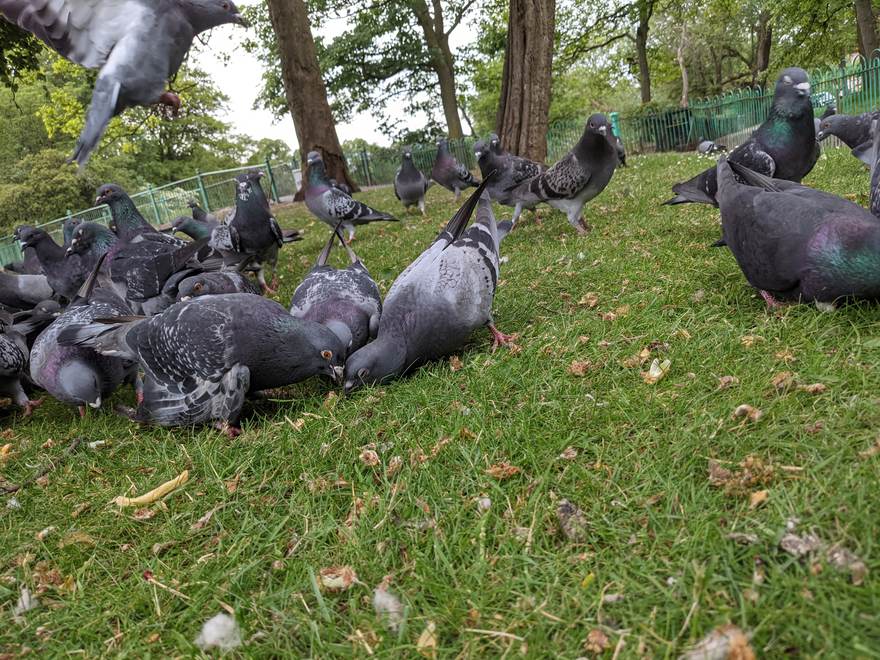
The Vienna study adds one detail for pigeon keepers. The familiar people in it did not only feed the birds; one just cleaned the aviary. Recognition built up through ordinary, everyday contact.
Whether that recognition comes with anything like affection is a separate question, which we look at in do pigeons have feelings. For more on how pigeons learn and remember, see are pigeons smart, and for a wider round-up, our pigeon facts.
Pigeon face recognition FAQs
Do pigeons remember people who feed them?
Yes, as far as the evidence goes. Feral pigeons in Paris learned within six to nine sessions which of two feeders was friendly, and homing pigeons in Vienna recognised photos of the people who looked after them.
Can pigeons recognise their owners?
Probably, if the owner spends regular time with them. In the Vienna study, people who regularly fed, caught or cleaned up after the birds were recognised from photos by half of the test pigeons.
Do pigeons hold grudges?
Not in any emotional sense that has been shown. What has been shown is that pigeons avoid a person who chased them, and keep avoiding that person after the chasing stops.
Do pigeons recognise people by their clothes?
Not mainly. In the Paris study, swapping coats did not fool them, and in the Bochum study the birds relied mostly on cues from the head.
How good is a pigeon’s memory?
Very good for pictures. Lab pigeons have memorised between 800 and 1,200 picture-response pairs. How long they keep a memory of one particular person has not been measured.