
There is some scientific evidence, and a lot of anecdotal evidence from owners, that pigeons have feelings.
Pigeons are monogamous birds who show affection to their partners and will also show affection to human handlers that they are comfortable with.
Animal Instinct
Many pet owners will swear blind that their animals can understand them and demonstrate a whole range of emotions.
You hear this mainly from cat and dog owners, but emotional responses have been noted in all kinds of species.
The question is: are these reactions just instinctive, based on certain stimuli or are they real feelings as we humans know them?
A short news story that was widely shared described a gorilla in captivity.
This gorilla was taken into captivity as a baby orphan.

It was chosen to participate in animal cognition experiments and was taught sign language.
One of its early keepers retired, but came back to visit the gorilla after many years.
Observers described clear signs of recognition and happiness from the gorilla.
According to the story, at the end of the visit the gorilla signed to its old keeper, ‘I love you.’
That looks like emotional feeling, but then again, great apes such as gorillas and chimpanzees share around 98% of their DNA with us.
So, what about pigeons?
Expressions
Probably the greatest guide to feelings in both humans and animals are their facial expressions.

We understand what people are feeling just by looking at the expressions on their faces.
It can be the same with animals too.
However, most animals have a limited range of facial expressions, so their feelings have to be judged or guessed at from their behaviour too.
Pigeons are one of those species that have no facial expressions with which to judge their feelings.
Behaviour, not expression would be the only way to measure emotion.
Bird Brained
We’ve all heard the expression.
It means stupidity and the general public view pigeons that way.
All they see are mindless creatures who constantly eat and defecate wherever they please.

On the other hand, pigeon fanciers, racing enthusiasts and scientists will tell you differently.
Pigeons are highly intelligent animals.
They can learn and be trained.
Experiments have shown they can learn categories, recognise individual people and tell some written words from non-words.
Some studies have reported that pigeons can pass a version of the ‘mirror test’, although this is disputed.
If it is true, it would suggest some degree of self-awareness.
That would point to some kind of thought.
Many people take thought as a sign that feelings are there too.
Unfortunately, this is difficult to prove.
Mating
The greatest displays of emotion that you will see in pigeons is either during mating or when they are desperately fleeing a predator.
When escaping danger they are sure to feel fear.
This is a primeval survival emotion.
Mating, on the other hand, is different.
Pigeons are faithful and usually pair for life, but we can’t know whether they feel love in the way we do.

Like many other species, pigeons have elaborate mating rituals.
This wooing is a biological imperative, not a choice.
It is an instinctive drive for the reproduction and survival of the species.
Pigeon courtship is driven largely by hormones and instinct, so it tells us little about their capacity for feeling.
Pigeons Showing Affection
It has been noted among pigeon owners that keep lone pigeons as pets that female pigeons can form an attachment to male owners.
They can become coquettish and display affection towards their owners.
One explanation is that, with no male pigeon to pair with, the female’s instincts lead her to treat the nearest companion, her owner, as a mate.
Pigeons Displaying Hate
Love and hate are strong emotions in humans.
In animals, it is doubtful that they truly suffer from hate.
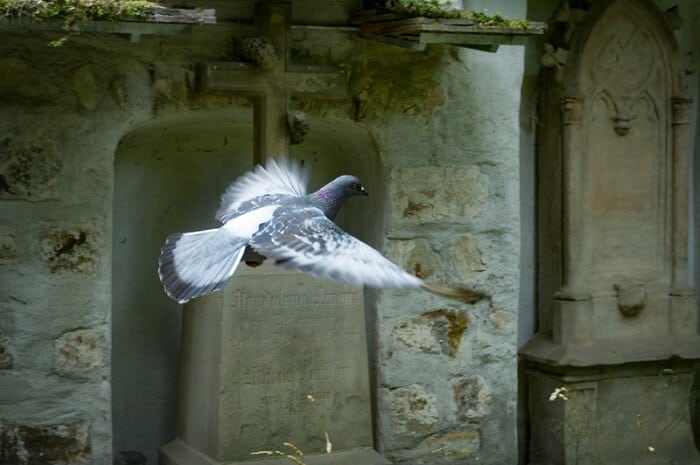
What they have is instinctual fear.
Most species have natural enemies, other species that prey on them. Instead of hate, they may attack things that may appear threatening out of fear.
A Sense Of Duty
One odd thing that has been noted and recognised in pigeons is their valour and determination.
In many past ages, carrier pigeons have been used to deliver messages.
During the two World Wars, carrier pigeons were used widely by armed forces on both sides.
Some were honoured for their service. In Britain, 32 pigeons received the Dickin Medal, an award for animals in wartime.
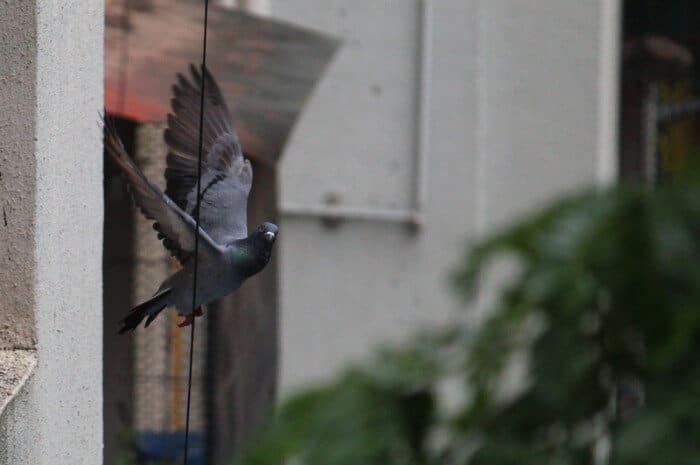
So, that begs the question: were they consciously brave and had notions of duty?
We know that homing pigeons have an instinctive urge to return home to their lofts, but flying through bombardments and sniper fire is extreme.
Many of these birds were wounded, but carried on in service when they had recovered.
You would think that most animals would flee the sounds and dangers of battle, never to return, but the pigeons didn’t.
So, did these pigeons ‘feel’ a sense of duty and loyalty?
Ask a Pigeon
Unfortunately, it is impossible to determine whether or not pigeons have feelings.
You can’t ask them, as they can’t talk.
Science hasn’t come up with a foolproof way of either proving or disproving the idea.
It’s not a question that really occupies the minds of many people anyway.
Pigeon owners probably have their own definite ideas on the subject.
Do Pigeons Grieve?
Pigeons mate for life and form strong bonds with their partner and chicks. Owners report signs of distress when a mate or chick dies, although this is hard to prove scientifically. Our article Do pigeons grieve? covers this in more detail.
Last updated 30 October 2026 · Behavior