
Pigeons rarely attack humans; they usually walk or fly away from people. The main exception is a pigeon guarding its eggs or chicks, which may peck hard and strike out with a wing at a hand that comes too close. Pigeons are very unlikely to cause serious harm, and a peck that breaks the skin needs only basic first aid.
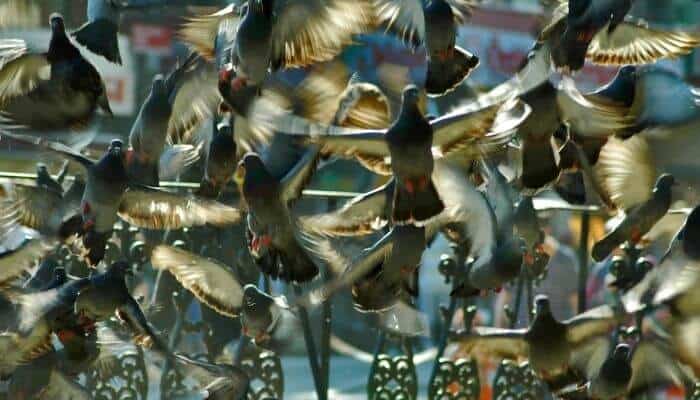
5 reasons a pigeon comes at you
When people say a pigeon attacked them, it is usually one of the situations below. Only the first is true defensive aggression.
Nest defence: the one real attack
Pigeons nest on ledges, in roof spaces and on balconies, and a nesting pair will defend its eggs and squabs. Goodwin’s ethogram describes what a domestic pigeon does when a hand reaches into the nest: a timid bird lifts the far wing, turns its head towards the intruder, rises up, calls loudly and strikes out with the near wing; a bird that is less afraid of people pecks fiercely instead.
| Behaviour | What the pigeon does | What to do |
|---|---|---|
| Defensive threat | Lifts the far wing, faces you, rises up and gives loud distress calls | Take your hand away; the bird is warning you |
| Wing strike | Hits out with the near wing when a hand reaches a critical distance | Leave the nest alone, or wear gloves if you have to check it |
| Pecking | A bolder bird pecks hard at the intruding hand, often cooing between attacks | Move back; pecks can sting |
| Escape | A more timid bird simply leaves the nest | Keep away so the parents can return |
Why pigeons rarely attack people
A pigeon’s first response to danger is to avoid it. Goodwin’s ethogram lists the usual sequence when a predator approaches: the bird eyes it anxiously, gives a distress call, freezes with its feathers sleeked down and then flies off. Goodwin found that pigeons seldom mob predators. Defending themselves from their natural predators means escaping, not fighting.
Pigeons also lack weapons. They have no hooked bill or talons, and their pecks are aimed mostly at other pigeons. Animal Diversity Web notes that in their nesting territory both sexes are aggressive and peck intruders on the head, but those intruders are other pigeons. Between pigeons, serious fights are mostly over nest sites and perches; see feral pigeons for how they live.
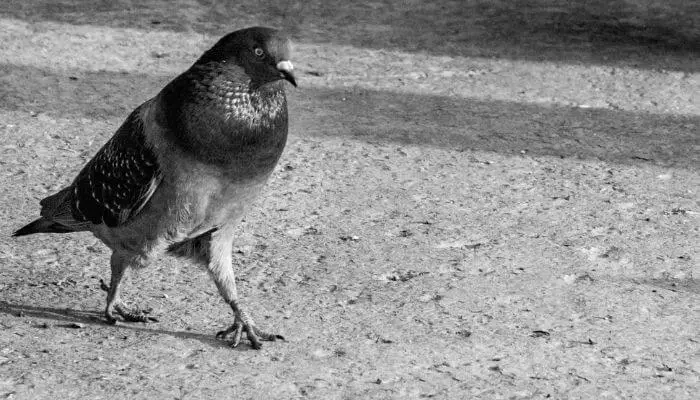
Do pigeons remember people who chased them?
Yes, and they avoid them. In a study in a Paris park, published in 2011, two researchers of similar build and age fed feral pigeons while wearing different-coloured lab coats. One let the birds feed and the other chased them away. Later, when neither chased them, the pigeons still kept away from the one who had been hostile, even after the two swapped coats. The researchers think the birds recognised faces.
The pigeons responded by keeping their distance, not by attacking. A pigeon that has been chased is more likely to avoid you, and one that has been fed is more likely to come close. For more on what pigeons can learn, see are pigeons smart; for their emotional lives, see do pigeons have feelings.
What about videos of pigeon attacks?
Clips of “attacking” pigeons do circulate. In one, posted by the local channel Talk of the Sound and titled “When Pigeons Attack (at New Roc City)”, a pigeon is shown flying at people.
A video cannot show what happened before filming started, such as a nest nearby, a person who had chased the bird or someone feeding it. A written account from Singapore in 2012, sent to the Bird Ecology Study Group, describes a pigeon flying low and fast towards a woman at a bus stop; it passed overhead and landed on a nearby lamp post without touching her.
Can a pigeon hurt you?
Please note: this article is general information, not medical advice. If you have symptoms or are worried about your health, see your GP or a doctor.
Not seriously. A peck or a wing slap can sting and occasionally breaks the skin. The NHS advises cleaning a small wound by rinsing it with tap water, cleaning the skin around it with soap and water and covering it with a plaster. Ask for an urgent GP appointment or contact NHS 111 if a wound is swollen, red and getting more painful, or if you feel unwell or have a high temperature.
Disease is a bigger worry for many people, but the risk is low. Psittacosis, the infection most often linked with pigeons, spreads mainly by breathing in dust from dried droppings or feathers, and usually fewer than 10 confirmed cases are reported in England each year, according to the UK Health Security Agency. New York City’s health department says the risk of pigeon-related diseases is rare and highest for people with weakened immune systems. See do pigeons carry diseases for more.
How to stop pigeons coming at you
- Do not hold food out or eat in the middle of a flock if you do not want birds landing on you.
- Leave nests alone. If you need to check one, move slowly and wear gloves; timid parents will usually leave.
- If a pigeon flies towards you, stay calm. It is almost always heading past you, not at you.
- If a pet pigeon pecks you, look for the cause, such as a nest, a mate or fear of handling. See why is my pigeon biting me.
- If you need to pick up a sick or injured pigeon, cover it gently with a towel first. See what to do if you find an injured pigeon.
In the UK, wild birds, their eggs and active nests are protected by law, and feral pigeons are included; damaging an active nest needs a licence, as explained by GOV.UK. If pigeons are nesting where you do not want them, see neighbour pigeon problems and where pigeons build their nests. Gulls, which some people mistake for pigeons, are bolder and do swoop at people near their chicks; see pigeons vs seagulls.
Frequently asked questions
Do pigeons attack people?
Very rarely. A pigeon defending its eggs or chicks may peck or hit out with a wing at a hand that comes near the nest. Unprovoked attacks on people are not part of normal pigeon behaviour.
Why did a pigeon fly at my head?
Usually because it was taking off, landing or heading for a perch behind you, or because a flock flushed at once. Pigeons are agile and steer round people. If you were holding food, it may have been after that.
Can pigeons hurt you?
Not seriously. Pecks and wing slaps can sting and occasionally break the skin. Clean any small wound and get medical advice if it becomes red, swollen and painful or you feel unwell.
Why is a pigeon following me?
Most often it expects food. Pigeons remember people and can recognise individuals, so birds that have been fed by someone will approach that person again.
Do pigeons peck humans?
Sometimes. Nesting pigeons peck at hands near their eggs, hungry pigeons may peck at food in your hand, and pet pigeons can peck owners during the breeding season or when frightened.
Will a pigeon attack a child?
Pigeons have no reason to target children. Problems come from children chasing pigeons or reaching into nests. Teach children to watch birds quietly and wash their hands after feeding them.
Sources
We checked each source on 4 November 2026.
- Goodwin, D. Ethogram of the pigeon (Great Lakes Pigeon Rescue) (opens in new tab)
- Animal Diversity Web: Columba livia (opens in new tab)
- Belguermi, A. et al. (2011). Pigeons discriminate between human feeders. Animal Cognition 14: 909–914 (opens in new tab)
- EurekAlert! (Society for Experimental Biology): Pigeons never forget a face (2011) (opens in new tab)
- Bird Ecology Study Group: Attacked by a rock pigeon (2012) (opens in new tab)
- Talk of the Sound: When Pigeons Attack (at New Roc City), YouTube (opens in new tab)
- NHS: Cuts and grazes (opens in new tab)
- UK Health Security Agency: Psittacosis (opens in new tab)
- NYC Health: Pigeon-related diseases (opens in new tab)
- GOV.UK: Wild birds, protection and licences (opens in new tab)
Last updated 4 November 2026 · Behavior